Japan Automated Mining Equipment Market Size
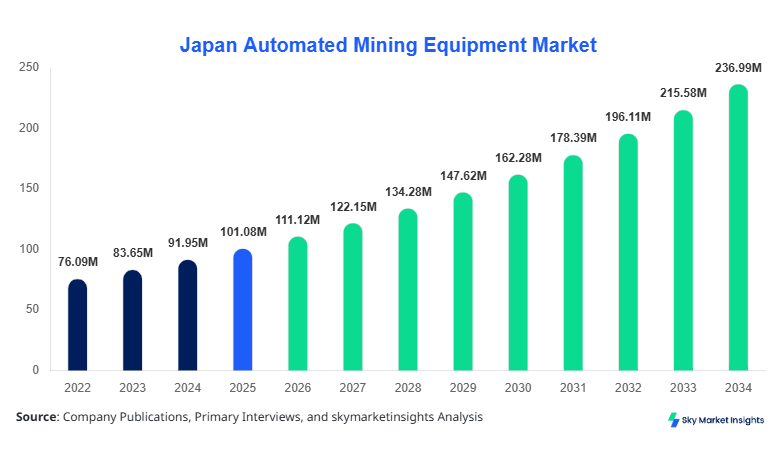
Japan Automated Mining Equipment Market size is projected at USD 111.12 million in 2026 and is expected to hit USD 235.45 million by 2034 with a CAGR of 9.93%. The assessment uses 2025 as the USD 101.18 million base year and evaluates 8 equipment categories, 4 mineral groups, deployment models, automation levels, software solutions, and end users alongside the competitive landscape.
Key Takeaways
- Autonomous haul trucks dominate equipment with 25.76% of 2026 revenue and USD 28.62 million, while remote-controlled equipment records the fastest 10.42% CAGR through 2034.
- Metallic minerals lead with 40.12% of mineral-based revenue in 2026 and USD 44.63 million; their 10.28% CAGR is also the fastest among mineral categories.
- Kanto is estimated to command approximately 36% of 2026 revenue, while Hokkaido and Tohoku represent the fastest-developing regional cluster at an estimated CAGR above 10%.
- Japan's addressable total advances from USD 101.18 million in 2025 to USD 111.12 million in 2026, adding USD 9.94 million within 1 year.
- Japan Automated Mining Equipment Market Growth is supported by autonomous loaders rising from USD 13.46 million in 2026 to USD 29.70 million by 2034 at a 10.40% CAGR.
The market encompasses autonomous haulage, drilling, loading, excavation, blasting, robotic and remote-operated machinery, together with navigation, safety, fleet-control and maintenance software used at surface and underground sites. Japan-based manufacturers support global mining production through systems operating continuously for 24 hours and 365 days; Komatsu's installed AHS fleet exceeded 700 trucks across 23 mines in 5 countries and had transported 7.5 billion tonnes by February 2024. Within Japan's 2026 market, autonomous haul trucks contribute 25.76%, automated drilling rigs 21.19%, metallic-mineral applications 40.12%, and rare-earth applications 10.02%.
Explore more data points, trends and opportunities Download Free Sample Report
Japan Automated Mining Equipment Market Trends
Interoperable Autonomy and Electrified Mine Operations
Mining automation is moving from single-machine control toward interoperable fleets combining haul trucks, excavators, light vehicles and dispatch software. Commercial AHS deployments surpassed 700 trucks and 7.5 billion tonnes hauled by 2024, while individual fleet-management platforms can coordinate as many as 100 vehicles. The technology stack increasingly combines 5G connectivity, high-precision positioning, LiDAR, radar, machine vision and AI-based routing to enable 24/7 operations.
Electrification is converging with automation as battery-haul-truck trials evaluate 3 fundamental operating functions—travel, turning and stopping—alongside charging cycles under production loads. Autonomous haulage has demonstrated loading and transport cost reductions exceeding 15% and tyre-life improvements of approximately 40%. Demand is strongest in high-volume surface operations, whereas underground sites prioritize tele-remote loading, collision avoidance and zero-entry workflows that can remove operators from 2 to 3 high-risk production zones.
Japan Automated Mining Equipment Market Drivers
Labor Constraints, Safety Targets and Continuous Production
Japan's ageing technical workforce and limited domestic mining-labor pipeline encourage producers and engineering groups to automate repetitive, hazardous processes. Autonomous systems can operate 24 hours per day and 365 days per year, coordinate fleets of up to 100 vehicles and reduce haulage costs by more than 15%. A global installed base above 700 AHS trucks across 23 sites demonstrates commercial scalability, while 40% longer tyre life improves operating economics and strengthens the case for automation in both surface and underground applications.
Japan Automated Mining Equipment Market Restraints
High Integration Costs and Fragmented Legacy Fleets
Automation projects require investment in vehicles, control rooms, positioning infrastructure, wireless coverage and cybersecurity before productivity benefits are realized. A mixed fleet may contain equipment from 3 to 5 OEMs, use assets with 10–15-year service lives and require network availability above 99%. Retrofitting even 20–40 machines can involve multiple control protocols, while software, sensor calibration and specialist training may add 10–20% to project expenditure and delay deployment by 12–24 months.
Japan Automated Mining Equipment Market Opportunities
Retrofit Platforms, Critical Minerals and Export-Oriented Technology
Open autonomy kits can expand the addressable installed base by converting selected conventional machines instead of replacing 100% of a fleet. A phased project may automate 10–20 trucks initially, scale toward 50–100 vehicles and integrate 5G, predictive analytics and collision avoidance within 2–3 implementation stages. Critical-mineral security, battery-material processing and overseas mine investment also create demand for Japanese control systems capable of lifting equipment utilization by 10–15% and reducing unplanned downtime by 15–25%.
Challenges in Japan Automated Mining Equipment Market
Cybersecurity, Connectivity and Operational Validation
Autonomous sites must synchronize hundreds of sensors at millisecond-level latency while maintaining safe separation among vehicles weighing more than 300 tonnes. Mountainous terrain, underground signal loss and severe weather can reduce network reliability below the 99.9% level expected for mission-critical control. Operators must validate at least 3 layers—machine safety, communications resilience and human intervention—while managing software updates, 24/7 monitoring and fail-safe stopping across fleets of 20–100 units.
Report Scope
| Report Metric | Details |
|---|---|
| Market Size in 2025 | USD 101.08 Million |
| Market Size in 2026 | USD 111.12 Million |
| Market Size in 2034 | USD 235.45 Million |
| CAGR | 9.93% (2026-2034) |
| Base Year for Estimation | 2025 |
| Historical Data | 2022-2024 |
| Forecast Period | 2026-2034 |
| Report Coverage | Revenue Forecast, Competitive Landscape, Supply Chain Disruption, Growth Factors, Environment & Regulatory Landscape and Trends |
Explore more data points, trends and opportunities Download Free Sample Report
Japan Automated Mining Equipment Market Segmentation
The market is segmented by 8 equipment types, 4 mineral categories, 3 deployment modes, 3 automation levels, 6 software solutions and 2 end-user groups. In 2026, autonomous haul trucks account for 25.76% of equipment revenue, while metallic applications represent 40.12% of the mineral-based total.
By Equipment Type
Autonomous haul trucks are the largest equipment category, increasing from USD 26.12 million in 2025 to USD 28.62 million in 2026 and USD 59.51 million by 2034 at a 9.58% CAGR. Automated drilling rigs rank second at USD 23.55 million in 2026 and USD 48.46 million in 2034, reflecting a 9.44% CAGR.
Remote-controlled equipment is the fastest-growing category at a 10.42% CAGR, followed by autonomous loaders at 10.40% and robotic mining equipment at 10.32%. Autonomous loaders advance from USD 13.46 million in 2026 to USD 29.70 million in 2034, while remote-controlled equipment rises from USD 7.34 million to USD 16.23 million.
By Mineral Type
Metallic minerals constitute the largest application, expanding from USD 40.47 million in 2025 to USD 44.63 million in 2026 and USD 97.63 million by 2034 at a 10.28% CAGR. Non-metallic minerals represent USD 27.73 million in 2026 and reach USD 57.85 million in 2034 at a 9.63% CAGR.
Metallic applications are also the fastest-growing mineral segment at 10.28%, marginally ahead of rare-earth minerals at 10.22%. Rare-earth applications increase from USD 11.15 million in 2026 to USD 24.30 million in 2034, while coal moves from USD 27.72 million to USD 57.71 million at a 9.60% CAGR.
By Deployment Mode
OEM-integrated solutions are the leading deployment model, supported by factory-installed sensors, drive-by-wire controls and unified warranties across 3 principal automation layers. Fully autonomous sites deliver the greatest operational integration, while retrofit automation addresses equipment with approximately 10–15 years of remaining useful life and fleets containing 20–100 machines.
Retrofit automation is expected to expand fastest as modular control systems reduce the need for complete fleet replacement. Deployments typically progress through 2–3 phases, beginning with 10–20 units before extending to 50 or more vehicles, while interoperability can lower conversion time by approximately 15–25%.
By Level of Automation
Semi-automated equipment remains the largest level because it combines operator supervision with automated drilling, braking, steering and route assistance. Fully autonomous platforms target 24/7 cycles and can coordinate up to 100 vehicles, whereas remote-controlled systems remove personnel from hazardous areas while retaining 1 operator per machine or work cell.
Fully autonomous equipment is expected to expand fastest as mine operators pursue zero-entry production zones and more predictable cycle times. Mature haulage systems have achieved more than 15% cost savings and approximately 40% longer tyre life, providing measurable returns across fleets operating 20–24 hours daily.
By Software Solution
Fleet-management software leads by coordinating dispatch, payload, traffic and maintenance across as many as 100 machines. Navigation and guidance, collision avoidance, tele-remote operations, predictive maintenance, and energy monitoring form 5 additional solution groups, with high-precision positioning commonly supported by 2 or more sensing technologies.
Predictive maintenance is expected to grow fastest as operators seek 15–25% reductions in unplanned downtime and 10–15% improvements in asset utilization. AI models analyze hundreds of equipment signals, while energy-monitoring platforms compare fuel use, idle time and emissions across 24-hour production cycles.
By End-User
Surface mining is the leading end-user because open pits support repeatable haul roads, large fleets and payloads exceeding 300 tonnes. Such operations can deploy 20–100 autonomous trucks with centralized dispatch, whereas underground mines emphasize compact loaders, robotic inspection and tele-remote equipment.
Underground mining is expected to expand faster as collision avoidance, ventilation optimization and zero-entry production address confined-space risks. Remote operation can separate workers from 2–3 hazardous zones, sustain 24/7 production and reduce exposure during blasting, draw-point loading and post-blast inspection.
Japan Automated Mining Equipment Market Segmentations
By Equipment Type
- Autonomous Haul Trucks
- Automated Drilling Rigs
- Autonomous Loaders
- Robotic Mining Equipment
- Dozers and Excavators
- Automated Blasting Systems
- Remote-Controlled Equipment
- Others (Grinders, Crushers, Graders)
By Mineral Type
- Metallic (Gold, Copper, Iron, Nickel, etc.)
- Non-Metallic (Limestone, Potash, Phosphate)
- Coal
- Rare Earth Minerals
By Deployment Mode
- On-Site (Fully Autonomous Sites)
- Retrofit Automation
- OEM-Integrated Solutions
By Level of Automation
- Semi-Automated
- Fully Autonomous
- Remote-Controlled
By Software Solution
- Fleet Management
- Navigation and Guidance
- Collision Avoidance and Safety
- Tele-remote Operations
- Predictive Maintenance
- Energy and Emissions Monitoring
By End-User
- Surface Mining
- Underground Mining
Japan Automated Mining Equipment Market Country Outlook
Kanto is estimated to contribute 36% of 2026 revenue, equivalent to approximately USD 40.00 million of the USD 111.12 million equipment-based total. Tokyo, Kanagawa and Chiba concentrate OEM headquarters, robotics developers and control-software providers; autonomous haulage and fleet-management solutions account for an estimated 50–55% of regional activity.
Kansai represents an estimated 24%, or USD 26.67 million in 2026, led by Osaka, Hyogo and Kyoto engineering networks. Chubu contributes approximately 18%, or USD 20.00 million, supported by Aichi manufacturing and Nagoya-area mobility expertise; combined, the 2 regions account for about 42% and USD 46.67 million.
Hokkaido and Tohoku hold an estimated 13%, equal to USD 14.45 million, and form the fastest-developing cluster because of quarrying, aggregates and remote-site labor requirements. Chugoku, Shikoku, Kyushu and Okinawa collectively contribute about 9%, or USD 10.00 million, with demand divided between surface extraction, limestone production and tele-remote equipment.
Top players in Japan Automated Mining Equipment Market
- Komatsu Ltd.
- Hitachi Construction Machinery Co., Ltd.
- Caterpillar Inc.
- Sandvik AB
- Epiroc AB
- Liebherr Group
- ABB Ltd.
- Hexagon AB
- Trimble Inc.
- Wenco International Mining Systems Ltd.
- Minebea Mitsumi Inc.
- Mitsubishi Heavy Industries, Ltd.
Top Two Companies
-
Komatsu Ltd. — estimated competitive influence: 28–32%. Komatsu holds the strongest position through its FrontRunner autonomous haulage ecosystem, ultra-class trucks, fleet controls and Japanese engineering base. By February 2024, more than 700 Komatsu autonomous trucks were operating across 23 mines in 5 countries and had transported 7.5 billion tonnes. The installed base, which includes trucks capable of carrying approximately 400 tonnes, creates recurring software, maintenance and retrofit opportunities. Demonstrated transport-cost reductions above 15% and tyre-life improvement near 40% reinforce the platform's productivity positioning. Collaboration with technology and vehicle partners also extends autonomy beyond haul trucks toward light vehicles, water trucks and integrated, mixed-traffic mine sites.
-
Hitachi Construction Machinery — estimated competitive influence: 18–22%. Hitachi Construction Machinery is positioned around interoperable autonomous haulage, ultra-large hydraulic excavators, battery-electric mine vehicles and Wenco fleet-management software. Its architecture can coordinate as many as 100 vehicles and supports mixed operation involving autonomous and operator-driven trucks. A remote support center introduced in 2024 operates 24 hours per day and 365 days per year, strengthening system availability and international service delivery. The company's battery dump-truck feasibility work evaluates travel, turning, stopping and charging under production loads, connecting decarbonization with automation. Its retrofit-compatible approach and semi-autonomous excavator development improve accessibility for mines seeking 2–3-stage adoption instead of immediate full-fleet replacement.
Recent Developments in Japan Automated Mining Equipment Market
- 2026: Komatsu reported that its 930E platform represented more than 500 autonomous trucks and expanded automation toward water-truck operations.
- 2026: Hitachi Construction Machinery showcased its LANDCROS autonomous haulage solution, emphasizing scalable production autonomy and mixed-fleet control.
- 2025: Komatsu and Applied Intuition announced software collaboration to accelerate AI-enabled mining-machine autonomy and scalable fleet intelligence.
Research Methodology
Japan Automated Mining Equipment Market Insights were developed through 3 analytical stages: secondary research, data normalization and forecast validation. The model uses 2022–2024 as historical years, 2025 as the base year, 2026 as the current year and 2026–2034 as the forecast period. Equipment and mineral totals were reconciled independently, with rounding differences of USD 0.11 million in 2026 and USD 2.04 million in 2034 retained as supplied. Company disclosures, government production statistics, technology deployments and bottom-up segment modeling were triangulated across more than 10 manufacturers and 6 solution categories.
Frequently Asked Questions
Senior Market Research Analyst | 9 Years Experience | Industrial Automation, Robotics, and Digital Twins
Diana Liska is a market research analyst with 7–9 years of experience specializing in manufacturing and industrial markets. Contributed to 70+ research reports for global clients. Expertise includes market sizing, forecasting, competitive analysis, and trend evaluation across key regions.