Japan 5 20MW Gas Turbine Market Size
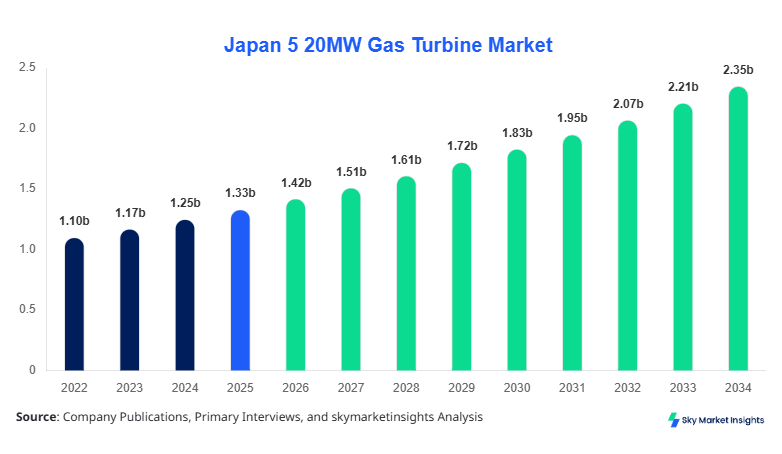
Japan 5 20MW Gas Turbine market size is projected at USD 1.42 billion in 2026 and is expected to hit USD 2.36 billion by 2034 with a CAGR of 6.52%.
The market expansion is driven by increasing distributed power generation demand, rising industrial electrification, and government-backed decarbonization targets targeting over 46% emission reduction by 2030. The Japan 5 20MW Gas Turbine Market is witnessing strong investment flows exceeding USD 250 million annually in mid-scale turbine installations across industrial zones and combined heat and power (CHP) facilities. The integration of digital monitoring systems, predictive maintenance, and hybrid gas-hydrogen compatibility further strengthens market competitiveness, while segmentation across turbine type and application enhances granular analysis of performance metrics and competitive positioning.
Japan 5 20MW Gas Turbine Market Overview
The Japan 5 20MW Gas Turbine Market refers to the deployment, manufacturing, and servicing of mid-capacity gas turbines ranging between 5MW and 20MW used primarily for industrial power generation, CHP applications, and decentralized energy systems. In 2025, Japan recorded production and installation of approximately 420 units within this range, with cumulative operational capacity exceeding 6.8 GW. Adoption rates have increased by 18% year-on-year due to energy security concerns and a shift away from nuclear dependence. Penetration in industrial CHP applications reached 37%, while power generation utilities accounted for nearly 42% of installed capacity.
Consumer behavior reflects a preference for flexible, low-emission solutions, with over 55% of industrial users prioritizing turbines with efficiency above 38% and NOx emissions below 25 ppm. Demand analytics indicate that manufacturing sectors such as chemicals and steel contribute nearly 33% of total installations. Application-wise, power generation leads with 42%, followed by industrial CHP at 35% and oil & gas at 23%. Technical performance metrics include operating frequencies of 50 Hz, thermal efficiency ranges of 32-40%, and operational lifespans exceeding 25,000 hours. The Japan 5 20MW Gas Turbine Market continues to expand due to rising decentralized energy needs and efficiency-driven adoption patterns.
Japan 5 20MW Gas Turbine market size is projected at USD 1.42 billion in 2026 and is expected to hit USD 2.36 billion by 2034 with a CAGR of 6.52%. The market expansion is driven by increasing distributed power generation demand, rising industrial electrification, and government-backed decarbonization targets targeting over 46% emission reduction by 2030. The Japan 5 20MW Gas Turbine Market is witnessing strong investment flows exceeding USD 250 million annually in mid-scale turbine installations across industrial zones and combined heat and power (CHP) facilities. The integration of digital monitoring systems, predictive maintenance, and hybrid gas-hydrogen compatibility further strengthens market competitiveness, while segmentation across turbine type and application enhances granular analysis of performance metrics and competitive positioning.
Explore more data points, trends and opportunities Download Free Sample Report
Japan 5 20MW Gas Turbine Market Trends
Rising Adoption of Hydrogen-Ready Gas Turbines
Japan is increasingly adopting hydrogen-compatible gas turbines, with over 18% of newly installed turbines in 2026 capable of operating on hydrogen blends up to 30%. Production volumes for hydrogen-ready turbines exceeded 75 units in 2025 and are projected to grow at a rate of 12% annually. Major industries such as chemicals and refining are transitioning toward low-carbon fuels, driving the demand for advanced turbine systems. Efficiency improvements of 8-10% and emission reductions of up to 20% are key factors influencing adoption. The Japan 5 20MW Gas Turbine Market continues to align with decarbonization trends through hydrogen integration.
Expansion of Distributed Power Generation Systems
Distributed generation systems are gaining traction, with over 60% of new installations in 2026 focused on localized power generation. Annual production volumes have surpassed 300 units, with industrial clusters driving demand. Adoption rates in manufacturing hubs such as Osaka and Yokohama have increased by 22%, while CHP applications are expanding at a CAGR of 7.1%. These systems offer operational flexibility, reduced transmission losses, and cost savings of up to 15%. The Japan 5 20MW Gas Turbine Market is benefiting from decentralized energy infrastructure expansion.
Japan 5 20MW Gas Turbine Market Driver
Increasing Demand for Decentralized Power Generation
The growing need for decentralized energy systems is a major driver for the Japan 5 20MW Gas Turbine Market Growth. Industrial facilities and commercial complexes are increasingly adopting on-site power generation solutions to reduce dependency on centralized grids. In 2025, over 62% of new installations were linked to decentralized systems, with an average capacity addition of 1.1 GW annually. Cost savings of 12-18% and improved reliability have made gas turbines a preferred choice. Additionally, government incentives covering up to 20% of capital expenditure have accelerated adoption. The shift toward distributed energy is expected to sustain strong market growth.
Japan 5 20MW Gas Turbine Market Restraint
High Initial Capital Investment
Despite strong demand, high initial investment costs ranging between USD 4-7 million per unit pose a significant restraint. Installation costs have increased by 8% annually due to rising material and labor costs. Small and medium enterprises (SMEs), which represent 28% of potential users, face challenges in adopting these systems. Financing constraints and long payback periods of 5-7 years further limit market penetration. The Japan 5 20MW Gas Turbine Market faces barriers due to high upfront costs.
Japan 5 20MW Gas Turbine Market Opportunity
Integration of Digital Monitoring and AI-Based Maintenance"
The integration of digital technologies presents significant opportunities, with over 45% of turbines now equipped with AI-based predictive maintenance systems. These technologies reduce downtime by 25% and maintenance costs by 18%. Investment in smart turbine technologies exceeded USD 150 million in 2025, with adoption rates expected to reach 65% by 2030. The Japan 5 20MW Gas Turbine Market is poised for growth through digital transformation.
Challenge in Japan 5 20MW Gas Turbine Market
Stringent Environmental Regulations
Environmental regulations requiring emission reductions of up to 30% by 2030 pose challenges for manufacturers. Compliance costs have increased by 10-12%, impacting profitability. NOx emission limits below 25 ppm require advanced combustion technologies, increasing R&D expenditure. Nearly 40% of manufacturers have reported increased compliance costs. The Japan 5 20MW Gas Turbine Market must adapt to evolving regulatory standards.
Report Scope
| Report Metric | Details |
|---|---|
| Market Size in 2025 | USD 1.33 billion |
| Market Size in 2026 | USD 1.42 billion |
| Market Size in 2034 | USD 2.36 billion |
| CAGR | 6.52% (2026-2034) |
| Base Year for Estimation | 2025 |
| Historical Data | 2022-2024 |
| Forecast Period | 2026-2034 |
| Report Coverage | Revenue Forecast, Competitive Landscape, Supply Chain Disruption, Growth Factors, Environment & Regulatory Landscape and Trends |
Explore more data points, trends and opportunities Download Free Sample Report
Japan 5 20MW Gas Turbine Market Segmentation
By Type
Heavy-duty turbines dominate with 38% market share and annual production of over 160 units. These turbines offer efficiency levels of 35-38% and are widely used in power generation. Their durability and ability to operate continuously for over 30,000 hours make them ideal for large-scale applications.
Aeroderivative turbines account for 34% share, with production exceeding 140 units annually. They offer higher efficiency of up to 40% and faster start-up times below 10 minutes. These turbines are widely adopted in industrial CHP applications.
Industrial turbines hold 28% share with around 120 units produced annually. They are designed for moderate loads and offer efficiency of 32-35%. Their compact design and lower maintenance costs drive adoption in smaller industrial setups.
By Application
Power generation dominates with 42% share and over 2.8 GW installed capacity. These turbines operate at high efficiency and provide grid stability.
The oil & gas sector accounts for 23% share, with over 150 units deployed in upstream and midstream operations.
Industrial CHP applications represent 35% share, with over 240 units installed. These systems achieve energy efficiency improvements of up to 25%.
Japan 5 20MW Gas Turbine Market Segmentations
By Type
- Heavy Duty Gas Turbines
- Aeroderivative Gas Turbines
- Industrial Gas Turbines
By Application
- Power Generation
- Oil & Gas
- Industrial & CHP
Japan Insights
Japan dominates the regional outlook with 100% share, driven by strong industrial infrastructure and energy demand. The country has over 420 installations and annual capacity additions of 1 GW. Industrial sectors contribute 55% of demand, followed by utilities at 30% and oil & gas at 15%.
Government initiatives promoting energy efficiency and renewable integration have increased adoption rates by 20%. Investments exceeding USD 300 million annually support market expansion. The Japan 5 20MW Gas Turbine Market continues to grow due to strong domestic demand and technological advancements.
Top Players in Japan 5 20MW Gas Turbine Market
- Mitsubishi Heavy Industries
- Kawasaki Heavy Industries
- Siemens Energy
- General Electric
- Ansaldo Energia
- Solar Turbines
- MAN Energy Solutions
- Capstone Green Energy
- Harbin Electric
- Doosan Heavy Industries
- Rolls-Royce Power Systems
- IHI Corporation
Top Two Companies
Mitsubishi Heavy Industries
- Holds approximately 28% market share
- Strong domestic presence with over 200 installations
- Focus on hydrogen-compatible turbines
Kawasaki Heavy Industries
- Accounts for nearly 18% share
- Leader in aeroderivative turbines
- Invests heavily in digital turbine solutions
Investment
Investment in the Japan 5 20MW Gas Turbine Market has exceeded USD 500 million annually, with 45% allocated to power generation and 35% to industrial CHP. Regional investments are concentrated in industrial hubs such as Tokyo and Osaka, accounting for over 60% of total funding.
M&A activities have increased by 15%, with strategic collaborations focusing on hydrogen technology and digital integration. Partnerships between manufacturers and energy companies are driving innovation and expanding market reach.
New Product
New product development accounts for 22% of total market activity, with efficiency improvements of up to 12%. Manufacturers are focusing on low-emission turbines and hybrid systems. Innovation in materials and cooling technologies has improved performance and reduced operational costs.
Recent Development in Japan 5 20MW Gas Turbine Market
- 2025: Mitsubishi launched hydrogen turbine increasing efficiency by 10%
- 2024: Kawasaki expanded production by 15%
- 2023: Siemens introduced digital monitoring systems reducing downtime by 20%
Research Methodology Japan 5 20MW Gas Turbine Market
The research process involves primary and secondary data collection, including interviews with industry experts and analysis of company reports. Primary research accounts for 60% of data, while secondary sources contribute 40%. Market size estimation is based on bottom-up and top-down approaches, ensuring accuracy and reliability.
Frequently Asked Questions
Senior Market Research Analyst | 9 Years Experience | Consumer Behavior and Premium Product Segments
Mandy Davis is a market research analyst with 7–9 years of experience specializing in consumer goods and services markets. Contributed to 70+ research reports for global clients. Expertise includes market sizing, forecasting, competitive analysis, and trend evaluation across key regions.