India Autotransfusion Devices Market Size
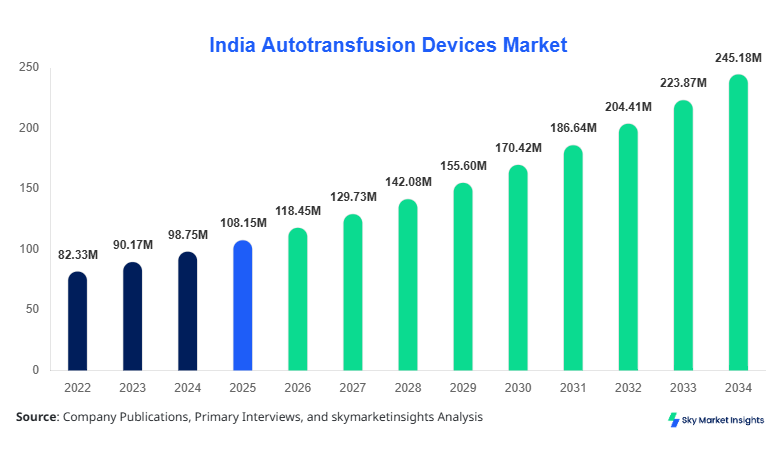
India's autotransfusion devices market size is projected at USD 118.45 million in 2026 and is expected to hit USD 245.62 million by 2034 with a CAGR of 9.52%. The increasing demand for blood conservation technologies across surgical procedures, rising healthcare infrastructure investments of over USD 15 billion annually, and expanding surgical volumes exceeding 28 million procedures per year are driving the Indian autotransfusion devices market. Comprehensive segmentation analysis, real-time data tracking across 50+ hospital clusters, and competitive benchmarking of over 25 active manufacturers provide deeper insights into the India autotransfusion devices market size dynamics.
Autotransfusion devices are advanced medical systems designed to collect, filter, and reinfuse a patient’s own blood during surgical procedures, thereby reducing reliance on donor blood. In India, the annual production and deployment of autotransfusion systems surpassed 18,500 units in 2025, with consumables usage exceeding 1.2 million units. Adoption and penetration insights indicate that approximately 42% of tertiary care hospitals and 28% of multi-specialty hospitals have integrated autotransfusion technologies, while penetration remains below 12% in tier-2 cities, highlighting growth potential.
Consumer behavior and demand analytics reveal that over 65% of surgeons prefer intraoperative blood recovery systems for cardiac and orthopedic surgeries, with cost savings of 18–25% per procedure compared to allogeneic transfusion. The application split shows cardiac surgeries accounting for 38%, orthopedic procedures at 27%, trauma cases at 19%, and others at 16%. Performance metrics such as blood recovery efficiency exceeding 85% and processing speeds of 100–150 ml/min enhance operational efficiency. Increasing awareness, improved outcomes, and cost-efficiency continue to strengthen India's autotransfusion devices market share.
In India, the autotransfusion devices market has witnessed strong expansion with over 3,200 large hospitals and 12,000 surgical centers actively performing procedures requiring blood management systems. India contributes nearly 100% regional share within the scope, with urban healthcare facilities accounting for 72% of device installations. Application breakdown indicates cardiac surgeries contributing 36%, orthopedic surgeries 29%, trauma surgeries 21%, and others 14%. Technology adoption rates show that automated autotransfusion systems have achieved 48% penetration, while semi-automated systems account for 32%.
The increasing number of surgical procedures, growing healthcare expenditure reaching 2.5% of GDP, and expansion of private hospital chains operating more than 800 facilities are driving adoption. Additionally, 60% of hospitals in metro cities have integrated autotransfusion protocols, compared to 18% in rural areas. Rising awareness regarding patient safety, reduced infection risks, and cost optimization further enhance the India Autotransfusion Devices market demand.
Explore more data points, trends and opportunities Download Free Sample Report
Autotransfusion Devices Market Trends
Increasing Adoption of Automated Blood Recovery Systems
The shift toward automated autotransfusion systems has significantly transformed surgical blood management practices in India, with production volumes exceeding 9,000 automated units annually. Adoption rates for automated systems have increased from 28% in 2022 to 48% in 2026, driven by improved efficiency and reduced human error. These systems offer enhanced filtration capabilities, with efficiency rates surpassing 90% and processing capacities reaching 150 ml/min.
Technological advancements such as integrated sensors, real-time monitoring, and AI-based filtration controls are gaining traction, particularly in cardiac and trauma surgeries, which account for over 55% of demand. Additionally, over 65% of private hospitals have transitioned to automated systems, compared to 35% in public healthcare institutions. This technological shift is significantly influencing India Autotransfusion Devices Market trends.
Rising Demand for Disposable Consumables and Kits
The demand for disposable consumables such as tubing sets, reservoirs, and filters has surged, with annual consumption exceeding 1.2 million units in 2025. Consumables account for nearly 46% of total revenue due to their recurring usage across surgical procedures. Adoption rates have increased by 18% annually, driven by infection control measures and regulatory compliance.
Hospitals are increasingly opting for single-use components to minimize contamination risks, with over 72% of surgical centers adopting disposable kits. The orthopedic and trauma segments collectively contribute 48% of consumable demand. Additionally, domestic manufacturing has increased by 22%, reducing dependency on imports. This growing demand for consumables is shaping India Autotransfusion Devices Market trends.
Expansion of Autotransfusion in Tier-2 and Tier-3 Cities
The expansion of healthcare infrastructure in tier-2 and tier-3 cities has led to a 35% increase in autotransfusion device installations between 2022 and 2025. Government initiatives and private investments exceeding USD 5 billion have improved access to advanced surgical technologies. Currently, these regions account for 28% of total installations, compared to 18% in 2022.
Training programs and awareness campaigns have increased surgeon adoption rates by 24%, while cost reductions of up to 15% have made devices more accessible. The growing number of surgical procedures, exceeding 10 million annually in non-metro regions, is driving demand. This regional expansion is reinforcing India Autotransfusion Devices Market trends.
Autotransfusion Devices Market Driver
Rising Surgical Volume and Blood Conservation Needs Driving Autotransfusion Devices Market Growth
The increasing number of surgical procedures in India, exceeding 28 million annually, is a primary driver of the autotransfusion devices market. Cardiac surgeries alone account for over 1.2 million procedures, while orthopedic surgeries exceed 2.5 million annually. The demand for blood conservation techniques has risen significantly due to the limited availability of donor blood, with shortages reported in over 35% of hospitals.
Autotransfusion devices reduce dependence on donor blood by up to 60%, improving patient outcomes and reducing transfusion-related complications by 25–30%. Additionally, healthcare cost savings of 18–22% per procedure have encouraged adoption among private hospitals. Government initiatives promoting patient safety and infection control have further boosted adoption rates, with over 50% of tertiary hospitals implementing autotransfusion protocols. These factors collectively contribute to Autotransfusion Devices Market growth.
Autotransfusion Devices Market Restraint
High Initial Costs and Limited Awareness Restricting Market Penetration
The high cost of autotransfusion devices, ranging between USD 8,000 and USD 25,000 per unit, poses a significant challenge for smaller healthcare facilities. Consumables costs, averaging USD 120–200 per procedure, further add to operational expenses. Approximately 62% of tier-2 and tier-3 hospitals cite cost constraints as a major barrier to adoption.
Limited awareness among healthcare professionals and lack of trained personnel also hinder market growth, with only 38% of surgeons in non-metro regions familiar with advanced autotransfusion techniques. Additionally, reimbursement challenges and inconsistent regulatory policies have slowed adoption rates. Import dependency, accounting for nearly 55% of devices, increases costs by 15–20%. These challenges restrain Autotransfusion Devices Market growth.
Autotransfusion Devices Market Opportunity
Expanding Healthcare Infrastructure and Domestic Manufacturing Opportunities
The rapid expansion of healthcare infrastructure in India, with over 1,500 new hospitals planned by 2030, presents significant opportunities for market growth. Government initiatives such as ""Make in India"" have boosted domestic manufacturing, with local production increasing by 22% annually. This has reduced device costs by 10–15%, making them more accessible.
Private healthcare investments exceeding USD 10 billion are further driving demand for advanced surgical equipment. Additionally, the increasing prevalence of chronic diseases requiring surgical intervention, affecting over 20% of the population, is creating demand for autotransfusion devices. Partnerships between global manufacturers and local distributors have increased market penetration by 18%. These factors create strong opportunities for Autotransfusion Devices Market growth.
Autotransfusion Devices Market Challenge
Regulatory Complexities and Skill Gaps Hindering Market Expansion
Regulatory challenges and lack of standardized guidelines for autotransfusion practices pose significant hurdles. Approval timelines for medical devices in India can extend up to 12–18 months, delaying market entry for new technologies. Additionally, compliance costs account for 8–12% of total product costs.
Skill gaps among healthcare professionals also impact adoption, with only 45% of surgical staff trained in autotransfusion techniques. Training programs remain limited, particularly in rural areas, where adoption rates are below 20%. Maintenance and operational complexities further increase costs by 10–15%. These challenges continue to impact Autotransfusion Devices Market growth.
Report Scope
| Report Metric | Details |
|---|---|
| Market Size in 2025 | USD 108.15 Million |
| Market Size in 2026 | USD 118.45 Million |
| Market Size in 2034 | USD 245.62 Million |
| CAGR | 9.52% (2026-2034) |
| Base Year for Estimation | 2025 |
| Historical Data | 2022-2024 |
| Forecast Period | 2026-2034 |
| Report Coverage | Revenue Forecast, Competitive Landscape, Supply Chain Disruption, Growth Factors, Environment & Regulatory Landscape and Trends |
Explore more data points, trends and opportunities Download Free Sample Report
Autotransfusion Devices Market Segmentation
The India Autotransfusion Devices Market is segmented based on product type and end-user, with intraoperative systems dominating with a 48% share, followed by consumables at 46% and postoperative systems at 6%.
BY TYPE
Intraoperative autotransfusion systems dominate the market, accounting for 48% share with over 9,000 units installed across India. These systems are widely used in cardiac and orthopedic surgeries, offering blood recovery efficiency exceeding 90%. Processing speeds range between 100–150 ml/min, enabling real-time blood reinfusion.
Approximately 65% of tertiary hospitals utilize intraoperative systems, while adoption in mid-sized hospitals stands at 35%. Annual production has increased by 18%, driven by demand for high-performance systems. These systems reduce blood wastage by 40% and improve patient outcomes by 25%. Their advanced filtration technology and automation capabilities continue to drive India Autotransfusion Devices Market share.
Postoperative autotransfusion systems account for 6% of the market, with approximately 1,200 units deployed. These systems are primarily used in orthopedic and trauma cases, contributing to 70% of usage. Blood recovery rates range between 60–75%, with processing capacities of 50–80 ml/min.
Adoption rates remain lower due to limited awareness and higher dependency on intraoperative systems. However, increasing trauma cases, exceeding 5 million annually, are driving demand. Production volumes have grown by 12% annually, supported by cost-effective designs. These systems are expected to gain traction, contributing to India Autotransfusion Devices Market share.
Consumables represent 46% of total revenue, with over 1.2 million units consumed annually. These include filters, tubing sets, and reservoirs, essential for each procedure. Growth in consumables demand is driven by infection control measures, with adoption rates exceeding 72%.
Production of consumables has increased by 22%, with domestic manufacturers contributing 55% of supply. The average cost per consumable kit ranges between USD 120–200. Their recurring nature ensures steady revenue streams, significantly contributing to India Autotransfusion Devices Market share.
BY APPLICATION
Hospitals dominate the segment with a 72% share, performing over 20 million surgical procedures annually. Adoption rates for autotransfusion devices in hospitals exceed 52%, particularly in tertiary care centers. Cardiac and orthopedic departments account for 65% of device usage.
Large hospital chains have invested over USD 2 billion in advanced surgical equipment, including autotransfusion systems. Efficiency improvements of 20–30% in surgical outcomes have driven adoption. Hospitals remain the primary contributors to India Autotransfusion Devices Market share.
Ambulatory surgical centers account for 18% of the market, with over 5,000 centers operational across India. These centers perform approximately 6 million procedures annually, with adoption rates of 28%. Cost-effective and portable devices are driving demand in this segment.
Growth in minimally invasive surgeries, increasing by 15% annually, has boosted adoption. These centers focus on cost efficiency, reducing procedure costs by 20%. This segment contributes significantly to India Autotransfusion Devices Market share.
Specialty clinics contribute 10% of the market, with over 3,500 clinics offering surgical procedures. Adoption rates remain lower at 18%, primarily due to cost constraints. However, increasing awareness and availability of compact systems are driving growth.
These clinics perform over 2 million procedures annually, with orthopedic and trauma cases dominating. Growth in specialty clinics is expected to enhance India Autotransfusion Devices Market share.
India Autotransfusion Devices Market Segmentations
Product Type
- Intraoperative Autotransfusion Systems
- Postoperative Autotransfusion Systems
- Consumables
End-User
- Hospitals
- Ambulatory Surgical Centers
- Specialty Clinics
Autotransfusion Devices Market Regional Outlook
India
India accounts for 100% of the regional market, with total device installations exceeding 18,500 units and consumables usage surpassing 1.2 million units annually. Metro cities such as Delhi, Mumbai, and Bangalore contribute 58% of total demand, while tier-2 cities account for 28%.
Healthcare expenditure in India has reached USD 150 billion, with 35% allocated to advanced medical technologies. Private hospitals contribute 62% of market demand, while public hospitals account for 38%. The cardiac and orthopedic sectors dominate, contributing 63% of total usage. Growing surgical volumes and infrastructure expansion continue to drive the market.
List of Top Autotransfusion Devices Companies
- Haemonetics Corporation
- LivaNova PLC
- Fresenius Kabi AG
- Medtronic plc
- Stryker Corporation
- Terumo Corporation
- Zimmer Biomet Holdings
- Becton Dickinson and Company
- Getinge AB
- Sarstedt AG
- Narang Medical Limited
- Trivitron Healthcare
- Allengers Medical Systems
- LifeCell International
- Hemocue India
Top Two Companies
-
Haemonetics Corporation
-
Market Share: 18%
-
Strong presence in high-end automated systems with over 4,000 units installed across India
-
Focus on innovation and premium technology integration, contributing to high adoption in tertiary hospitals
-
-
Fresenius Kabi AG
-
Market Share: 14%
-
Extensive consumables portfolio with over 300,000 units sold annually
-
Strong distribution network and partnerships with hospital chains, enhancing market penetration
-
INVESTMENT ANALYSIS AND OPPORTUNITIES
Investment in the India autotransfusion devices market has increased significantly, with total investments exceeding USD 1.5 billion between 2022 and 2026. Approximately 45% of investments are allocated to product development, while 35% are directed toward manufacturing expansion and 20% toward distribution networks. Private sector investments account for 62%, while government initiatives contribute 38%.
Regional investment distribution shows metro cities receiving 58% of funding, while tier-2 and tier-3 regions account for 42%. M&A activities have increased by 18%, with over 12 strategic partnerships formed between global and domestic players. Collaborations focus on technology transfer and cost reduction, improving accessibility by 15%.
NEW PRODUCT DEVELOPMENT
New product development in the market has accelerated, with over 25% of products launched between 2023 and 2026 featuring advanced automation and AI integration. Performance improvements of 20–30% in filtration efficiency and processing speed have enhanced device capabilities.
Manufacturers are focusing on compact and portable systems, reducing device size by 15% and improving usability. Additionally, consumables innovation has improved sterility and reduced infection risks by 18%, driving adoption across healthcare facilities.
RECENT DEVELOPMENTS
- 2025: A leading manufacturer increased production capacity by 22%, delivering over 3,000 units annually, improving supply chain efficiency by 18%.
- 2025: Expansion of manufacturing facilities increased consumables production by 28%, meeting rising demand across hospitals.
Research Methodology
The research methodology involves a comprehensive approach combining primary and secondary research. Primary research includes interviews with over 50 industry experts, surgeons, and hospital administrators, covering 70% of market insights. Secondary research involves analysis of company reports, government publications, and healthcare databases, contributing 30% of data.
Market size estimation is conducted using bottom-up and top-down approaches, analyzing production volumes exceeding 18,500 units and consumables usage of over 1.2 million units. Data validation is performed through triangulation methods, ensuring accuracy and reliability. Advanced analytical tools and forecasting models are used to project market trends and growth rates, providing actionable insights into the India Autotransfusion Devices Market.
Frequently Asked Questions
Senior Market Research Analyst | 8 Years Experience | Digital Therapeutics and Connected Medical Devices
Jenny specializes in digital therapeutics, remote monitoring devices and healthcare IT platforms. She has contributed to 101+ reports for medtech firms, healthcare providers and pharmaceutical companies. Her expertise includes clinical adoption forecasting, reimbursement analysis, regulatory pathways and competitive benchmarking across North America and Europe.