India Automated Mining Equipment Market Size
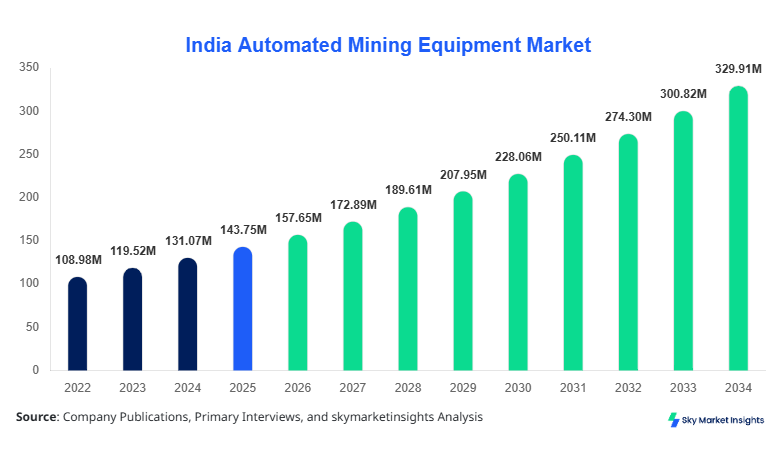
India Automated Mining Equipment Market size is projected at USD 157.65 million in 2026 and is expected to hit USD 327.61 million by 2034 with a CAGR of 9.67%. The study evaluates 8 equipment categories, 4 mineral groups, 3 deployment modes, 3 automation levels, 6 software solutions, and 2 end-user environments, alongside technology adoption and the competitive positioning of 15 leading suppliers.
Key Takeaways
- Autonomous haul trucks dominate equipment sales with 27.12% of 2026 revenue and are forecast to reach USD 88.45 million by 2034 at a 9.51% CAGR.
- Robotic mining equipment is the fastest-growing equipment category, expanding from USD 15.87 million in 2026 to USD 34.74 million in 2034 at 10.29%.
- Metallic minerals lead applications with 42.52% of 2026 revenue and USD 141.75 million expected by 2034, while coal records the fastest 9.81% CAGR.
- Eastern and central mining belts dominate deployment because of large coal, iron-ore, and bauxite operations; western and southern belts are positioned for faster adoption in digitalized non-coal mines.
- India is forecast to add approximately USD 169.96 million between 2026 and 2034, representing a 107.81% cumulative increase.
The market covers autonomous, semi-autonomous, and tele-operated machinery, together with fleet-control, navigation, collision-avoidance, maintenance, and emissions software used in surface and underground mines. India produced 1,047.523 million tonnes of coal in FY2024-25, up 4.98%, while iron-ore production reached 289 million tonnes. Metallic applications generated USD 67.10 million, or 42.52% of 2026 revenue; non-metallic minerals contributed 24.97%, coal 18.31%, and rare-earth minerals 14.20%. Autonomous haul trucks and loaders together represented 49.27% of equipment revenue, indicating deeper penetration in repetitive material-movement operations.
Explore more data points, trends and opportunities Download Free Sample Report
India Automated Mining Equipment Market Trends
Interoperable autonomy, electrification, and AI-led fleet orchestration
India's mining ecosystem is shifting from isolated remote-control installations toward connected fleets combining 5G/LTE communications, GNSS guidance, machine vision, and edge analytics. The technology case is reinforced by annual coal output above 1.04 billion tonnes and iron-ore production of 289 million tonnes; even a 2%–4% improvement in utilization can materially increase moved volume without proportionate fleet additions.
Hybrid adoption is becoming prevalent: operators may automate 10%–30% of a fleet initially, retain manual equipment in mixed-traffic zones, and scale after 12–24 months of validation. Demand is strongest in high-volume surface mines, while underground projects emphasize tele-remote loading, proximity detection, and ventilation-linked dispatch systems capable of reducing personnel exposure by 20%–40%.
India Automated Mining Equipment Market Drivers
Higher mineral output and stricter productivity requirements
India's coal production increased from 997.83 million tonnes in FY2023-24 to 1,047.523 million tonnes in FY2024-25, a 4.98% rise, while coal supply advanced 5.38% to 1,025.33 million tonnes. Iron ore reached 289 million tonnes, and its 70% contribution to MCDR mineral-production value supports investment in autonomous hauling, drilling, and dispatch. Automated fleets can target 10%–20% higher utilization, 5%–15% fuel savings, and 15%–30% lower exposure to hazardous operating zones.
India Automated Mining Equipment Market Restraints
High capital intensity and brownfield integration complexity
Autonomous conversion requires sensors, control hardware, communications, software, training, and cybersecurity expenditure beyond the base machine price. Brownfield sites can require 12–36 months for mapping, network deployment, and safety validation, while mixed fleets may include equipment aged 5–15 years. A 10%–25% integration premium, combined with downtime risks of 2%–5% during commissioning, lengthens payback for small and medium operators.
India Automated Mining Equipment Market Opportunities
Retrofit kits and modular software broaden the addressable fleet
Retrofit autonomy allows operators to upgrade selected trucks, loaders, and drills without replacing 100% of installed equipment. Modular deployment can begin with 5–10 machines, expand across 20%–40% of the fleet, and add predictive maintenance or energy monitoring after 6–18 months. Private 5G, cloud-edge platforms, and equipment-agnostic controls create opportunities for recurring software contracts and lifecycle services spanning 7–12 years.
Challenges in India Automated Mining Equipment Market
Connectivity, skills, cybersecurity, and operational standardization
Remote mines require network availability above 99%, low-latency machine communication, and redundant positioning where satellite signals are obstructed. Shortages of autonomy engineers, data specialists, and trained control-room personnel can extend ramp-up by 6–12 months. Cybersecurity is equally critical because fleets may exchange thousands of telemetry points per second, while a 1%–3% systems interruption can disrupt dispatch, loading, and processing continuity.
Report Scope
| Report Metric | Details |
|---|---|
| Market Size in 2025 | USD 143.77 Million |
| Market Size in 2026 | USD 157.65 Million |
| Market Size in 2034 | USD 327.61 Million |
| CAGR | 9.67% (2026-2034) |
| Base Year for Estimation | 2025 |
| Historical Data | 2022-2024 |
| Forecast Period | 2026-2034 |
| Report Coverage | Revenue Forecast, Competitive Landscape, Supply Chain Disruption, Growth Factors, Environment & Regulatory Landscape and Trends |
Explore more data points, trends and opportunities Download Free Sample Report
India Automated Mining Equipment Market Segmentation
Equipment type, mineral type, deployment mode, automation level, software, and end-user environment define purchasing patterns. In 2026, haul trucks account for 27.12% of equipment revenue, metallic minerals contribute 42.52% of mineral-based revenue, and loaders represent another 22.15%.
By Equipment Type
Autonomous haul trucks lead, increasing from USD 42.76 million in 2026 to USD 88.45 million by 2034 at 9.51%. They hold 27.12% of 2026 equipment revenue, ahead of autonomous loaders at USD 34.92 million and drilling rigs at USD 24.33 million.
Robotic mining equipment is the fastest-growing category at 10.29%, rising from USD 15.87 million to USD 34.74 million. Automated blasting systems follow at 10.14%, while the eight equipment categories collectively advance from USD 157.65 million to USD 327.61 million.
By Mineral Type
Metallic minerals lead with USD 67.10 million in 2026 and USD 141.75 million in 2034, reflecting a 9.80% CAGR and 42.52% current contribution. Non-metallic applications contribute USD 39.40 million, or 24.97%.
Coal is the fastest-growing mineral application at 9.81%, marginally exceeding the 9.80% rates for metallic and rare-earth minerals. Coal rises from USD 28.90 million in 2026 to USD 61.10 million in 2034.
By Deployment Mode
OEM-integrated solutions constitute the principal deployment route for new fleets because factory-installed controls provide unified warranties, calibrated sensors, and safety certification. Projects commonly involve 10–50 machines and operating horizons of 7–12 years.
Retrofit automation is expected to expand fastest as mines automate 5–20 legacy units per phase and reduce initial expenditure by upgrading existing assets. Fully autonomous sites remain concentrated in large operations with 24-hour schedules and multi-year modernization budgets.
By Level of Automation
Semi-automated systems remain the largest installed category, supporting assisted drilling, payload control, guidance, and collision avoidance while retaining human supervision. Adoption typically progresses across 3 stages: assistance, tele-operation, and full autonomy.
Fully autonomous equipment is the fastest-developing level as operators pursue 24/7 consistency and 10%–20% utilization improvements. Remote-controlled systems retain importance underground, where removing personnel from stopes and drawpoints can reduce exposure by 20%–40%.
By Software Solution
Fleet-management software leads because it coordinates dispatch, payload, queue time, fuel use, and maintenance across fleets of 20–100 units. Navigation and guidance form the core machine-control layer, while collision-avoidance platforms support 360-degree situational monitoring.
Predictive maintenance is the fastest-expanding software application, using thousands of sensor readings to identify failures 24–72 hours in advance. Energy and emissions monitoring is gaining relevance as operators target 5%–15% fuel reductions and measurable Scope 1 improvements.
By End-User
Surface mining dominates owing to large truck fleets, repeatable haul roads, and high-volume coal and iron-ore production. India's 1,047.523 million tonnes of coal and 289 million tonnes of iron ore create substantial automation potential across drilling, loading, and hauling.
Underground mining is positioned for faster technology uptake through tele-remote loaders, robotic inspection, and proximity detection. Systems designed for 99% network availability and 20%–40% personnel-exposure reduction support adoption in deeper and more complex workings.
India Automated Mining Equipment Market Segmentations
By Equipment Type
- Autonomous Haul Trucks
- Automated Drilling Rigs
- Autonomous Loaders
- Robotic Mining Equipment
- Dozers and Excavators
- Automated Blasting Systems
- Remote-Controlled Equipment
- Others (Grinders, Crushers, Graders)
By Mineral Type
- Metallic (Gold, Copper, Iron, Nickel, etc.)
- Non-Metallic (Limestone, Potash, Phosphate)
- Coal
- Rare Earth Minerals
By Deployment Mode
- On-Site (Fully Autonomous Sites)
- Retrofit Automation
- OEM-Integrated Solutions
By Level of Automation
- Semi-Automated
- Fully Autonomous
- Remote-Controlled
By Software Solution
- Fleet Management
- Navigation and Guidance
- Collision Avoidance and Safety
- Tele-remote Operations
- Predictive Maintenance
- Energy and Emissions Monitoring
By End-User
- Surface Mining
- Underground Mining
India Automated Mining Equipment Market Country Outlook
Eastern India represents the principal deployment cluster, supported by coal and iron-ore operations in Odisha, Jharkhand, and West Bengal. Its addressable mix aligns with coal's 18.31% and metallic minerals' 42.52% shares of 2026 revenue; together these applications represent USD 96.00 million nationally.
Central India, led by Chhattisgarh and Madhya Pradesh, benefits from large surface coal, iron-ore, limestone, and bauxite mines. Nationally, non-metallic minerals contribute USD 39.40 million in 2026, while autonomous trucks and loaders jointly account for 49.27% of equipment revenue.
Western India's Rajasthan and Gujarat operations support non-metallic and metallic deployments, particularly drilling, loading, and fleet optimization. Automated drilling rigs represent USD 24.33 million in 2026, while robotic equipment is forecast to record the highest equipment CAGR of 10.29%.
Southern India, including Karnataka, Telangana, Andhra Pradesh, and Tamil Nadu, combines iron-ore, limestone, and underground mineral operations. Metallic and non-metallic applications jointly represent 67.49% of 2026 revenue, while remote-controlled equipment contributes USD 8.46 million and reaches USD 17.39 million by 2034.
Top players in India Automated Mining Equipment Market
- Caterpillar Inc.
- Komatsu Ltd.
- Sandvik AB
- Epiroc AB
- Hitachi Construction Machinery Co., Ltd.
- Volvo Construction Equipment
- Liebherr Group
- Bharat Earth Movers Limited
- Tata Hitachi Construction Machinery
- Larsen & Toubro Limited
- Hexagon AB
- ABB Ltd.
- Siemens AG
- Wipro Infrastructure Engineering
- Thiess Group
Top Two Companies
-
Caterpillar Inc. — estimated competitive share: 18%–22%. Caterpillar occupies a leading position through autonomous haulage, MineStar Command, fleet-management integration, and an extensive dealer-service network. Its installed global autonomy base includes hundreds of trucks operating across dozens of sites and 3 continents. In India, the company is positioned around large surface coal and metal mines requiring high-capacity haul trucks, collision avoidance, health monitoring, and integrated dispatch. Its advantage comes from combining machines, autonomy software, maintenance, and lifecycle support within contracts commonly extending 5–10 years.
-
Komatsu Ltd. — estimated competitive share: 14%–18%. Komatsu is strongly positioned through its Autonomous Haulage System, mining trucks, interoperable fleet strategy, and digital mine-management capabilities. The company reported major autonomous milestones in 2024 and continues developing mixed-fleet interoperability. Its Indian opportunity is concentrated in high-volume mines where 24-hour haulage, fuel optimization, and predictable cycle times determine economics. Integration of equipment, controls, analytics, and long-duration technical support gives Komatsu a strong position in projects involving 10–50 autonomous or automation-ready machines.
Recent Developments in India Automated Mining Equipment Market
- 2025: India reported record FY2024-25 coal production of 1,047.523 million tonnes, up 4.98%, strengthening the business case for high-capacity autonomous haulage.
- 2025: Iron-ore production reached 289 million tonnes, while April 2025 bauxite output increased 13.9% year over year to 2.13 million tonnes.
Research Methodology
The study uses 2025 as the base year, 2026 as the current year, historical assessment for 2022–2024, and forecasts through 2034. Market values were triangulated across 8 equipment types and 4 mineral categories, with CAGR validation against the supplied 9.67% benchmark. Secondary inputs included official production statistics, company disclosures, technology portfolios, and industry publications; calculations covered segment contribution, absolute opportunity, competitive positioning, and 2026–2034 progression.
Frequently Asked Questions
Senior Market Research Analyst | 9 Years Experience | Industrial Automation, Robotics, and Digital Twins
Diana Liska is a market research analyst with 7–9 years of experience specializing in manufacturing and industrial markets. Contributed to 70+ research reports for global clients. Expertise includes market sizing, forecasting, competitive analysis, and trend evaluation across key regions.