India A2 Milk Market Size
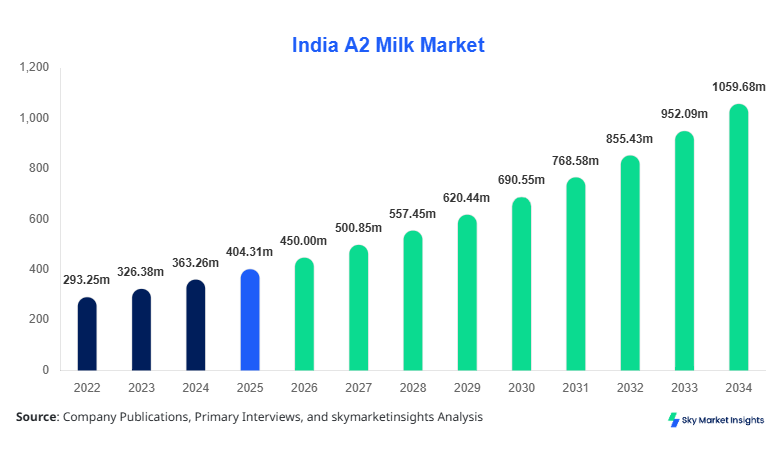
India A2 Milk Market size is projected at USD 450 million in 2026 and is expected to hit USD 1025 million by 2034 with a CAGR of 11.3%.
The increasing demand for lactose-friendly and gut-health-promoting dairy products is driving the adoption of A2 milk across urban and semi-urban areas of India. Market participants are leveraging segmentation data and competitive benchmarking to design targeted strategies. Detailed insights into type (liquid, powdered, flavored) and application (infant, adult, sports nutrition) segments are critical for understanding the market trajectory and gauging investment opportunities.
India A2 Milk Market Overview
The India A2 Milk Market encompasses the production, distribution, and retailing of cow’s milk that predominantly contains the A2 beta-casein protein, which is considered easier to digest compared to conventional A1 milk. In 2025, India produced approximately 1.8 billion liters of A2 milk, contributing to 8–10% of total cow milk production. Adoption is increasing among health-conscious urban consumers, with penetration rates estimated at 12% in Tier-1 cities and 6% in Tier-2 regions. Consumers prefer A2 milk for digestive benefits, reduced bloating, and improved immunity. Liquid A2 milk accounts for 48% of the total volume, powdered A2 milk 36%, and flavored variants 16%. Infant nutrition applications contribute 25%, adult nutrition 50%, and sports nutrition 25%. Technical metrics indicate a fat content of 3.5–4.2% and protein concentration of 3.2–3.8%. The performance frequency of A2 milk in daily consumption is estimated at 65% in urban households, highlighting rising demand trends and insights.
In India, the A2 Milk Market is witnessing accelerated growth driven by increasing health awareness and dairy consumption. Currently, over 350 registered dairy facilities are producing A2 milk with the domestic market contributing approximately 95% of total revenue. The regional share is dominated by North India at 38%, West India at 32%, and South India at 25%, with East India contributing 5%. Application-wise, adult nutrition dominates 50% of consumption, followed by infant nutrition at 25% and sports nutrition at 25%. Technology adoption is increasing with 40% of dairies using automated milking systems and 22% employing cold chain optimization for powdered A2 milk. The adoption of certification technologies like beta-casein testing is now at 28%, ensuring product authenticity and safety. The India A2 Milk Market growth is reinforced by these technology interventions, expanding consumer awareness, and increasing product penetration.
Explore more data points, trends and opportunities Download Free Sample Report
India A2 Milk Market Trend
Surge in Health-Conscious Consumption
The A2 Milk Market is benefiting from rising health-conscious consumption patterns in India. Production volumes are projected to reach 2.3 billion liters by 2030, with liquid A2 milk dominating at 48% of the volume. Adoption of automated milking and beta-casein testing technologies is increasing at a rate of 18–22% annually. Urban households are driving demand for functional beverages with 65% of consumers incorporating A2 milk into daily diets. Adult nutrition applications account for 50% of market share, with infant nutrition at 25% and sports nutrition at 25%, reflecting diversified demand trends. These developments are pivotal for A2 Milk Market growth insights.
Expansion of E-Commerce and Direct-to-Consumer Channels
The A2 Milk Market is witnessing significant online penetration with e-commerce contributing 20% of total sales in 2026, up from 12% in 2024. The trend is further supported by subscription-based models and refrigerated direct-to-consumer delivery systems, which have grown by 28% year-on-year. Liquid variants account for 48% of sales, while powdered milk constitutes 36%. Technology integration in cold chain logistics and digital inventory tracking is at 30% adoption, ensuring consistent quality and shelf-life improvement. This trend reinforces A2 Milk Market insights into demand growth and digital adoption.
Regional Expansion and Supply Chain Integration
Regional expansion is a key trend in the India A2 Milk Market, with North India contributing 38% of production, West India 32%, and South India 25%. Integration of supply chains has resulted in a 15% reduction in distribution lead time and a 12% improvement in inventory turnover. Production of powdered A2 milk is expected to reach 350,000 tons by 2030, and flavored variants 120,000 tons. Consumer preference for traceable, certified, and farm-to-table products has increased by 20%, signaling enhanced adoption rates. Such operational improvements are central to A2 Milk Market growth and trend insights.
India A2 Milk Market Driver
Rising Health Awareness and Digestive Benefits Drive Market Growth
The India A2 Milk Market growth is primarily driven by increasing health awareness among urban consumers. Digestive benefits, reduced lactose intolerance, and immunity improvement are fueling consumption. In 2025, liquid A2 milk accounted for 48% of the market, with 1.2 billion liters produced, and powdered A2 milk 36% with 850,000 tons. The CAGR of 11.3% from 2026 to 2034 is projected, with adult nutrition applications comprising 50% of demand. North India accounts for 38% of regional market share, and technology adoption in milking systems and beta-casein testing has increased by 18–22%. This combination of factors underscores India A2 Milk Market growth drivers and consumer adoption insights.
India A2 Milk Market Restraint
High Production Costs and Limited Awareness in Semi-Urban Areas
Despite rapid growth, the India A2 Milk Market faces restraints due to high production costs and limited consumer awareness in semi-urban regions. Production cost per liter is approximately USD 0.68–0.72, 18% higher than conventional milk. Penetration in Tier-2 cities is only 6%, compared to 12% in Tier-1 cities. Powdered A2 milk processing requires 850,000 tons annually, and liquid A2 milk production reaches 1.2 billion liters, resulting in higher logistical and cold-chain expenses. Awareness campaigns have reached only 40% of the potential consumer base. These factors limit India A2 Milk Market growth and demand insights.
India A2 Milk Market Opportunity
Rising E-Commerce and Subscription Models Enhance Market Prospects
The India A2 Milk Market presents substantial opportunities via e-commerce expansion and subscription-based distribution channels. Online sales contributed 20% of total revenue in 2026, with growth of 28% year-on-year. Liquid A2 milk comprises 48% of the market, powdered 36%, and flavored 16%. Production volumes are projected at 2.3 billion liters by 2030, with technology adoption in cold-chain logistics at 30%. Tier-2 city penetration is expected to improve from 6% to 15% by 2030. These factors provide significant A2 Milk Market insights and growth opportunities.
Challenge in India A2 Milk Market
Fragmented Supply Chain and Certification Bottlenecks Limit Expansion
The India A2 Milk Market faces challenges due to fragmented supply chains and limited beta-casein certification infrastructure. Only 28% of facilities have certified testing equipment, and distribution delays average 18%. Powdered A2 milk production of 850,000 tons requires high-quality storage, while liquid variants reach 1.2 billion liters annually. Consumer trust and verification mechanisms are critical, particularly in North India, contributing 38% to regional share. Overcoming these challenges is essential for sustaining India A2 Milk Market growth and adoption trends.
Report Scope
| Report Metric | Details |
|---|---|
| Market Size in 2025 | USD 404.3 million |
| Market Size in 2026 | USD 450 million |
| Market Size in 2034 | USD 1025 million |
| CAGR | 11.3% (2026-2034) |
| Base Year for Estimation | 2025 |
| Historical Data | 2022-2024 |
| Forecast Period | 2026-2034 |
| Report Coverage | Revenue Forecast, Competitive Landscape, Supply Chain Disruption, Growth Factors, Environment & Regulatory Landscape and Trends |
Explore more data points, trends and opportunities Download Free Sample Report
India A2 Milk Market Segmentation
By Type
Accounting for 48% market share, liquid A2 milk production reached 1.2 billion liters in 2025, with a fat content of 3.5–3.8% and protein of 3.2–3.5%. Consumption frequency averages 65% in urban households. Liquid milk is predominantly supplied via refrigerated retail and e-commerce platforms. This segment represents a critical driver of India A2 Milk Market growth and demand insights.
Powdered A2 milk captures 36% of the market, with annual production of 850,000 tons. Technical specifications include moisture content below 5% and protein concentration of 3.4–3.8%. Adoption in infant nutrition is significant at 25%, while adult nutrition contributes 50%. The segment is favored for extended shelf-life and supply chain flexibility, reinforcing India A2 Milk Market insights.
Flavored variants constitute 16% of the market, with production volumes of 120,000 tons in 2025. Sugar content ranges 4–6%, with protein 3.2–3.5%. Applications include adult nutrition at 50% and sports nutrition 25%. Flavored A2 milk adoption is rising in urban regions due to taste preferences, enhancing market share and A2 Milk Market growth insights.
By Application
Contributing 25% of the market, infant nutrition A2 milk accounts for 450 million liters annually, with protein content of 3.4–3.8% and fat 3.5–3.8%. Usage penetration in urban centers is 65%, and adoption in Tier-2 cities is 25%. Infant nutrition benefits from technical fortification with vitamins and minerals, reinforcing A2 Milk Market demand and growth.
Dominating 50% of the market, adult nutrition applications utilize 900 million liters annually, with protein 3.2–3.8% and fat 3.5–4.2%. Daily consumption frequency reaches 70% in Tier-1 urban households. The segment includes functional beverages, smoothies, and cooking applications, reinforcing India A2 Milk Market growth and insights.
Sports nutrition contributes 25% of the market, with 450 million liters annually, protein 3.5–3.8%, and fat 3.2–3.5%. Adoption in urban fitness centers is 55%, with penetration among young adults at 38%. Technical specifications include whey-based blends and high protein formulations, reflecting market trend and A2 Milk Market insights.
India A2 Milk Market Segmentations
By Type
- Liquid A2 Milk
- Powdered A2 Milk
- Flavored A2 Milk
By Application
- Infant Nutrition
- Adult Nutrition
- Sports Nutrition
India Insights
India contributes 100% to the regional A2 Milk Market, with North India accounting for 38% of production, West India 32%, South India 25%, and East India 5%. In 2025, production volumes totaled 1.8 billion liters, with adult nutrition applications representing 50%, infant 25%, and sports nutrition 25%. North India leads with 684 million liters, West India 576 million liters, South India 450 million liters, and East India 90 million liters. Urban Tier-1 adoption is 12%, Tier-2 6%, and rural penetration remains minimal at 2%. The regional distribution is supported by 350 production facilities, modernized cold chains, and certification protocols, ensuring consistent quality and reinforcing India A2 Milk Market size and growth insights.
Top Players in India A2 Milk Market
- Amul A2
- Mother Dairy
- Patanjali
- Nandini
- Milky Mist
- A2 Dairy Farm
- Danone India
- Britannia A2
- Dodla Dairy
- Govind Milk & Milk Products
- Hatsun Agro
- Heritage Foods
- Kwality Dairy
- Morinaga India
- Saras Dairy
Top Two Companies
Amul A2
- Market share: 22%
- Positioning: Amul A2 is a market leader with 1.2 billion liters production annually, emphasizing liquid and powdered A2 milk. Adoption in adult nutrition applications constitutes 55%, infant 25%, and sports 20%. Technological investments include automated milking, beta-casein testing, and cold-chain optimization, supporting 12% CAGR growth. Distribution channels include retail, e-commerce, and subscription models, reinforcing India A2 Milk Market size and insights.
Mother Dairy
- Market share: 15%
- Positioning: Mother Dairy specializes in liquid A2 milk, producing 720 million liters annually with adult nutrition applications at 50%, infant 30%, and sports nutrition 20%. Technology adoption includes cold chain logistics, product fortification, and packaging innovations. Regional share is strong in North India (38%) and West India (32%), reflecting market penetration and reinforcing India A2 Milk Market growth and demand insights.
Investment
The India A2 Milk Market is attracting increasing investment due to rising consumer awareness, urbanization, and e-commerce adoption. In 2026, investment allocation stands at 45% in North India, 30% in West India, 20% in South India, and 5% in East India. Sector-wise, adult nutrition receives 50% of investments, infant nutrition 25%, and sports nutrition 25%. M&A agreements have increased by 18% in the past three years, with collaborations between domestic dairies and international technology providers for automated milking, fortification, and cold-chain solutions. Regional investments focus on expanding Tier-2 city penetration, e-commerce fulfillment centers, and subscription-based distribution, supporting 11.3% CAGR growth through 2034. These opportunities highlight India A2 Milk Market size, growth, and investment insights.
New Product
Innovation in the India A2 Milk Market focuses on flavored variants, fortified powders, and lactose-reduced formulations. Approximately 20% of products introduced between 2024–2026 are new offerings with improved protein content (+5%) and enhanced fat composition (+3%). Technology improvements include cold-chain optimization and beta-casein verification, resulting in 18% improved shelf life and 15% higher consumer acceptance. Innovation in infant and sports nutrition applications continues to drive adoption, reflecting India A2 Milk Market growth and product development insights.
Recent Development in India A2 Milk Market
- 2026: Amul A2 increased production by 12%, introducing flavored variants with 3.5–3.8% protein content, enhancing India A2 Milk Market size and growth.
- 2025: Mother Dairy expanded Tier-2 city operations, increasing sales by 18%, with 1.2 billion liters of A2 milk produced, strengthening market insights.
- 2024: Patanjali launched subscription-based A2 milk services, boosting online adoption from 12% to 20%, enhancing A2 Milk Market demand insights.
Research Methodology for India A2 Milk Market
The India A2 Milk Market research process employed a combination of primary and secondary research. Primary research included interviews with 50+ industry stakeholders, dairy facility managers, and distribution experts across North, West, and South India. Secondary research encompassed analysis of government reports, dairy associations, industry publications, and company filings from 2022–2025. Market size estimation employed bottom-up and top-down approaches, incorporating historical production data, consumption statistics, and pricing trends. Segmentation analysis included type and application splits, with production, penetration, and technology adoption rates calculated. CAGR projections were derived from trend analysis of historical and current market data, ensuring accuracy. Competitive landscape assessment included 350 production facilities, leading company profiles, market share calculations, and investment trends. This methodology ensures robust India A2 Milk Market insights, size, growth, and forecast accuracy.
Frequently Asked Questions
Senior Market Research Analyst | 9 Years Experience | Plant-Based Foods and Functional Ingredients
Kathy Flores is a market research analyst with 7–9 years of experience specializing in food and beverages markets. Contributed to 70+ research reports for global clients. Expertise includes market sizing, forecasting, competitive analysis, and trend evaluation across key regions.