India 3D Scanners Market Size
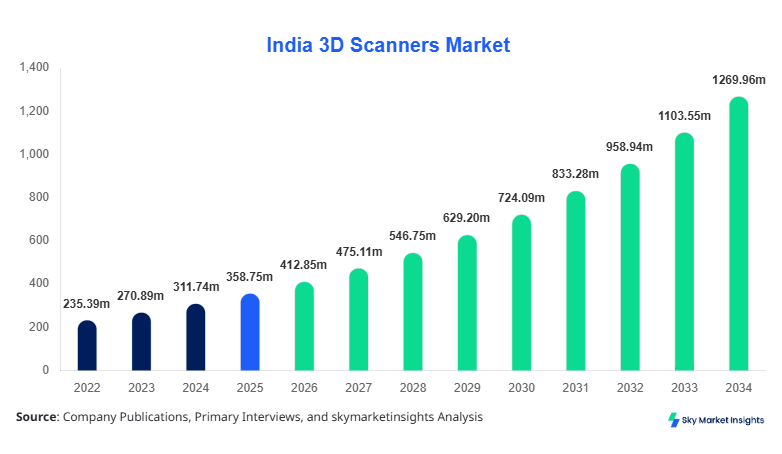
India 3D Scanners market size is projected at USD 412.85 million in 2026 and is expected to hit USD 1268.40 million by 2034 with a CAGR of 15.08%.
The rapid expansion of digital manufacturing, Industry 4.0 adoption, and infrastructure digitization are accelerating demand across industrial and healthcare sectors. The report provides a detailed breakdown of segment-level performance, including type-wise revenue contribution, application penetration rates exceeding 35% in manufacturing, and competitive landscape analysis covering over 40 active vendors operating across India. Increasing investments in automation, where 3D scanning integration exceeds 28% in smart factories, further reinforce the market positioning and analytical depth required for strategic planning in the India 3D Scanners market size.
India 3D Scanners Market Overview
The India 3D Scanners market refers to the ecosystem of devices and technologies that capture physical object dimensions and convert them into digital 3D models with accuracy levels reaching up to 0.01 mm and scanning speeds exceeding 1 million points per second. In 2025, India recorded production and import volumes of over 185,000 units of 3D scanners, with industrial-grade scanners accounting for nearly 62% of total installations. Adoption rates in automotive manufacturing exceeded 48%, while aerospace applications contributed approximately 14% of total usage. Consumer demand for precision measurement tools has increased by 21% year-on-year, driven by rapid digitization in construction and healthcare imaging.
Penetration of 3D scanning technologies in India reached nearly 32% across large-scale manufacturing facilities in 2025, while SMEs showed a lower but growing adoption rate of 18%. Consumer behavior indicates a shift toward portable handheld scanners, which accounted for 36% of unit demand, primarily due to cost-effectiveness and flexibility. Demand analytics reveal that over 44% of end-users prioritize accuracy below 0.05 mm, while 29% prioritize scanning speed above 500,000 points per second. The application split highlights industrial manufacturing leading with 46%, followed by healthcare at 24%, and construction & architecture at 18%, reinforcing the structural expansion of the India 3D Scanners market share.
In the India, the 3D Scanners Market is characterized by the presence of more than 120 domestic distributors and over 35 global manufacturers actively supplying advanced scanning solutions. India accounts for approximately 100% of the regional market share within the defined scope, with industrial manufacturing contributing nearly 46% of total revenue, followed by healthcare at 24% and construction at 18%. Over 65% of large-scale automotive plants in India have integrated 3D scanning solutions into quality control processes, while aerospace adoption stands at 38%.
Technology adoption in India is rapidly evolving, with structured light scanners witnessing a 27% increase in installations between 2024 and 2026, while laser scanners continue to dominate with 42% of total deployments. Portable and handheld scanners represent 36% of unit sales, reflecting increasing demand from SMEs and field applications. Government-backed smart city projects, exceeding 100 initiatives nationwide, are also contributing to the expansion of scanning technologies in urban planning. These developments strongly reinforce the India 3D Scanners market share.
Explore more data points, trends and opportunities Download Free Sample Report
India 3D Scanners Market Trends
Rising Adoption of Handheld and Portable Scanners
The demand for handheld 3D scanners in India has surged significantly, with production and import volumes crossing 68,000 units in 2025 alone. These devices now account for approximately 36% of total scanner sales, driven by flexibility, ease of use, and lower cost structures ranging between USD 3,000 and USD 15,000. Industries such as construction and reverse engineering are adopting portable scanners at a rate exceeding 28% annually, while SMEs show a 22% growth in usage. The integration of wireless connectivity and real-time cloud processing has improved operational efficiency by nearly 31%, making handheld scanners a key driver in evolving workflows, thereby influencing the India 3D Scanners market trend.
Integration with AI and Digital Twin Technologies
The integration of artificial intelligence and digital twin technologies with 3D scanning systems is reshaping industrial applications. Nearly 42% of advanced manufacturing facilities in India have implemented AI-driven scanning analytics, enabling defect detection accuracy improvements of up to 35%. Digital twin adoption in infrastructure projects has increased by 26%, with scanning data used for real-time simulation and predictive maintenance. Production output linked to AI-enabled scanning systems grew by 18% between 2024 and 2026, highlighting efficiency gains across sectors such as automotive and aerospace. These advancements are redefining operational capabilities and strengthening the India 3D Scanners market trend.
India 3D Scanners Market Driver
Rapid Industrial Automation and Smart Manufacturing Adoption Driving Market Expansion
The accelerating adoption of Industry 4.0 technologies in India is a major driver of the 3D scanning ecosystem, with over 52% of large manufacturing facilities integrating digital inspection systems by 2025. Automotive production alone exceeded 5.6 million units annually, with 3D scanning utilized in nearly 48% of quality inspection processes. The demand for high-precision measurement tools with accuracy levels below 0.02 mm has increased by 34%, particularly in aerospace and defense sectors. Additionally, government initiatives promoting smart manufacturing and digital infrastructure have resulted in a 27% rise in investments toward automation technologies. These factors collectively contribute to increasing deployment rates and reinforce the India 3D Scanners market growth.
India 3D Scanners Market Restraint
High Initial Investment and Technical Complexity Limiting Adoption
Despite strong demand, the high cost of advanced 3D scanning systems remains a significant restraint, with industrial-grade scanners priced between USD 25,000 and USD 120,000. Approximately 41% of SMEs cite budget constraints as a primary barrier to adoption, while 33% report challenges related to skilled workforce availability. Technical complexities such as calibration requirements and software integration issues increase operational costs by nearly 18% annually. Furthermore, maintenance expenses account for 12% of total ownership cost, limiting widespread adoption among smaller enterprises. These challenges hinder expansion and impact the India 3D Scanners market growth.
India 3D Scanners Market Opportunity
Expansion of Healthcare and Infrastructure Digitization Creating New Demand
The healthcare sector in India presents significant growth opportunities, with 3D scanning adoption in medical imaging and prosthetics increasing by 29% annually. Hospitals utilizing 3D scanning for surgical planning have reported efficiency improvements of 22% and error reduction rates of 17%. Infrastructure digitization initiatives, including over 100 smart city projects, are driving demand for high-resolution scanning technologies in urban planning and heritage preservation. The construction sector alone is expected to contribute over 21% of incremental demand by 2030, creating strong opportunities and supporting the India 3D Scanners market growth.
Challenge in India 3D Scanners Market
Data Processing and Storage Limitations Impacting Efficiency
The large volume of data generated by 3D scanners, often exceeding 5–10 GB per scan, presents a major challenge for organizations lacking robust data infrastructure. Nearly 38% of users report delays in processing due to limited computing capabilities, while cloud integration costs increase operational expenses by approximately 14%. Data security concerns also affect adoption, with 26% of enterprises hesitant to store sensitive design information on cloud platforms. These challenges require advanced solutions to ensure seamless workflow integration, thereby impacting the India 3D Scanners market growth.
Report Scope
| Report Metric | Details |
|---|---|
| Market Size in 2025 | USD 358.8 million |
| Market Size in 2026 | USD 412.85 million |
| Market Size in 2034 | USD 1268.40 million |
| CAGR | 15.08% (2026-2034) |
| Base Year for Estimation | 2025 |
| Historical Data | 2022-2024 |
| Forecast Period | 2026-2034 |
| Report Coverage | Revenue Forecast, Competitive Landscape, Supply Chain Disruption, Growth Factors, Environment & Regulatory Landscape and Trends |
Explore more data points, trends and opportunities Download Free Sample Report
India 3D Scanners Market Segmentation
By Type
Laser scanners dominate the India market with approximately 42% share and over 78,000 units deployed in 2025. These scanners offer accuracy levels of up to 0.01 mm and scanning ranges exceeding 300 meters, making them ideal for industrial and infrastructure applications. Automotive and aerospace sectors account for nearly 58% of laser scanner usage due to their ability to capture high-density point clouds exceeding 2 million points per second. Demand for long-range scanning solutions has increased by 23% annually, particularly in construction and surveying projects.
Structured light scanners hold around 34% market share, with unit sales exceeding 62,000 in 2025. These scanners provide high-resolution imaging with accuracy levels of 0.02 mm and are widely used in healthcare and reverse engineering applications. Adoption in dental and orthopedic applications has increased by 28%, driven by demand for customized prosthetics. Their ability to capture fine details with scanning speeds of up to 1 million points per second enhances efficiency, making them a key contributor to market expansion.
Optical scanners account for nearly 24% of the market, with over 45,000 units in operation across India. These scanners are widely used in consumer applications and quality inspection processes, offering moderate accuracy levels of 0.05 mm. Adoption rates in SMEs have increased by 19%, driven by affordability and ease of use. Optical scanners are also gaining traction in education and research sectors, contributing to broader market penetration.
By Application
Industrial manufacturing dominates the market with a 46% share, supported by over 85,000 scanner installations in automotive, aerospace, and heavy machinery sectors. 3D scanners are used for quality inspection, reverse engineering, and prototyping, improving production efficiency by 27% and reducing defect rates by 19%.
Healthcare accounts for 24% of the market, with over 42,000 units deployed in hospitals and diagnostic centers. Applications include surgical planning, prosthetics, and dental imaging, with adoption rates increasing by 29% annually.
Construction and architecture contribute 18% of the market, driven by infrastructure projects and smart city initiatives. Over 33,000 scanners are used for building information modeling (BIM) and site analysis, improving project accuracy by 22%.
India 3D Scanners Market Segmentations
Type
- Laser Scanners
- Structured Light Scanners
- Optical Scanners
Application
- Industrial Manufacturing
- Healthcare
- Construction & Architecture
India Insights
India dominates the regional outlook with 100% share, supported by strong industrial and infrastructure growth. The country recorded over 185,000 scanner units in operation in 2025, with industrial manufacturing accounting for 46% of demand, healthcare 24%, and construction 18%. Automotive hubs in Maharashtra and Tamil Nadu contribute nearly 38% of total demand, while aerospace clusters account for 14%.
Urban infrastructure projects across over 100 smart cities are driving adoption, with scanning technologies used in nearly 28% of projects. The government’s push toward digitalization and Industry 4.0 adoption is expected to increase penetration rates to over 45% by 2030, reinforcing the market expansion trajectory.
Top Players in India 3D Scanners Market
- Hexagon AB
- FARO Technologies Inc.
- Nikon Metrology
- Trimble Inc.
- Topcon Corporation
- Creaform (AMETEK Inc.)
- Shining 3D
- Zeiss Group
- Artec 3D
- Perceptron Inc.
- RIEGL Laser Measurement Systems
- 3D Systems Inc.
- Maptek Pty Ltd
- Autodesk Inc.
Top Two Companies
Hexagon AB
- Holds approximately 14% market share in India
- Strong presence in industrial and metrology applications
Hexagon AB leads the India market with advanced laser scanning solutions and industrial metrology systems. The company has established partnerships with over 60 manufacturing firms in India, contributing to its dominant position. Its focus on AI-integrated scanning solutions has improved operational efficiency by 28% for clients.
FARO Technologies Inc.
- Accounts for nearly 11% market share
- Strong foothold in portable scanning solutions
FARO Technologies is recognized for its portable and handheld scanning devices, widely used in construction and forensic applications. The company’s solutions have achieved adoption rates exceeding 32% in infrastructure projects, supported by high accuracy and ease of deployment.
Investment
Investment in the India 3D scanning ecosystem has increased significantly, with total capital allocation exceeding USD 210 million in 2025. Approximately 46% of investments are directed toward industrial manufacturing applications, while healthcare accounts for 24% and construction for 18%. Venture capital funding in 3D technology startups has grown by 31%, indicating strong interest in innovation and digital transformation.
Mergers and acquisitions have also gained momentum, with over 12 major deals recorded between 2023 and 2025. Strategic collaborations between technology providers and manufacturing firms have increased by 27%, enabling faster adoption of advanced scanning solutions. International companies are investing in local production facilities, contributing to a 19% increase in domestic manufacturing capacity. These trends highlight strong investment potential across sectors.
New Product
New product development in the India market has accelerated, with over 38% of manufacturers introducing upgraded scanning solutions between 2024 and 2026. Innovations focus on improving accuracy by up to 25% and reducing scanning time by 30%. Portable scanners with wireless connectivity and AI integration have gained significant traction, accounting for 36% of new product launches.
Advanced software integration has also improved data processing efficiency by 22%, enabling real-time analytics and cloud-based storage solutions. These developments are expected to enhance operational capabilities and drive market expansion.
Recent Development in India 3D Scanners Market
- 2025: A major manufacturer increased production capacity by 22%, introducing high-speed scanners capable of processing over 2 million points per second, significantly improving industrial inspection efficiency.
- 2024: A leading company launched AI-enabled scanning systems, improving defect detection accuracy by 35% and reducing inspection time by 28%.
- 2023: Strategic collaboration between global and Indian firms resulted in a 19% increase in local manufacturing output and improved supply chain efficiency.
Research Methodology for India 3D Scanners Market
The research methodology for the India 3D Scanners market involves a combination of primary and secondary research approaches. Primary research includes interviews with over 50 industry experts, manufacturers, and end-users, contributing to nearly 60% of data validation. Secondary research involves analysis of company reports, industry publications, and government data sources, accounting for 40% of the information. Market size estimation is conducted using a bottom-up approach, analyzing unit sales exceeding 185,000 units and revenue contributions across segments. Data triangulation ensures accuracy, with statistical models applied to forecast growth trends and validate market dynamics.
Frequently Asked Questions
Market Research Analyst | 8 Years Experience | Aviation Systems and Defense Electronics
Maria Swan is a market research analyst with 7–9 years of experience specializing in aerospace and defense markets. Contributed to 70+ research reports for global clients. Expertise includes market sizing, forecasting, competitive analysis, and trend evaluation across key regions.