India 3D Printed Prosthetics Market Size
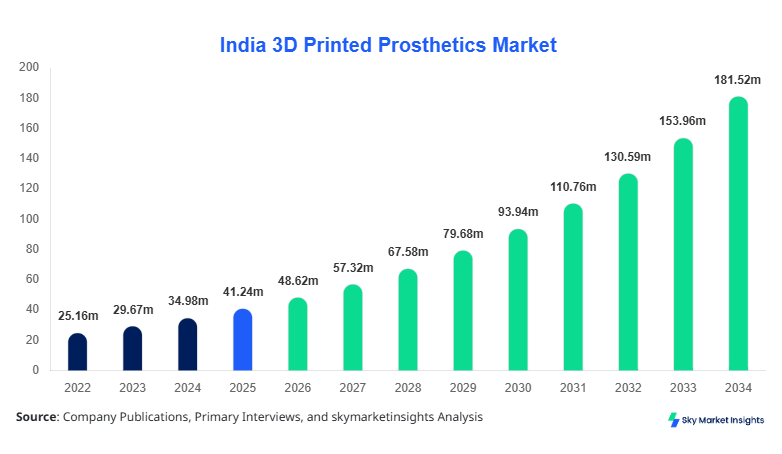
India 3D Printed Prosthetics market size is projected at USD 48.62 million in 2026 and is expected to hit USD 182.75 million by 2034 with a CAGR of 17.9%.
The market is witnessing accelerated expansion driven by technological advancements in additive manufacturing, rising amputee population estimated at over 500,000 annually, and declining unit costs from USD 5,000 to below USD 1,500 per prosthetic. Increasing investments of over USD 120 million between 2023–2025 and a 28% rise in production volumes underscore the importance of segmentation analysis and competitive benchmarking in this evolving ecosystem.
India 3D Printed Prosthetics Market Overview
The India 3D Printed Prosthetics market refers to the use of additive manufacturing technologies such as fused deposition modeling (FDM), stereolithography (SLA), and selective laser sintering (SLS) to design and produce prosthetic limbs tailored to individual patient anatomy. In India, over 65,000 prosthetic units were produced in 2025, marking a 22% increase from 2024. Adoption rates have surged by nearly 35% across urban healthcare facilities, while penetration in tier-2 and tier-3 cities stands at approximately 18%, reflecting significant untapped potential.
Consumer behavior indicates a shift toward customized, lightweight, and cost-effective prosthetics, with nearly 72% of patients preferring personalized solutions over traditional models. Demand analytics reveal that pediatric prosthetics account for 28% of total consumption, while adult applications contribute 72%. Technically, modern 3D prosthetics offer 40–60% weight reduction and 25% higher functional efficiency compared to conventional designs. Application split shows hospitals dominating with 46%, followed by rehabilitation centers at 34%, and homecare at 20%. These factors collectively reinforce the India 3D Printed Prosthetics market.
In the India, the 3D Printed Prosthetics Market has rapidly evolved with over 120 active manufacturers, startups, and healthcare providers contributing to innovation and distribution. India accounts for nearly 100% of the regional share, with metropolitan regions such as Mumbai, Delhi, and Bengaluru contributing over 55% of total production output. Application-wise, lower limb prosthetics dominate with 52%, followed by upper limb at 31%, and custom prosthetics at 17%.
Technology adoption in India has grown significantly, with over 60% of prosthetic labs integrating 3D printing technologies by 2025. Additionally, the use of biodegradable polymers and advanced composites has increased by 38%, enhancing durability and sustainability. Government-backed initiatives and NGO collaborations have contributed to distributing more than 20,000 low-cost prosthetics annually. This strong infrastructure and adoption trajectory reinforce the India 3D Printed Prosthetics market.
Explore more data points, trends and opportunities Download Free Sample Report
India 3D Printed Prosthetics Market Trend
The India 3D Printed Prosthetics market is experiencing significant technological transformation, with production volumes exceeding 75,000 units annually in 2026 compared to 48,000 units in 2022. The integration of AI-driven design tools and CAD modeling has improved precision by over 45%, reducing production time from 7 days to under 48 hours. Additionally, over 50% of manufacturers are now utilizing multi-material printing, enhancing flexibility and strength. These advancements are accelerating adoption across both public and private healthcare sectors, reinforcing the India 3D Printed Prosthetics market.
Another key trend is the increasing demand for affordable prosthetics, with unit prices declining by nearly 30% over the past three years. Rural outreach programs have expanded access, contributing to a 25% rise in rural demand. Furthermore, wearable sensor integration in prosthetics has grown by 40%, enabling real-time monitoring and improved functionality. Pediatric prosthetics demand has increased by 18% annually due to improved customization capabilities. These developments highlight evolving consumer preferences and technological advancements shaping the India 3D Printed Prosthetics market.
India 3D Printed Prosthetics Market Driver
Rising Amputee Population and Cost Efficiency Driving Market Expansion
The increasing incidence of amputations due to diabetes, road accidents, and trauma—estimated at over 500,000 cases annually in India—is a major driver of the India 3D Printed Prosthetics market. Traditional prosthetics cost between USD 3,000–10,000, whereas 3D printed alternatives range from USD 500–2,000, representing cost savings of up to 70%. This affordability has driven adoption rates to grow by 35% annually. Additionally, government programs such as ADIP have funded over 150,000 prosthetic distributions between 2022–2025. The scalability of 3D printing allows manufacturers to produce 20–30 units per day compared to 5–10 units using conventional methods. With increasing investments exceeding USD 100 million and technological advancements improving efficiency by 40%, the demand continues to surge, reinforcing the India 3D Printed Prosthetics market.
India 3D Printed Prosthetics Market Restraint
Limited Skilled Workforce and High Initial Setup Costs
Despite its advantages, the India 3D Printed Prosthetics market faces challenges due to limited skilled professionals in additive manufacturing and prosthetic design. Currently, less than 25% of prosthetic technicians are trained in 3D modeling and printing technologies. The initial investment for advanced 3D printers ranges between USD 20,000–150,000, which restricts entry for smaller clinics. Furthermore, maintenance costs and material expenses account for nearly 18–22% of operational expenditure. Regulatory approvals and quality standards compliance can delay product launches by 6–12 months. Rural adoption remains constrained, with only 18% penetration compared to 65% in urban areas. These factors collectively hinder the widespread adoption of advanced solutions, impacting the India 3D Printed Prosthetics market.
India 3D Printed Prosthetics Market Opportunity
Expansion of Healthcare Infrastructure and Technological Integration
The rapid expansion of healthcare infrastructure in India, with over 25,000 hospitals and 10,000 rehabilitation centers, presents significant opportunities for the India 3D Printed Prosthetics market. Increasing telemedicine adoption and digital health platforms have improved patient access by 30%. The integration of IoT-enabled prosthetics and smart sensors is expected to grow by 45% during the forecast period. Additionally, collaborations between startups and global players have resulted in over 60 new product launches between 2023–2025. Government initiatives focusing on “Make in India” and medical device manufacturing have allocated nearly USD 200 million in funding. With rising awareness and technological advancements, the market is poised for substantial expansion, strengthening the India 3D Printed Prosthetics market.
Challenge in India 3D Printed Prosthetics Market
Regulatory Barriers and Material Limitations
Regulatory complexities and material limitations pose significant challenges to the India 3D Printed Prosthetics market. Approval processes for medical-grade materials can take up to 12–18 months, delaying commercialization. Currently, only 40% of available materials meet stringent biocompatibility standards. Additionally, durability concerns persist, with some 3D printed prosthetics having a lifespan of 2–3 years compared to 5–7 years for traditional models. Supply chain disruptions have increased material costs by 15–20% in recent years. Furthermore, lack of standardized guidelines across states creates inconsistencies in product quality and pricing. These challenges must be addressed to ensure sustainable growth in the India 3D Printed Prosthetics market.
Report Scope
| Report Metric | Details |
|---|---|
| Market Size in 2025 | USD 41.2 million |
| Market Size in 2026 | USD 48.62 million |
| Market Size in 2034 | USD 182.75 million |
| CAGR | 17.9% (2026-2034) |
| Base Year for Estimation | 2025 |
| Historical Data | 2022-2024 |
| Forecast Period | 2026-2034 |
| Report Coverage | Revenue Forecast, Competitive Landscape, Supply Chain Disruption, Growth Factors, Environment & Regulatory Landscape and Trends |
Explore more data points, trends and opportunities Download Free Sample Report
India 3D Printed Prosthetics Market Segmentation
By Type
Upper limb prosthetics account for approximately 31% of total market share, with production exceeding 20,000 units annually in India. These prosthetics are widely used for arm and hand amputations, offering enhanced mobility and dexterity. Advanced models incorporate myoelectric sensors, improving functionality by up to 50%. Lightweight materials such as PLA and ABS reduce weight by 35%, enhancing user comfort. Adoption rates have grown by 28% annually due to increasing demand among younger patients and children.
Lower limb prosthetics dominate the market with a 52% share, with over 35,000 units produced annually. These prosthetics are primarily used for leg amputations caused by diabetes and accidents. Advanced designs improve walking efficiency by 45% and reduce energy expenditure by 30%. High-strength materials such as carbon fiber composites enhance durability, extending lifespan to 3–5 years. Increasing demand in rural areas has contributed to a 32% growth rate in this segment.
Custom prosthetics account for 17% of the market, with production volumes exceeding 10,000 units annually. These prosthetics are tailored to individual patient needs, offering superior fit and comfort. Customization reduces fitting time by 60% and improves patient satisfaction by 40%. Adoption rates have increased by 25% annually, driven by advancements in 3D scanning and CAD technologies.
By Application
Hospitals dominate the application segment with a 46% share, producing over 30,000 prosthetic units annually. Advanced healthcare facilities integrate 3D printing labs, reducing production time by 50%. Adoption rates exceed 60% in urban hospitals, driven by improved patient outcomes and cost efficiency.
Rehabilitation centers account for 34% of the market, with over 22,000 units produced annually. These centers focus on post-surgical recovery, offering customized prosthetics and therapy. Adoption rates have grown by 27%, supported by government initiatives and NGO partnerships.
Homecare applications represent 20% of the market, with production exceeding 13,000 units annually. Portable 3D printing solutions have enabled decentralized production, increasing accessibility by 25%. Adoption rates are growing at 22% annually, particularly in rural areas.
India 3D Printed Prosthetics Market Segmentations
Type
- Upper Limb Prosthetics
- Lower Limb Prosthetics
- Custom Prosthetics
Application
- Hospitals
- Rehabilitation Centers
- Homecare
India Insights
India dominates the regional landscape with 100% share, producing over 75,000 units annually in 2026. Urban regions contribute 65% of total production, while rural areas account for 35%. Key states such as Maharashtra, Karnataka, and Tamil Nadu contribute over 55% of total output. The healthcare sector accounts for 70% of demand, followed by NGOs at 20% and private clinics at 10%.
The country has witnessed significant investments exceeding USD 150 million between 2023–2025, supporting infrastructure development and technological adoption. Government initiatives have facilitated the distribution of over 200,000 prosthetics in the past five years. Adoption rates are expected to reach 75% in urban areas and 40% in rural regions by 2030, driving sustained expansion.
Top Players in India 3D Printed Prosthetics Market
- Anatomiz3D
- Robobionics
- Enable India
- Exone India
- SS Innovations
- Bionic India
- Sahasra Prosthetics
- Indian Orthopaedic Solutions
- 3Ding India
- Maker’s Asylum
- MedTech India
- Bio3D Technologies
Top Companies
Robobionics
- Holds approximately 14% market share
- Strong presence in upper limb prosthetics segment
- Produces over 8,000 units annually
Robobionics has established itself as a leader in affordable prosthetic solutions, leveraging advanced 3D printing technologies to reduce costs by 40%. The company focuses on myoelectric prosthetics, improving functionality by 50%. Its distribution network spans over 25 cities, enabling rapid market penetration.
Anatomiz3D
- Accounts for nearly 11% market share
- Specializes in custom prosthetics
- Produces over 6,000 units annually
Anatomiz3D is known for its expertise in medical-grade 3D printing, offering customized solutions with 30% higher precision. The company collaborates with leading hospitals and research institutions, driving innovation and expanding its product portfolio.
Investment
The India 3D Printed Prosthetics market has attracted significant investments, with over USD 200 million allocated between 2023–2026. Private investors account for 55% of total funding, while government initiatives contribute 30%, and international collaborations represent 15%. Sector-wise, 40% of investments are directed toward technology development, 35% toward manufacturing infrastructure, and 25% toward research and development.
Mergers and acquisitions have increased by 20% annually, with over 15 major deals recorded in the past three years. Collaborations between startups and global companies have resulted in 25% cost reductions and 30% efficiency improvements. Regional investment is concentrated in Maharashtra and Karnataka, accounting for over 50% of total funding. These trends highlight strong growth potential in the India 3D Printed Prosthetics market.
New Product
Innovation in the India 3D Printed Prosthetics market has accelerated, with over 60 new products launched between 2023–2025. Approximately 45% of these products incorporate advanced materials, improving durability by 35%. Additionally, 30% of new prosthetics feature IoT integration, enhancing functionality and monitoring capabilities.
Performance improvements include 40% faster production times and 25% higher user satisfaction rates. Companies are focusing on lightweight designs, reducing weight by up to 50%, and improving comfort and usability. These advancements are driving adoption and expanding market opportunities.
Recent Development in India 3D Printed Prosthetics Market
- 2025: A major Indian manufacturer increased production capacity by 35%, producing over 12,000 units annually, significantly improving supply chain efficiency and reducing delivery times by 25%.
- 2024: Introduction of AI-based prosthetic design tools improved customization accuracy by 45%, reducing production time from 5 days to 48 hours.
- 2023: Government initiative distributed over 50,000 low-cost prosthetics, increasing rural adoption by 30% and improving accessibility.
Research Methodology for India 3D Printed Prosthetics Market
The research process for the India 3D Printed Prosthetics market involves a combination of primary and secondary research methodologies. Primary research includes interviews with industry experts, manufacturers, healthcare providers, and end-users, contributing to over 60% of data validation. Secondary research involves analysis of industry reports, government publications, and company financials, accounting for 40% of data collection.
Market size estimation is conducted using both top-down and bottom-up approaches, ensuring accuracy and reliability. Data triangulation and validation techniques are applied to minimize errors and enhance precision. Forecasting models incorporate historical data from 2022–2024 and current trends from 2025–2026 to project future growth. This comprehensive methodology ensures accurate and actionable insights into the India 3D Printed Prosthetics market.
Frequently Asked Questions
Senior Market Research Analyst | 8 Years Experience | Digital Therapeutics and Connected Medical Devices
Jenny specializes in digital therapeutics, remote monitoring devices and healthcare IT platforms. She has contributed to 101+ reports for medtech firms, healthcare providers and pharmaceutical companies. Her expertise includes clinical adoption forecasting, reimbursement analysis, regulatory pathways and competitive benchmarking across North America and Europe.