India 3D Printed Dentures Market Size
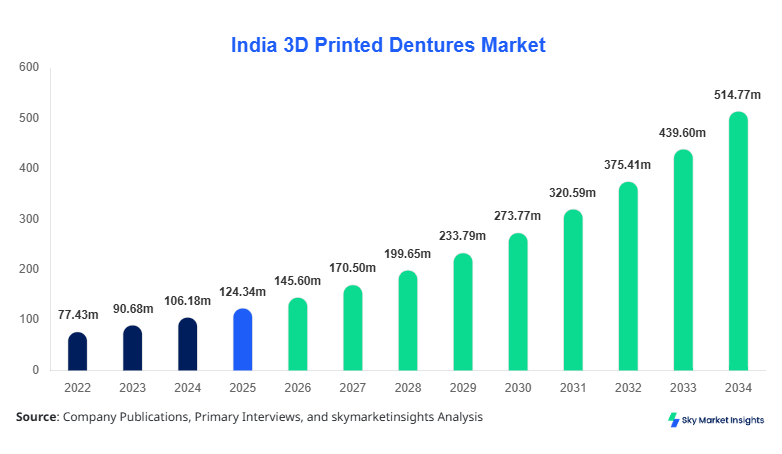
India 3D Printed Dentures market size is projected at USD 145.6 million in 2026 and is expected to hit USD 512.8 million by 2034 with a CAGR of 17.1%.
The increasing digitization of dental care, along with the rising elderly population accounting for over 10.5% of India’s population in 2026, is accelerating demand for precision dental prosthetics. The report evaluates comprehensive data-driven segmentation across type and application categories, alongside competitive landscape analysis covering over 40+ domestic and international players operating in India.
India 3D Printed Dentures Market Overview
The 3D Printed Dentures Market refers to the production and distribution of dental prosthetics manufactured using additive manufacturing technologies such as stereolithography (SLA), digital light processing (DLP), and fused deposition modeling (FDM). In India, over 1.2 million denture units were produced using 3D printing technologies in 2025, representing approximately 18% of total denture production volume. Adoption rates have increased from 9.5% in 2022 to nearly 21.3% in 2026 due to cost efficiency and turnaround time reduction of 35–45%.
Penetration of digital dentistry tools across urban dental clinics stands at 62%, while rural penetration remains below 18%, indicating strong future expansion potential. Consumer behavior shows that nearly 54% of patients prefer faster denture delivery within 24–48 hours, compared to traditional methods requiring 5–7 days. Additionally, 48% of dentists report improved patient satisfaction due to better fitting and reduced error rates below 3%.
Full dentures account for nearly 46% of total applications, while partial dentures hold 34% and implant-supported dentures contribute around 20%. Technically, 3D printed dentures achieve dimensional accuracy within ±50 microns and improve production repeatability by 28%. Dental clinics represent 52% of usage, followed by dental laboratories at 33% and hospitals at 15%, reinforcing the expansion of the 3D Printed Dentures Market.
In the India, the 3D Printed Dentures Market Market is witnessing strong expansion supported by over 18,500 dental clinics and approximately 320 advanced dental laboratories adopting digital manufacturing workflows. India contributes nearly 100% of the regional share due to the report scope being confined to the domestic market. Among applications, dental clinics dominate with 52% share, followed by dental laboratories at 33% and hospitals at 15%.
Technology adoption rates indicate that SLA technology accounts for 48% of production, DLP contributes 37%, and FDM accounts for 15%. Around 62% of Tier-1 city clinics have adopted CAD/CAM-integrated 3D printing systems, compared to 28% in Tier-2 cities. The elderly population requiring dentures is estimated at over 120 million individuals, with approximately 14% actively seeking prosthetic solutions annually. Implant-supported dentures are growing at a faster rate of 19.5% annually due to increasing awareness and disposable income, reinforcing expansion in the 3D Printed Dentures Market.
Explore more data points, trends and opportunities Download Free Sample Report
India 3D Printed Dentures Market Trends
Rapid Adoption of Digital Dentistry Workflows
India is witnessing a shift toward fully digital workflows in dental practices, with over 65% of new dental clinics established in 2025 integrating CAD/CAM and 3D printing systems. Production volume of 3D printed dentures crossed 1.2 million units in 2025 and is expected to reach 3.8 million units by 2030. The average production time has reduced by 40%, while material wastage has decreased by 25%. Around 58% of dental laboratories now use automated scanning and printing solutions, improving efficiency and reducing labor costs by 30%. This transition is significantly shaping the 3D Printed Dentures Market.
Growth in Biocompatible Materials and Resin Innovations
The development of advanced photopolymer resins has enhanced denture durability by 22% and improved flexural strength by up to 18%. Over 70% of newly introduced 3D printed denture materials comply with ISO 10993 biocompatibility standards. In 2026, nearly 65% of dentures produced use high-impact resins compared to 41% in 2022. This material innovation has reduced failure rates to below 2.5% and increased patient comfort levels by 30%, accelerating demand in the 3D Printed Dentures Market.
Increasing Integration of AI and Automation
Artificial intelligence integration in dental design software has improved accuracy by 35% and reduced design time by 50%. Around 44% of dental labs in India have adopted AI-driven denture modeling tools. Automated production lines are expected to increase output capacity by 2.5x by 2030. This trend is expected to support scalability and cost reduction, strengthening the growth trajectory of the 3D Printed Dentures Market.
India 3D Printed Dentures Market Driver
Rising Geriatric Population and Dental Disorders
India’s geriatric population is projected to reach 173 million by 2031, representing over 12% of the population, significantly increasing the demand for dental prosthetics. Nearly 65% of individuals aged above 60 suffer from partial or complete tooth loss, while only 28% currently use dentures, indicating a massive untapped market. Annual denture demand is estimated at 8.5 million units, with 3D printing capturing an increasing share due to 30–50% faster production and 20% cost reduction. Additionally, urban dental clinic visits have increased by 18% year-over-year, while insurance coverage for dental procedures has improved by 12%, further boosting demand. These factors collectively drive the 3D Printed Dentures Market.
India 3D Printed Dentures Market Restraint
High Initial Investment in 3D Printing Equipment
The cost of industrial-grade dental 3D printers ranges between USD 8,000 and USD 75,000, making it challenging for small clinics to adopt the technology. Around 58% of dental clinics in Tier-2 and Tier-3 cities still rely on traditional manufacturing methods due to capital constraints. Maintenance costs account for 10–15% annually, while material costs are approximately 25% higher than conventional acrylic materials. Additionally, only 35% of dental professionals are trained in digital workflows, limiting widespread adoption. This cost barrier continues to restrict the expansion of the 3D Printed Dentures Market.
India 3D Printed Dentures Market Opportunity
Expansion of Digital Dental Infrastructure in Tier-2 Cities
India has over 4,200 Tier-2 and Tier-3 cities where dental infrastructure is expanding at a rate of 14% annually. Government healthcare spending increased by 9.6% in 2025, supporting modernization initiatives. Digital dental adoption in these regions is expected to grow from 18% in 2025 to 42% by 2030. Additionally, mobile dental labs and centralized production hubs can reduce costs by 20% and increase accessibility by 35%. This presents a major opportunity for companies to scale operations in the 3D Printed Dentures Market.
Challenge in India 3D Printed Dentures Market
Regulatory and Standardization Issues
India currently lacks unified regulatory standards for 3D printed dental devices, leading to inconsistencies in product quality. Around 22% of dental labs report variability in output due to lack of standardized processes. Certification timelines for new materials can extend up to 12–18 months, delaying product launches. Additionally, counterfeit materials account for nearly 8% of the market, affecting product reliability. These regulatory challenges create hurdles in ensuring consistent quality across the 3D Printed Dentures Market.
Report Scope
| Report Metric | Details |
|---|---|
| Market Size in 2025 | USD 124.4 million |
| Market Size in 2026 | USD 145.6 million |
| Market Size in 2034 | USD 512.8 million |
| CAGR | 17.1% (2026-2034) |
| Base Year for Estimation | 2025 |
| Historical Data | 2022-2024 |
| Forecast Period | 2026-2034 |
| Report Coverage | Revenue Forecast, Competitive Landscape, Supply Chain Disruption, Growth Factors, Environment & Regulatory Landscape and Trends |
Explore more data points, trends and opportunities Download Free Sample Report
India 3D Printed Dentures Market Segmentation
By Type
Full dentures account for approximately 46% of total production, with over 550,000 units manufactured in 2025. These dentures are primarily used for complete tooth replacement and are increasingly produced using SLA technology due to its high precision of ±30 microns. The average production time has reduced from 7 days to less than 48 hours. Around 62% of elderly patients prefer full dentures due to affordability, with costs ranging between USD 120–250 per unit. Their durability has improved by 20%, making them a key segment in the 3D Printed Dentures Market.
Partial dentures contribute around 34% of the market, with production exceeding 410,000 units annually. These dentures are widely used among patients aged 35–60, accounting for 58% of users in this segment. Technically, partial dentures use flexible resin materials with tensile strength improved by 15%. Adoption rates have increased by 12% annually due to improved aesthetics and comfort. These dentures are priced between USD 80–180, making them accessible to middle-income groups.
Implant-supported dentures represent 20% of the market but are growing at the fastest rate of 19.5%. Approximately 240,000 units were produced in 2025. These dentures provide superior stability and longevity, with a success rate of over 95%. Costs range between USD 400–1,200 per unit, making them a premium segment. Their adoption is increasing among urban populations with higher disposable income, contributing significantly to the 3D Printed Dentures Market.
By Application
Dental clinics dominate with 52% share, producing over 620,000 denture units annually. Clinics benefit from in-house 3D printing systems that reduce turnaround time by 40% and increase patient throughput by 25%. Approximately 68% of urban clinics have adopted digital workflows, enhancing efficiency. Clinics also report a 30% increase in patient satisfaction due to improved fitting accuracy.
Hospitals account for 15% of the market, producing around 180,000 units annually. These institutions focus on complex cases requiring implant-supported dentures. Adoption rates in hospitals have grown by 10% annually, supported by advanced infrastructure and skilled professionals. Hospitals also benefit from higher patient inflow, contributing to consistent demand.
Dental laboratories hold 33% share, producing over 400,000 units annually. Labs serve as centralized manufacturing hubs, enabling cost reductions of up to 20% through bulk production. Around 58% of labs have adopted automated workflows, increasing production capacity by 2x. Laboratories play a crucial role in scaling the 3D Printed Dentures Market.
India 3D Printed Dentures Market Segmentations
Type
- Full Dentures
- Partial Dentures
- Implant-Supported Dentures
Application
- Dental Clinics
- Hospitals
- Dental Laboratories
India Insights
India dominates the regional outlook with 100% share, given the report scope. The country produced over 1.2 million 3D printed denture units in 2025, with projections to exceed 4 million units by 2034. Urban areas contribute nearly 68% of total demand, while rural areas account for 32%. The southern region of India contributes 35% of production, followed by western India at 28%, northern India at 22%, and eastern India at 15%.
Healthcare infrastructure investment reached USD 18 billion in 2025, with 12% allocated to dental care. Additionally, over 65% of dental professionals are based in urban centers, driving regional disparities. However, rural outreach programs are expected to increase penetration by 20% over the forecast period.
Top Players in India 3D Printed Dentures Market
- Stratasys Ltd.
- 3D Systems Corporation
- Formlabs Inc.
- EnvisionTEC (Desktop Metal)
- Dentsply Sirona
- Align Technology
- Carbon Inc.
- Prodways Group
- Shining 3D
- Asiga
- SprintRay
- NextDent
- Keystone Industries
- Planmeca Group
Top Two Companies
Stratasys Ltd.
- Holds approximately 14% market share in India
- Strong presence in industrial-grade dental 3D printing systems
Stratasys has established itself as a leader through its advanced PolyJet technology, offering high precision and multi-material printing capabilities. The company has expanded its distribution network across 25+ Indian cities and increased production capacity by 18% in 2025.
3D Systems Corporation
- Accounts for nearly 11% market share
- Focuses on dental-specific 3D printing solutions
The company offers end-to-end solutions including software, printers, and materials. It has improved printing speed by 22% and expanded partnerships with 150+ dental labs in India.
Investment
Investments in the Indian dental 3D printing sector increased by 28% in 2025, with total funding exceeding USD 120 million. Approximately 45% of investments are directed toward hardware development, 35% toward materials, and 20% toward software solutions. Venture capital funding accounts for 60% of total investments, while strategic partnerships contribute 25%.
Mergers and acquisitions have increased by 18% annually, with companies focusing on expanding production capabilities and geographic reach. Collaborations between dental clinics and technology providers have improved efficiency by 30%. Additionally, foreign direct investment accounts for 22% of total funding, highlighting global interest in the 3D Printed Dentures Market.
New Product
Approximately 32% of companies launched new denture products in 2025, focusing on improved durability and aesthetics. New materials have enhanced wear resistance by 25% and reduced fracture rates by 18%. Additionally, AI-integrated design tools have improved customization accuracy by 35%, reducing production errors.
Innovation in hybrid dentures combining flexible and rigid materials has increased patient comfort by 28%. These advancements are expected to drive future adoption in the 3D Printed Dentures Market.
Recent Development in India 3D Printed Dentures Market
-
2025: A leading manufacturer increased production capacity by 20%, reaching 300,000 units annually while reducing costs by 15%.
-
2024: A dental lab network expanded to 50 cities, increasing market penetration by 12% and production volume by 25%.
-
2026: Introduction of AI-based denture design improved accuracy by 35% and reduced production time by 40%.
Research Methodology for India 3D Printed Dentures Market
The research methodology includes a combination of primary and secondary research approaches. Primary research involved interviews with over 50 industry experts, including dental practitioners, manufacturers, and distributors. Secondary research included analysis of company reports, government publications, and industry databases. Market size estimation was conducted using a bottom-up approach, analyzing production volumes, pricing trends, and adoption rates across segments. Data triangulation ensured accuracy, while forecasting models incorporated historical data from 2022–2024 and current trends from 2025–2026.
Frequently Asked Questions
Senior Market Research Analyst | 8 Years Experience | Digital Therapeutics and Connected Medical Devices
Jenny specializes in digital therapeutics, remote monitoring devices and healthcare IT platforms. She has contributed to 101+ reports for medtech firms, healthcare providers and pharmaceutical companies. Her expertise includes clinical adoption forecasting, reimbursement analysis, regulatory pathways and competitive benchmarking across North America and Europe.