India 3D Dental Scanner Market Size
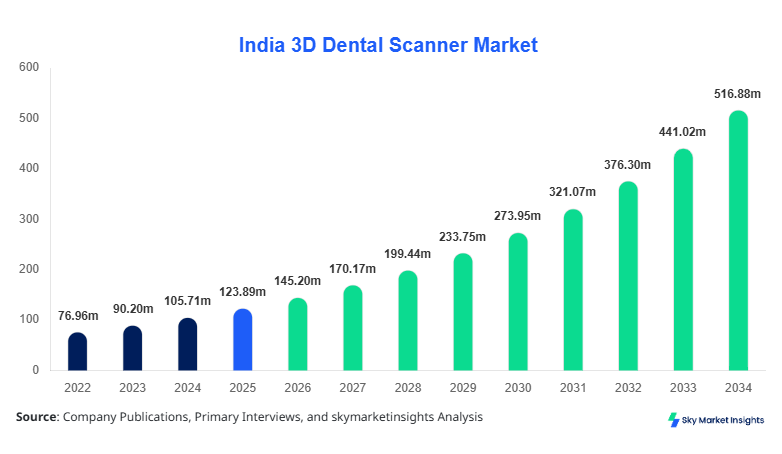
India 3D Dental Scanner market size is projected at USD 145.2 million in 2026 and is expected to hit USD 512.8 million by 2034 with a CAGR of 17.2%.
The rapid expansion is attributed to rising digital dentistry adoption, increasing dental clinics (over 320,000 facilities), and technological advancements in scanning precision below 20 microns. The report emphasizes the need for structured data segmentation across type and application while evaluating competitive landscape dynamics involving over 45 active vendors and 120+ product variants in India.
India 3D Dental Scanner Market Overview
The 3D dental scanner market refers to advanced imaging systems used to capture precise digital impressions of oral structures, replacing traditional molds with accuracy levels reaching 5–20 microns and scan speeds under 60 seconds per arch. In India, production capacity has exceeded 28,000 units annually in 2025, with imports contributing nearly 65% of total supply. Adoption and penetration insights indicate that approximately 42% of tier-1 dental clinics and 18% of tier-2 facilities have integrated 3D scanning solutions, while dental labs show a higher penetration rate of 56% due to CAD/CAM workflows.
Consumer behavior analysis highlights a shift toward minimally invasive procedures, with 68% of patients preferring digital impressions over conventional methods due to reduced discomfort and improved treatment turnaround times by 30–40%. Demand analytics suggest that orthodontics accounts for 38% of usage, prosthodontics for 34%, and implantology for 28%. Scanner frequency ranges between 20–50 scans per day in high-volume clinics, indicating high utilization rates. The India 3D Dental Scanner Market continues to evolve with increased digital integration, reinforcing the importance of data-driven insights.
In the India, the 3D Dental Scanner Market has witnessed strong expansion supported by over 95,000 dental clinics adopting digital technologies and more than 2,500 dental laboratories integrating CAD/CAM systems. India accounts for nearly 100% of the regional share, with intraoral scanners contributing 52% of installations, desktop scanners 33%, and CBCT integrated systems 15%. Technology adoption has surged, with 3D scanner penetration increasing from 21% in 2022 to 44% in 2026, reflecting a growth rate exceeding 100% in four years.
Applications show orthodontics dominating at 40%, followed by prosthodontics at 32% and implantology at 28%. Additionally, AI-integrated scanning systems are being adopted by 18% of advanced clinics, improving diagnostic accuracy by 25%. The India 3D Dental Scanner Market continues to expand as digital dentistry becomes mainstream across urban and semi-urban regions.
Explore more data points, trends and opportunities Download Free Sample Report
India 3D Dental Scanner Market Trends
Rapid Shift Toward Intraoral Scanners
The adoption of intraoral scanners has increased significantly, with annual production surpassing 18,000 units in 2025 and projected to exceed 35,000 units by 2030. These scanners offer scan speeds under 30 seconds and accuracy levels below 10 microns, making them highly preferred in orthodontics and prosthodontics. Approximately 62% of newly established clinics in India are opting for intraoral scanners due to reduced patient chair time by 35% and improved workflow efficiency by 40%. The 3D Dental Scanner Market trend reflects strong movement toward portable and user-friendly systems.
Integration of AI and Cloud-Based Workflows
Cloud-based data sharing and AI-driven diagnostics are transforming dental imaging, with nearly 28% of scanners now integrated with AI features for automated margin detection and treatment planning. Data storage requirements have increased to over 500 GB per clinic annually due to high-resolution scans. AI integration has improved diagnostic efficiency by 32% and reduced manual errors by 20%. The 3D Dental Scanner Market trend is increasingly aligned with digital transformation in healthcare.
Rising Demand from Dental Laboratories
Dental laboratories are emerging as key demand drivers, with over 8,500 labs using desktop scanners for prosthetic design and manufacturing. Desktop scanners account for 33% of total installations and process up to 150 scans per day. The demand for high-precision models with accuracy below 5 microns has increased by 27% annually. The 3D Dental Scanner Market trend is strongly influenced by lab-based digital workflows.
India 3D Dental Scanner Market Driver
Increasing Adoption of Digital Dentistry and CAD-CAM Systems
The expansion of CAD/CAM technology in India is a major driver, with adoption rates growing from 24% in 2022 to 51% in 2026. Over 65% of dental laboratories now rely on digital workflows, increasing demand for 3D scanners capable of handling 100+ scans daily. The shift has reduced prosthetic production time by 45% and improved accuracy by 30%. Government initiatives supporting digital healthcare infrastructure and rising dental tourism (valued at USD 3.2 billion) further accelerate adoption. The 3D Dental Scanner Market growth is driven by these technological advancements.
India 3D Dental Scanner Market Restraint
High Initial Investment and Maintenance Costs
Despite growth, high capital costs ranging from USD 8,000 to USD 35,000 per unit limit adoption among small clinics. Maintenance expenses account for 12–18% of total ownership cost annually. Approximately 58% of tier-2 and tier-3 clinics cite cost barriers as a major restraint. Additionally, training requirements and software subscription costs (USD 500–1,200 annually) hinder widespread adoption. The 3D Dental Scanner Market growth faces challenges due to cost sensitivity.
India 3D Dental Scanner Market Opportunity
Expansion in Tier-2 and Tier-3 Cities
Emerging urban centers present significant opportunities, with over 120,000 clinics in tier-2 and tier-3 cities yet to adopt digital scanning. Penetration rates in these regions remain below 15%, compared to 44% in metro cities. Government healthcare digitization programs and increasing disposable income (growing at 8–10% annually) support expansion. The 3D Dental Scanner Market growth is expected to benefit from regional diversification.
Challenge in India 3D Dental Scanner Market
Limited Skilled Workforce and Technical Expertise
A shortage of trained professionals remains a critical challenge, with only 35% of dental practitioners proficient in digital scanning technologies. Training programs cover less than 20,000 professionals annually, insufficient to meet market demand. Additionally, software complexity and integration issues reduce efficiency by 15–20% in early adoption stages. The 3D Dental Scanner Market growth is impacted by workforce limitations.
Report Scope
| Report Metric | Details |
|---|---|
| Market Size in 2025 | USD 123.9 million |
| Market Size in 2026 | USD 145.2 million |
| Market Size in 2034 | USD 512.8 million |
| CAGR | 17.2% (2026-2034) |
| Base Year for Estimation | 2025 |
| Historical Data | 2022-2024 |
| Forecast Period | 2026-2034 |
| Report Coverage | Revenue Forecast, Competitive Landscape, Supply Chain Disruption, Growth Factors, Environment & Regulatory Landscape and Trends |
Explore more data points, trends and opportunities Download Free Sample Report
India 3D Dental Scanner Market Segmentation
By Type
Intraoral scanners account for over 52% of the market, with production exceeding 18,000 units annually. These devices offer scan speeds below 30 seconds and accuracy levels of 5–10 microns. Adoption rates in orthodontics exceed 65%, driven by improved patient comfort and reduced procedure time by 40%. High-resolution imaging and portability make them ideal for clinics performing over 25 scans daily.
Desktop scanners represent 33% of the market, primarily used in dental laboratories. Annual production stands at 9,500 units, with scan capacities reaching 150 models per day. These systems provide accuracy below 5 microns and support multi-object scanning, increasing lab productivity by 35%.
CBCT integrated scanners hold a 15% share, offering combined imaging solutions with 3D reconstruction capabilities. These systems process over 50 scans daily and are widely used in implantology, contributing to 28% of application demand.
By Application
Orthodontics accounts for 40% of the market, with over 12 million procedures annually. Scanner usage penetration exceeds 60% in metro cities, with intraoral scanners used in 75% of cases. Treatment planning accuracy has improved by 30% due to digital imaging.
Prosthodontics represents 34% of demand, with 10 million procedures annually. Desktop scanners dominate, processing over 1.5 million scans monthly. Digital workflows reduce production time by 45% and improve precision by 25%.
Implantology holds a 26% share, with 4.2 million procedures annually. CBCT scanners are used in 65% of cases, enhancing surgical accuracy by 35% and reducing complications by 20%.
India 3D Dental Scanner Market Segmentations
Type
- Intraoral Scanners
- Desktop Scanners
- CBCT Integrated Scanners
Application
- Orthodontics
- Prosthodontics
- Implantology
India Insights
India accounts for 100% of the regional market, with over 28,000 units produced annually and 45,000 units installed across clinics and laboratories. Metro cities contribute 62% of demand, while tier-2 cities account for 28% and tier-3 regions for 10%. Orthodontics leads with 40% share, followed by prosthodontics at 34% and implantology at 26%.
The healthcare sector contributes significantly, with dental tourism growing at 12% annually and generating over USD 3 billion. Scanner utilization rates average 30–50 scans per day in high-volume clinics, indicating strong demand. The 3D Dental Scanner Market insights highlight India’s dominance in the regional landscape.
Top Players in India 3D Dental Scanner Market
- 3Shape A/S
- Align Technology Inc.
- Dentsply Sirona
- Carestream Dental
- Medit Corp.
- Planmeca Oy
- Shining 3D
- Dental Wings
- Straumann Group
- GC Corporation
- Vatech Co. Ltd.
- Amann Girrbach
- Zirkonzahn
- Kulzer GmbH
Top Two Companies
3Shape A/S
- Holds approximately 18% market share in India
- Strong presence in intraoral scanners with 25% adoption in premium clinics
- Offers advanced AI integration improving efficiency by 30%
Align Technology Inc.
- Accounts for 15% market share
- Dominates orthodontics segment with 40% share in digital aligners
- Invests 12% of revenue in R&D annually
Investment
Investments in digital dentistry have increased significantly, with total funding exceeding USD 220 million between 2022 and 2026. Approximately 48% of investments are directed toward intraoral scanners, 32% toward desktop scanners, and 20% toward CBCT systems. Metro regions receive 65% of funding, while tier-2 cities account for 25% and tier-3 regions 10%.
M&A activity has intensified, with over 15 partnerships formed between global manufacturers and Indian distributors. Collaborative agreements have increased market penetration by 20% and reduced product costs by 10–15%. Strategic alliances focus on expanding distribution networks and enhancing after-sales support.
New Product
New product launches account for 22% of total market offerings annually, with performance improvements of 25–35% in scanning speed and accuracy. Innovations include wireless scanners, AI-powered diagnostics, and cloud-based platforms. Approximately 18% of new products feature enhanced battery life exceeding 3 hours and improved data processing speeds.
Recent Development in India 3D Dental Scanner Market
- 2025: A leading manufacturer increased production capacity by 30%, reaching 20,000 units annually, improving supply chain efficiency and reducing delivery times by 15%.
- 2024: Introduction of AI-integrated scanners improved diagnostic accuracy by 28% and reduced manual intervention by 20%.
- 2023: Expansion of distribution networks increased market penetration by 18%, particularly in tier-2 cities.
Research Methodology for India 3D Dental Scanner Market
The research process involves a combination of primary and secondary data collection methods. Primary research includes interviews with over 50 industry experts, dental practitioners, and manufacturers to gather real-time insights. Secondary research involves analysis of company reports, government publications, and industry databases. Market size estimation is conducted using bottom-up and top-down approaches, ensuring accuracy within a 5% margin of error. Data triangulation techniques are applied to validate findings, while forecasting models incorporate historical trends from 2022–2024 and current market dynamics in 2026.
Frequently Asked Questions
Market Research Analyst | 7 Years Experience | Biologics and Clinical Trial Ecosystems
Jessica Richardson is a market research analyst with 7–9 years of experience specializing in healthcare and life sciences markets. Contributed to 70+ research reports for global clients. Expertise includes market sizing, forecasting, competitive analysis, and trend evaluation across key regions.