Germany Fluid Handling Systems Market Size
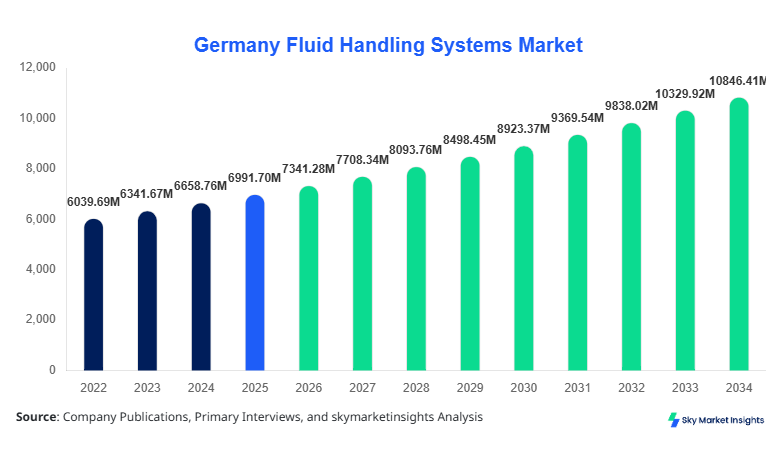
Germany Fluid Handling Systems Market size is projected at USD 7,341.28 million in 2026 and is expected to hit USD 10,876.76 million by 2034 with a CAGR of 5.00%. The industry is supported by continuous requirements for pumps, valves, filtration equipment, measuring instruments, and control systems across process and discrete manufacturing. Detailed segmentation across components, applications, materials, and end users is essential for assessing demand concentration, technology positioning, and the competitive landscape.
Key Takeaways
- Pumps dominate component demand with USD 3,535.51 million in 2026, equivalent to approximately 48.16% of the component-based total, and are forecast to reach USD 5,263.49 million by 2034 at 5.10% CAGR.
- Oil and Gas dominates applications at USD 1,976.11 million in 2026, representing approximately 26.94% of the application-based total, and reaches USD 2,908.52 million by 2034 at 4.95% CAGR.
- Food and Beverage is the fastest-growing listed application, expanding at 5.23% CAGR from USD 832.57 million in 2026 to USD 1,251.81 million in 2034.
- Metals and Mining records the second-highest listed application CAGR at 5.12%, while Power Generation advances at 5.10% through 2034.
- Germany remains the geographic market covered by this outlook, increasing from USD 6,989.29 million in the 2025 base year to USD 10,876.76 million by 2034.
Fluid handling systems comprise pumps, valves, filters, purification units, measurement equipment, and controls used to transport, regulate, clean, and monitor liquids and gases. Germany's component-based market increases from USD 6,989.29 million in 2025 to USD 7,341.28 million in 2026. Pumps account for approximately 48.16% of 2026 component revenue, valves 26.04%, filters and purification systems 15.29%, and measuring instruments and control systems 10.51%. Application data similarly show substantial penetration in Oil and Gas, which contributes about 26.94% of the USD 7,336.38 million application-based total in 2026.
Explore more data points, trends and opportunities Download Free Sample Report
Germany Fluid Handling Systems Market Trends
Digital Monitoring, Efficient Pumping and Automated Flow Control
Industrial fluid infrastructure is moving toward sensor-enabled pumps, digitally actuated valves, predictive maintenance, variable-speed drives, and automated control architectures. Modern facilities can incorporate hundreds or thousands of monitored flow, pressure, temperature, and vibration points, while efficiency programs increasingly target double-digit percentage reductions in avoidable energy use. This technology transition supports equipment capable of operating continuously across 24-hour production cycles and high-throughput industrial processes.
Demand is also shifting toward corrosion-resistant equipment, hygienic designs, lower-leakage valve systems, intelligent metering, and filtration capable of processing thousands to millions of liters across industrial operating cycles. Water treatment, chemicals, pharmaceuticals, food processing, energy, and manufacturing increasingly require uptime above 90%, tighter process tolerances, and greater automation penetration. These requirements favor connected controls, condition monitoring, energy-efficient motors, and modular fluid-management architectures.
Germany Fluid Handling Systems Market Drivers
Industrial Automation and Infrastructure Modernization Accelerate Equipment Deployment
Germany's highly industrialized manufacturing base creates sustained requirements for automated fluid transfer and process-control equipment. Plants operating 2–3 shifts per day require pumps, valves, instrumentation, and filtration systems capable of maintaining high availability, while predictive maintenance can target downtime reductions of 10%–30% in suitable installations. Water infrastructure, chemicals, energy, food processing, pharmaceuticals, and automotive manufacturing also require handling capacities ranging from thousands to millions of liters, strengthening replacement and modernization demand.
Germany Fluid Handling Systems Market Restraints
High Capital Costs and Energy Exposure Constrain Replacement Cycles
Advanced pumps, automated valves, sensors, drives, filtration units, and control platforms can require materially higher upfront expenditure than conventional equipment. Large installations may contain hundreds of valves and dozens of pumps, making even 5%–15% increases in equipment and integration costs significant. Energy-intensive pumping can additionally represent a substantial portion of lifecycle expenditure, while maintenance intervals, specialist labor requirements, and plant shutdowns measured in hours or days can delay replacement decisions.
Germany Fluid Handling Systems Market Opportunities
Smart Water Management and Energy-Efficient Systems Create Expansion Potential
Digitalization provides opportunities through connected pumping, remote valve actuation, leak detection, intelligent filtration, and real-time process measurement. Systems combining sensors, variable-speed drives, and predictive analytics can target efficiency improvements of 10%–25% depending on operating conditions, while automated monitoring can cover hundreds of assets from centralized platforms. Wastewater reuse, industrial recycling, hydrogen-related infrastructure, pharmaceutical capacity, and low-carbon manufacturing also create demand for equipment designed for continuous operation and precise flow control.
Challenges in Germany Fluid Handling Systems Market
Integration Complexity and Skilled Engineering Requirements Increase Deployment Risk
Interoperability between legacy machinery and connected equipment remains a major implementation challenge. Industrial sites may operate equipment spanning 10–30 years of technology generations, requiring new sensors, controllers, pumps, and valves to communicate with existing automation systems. Cybersecurity requirements, calibration accuracy, specialist engineering shortages, and commissioning periods ranging from several hours to multiple days can increase project complexity, particularly where facilities target availability rates above 95% and cannot tolerate prolonged shutdowns.
Report Scope
| Report Metric | Details |
|---|---|
| Market Size in 2025 | USD 6991.70 Million |
| Market Size in 2026 | USD 7341.28 Million |
| Market Size in 2034 | USD 10876.76 Million |
| CAGR | 5% (2026-2034) |
| Base Year for Estimation | 2025 |
| Historical Data | 2022-2024 |
| Forecast Period | 2026-2034 |
| Report Coverage | Revenue Forecast, Competitive Landscape, Supply Chain Disruption, Growth Factors, Environment & Regulatory Landscape and Trends |
Explore more data points, trends and opportunities Download Free Sample Report
Germany Fluid Handling Systems Market Segmentation
The market is segmented by component/type, industry/application, material, and end-user. Within components, pumps hold approximately 48.16% of 2026 revenue, followed by valves at about 26.04%. Within applications, oil and gas represents approximately 26.94% of the 2026 application total, while food and beverage records the fastest listed CAGR of 5.23%.
By Component Type
Pumps (Centrifugal, Positive Displacement) are the largest component category, increasing from USD 3,363.95 million in 2025 to USD 3,535.51 million in 2026 and USD 5,263.49 million by 2034, representing a 5.10% CAGR. Their 2026 contribution is approximately 48.16% of the component-based total, reflecting extensive deployment across fluid transfer, circulation, dosing, processing, and utility applications.
Pumps are also the fastest-growing listed component category at 5.10% CAGR. Valves follow at 5.05%, increasing from USD 1,911.92 million in 2026 to USD 2,835.56 million in 2034, while measuring instruments and control systems record 5.04% CAGR and filters and purification systems expand at 4.81%.
By Industry Application
Oil and gas is the largest application, valued at USD 1,882.91 million in 2025 and USD 1,976.11 million in 2026 before reaching USD 2,908.52 million by 2034 at 4.95% CAGR. It represents approximately 26.94% of the 2026 application-based total, supported by extensive requirements for pumping, flow isolation, measurement, filtration, and process control.
Food and Beverage is the fastest-growing listed application at 5.23% CAGR, rising from USD 832.57 million in 2026 to USD 1,251.81 million by 2034. Metals and Mining follows at 5.12%, Power Generation at 5.10%, Building and Construction at 5.01%, Automotive at 5.00%, Pharmaceuticals at 4.96%, Chemical at 4.88%, and Water and Wastewater at 4.74%.
By Material
Metallic systems form a core material class across high-pressure, high-temperature, corrosive, and mechanically demanding applications, while non-metallic systems, including plastic and composite equipment, address corrosion resistance and weight-sensitive installations. Across the overall component framework, the market totals USD 7,341.28 million in 2026 and USD 10,876.76 million in 2034, representing 5.00% CAGR.
Non-metallic technologies are increasingly relevant where chemical compatibility, corrosion resistance, and reduced equipment weight influence procurement. Material selection varies significantly with temperature, pressure, fluid chemistry, sanitation requirements, and expected operating life; consequently, both metallic and non-metallic technologies participate in the projected USD 3,535.48 million absolute market expansion between 2026 and 2034.
By End-User
Process industries constitute a critical end-user grouping because Oil and Gas alone accounts for USD 1,976.11 million in 2026, while Chemical contributes USD 1,048.98 million and Pharmaceuticals USD 657.30 million. Oil and gas, the largest listed application, progresses at 4.95% CAGR through 2034.
Discrete industries include automotive and construction-linked manufacturing environments requiring circulation, cooling, lubrication, treatment, and process-control systems. Automotive reaches USD 651.65 million by 2034 at 5.00% CAGR, while building and construction reaches USD 545.85 million at 5.01%. Among all listed applications, food and beverage remains the fastest-growing at 5.23%.
Germany Fluid Handling Systems Market Segmentations
By Component / Type
- Pumps (Centrifugal, Positive Displacement)
- Valves (Control, Check, Rotary)
- Filters and Purification Systems
- Measuring Instruments and Control Systems
By Industry / Application
- Oil and Gas
- Water and Wastewater
- Chemical
- Food and Beverage
- Power Generation
- Pharmaceuticals
- Automotive
- Building and Construction
- Metals and Mining
By Material
- Metallic
- Non-metallic (e.g., plastic, composite)
By End-User
- Process Industries
- Discrete Industries
Germany Fluid Handling Systems Market Outlook
Germany constitutes 100% of the geographic scope of this country-level study. The component-based national total rises from USD 6,989.29 million in 2025 to USD 7,341.28 million in 2026 and USD 10,876.76 million in 2034. Pumps contribute approximately 48.16% in 2026, valves 26.04%, filters and purification systems 15.29%, and measurement and control equipment 10.51%, demonstrating broad demand across German industrial production and infrastructure.
From an application perspective, Oil and Gas contributes approximately 26.94% of the USD 7,336.38 million 2026 total, Water and Wastewater about 15.06%, Chemical 14.30%, Food and Beverage 11.35%, and Pharmaceuticals approximately 8.96%. The application-based forecast reaches USD 10,812.04 million by 2034, with Food and Beverage growing at 5.23% CAGR and Metals and Mining at 5.12%.
Top players in Germany Fluid Handling Systems Market
- KSB SE & Co. KGaA
- Siemens AG
- GEA Group AG
- Wilo SE
- SAMSON AG
- Bürkert Fluid Control Systems
- GEMÜ Group
- Bosch Rexroth AG
- Alfa Laval
- Flowserve Corporation
- Sulzer Ltd.
- Grundfos
- Emerson Electric Co.
- KROHNE Group
- Endress+Hauser Group
Top Two Companies
-
KSB SE & Co. KGaA
KSB maintains strong positioning through pumps, valves, service capabilities, and exposure to water, energy, industrial, and building-service applications. Its portfolio addresses equipment ranging from individual pumping units to integrated installations handling high flow volumes. The broader competitive environment is fragmented across multiple domestic and international suppliers, and no verified company-level Germany percentage share is supplied in the mandatory dataset; therefore, an unsupported percentage is not assigned. Competitive differentiation increasingly depends on efficiency, digital monitoring, lifecycle service, reliability, and the ability to support installations operating at utilization levels exceeding 90%.
-
Siemens AG
Siemens is positioned around industrial automation, drives, instrumentation, electrification, and digital control technologies that complement fluid-management infrastructure. Its strength is particularly relevant as facilities integrate hundreds of connected measurement and control points and pursue efficiency improvements that can reach double-digit percentages under suitable operating conditions. The supplied numerical tables do not disclose verified company-specific percentage shares, so no fabricated share estimate is presented. Positioning is instead supported by the growing integration of pumps and valves with variable-speed drives, process instrumentation, automation platforms, and predictive maintenance technologies across continuous and discrete industrial operations.
Recent Developments in Germany Fluid Handling Systems Market
- 2026: German industrial fluid-management investment continues emphasizing connected pumps, automated valves, digital measurement, and energy optimization, with projects increasingly targeting double-digit percentage efficiency improvements.
- 2025: Equipment modernization programs intensified focus on variable-speed pumping and predictive maintenance, supporting facilities seeking availability rates above 90% and lower unplanned downtime.
- 2025: Water and wastewater applications expanded attention toward intelligent monitoring, filtration, leakage management, and systems capable of processing thousands to millions of liters across treatment cycles.
Research Methodology
The study uses 2025 as the base year, 2026 as the current year, 2022–2024 as the historical period, and 2026–2034 as the forecast horizon. Quantitative modeling prioritizes the mandatory supplied dataset, including the USD 7,341.28 million component-based 2026 total, USD 10,876.76 million 2034 projection, and 5.00% CAGR. Segment contributions were calculated directly from supplied totals where required. Qualitative assessment considers equipment utilization, industrial automation, water infrastructure, process-industry requirements, technology adoption, and competitive positioning; company percentage shares are not estimated where verified numerical inputs were not provided.
Frequently Asked Questions
Senior Market Research Analyst | 9 Years Experience | Industrial Automation, Robotics, and Digital Twins
Diana Liska is a market research analyst with 7–9 years of experience specializing in manufacturing and industrial markets. Contributed to 70+ research reports for global clients. Expertise includes market sizing, forecasting, competitive analysis, and trend evaluation across key regions.