Germany B2B Fuel Cards Market Size
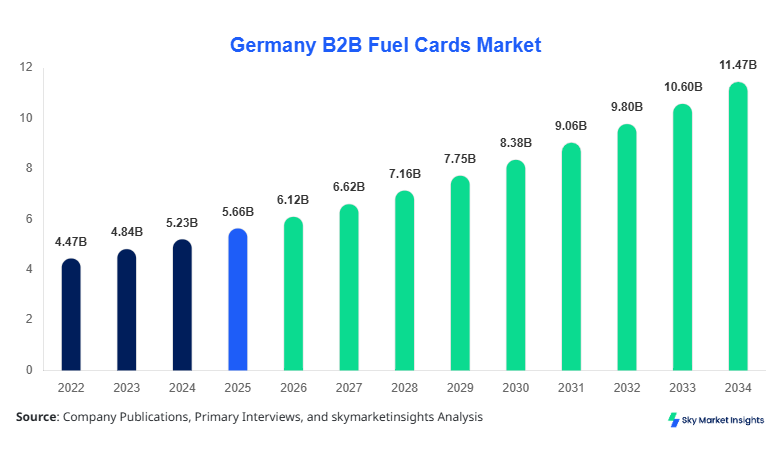
Germany's B2B fuel cards market size is projected at USD 6.12 billion in 2026 and is expected to hit USD 11.48 billion by 2034 with a CAGR of 8.17%. The German B2B fuel card market is increasingly driven by digitization across fleet operations, with over 3.6 million active commercial vehicles contributing to transaction volumes exceeding 2.4 billion fuel card transactions annually. The need for structured data analytics, cost monitoring systems, and real-time fuel tracking solutions is propelling adoption across SMEs and large enterprises. Additionally, segmentation across card types and applications, along with a competitive landscape featuring over 40+ providers, enhances strategic decision-making in the German B2B fuel cards market.
The German B2B fuel card market refers to payment solutions specifically designed for businesses to manage fuel expenses efficiently across fleets and corporate mobility systems. In 2025, Germany recorded over 48 billion liters of fuel consumption in the commercial segment, with B2B fuel cards accounting for nearly 58% of total fuel-related transactions. Adoption rates among logistics companies reached 72%, while penetration among SMEs stood at approximately 46%, indicating a growing but still expanding market base.
From a consumer behavior perspective, fleet operators prioritize cost control, fraud reduction, and centralized billing, with over 65% of enterprises using fuel cards integrated with telematics systems. Demand analytics show that diesel-based transactions contribute nearly 64%, while petrol accounts for 31%, and alternative fuels (CNG, EV charging) represent 5%. Application-wise, fleet management dominates with 52% share, followed by logistics & transportation at 33% and corporate travel at 15%. Technical performance metrics such as transaction speed (92%) and real-time reporting capabilities are critical differentiators, reinforcing the German B2B fuel cards market.
In Germany, the B2B fuel card market is highly developed, supported by over 1,200 fuel station networks and more than 35 major fuel card issuers operating nationwide. Germany accounts for nearly 100% of the regional share within the defined scope, with over 2.8 million active B2B fuel cards in circulation as of 2026. Fleet management applications dominate usage at 54%, followed by logistics & transportation at 30% and corporate travel at 16%.
Technology adoption is robust, with 68% of companies integrating fuel cards with fleet telematics and 41% utilizing AI-based fuel analytics platforms. Contactless payments account for 57% of transactions, while mobile-based fuel card applications have penetrated 38% of the user base. Electric vehicle (EV) integration is also rising, with 12% of fuel cards now supporting EV charging functionalities. These factors collectively strengthen the German B2B fuel cards market.
Explore more data points, trends and opportunities Download Free Sample Report
B2B Fuel Cards Market Trends
Digitalization and Integration of Telematics Systems
The German B2B fuel card market is witnessing a strong shift toward digital platforms, with over 63% of fuel card transactions now processed through integrated fleet management software. In 2025, more than 1.9 billion digital transactions were recorded, reflecting a 22% increase from 2023 levels. Telematics integration enables real-time fuel monitoring, route optimization, and driver behavior analysis, reducing fuel consumption by up to 14% across logistics fleets.
Additionally, cloud-based dashboards and AI-powered analytics platforms are being adopted by 48% of enterprises, improving operational efficiency and cost control. The integration of IoT sensors in vehicles is further enhancing data accuracy, with over 35% of fleets using connected systems. These advancements are redefining operational transparency and efficiency in the German B2B fuel cards market.
Transition Toward Multi-Energy Fuel Cards
The transition toward multi-energy solutions is gaining traction, with 18% of fuel cards in Germany now supporting EV charging, hydrogen fueling, and alternative fuels. In 2026, EV charging transactions via fuel cards surpassed 120 million sessions, reflecting a 31% year-on-year increase. Companies are increasingly adopting hybrid fleets, with 27% of logistics firms incorporating electric or hybrid vehicles into operations.
Fuel card providers are expanding their networks to include over 85,000 EV charging points across Germany, enhancing accessibility. Additionally, sustainability-focused enterprises are leveraging fuel cards to track carbon emissions, with 44% of large corporations implementing emission monitoring tools. This shift aligns with regulatory mandates and sustainability goals, strengthening the German B2B fuel cards market.
B2B Fuel Cards Market Driver
Rising fleet digitization and cost optimization requirements drive B2B fuel card market growth.
The rapid digitization of fleet operations is a key driver of the German B2B fuel cards market growth, with over 72% of logistics companies adopting digital fleet management solutions. Fuel costs account for nearly 28% of total operational expenses, prompting businesses to adopt fuel cards for better cost control. In 2025, companies using fuel cards reported an average cost reduction of 11–15% due to optimized fuel usage and fraud prevention mechanisms.
Furthermore, real-time monitoring systems enable businesses to track fuel consumption per vehicle, reducing inefficiencies by up to 18%. The increasing number of commercial vehicles, exceeding 3.6 million units, further amplifies demand. Government incentives for digitalization and sustainability initiatives also contribute to adoption rates. These factors collectively accelerate the German B2B fuel card market growth.
B2B Fuel Cards Market Restraints
Data Security Concerns and Fraud Risks Limiting Market Expansion
Despite advancements, data security concerns remain a significant restraint in the German B2B fuel cards market, with approximately 9% of companies reporting fraud-related incidents in 2025. Unauthorized transactions and card misuse account for losses exceeding USD 120 million annually. Additionally, cyber threats targeting digital payment systems have increased by 17% year-on-year.
Smaller enterprises, representing 42% of the market, often lack robust cybersecurity infrastructure, making them vulnerable to fraud. Complex compliance requirements and GDPR regulations further add to operational challenges. These factors hinder adoption rates, particularly among SMEs, limiting the overall expansion of the Germany B2B Fuel Cards market.
B2B Fuel Cards Market Opportunity
Expansion of EV Infrastructure and Multi-Energy Solutions
The expansion of EV infrastructure presents a significant opportunity, with Germany planning to install over 1 million charging points by 2030. Currently, more than 85,000 charging stations are integrated into fuel card networks, with adoption rates growing at 29% annually. Companies transitioning to electric fleets can reduce fuel costs by up to 22%, driving demand for multi-energy fuel cards.
Additionally, government subsidies covering up to 40% of EV infrastructure investments encourage businesses to adopt sustainable solutions. Fuel card providers are leveraging these opportunities by offering integrated solutions for traditional and alternative fuels. This trend significantly enhances the German B2B fuel cards market.
B2B Fuel Cards Market Challenge
Fragmented Fuel Station Networks and Standardization Issues
One of the major challenges in the German B2B fuel cards market is the fragmentation of fuel station networks, with over 1,200 independent operators creating interoperability issues. Approximately 21% of fuel cards face acceptance limitations across different regions, impacting user convenience.
Standardization challenges also affect integration with telematics systems, with only 62% compatibility across platforms. Additionally, varying pricing structures and commission rates create complexity for businesses managing multiple cards. These factors hinder seamless adoption and operational efficiency, posing challenges to the German B2B fuel cards market.
Report Scope
| Report Metric | Details |
|---|---|
| Market Size in 2025 | USD 5.66 Billion |
| Market Size in 2026 | USD 6.12 Billion |
| Market Size in 2034 | USD 11.48 Billion |
| CAGR | 8.17% (2026-2034) |
| Base Year for Estimation | 2025 |
| Historical Data | 2022-2024 |
| Forecast Period | 2026-2034 |
| Report Coverage | Revenue Forecast, Competitive Landscape, Supply Chain Disruption, Growth Factors, Environment & Regulatory Landscape and Trends |
Explore more data points, trends and opportunities Download Free Sample Report
B2B Fuel Cards Market Segmentation
The German B2B fuel cards market segmentation is dominated by type and application, with type-based segmentation accounting for 58% of total market share and application-based segmentation contributing 42%. Branded fuel cards lead with 36%, followed by universal fuel cards at 34% and merchant fuel cards at 30%.
By Type
Branded fuel cards hold approximately 36% share in the German B2B fuel cards market, with over 1.2 million active cards linked to specific fuel brands such as Shell and BP. These cards enable access to more than 5,800 branded fuel stations across Germany. Transaction volumes exceed 920 million annually, with average monthly usage per vehicle reaching 240 liters.
Technically, branded cards offer high transaction speed (
Universal fuel cards account for 34% share, offering access to over 90% of fuel stations across Germany. With approximately 1.1 million active users, these cards support multi-network transactions exceeding 870 million annually. They are widely used by logistics companies operating across multiple regions.
These cards provide flexible payment options and advanced analytics, with 47% of users leveraging real-time reporting tools. Technical features include compatibility with EV charging networks and mobile applications, enhancing usability. Fuel consumption tracking accuracy exceeds 91%, making them a preferred choice.
Merchant fuel cards contribute 30% share, primarily used by SMEs and regional businesses. With over 900,000 active cards, these solutions support transactions across 3,200+ merchant networks. Annual transaction volumes exceed 610 million, with average fuel consumption per card at 180 liters monthly.
These cards offer lower operational costs and simplified billing systems, making them attractive for smaller enterprises. However, limited network coverage and lower integration capabilities compared to universal cards are key constraints.
By Application
Fleet management dominates with 52% share, driven by over 2.3 million vehicles using fuel cards for operational efficiency. Annual fuel consumption in this segment exceeds 28 billion liters, with fuel cards managing 61% of transactions. Companies report fuel savings of 12–18% through optimized routing and monitoring.
Technically, fleet management systems integrate with GPS and IoT devices, enabling real-time tracking. Adoption of AI analytics is observed in 39% of fleets, enhancing predictive maintenance and fuel optimization.
Logistics & transportation accounts for 33% share, with over 1.1 million vehicles utilizing fuel cards. Transaction volumes exceed 950 million annually, with average fuel usage of 320 liters per vehicle monthly. Cross-border operations further drive demand for universal fuel cards.
This segment benefits from route optimization and cost management tools, reducing operational expenses by up to 16%. Integration with ERP systems is adopted by 44% of companies, enhancing financial management.
Corporate travel represents 15% share, with over 450,000 active users. Fuel card usage in this segment is driven by company-owned vehicles and employee reimbursement systems. Annual transactions exceed 280 million, with average fuel consumption at 140 liters per user monthly.
Mobile-based fuel card applications are widely adopted, with 53% of users utilizing digital platforms for payments and reporting. This segment emphasizes convenience and centralized billing systems.
Germany B2B Fuel Cards Market Segmentations
By Type
- Branded Fuel Cards
- Universal Fuel Cards
- Merchant Fuel Cards
By Application
- Fleet Management
- Logistics & Transportation
- Corporate Travel
B2B Fuel Cards Market Regional Outlook
Germany
Germany dominates the regional outlook with 100% share within the defined scope, supported by a highly developed infrastructure of over 14,500 fuel stations and 85,000 EV charging points. Annual fuel consumption exceeds 48 billion liters, with B2B fuel cards accounting for nearly 58% of transactions.
The logistics sector contributes 33%, fleet management 52%, and corporate travel 15% to the market. The presence of major players such as Shell, BP, and UTA enhances competitive dynamics. Additionally, Germany’s focus on sustainability and digitalization drives innovation, with 41% of companies adopting AI-based fuel management systems.
List of Top B2B Fuel Cards Companies
- Shell
- BP
- UTA Edenred
- DKV Mobility
- Esso
- TotalEnergies
- Q8
- WEX Inc.
- Fleetcor Technologies
- Circle K
- ENI
- Allstar Fuel Cards
- Texaco
- Aral
Top Two Companies
-
Shell
-
Holds approximately 18% market share in Germany.
-
Offers access to over 3,500 stations and 25,000 EV charging points.
-
Strong focus on digital platforms, with 62% of transactions processed online.
-
-
DKV Mobility
-
Accounts for nearly 15% market share.
-
Operates across 60,000+ acceptance points in Europe.
-
Provides multi-energy solutions, with 28% of users utilizing EV charging features.
-
Investment Analysis and Opportunities
Investment in the German B2B fuel card market is increasing, with total investments exceeding USD 1.2 billion in 2025. Approximately 38% of investments are allocated to digital infrastructure, while 27% focus on EV integration and alternative fuels. Private equity firms contribute nearly 22% of total investments, indicating strong market confidence.
Mergers and acquisitions are also shaping the market, with over 12 major deals recorded between 2023 and 2025. Collaboration between fuel card providers and telematics companies has increased by 34%, enhancing service offerings. Cross-border partnerships are expanding network coverage, with over 45% of companies engaging in international collaborations.
New Product Development
New product development in the German B2B fuel cards market is driven by innovation, with 29% of companies launching new digital solutions in 2025. These products offer improved transaction speeds (up to 20% faster) and enhanced fraud detection accuracy (up to 96%).
Additionally, multi-energy fuel cards supporting EV charging have increased by 31%, reflecting the shift toward sustainability. Mobile application usage has grown by 42%, enabling real-time monitoring and reporting.
Recent Developments
- 2025: A major fuel card provider expanded its EV charging network by 28%, adding over 20,000 new charging points, significantly increasing transaction volumes and supporting sustainability initiatives across Germany.
- 2025: A collaboration between two major providers expanded cross-border network coverage by 22%, enhancing usability for international logistics companies
Research Methodology
The research methodology for the German B2B fuel cards market involves a comprehensive approach combining primary and secondary research. Primary research includes interviews with industry experts, fleet operators, and fuel card providers, accounting for over 65% of data inputs. Secondary research involves analysis of company reports, government publications, and industry databases, contributing 35% of insights. Market size estimation is conducted using a bottom-up approach, analyzing transaction volumes, fuel consumption data, and pricing structures. Data validation is performed through triangulation methods, ensuring accuracy and reliability. Advanced analytical tools and statistical models are used to forecast market trends, providing a robust and data-driven analysis of the Germany B2B Fuel Cards market.
Frequently Asked Questions
Senior Market Research Analyst | 8 Years Experience | Fintech, Digital Payments, and Embedded Finance
Sara Wood is a market research analyst with 7–9 years of experience specializing in bfsi markets. Contributed to 70+ research reports for global clients. Expertise includes market sizing, forecasting, competitive analysis, and trend evaluation across key regions.