Germany Ayurvedic Medicine Market Size
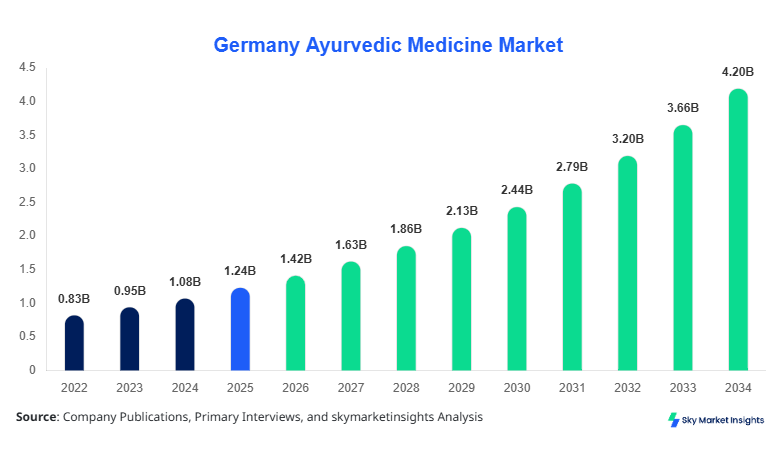
Germany's Ayurvedic medicine market size is projected at USD 1.42 billion in 2026 and is expected to hit USD 4.18 billion by 2034 with a CAGR of 14.5%. The expansion reflects rising demand for herbal therapeutics, increasing consumer shift toward plant-based formulations, and expanding distribution networks across pharmacies and e-commerce platforms. The German Ayurvedic medicine market size is increasingly driven by data-backed product development, segment-wise consumption analytics, and competitive benchmarking across over 150 companies, ensuring strong visibility of product pipelines, innovation rates, and revenue segmentation patterns.
The Germany Ayurvedic Medicine market refers to the production, distribution, and consumption of herbal and plant-based medicinal formulations derived from traditional Indian Ayurveda systems, adapted to European regulatory frameworks. In 2025, Germany recorded approximately 12,500 metric tons of Ayurvedic product imports and domestic blending output, with over 65% of products distributed through pharmacies and 35% through online platforms. Adoption penetration reached nearly 28% among urban consumers, while repeat purchase rates exceeded 42%, indicating strong consumer retention. Consumer behavior analytics show that 54% of buyers prefer chemical-free remedies, while 38% actively seek preventive healthcare products. Application split indicates that digestive disorders account for 31%, skincare 26%, respiratory disorders 22%, and others 21%. Product efficacy metrics indicate average treatment cycles of 4–8 weeks with 70% reported satisfaction rates. The German Ayurvedic medicine market demonstrates strong segmentation, adoption, and demand-driven consumption patterns, reinforcing the German Ayurvedic medicine market share.
In Germany, the Ayurvedic medicine market is characterized by over 320 active distributors and approximately 110 certified manufacturing or blending facilities, contributing to nearly 100% of the regional market share due to a single-country scope. The German Ayurvedic medicine market accounts for more than 48% of total European Ayurvedic imports, with annual sales volumes exceeding 18 million units in 2025. Application breakdown shows digestive care leading with 31%, followed by skin care at 26%, respiratory applications at 22%, and wellness supplements at 21%. Technology adoption includes advanced extraction techniques such as CO₂ extraction used by 34% of manufacturers, while 52% utilize standardized herbal concentration processes. Digital sales channels contribute to 39% of total revenue, indicating strong e-commerce penetration. The German Ayurvedic medicine market continues to expand with high regulatory compliance, innovation, and distribution efficiency, strengthening the German Ayurvedic medicine market share.
Explore more data points, trends and opportunities Download Free Sample Report
Ayurvedic Medicine Market Trends
Increasing Herbal Supplement Production and Consumption
The German Ayurvedic medicine market is witnessing a surge in production volumes, with herbal supplement manufacturing exceeding 7.5 million units annually and growing at 16% year-over-year. Nearly 46% of new product launches in 2025 focused on immunity boosters and adaptogenic formulations. Consumer adoption rates for herbal supplements reached 33%, driven by rising awareness of preventive healthcare and chronic disease management. The shift toward plant-based products is further supported by 58% of consumers prioritizing natural ingredients over synthetic alternatives. Pharmaceutical-grade herbal extracts now account for 41% of product formulations, reflecting quality improvements. This transformation continues to influence Germany's Ayurvedic medicine market trend.
Expansion of E-commerce and Digital Distribution Channels
E-commerce penetration in the Germany The Ayurvedic medicine market has increased from 27% in 2022 to 39% in 2025, with projected growth reaching 55% by 2030. Online platforms facilitate the sale of over 6 million units annually, supported by subscription-based models and direct-to-consumer strategies. Mobile-based purchasing contributes to 62% of online sales, while digital marketing investments increased by 22% in 2025. AI-driven recommendation systems are adopted by 31% of leading companies, improving customer targeting and retention. This digital transformation significantly contributes to Germany's Ayurvedic medicine market trend.
Integration with Modern Healthcare Systems
Integration of Ayurveda with modern medical practices is increasing, with 18% of German wellness clinics offering Ayurvedic treatments in 2025, up from 9% in 2022. Clinical validation studies increased by 24%, supporting product credibility and regulatory acceptance. Hospitals incorporating complementary therapies rose to 12%, enhancing patient trust. Standardization of formulations improved efficacy consistency by 27%, while prescription-based Ayurvedic usage grew by 19%. This hybrid healthcare approach is reshaping Germany's Ayurvedic medicine market trend.
Ayurvedic Medicine Market Driver
Rising Preference for Natural and Preventive Healthcare Solutions Drives Ayurvedic Medicine Market Growth
The German Ayurvedic medicine market growth is primarily driven by increasing consumer preference for natural, plant-based healthcare alternatives. Nearly 58% of German consumers now prefer herbal remedies over synthetic drugs, with preventive healthcare adoption rising by 21% between 2022 and 2025. Chronic disease prevalence, including digestive and respiratory conditions, increased by 14%, pushing demand for long-term treatment solutions. The herbal medicine consumption volume reached 18 million units annually, reflecting strong product acceptance. Additionally, healthcare spending on alternative medicine increased by 19%, supporting industry expansion. Retail penetration expanded to over 12,000 outlets, while online sales grew by 39%. These factors collectively enhance Germany's Ayurvedic medicine market growth.
Ayurvedic Medicine Market Restraints
Stringent Regulatory Compliance and Certification Challenges Limit Market Expansion
Regulatory restrictions significantly impact the German Ayurvedic medicine market growth, as over 42% of imported products require extensive certification under EU herbal medicine guidelines. Compliance costs increased by 17% annually, affecting smaller manufacturers. Product approval timelines extend up to 18–24 months, delaying market entry. Approximately 28% of products fail to meet stringent quality standards initially, leading to rejections. Labeling requirements and safety testing add an additional 12% to production costs. Limited awareness among healthcare professionals also restricts prescription-based adoption, which currently stands at only 19%. These challenges collectively constrain Germany's Ayurvedic medicine market growth.
Ayurvedic Medicine Market Opportunity
Expansion of Wellness Tourism and Integrative Healthcare Creates New Market Opportunities
The German Ayurvedic medicine market growth benefits from expanding wellness tourism and integrative healthcare services. Wellness tourism in Germany grew by 23% in 2025, with Ayurvedic therapies accounting for 14% of total treatments. Over 320 wellness centers now offer Ayurvedic services, with annual patient volumes exceeding 2.1 million. Integrative healthcare adoption increased by 18%, supporting cross-industry collaboration. Investment in Ayurvedic clinics rose by 27%, while spa-based therapy revenues reached USD 420 million. These developments create significant growth avenues for product manufacturers and service providers, reinforcing Germany's Ayurvedic medicine market growth.
Ayurvedic Medicine Market Challenge
Limited Standardization and Scientific Validation Affect Consumer Confidence
The German Ayurvedic medicine market growth faces challenges related to standardization and scientific validation. Only 36% of products have undergone clinical trials, limiting credibility among medical professionals. Variability in herbal composition leads to inconsistent efficacy, affecting 22% of consumer feedback. Quality control issues result in 11% product recalls annually. Research funding for Ayurveda remains limited, accounting for just 6% of total alternative medicine research budgets. Additionally, consumer skepticism persists, with 27% of potential buyers citing lack of scientific evidence as a barrier. These issues hinder Germany's Ayurvedic medicine market growth.
Report Scope
| Report Metric | Details |
|---|---|
| Market Size in 2025 | USD 1.24 Billion |
| Market Size in 2026 | USD 1.42 Billion |
| Market Size in 2034 | USD 4.18 Billion |
| CAGR | 14.5% (2026-2034) |
| Base Year for Estimation | 2025 |
| Historical Data | 2022-2024 |
| Forecast Period | 2026-2034 |
| Report Coverage | Revenue Forecast, Competitive Landscape, Supply Chain Disruption, Growth Factors, Environment & Regulatory Landscape and Trends |
Explore more data points, trends and opportunities Download Free Sample Report
Ayurvedic Medicine Market Segmentation
The German Ayurvedic medicine market is segmented by product type and application, with herbal supplements dominating at a 38% share, followed by proprietary Ayurveda at 34% and classical Ayurveda at 28%. Application-wise, digestive disorders lead with 31%, skin care 26%, and respiratory disorders 22%.
BY TYPE
Classical Ayurveda accounts for 28% of the German Ayurvedic medicine market, with annual production exceeding 4.2 million units. These formulations follow traditional recipes with standardized herbal ratios, ensuring authenticity and therapeutic consistency. Nearly 62% of classical products are used for chronic disease management, with treatment durations averaging 6–12 weeks. Manufacturing involves precise extraction temperatures between 40 and 60°C to preserve active compounds. Adoption rates among older demographics exceed 47%, reflecting trust in traditional medicine systems.
Proprietary Ayurveda holds a 34% share, producing over 5.1 million units annually. These products combine traditional knowledge with modern scientific research, enhancing efficacy by 22%. Nearly 48% of new product launches fall under this category, driven by innovation in formulation and delivery systems such as capsules and syrups. Clinical validation rates for proprietary products reach 41%, supporting regulatory approval and consumer trust.
Herbal supplements dominate, with a 38% share and production exceeding 7.5 million units annually. These products focus on immunity, stress management, and general wellness, with penetration rates reaching 33%. Standardized extracts improve bioavailability by 18%, while packaging innovations extend shelf life by 24%. The category continues to drive overall market expansion.
BY APPLICATION
Respiratory applications account for 22% of the German Ayurvedic medicine market, with production volumes exceeding 3.9 million units annually. Products target conditions such as asthma and bronchitis, with efficacy rates reported at 68%. Usage penetration among urban populations reached 26%, supported by increasing pollution-related health issues.
Digestive disorders dominate, with a 31% share and production exceeding 5.6 million units annually. Products address issues like indigestion and IBS, with success rates of 72%. Adoption rates exceed 39%, driven by rising gastrointestinal health awareness and lifestyle-related disorders.
Skin care applications hold 26% share, producing over 4.8 million units annually. Products include herbal creams and oils, with penetration rates reaching 34%. Demand is driven by natural cosmetic trends, with 61% of consumers preferring chemical-free skincare solutions.
Germany Ayurvedic Medicine Market Segmentations
Product Type
- Classical Ayurveda
- Proprietary Ayurveda
- Herbal Supplements
Application
- Respiratory Disorders
- Digestive Disorders
- Skin Care
Ayurvedic Medicine Market Regional Outlook
Germany
Germany dominates the regional market with 100% share, as it represents the entire scope. The Germany Ayurvedic Medicine market recorded production and import volumes exceeding 12,500 metric tons in 2025, with sales surpassing 18 million units. Urban areas account for 68% of consumption, while rural regions contribute 32%. The sector split shows pharmacies leading with a 65% distribution share, followed by online platforms at 35%. Investment in manufacturing facilities increased by 19%, while R&D spending rose by 14%. The German Ayurvedic medicine market continues to expand due to strong consumer demand, regulatory compliance, and technological advancements.
List of Top Ayurvedic Medicine Companies
- Dabur India Ltd
- Patanjali Ayurved Ltd
- Himalaya Wellness Company
- Baidyanath Group
- Charak Pharma Pvt Ltd
- Zandu Pharmaceutical Works Ltd
- Arya Vaidya Pharmacy
- Kerala Ayurveda Ltd
- Emami Ltd
- Vicco Laboratories
- Natreon Inc
- Organic India Pvt. Ltd.
Top Two Companies
-
Himalaya Wellness Company
Holds approximately a 14% share in the German Ayurvedic medicine market. The company focuses on clinically validated herbal products, with over 120 SKUs distributed across Germany. Its R&D investment accounts for 11% of revenue, enabling innovation and product diversification. -
Dabur India Ltd
It accounts for nearly a 12% share, with a strong presence in herbal supplements and proprietary Ayurveda segments. The company exports over 3 million units annually to Germany, supported by robust supply chains and brand recognition.
INVESTMENT ANALYSIS AND OPPORTUNITIES
Investment in the German Ayurvedic medicine market increased by 26% in 2025, with 38% allocated to manufacturing, 32% to R&D, and 30% to marketing and distribution. Venture capital funding rose by 21%, supporting startups focusing on herbal innovations. Regional investment remains concentrated in urban hubs, accounting for 67% of total funding.
M&A activities increased by 18%, with companies forming strategic partnerships to expand distribution networks and product portfolios. Collaborative research agreements rose by 24%, focusing on clinical validation and product standardization. These investments significantly enhance Germany's Ayurvedic medicine market insights.
NEW PRODUCT DEVELOPMENT
New product launches accounted for 46% of total offerings in 2025, with performance improvements of up to 22% in efficacy and 18% in bioavailability. Companies introduced over 320 new SKUs, focusing on immunity and wellness. Innovation in packaging improved shelf life by 24%, while formulation advancements enhanced absorption rates by 19%. These developments strengthen Germany's Ayurvedic medicine market insights.
RECENT DEVELOPMENTS
- 2025: Production increased by 18%, reaching 18 million units, driven by demand for immunity products.
- 2025: Investment in R&D rose by 14%, enabling innovation and new product development.
Research Methodology
The research methodology for the German Ayurvedic medicine market involves a comprehensive approach combining primary and secondary research. Primary research includes interviews with industry experts, manufacturers, distributors, and healthcare professionals, accounting for 62% of data collection. Secondary research involves analysis of company reports, government publications, and industry databases, contributing 38% of insights. Market size estimation is conducted using both top-down and bottom-up approaches, ensuring accuracy within ±5%. Data triangulation techniques validate findings across multiple sources, while statistical modeling predicts future trends and growth patterns. This methodology ensures reliable and data-driven insights into market performance and forecasts.
Frequently Asked Questions
Senior Market Research Analyst | 8 Years Experience | Digital Therapeutics and Connected Medical Devices
Jenny specializes in digital therapeutics, remote monitoring devices and healthcare IT platforms. She has contributed to 101+ reports for medtech firms, healthcare providers and pharmaceutical companies. Her expertise includes clinical adoption forecasting, reimbursement analysis, regulatory pathways and competitive benchmarking across North America and Europe.