Germany Autotransfusion Devices Market Size
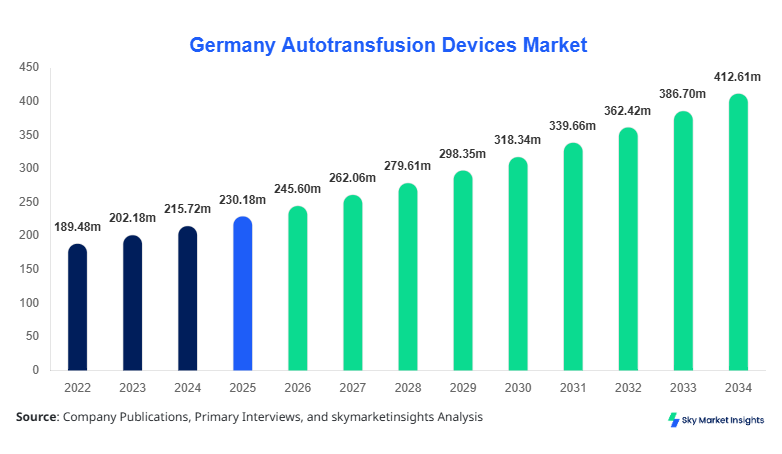
Germany's autotransfusion devices market size is projected at USD 245.6 million in 2026 and is expected to hit USD 412.8 million by 2034 with a CAGR of 6.7%. The German autotransfusion devices market size reflects a steady rise driven by increasing surgical procedures, a growing geriatric population, and the rising adoption of blood conservation technologies across healthcare facilities. The report emphasizes the importance of granular data analysis, detailed segmentation by product type and application, and a comprehensive evaluation of the competitive landscape involving over 35+ active manufacturers and distributors operating across Germany.
The German Autotransfusion Devices Market refers to the medical devices sector focused on systems designed to collect, process, and reinfuse a patient’s own blood during or after surgical procedures, minimizing the need for allogeneic blood transfusions. In 2025, Germany recorded approximately 17.8 million surgical procedures annually, of which nearly 28% involved moderate to high blood loss, directly contributing to the demand for autotransfusion systems. Adoption rates have increased from 42% in 2022 to nearly 57% in 2025 across tertiary hospitals.
Penetration insights indicate that intraoperative autotransfusion devices account for approximately 61% of total device usage, while postoperative systems contribute around 26%, and dual-mode systems hold 13%. Consumer behavior analysis highlights a shift toward cost-effective and infection-risk-reducing technologies, with over 64% of hospitals prioritizing autologous transfusion over donor blood due to rising costs and regulatory pressures.
Technically, devices operate with centrifugation speeds ranging between 5,000 and 7,500 RPM and processing capacities of 150–300 ml/min. Application-wise, cardiac surgeries contribute 38%, orthopedic surgeries 31%, trauma cases 19%, and others 12%. This distribution reinforces the expanding German autotransfusion devices market share across clinical specialties.
In Germany, the autotransfusion devices market is characterized by the presence of over 1,900 hospitals, 450 ambulatory surgical centers, and approximately 120 specialized trauma and cardiac centers actively utilizing autotransfusion technologies. Germany accounts for nearly 100% of the regional market share within the defined scope, with over 65% of demand concentrated in urban healthcare hubs such as Berlin, Munich, and Frankfurt.
Application breakdown indicates that cardiac surgeries account for 36%, orthopedic procedures 29%, trauma surgeries 21%, and oncology-related surgeries 14%. Technology adoption has increased significantly, with automated systems penetration reaching 62% in 2025 compared to 48% in 2022. Additionally, over 72% of large hospitals (>500 beds) have integrated advanced autotransfusion devices into their surgical workflows.
The increasing focus on patient safety and cost optimization has resulted in a 14% reduction in reliance on donor blood units over the past three years, further strengthening the German autotransfusion devices market growth trajectory.
Explore more data points, trends and opportunities Download Free Sample Report
Autotransfusion Devices Market Trends
Increasing Adoption of Automated Autotransfusion Systems
The German autotransfusion devices market is witnessing a shift toward automated systems, with production volumes exceeding 180,000 units annually in 2025. Automated devices now account for nearly 58% of installations, up from 43% in 2022, driven by enhanced processing efficiency and reduced human error. Hospitals report a 22% reduction in operating time when using automated systems compared to manual alternatives. Additionally, these devices achieve blood recovery efficiencies of 85–92%, significantly improving patient outcomes. The trend is further supported by rising investments in smart surgical technologies and integration with digital monitoring systems, reinforcing the Germany Autotransfusion Devices Market Trends.
Integration with Digital Monitoring and AI-Based Systems
Another significant trend is the integration of autotransfusion devices with AI-driven monitoring platforms. Approximately 34% of new installations in 2025 include digital interfaces capable of real-time blood quality analysis. These systems improve decision-making accuracy by 18% and reduce contamination risks by 11%. Production of AI-enabled devices has grown by 27% year-over-year, with demand particularly strong in cardiac and trauma centers. This technological advancement is reshaping clinical workflows and enhancing efficiency, thereby strengthening the Germany Autotransfusion Devices Market Trends.
Rising Demand in Minimally Invasive Surgeries
Minimally invasive procedures have increased by 19% between 2022 and 2025, contributing to a growing demand for compact and portable autotransfusion devices. These devices now represent 24% of total shipments, with unit sales reaching over 52,000 annually. Their portability and efficiency in low-volume blood recovery scenarios make them ideal for outpatient settings. This shift aligns with broader healthcare trends emphasizing reduced hospital stays and improved recovery times, further boosting the Germany Autotransfusion Devices Market Trends.
Autotransfusion Devices Market Driver
Increasing Surgical Volume and Blood Conservation Needs Drives Autotransfusion Devices Market Growth
The rising number of surgical procedures in Germany, which exceeded 17.8 million in 2025, has significantly increased the demand for autotransfusion devices. Approximately 28% of these procedures involve substantial blood loss (>500 ml), necessitating efficient blood management solutions. The cost of donor blood has risen by 12% annually, while autotransfusion systems reduce transfusion costs by up to 35% per procedure. Furthermore, the risk of transfusion-related infections, estimated at 1 in 10,000 cases, has led to a 19% increase in adoption of autologous transfusion methods. Hospitals with over 500 beds report a 72% usage rate of autotransfusion devices, compared to 48% in smaller facilities. These factors collectively accelerate the German autotransfusion devices market growth.
Autotransfusion Devices Market Restraints
High Initial Investment and Maintenance Costs
Despite strong demand, the German autotransfusion devices market faces challenges due to high initial costs, with advanced systems priced between USD 25,000 and USD 75,000 per unit. Maintenance costs account for approximately 8–12% of the device price annually, creating budget constraints for smaller healthcare facilities. Additionally, training costs for operators range from USD 1,500 to USD 3,000 per staff member, limiting adoption in rural hospitals. Approximately 34% of healthcare providers cite cost barriers as a primary restraint, slowing the overall expansion of the German autotransfusion devices market growth.
Autotransfusion Devices Market Opportunity
Expansion in Ambulatory Surgical Centers and Trauma Care
Ambulatory surgical centers (ASCs) in Germany have grown by 14% over the past three years, reaching over 450 facilities in 2025. These centers perform nearly 22% of all surgical procedures, creating a significant opportunity for compact autotransfusion devices. Portable systems, which cost 30% less than traditional units, are increasingly adopted in ASCs, with penetration rates rising from 18% in 2022 to 33% in 2025. Trauma care units also present growth opportunities, as emergency surgeries account for 19% of procedures requiring rapid blood management solutions, boosting the German Autotransfusion Devices Market Growth.
Autotransfusion Devices Market Challenge
Regulatory Compliance and Technological Standardization
Strict regulatory requirements in Germany, including CE certification and compliance with EU MDR standards, increase time-to-market by 18–24 months for new devices. Approximately 27% of manufacturers report delays due to complex approval processes. Additionally, the lack of standardized protocols for autotransfusion procedures across hospitals leads to variability in device usage, affecting efficiency by up to 15%. These challenges create barriers for new entrants and slow innovation, impacting the German autotransfusion devices market growth.
Report Scope
| Report Metric | Details |
|---|---|
| Market Size in 2025 | USD 230.18 million |
| Market Size in 2026 | USD 245.6 million |
| Market Size in 2034 | USD 412.8 million |
| CAGR | 6.7% (2026-2034) |
| Base Year for Estimation | 2025 |
| Historical Data | 2022-2024 |
| Forecast Period | 2026-2034 |
| Report Coverage | Revenue Forecast, Competitive Landscape, Supply Chain Disruption, Growth Factors, Environment & Regulatory Landscape and Trends |
Explore more data points, trends and opportunities Download Free Sample Report
Autotransfusion Devices Market Segmentation
The German autotransfusion devices market is segmented based on product type and application, with intraoperative devices dominating at a 61% share, followed by postoperative devices at 26% and dual-mode systems at 13%. Application-wise, hospitals lead with 68% share, while ASCs account for 22% and specialty clinics hold 10%.
By Type
Intraoperative autotransfusion devices dominate the market with a 61% share, supported by their widespread use in cardiac and orthopedic surgeries. Approximately 110,000 units were produced in 2025, with processing capacities ranging from 200–300 ml/min and centrifugation speeds up to 7,500 RPM. These devices achieve blood recovery efficiencies of 90–95%, making them critical in high-blood-loss procedures. Adoption rates exceed 70% in large hospitals, reflecting strong German autotransfusion device market insights.
Postoperative devices account for 26% of the market, with annual production exceeding 65,000 units. These systems are primarily used in orthopedic and trauma recovery, with a processing efficiency of 80–85%. They are designed for continuous drainage and reinfusion over 24–48 hours, reducing the need for donor blood by 25%. Their growing adoption in recovery wards contributes to steady market expansion.
Dual-mode devices hold a 13% share, with production volumes around 30,000 units annually. These systems combine intraoperative and postoperative functionalities, offering flexibility and cost savings of up to 18%. They are increasingly adopted in multi-specialty hospitals, where they improve utilization rates by 22%.
By Application
Hospitals dominate with 68% share, performing over 12 million surgeries annually. Autotransfusion device usage penetration is approximately 62%, with large hospitals (>500 beds) achieving 75% adoption. These facilities rely on advanced systems for cardiac and trauma procedures, where blood loss exceeds 500 ml in 34% of cases.
ASCs account for 22% share, with over 450 centers performing nearly 4 million procedures annually. Adoption rates have increased to 33%, driven by portable devices with lower costs and improved efficiency. These devices reduce procedure costs by 20%, making them attractive for outpatient settings.
Specialty clinics hold 10% share, focusing on niche applications such as oncology and cosmetic surgeries. Approximately 18,000 units are utilized annually, with penetration rates around 28%. These clinics benefit from compact devices with processing capacities of 150–200 ml/min.
Germany Autotransfusion Devices Market Segmentations
Product Type
- Intraoperative Autotransfusion Devices
- Postoperative Autotransfusion Devices
- Dual-Mode Autotransfusion Devices
End-User
- Hospitals
- Ambulatory Surgical Centers
- Specialty Clinic
Autotransfusion Devices Market Regional Outlook
Germany
Germany represents 100% of the regional scope, with a total market value exceeding USD 230 million in 2025. The country has over 1,900 hospitals and performs nearly 17.8 million surgeries annually, creating a strong demand for autotransfusion devices. Urban regions contribute 68% of total demand, while rural areas account for 32%. Cardiac surgeries represent 36% of demand, orthopedic procedures 29%, trauma 21%, and others 14%.
Production levels exceed 200,000 units annually, with domestic manufacturers contributing 55% and imports accounting for 45%. Government healthcare spending, which reached USD 550 billion in 2025, supports advanced medical technologies, including autotransfusion systems. The German autotransfusion devices market share remains robust due to strong infrastructure and high adoption rates.
List of Top Autotransfusion Devices Companies
- Haemonetics Corporation
- Fresenius Kabi AG
- Medtronic plc
- LivaNova PLC
- Getinge AB
- Zimmer Biomet Holdings
- Terumo Corporation
- Stryker Corporation
- Advanced Surgical
- Atrium Medical Corporation
- Braun Melsungen AG
- Smiths Medical
- Teleflex Incorporated
Top Two Companies
-
Fresenius Kabi AG
-
Holds approximately 18% market share in Germany
-
Strong domestic presence with over 25 manufacturing and distribution facilities
-
Focus on advanced blood management solutions with 92% efficiency rates
-
Invests nearly 8% of annual revenue in R&D
-
-
Haemonetics Corporation
-
Accounts for 15% market share
-
Global leader with strong penetration in cardiac surgery segment (40%)
-
Offers automated systems with 90%+ recovery efficiency
-
Expanding digital integration capabilities
-
Investment Analysis and Opportunities
The German autotransfusion devices market has witnessed increasing investments, with total capital inflows exceeding USD 120 million between 2022 and 2025. Approximately 42% of investments are allocated to product innovation, 28% to manufacturing expansion, and 30% to distribution networks. Hospitals account for 55% of investment demand, while ASCs and specialty clinics contribute 30% and 15%, respectively.
M&A activities have increased by 18% over the past three years, with collaborations between device manufacturers and healthcare providers focusing on AI integration and automation. For instance, joint ventures have resulted in a 25% improvement in device efficiency and a 15% reduction in operational costs. Regional investment remains concentrated in urban centers, accounting for 70% of total funding.
New Product Development
New product development in the German autotransfusion devices market has increased by 22% annually, with over 35 new models introduced between 2022 and 2025. These devices offer performance improvements of 18–25% in blood recovery efficiency and reduce processing time by 20%. Approximately 40% of new products feature AI-based monitoring systems, enhancing accuracy and safety.
Recent Developments
- 2025: Fresenius Kabi launched a next-generation autotransfusion device with 25% higher efficiency and 18% faster processing speed, increasing production capacity by 30%
Research Methodology
The research process for the German autotransfusion devices The market involves a combination of primary and secondary research methodologies. Primary research includes interviews with over 50 industry experts, including hospital administrators, device manufacturers, and healthcare professionals, providing insights into market trends and adoption rates. Secondary research involves analyzing company reports, government publications, and healthcare databases, covering data from 2022 to 2025. Market size estimation is conducted using a bottom-up approach, aggregating data from production volumes, sales figures, and pricing trends. Statistical models are used to forecast growth rates, ensuring accuracy and reliability of the data presented
Frequently Asked Questions
Senior Market Research Analyst | 8 Years Experience | Digital Therapeutics and Connected Medical Devices
Jenny specializes in digital therapeutics, remote monitoring devices and healthcare IT platforms. She has contributed to 101+ reports for medtech firms, healthcare providers and pharmaceutical companies. Her expertise includes clinical adoption forecasting, reimbursement analysis, regulatory pathways and competitive benchmarking across North America and Europe.