Germany Automated Mining Equipment Market Size
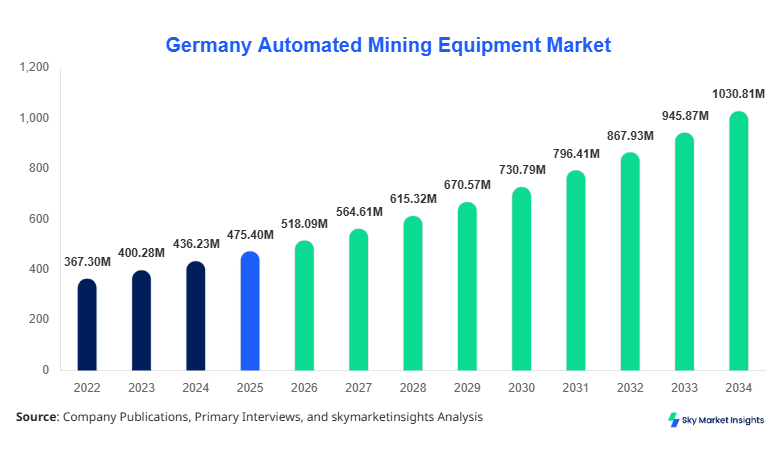
Germany Automated Mining Equipment Market size is projected at USD 518.09 million in 2026 and is expected to hit USD 1,035.18 million by 2034 with a CAGR of 8.98%. The assessment covers 8 equipment categories, 4 mineral groups, 3 deployment modes, 3 automation levels, 6 software solutions, and 2 end-user environments, supported by segment-level data and competitive positioning analysis.
Key Takeaways
- Autonomous haul trucks dominate equipment demand with a 29.50% share in 2026, while robotic mining equipment is the fastest-growing equipment category at a 9.61% CAGR.
- Metallic minerals lead mineral applications with a 42.70% share in 2026; non-metallic minerals are the fastest-growing mineral category at a 9.29% CAGR.
- Western Germany is the leading county cluster, supported by lignite, potash, limestone, aggregates, and mining equipment manufacturing activity.
- Eastern Germany is expected to record comparatively rapid automation adoption through brownfield modernization, reclamation operations, and remote equipment deployment.
- The national market is forecast to add approximately USD 517.09 million between 2026 and 2034, nearly doubling over 8 years.
Germany's automated mining equipment industry comprises autonomous, semi-autonomous, robotic, and remotely operated machinery used for extraction, drilling, loading, hauling, blasting, excavation, crushing, and site management. The country produced approximately 102 million metric tons of lignite in 2023, alongside more than 30 million metric tons of potash and salt products and substantial limestone and aggregate volumes. Autonomous haul trucks contribute 29.50% of 2026 equipment revenue, automated drilling rigs account for 18.75%, and autonomous loaders represent 17.24%. Metallic applications constitute 42.70% of mineral-related revenue, compared with 30.36% for non-metallic minerals and 15.02% for coal.
Explore more data points, trends and opportunities Download Free Sample Report
Germany Automated Mining Equipment Market Trends
Connected, Electrified and Software-Defined Mining Fleets
German mines are shifting from isolated machine automation toward connected fleets integrating high-precision positioning, machine vision, 5G connectivity, digital twins, and artificial intelligence. Large mining vehicles can move payloads exceeding 200 metric tons, while automated drills can maintain positioning accuracy within several centimeters. New systems increasingly combine 20–40 sensors per machine, sub-second collision alerts, and continuous operating-data collection across 2 or 3 daily shifts.
Electrification is developing alongside autonomy as operators target lower diesel consumption, reduced ventilation requirements, and compliance with national climate objectives. Underground operations can attribute 30–50% of energy requirements to ventilation, creating demand for battery-electric and remotely operated machinery. Predictive-maintenance platforms can monitor more than 100 equipment parameters, while condition-based servicing may reduce unplanned stoppages by 10–25% and improve asset utilization by 5–15%.
Germany Automated Mining Equipment Market Drivers
Worker Safety and Productivity Requirements Accelerate Automation
Automation reduces personnel exposure to blasting zones, unstable workings, dust, heat, noise, and vehicle-interaction risks. Remote operating stations can place workers several kilometers from active faces, while proximity-detection systems evaluate hazards within milliseconds. Continuous autonomous operation can extend productive utilization toward 20–22 hours per day, reduce shift-change losses by 30–60 minutes, and improve haul-cycle consistency by 10–20%. These benefits are increasingly material as experienced mining workforces age and employers face vacancy rates exceeding 5% in specialized technical occupations.
Germany Automated Mining Equipment Market Restraints
High Capital Costs and Brownfield Integration Limit Deployment
A single large autonomous haulage platform can require several million dollars in vehicle, communications, control, and site-readiness expenditure. Retrofitting mixed fleets may add 10–25% to equipment costs, while private wireless networks, control rooms, and positioning infrastructure can require multi-year investment programs. Smaller quarries operating fewer than 20 major mobile assets often face weaker economies of scale, and integration shutdowns lasting several days can disrupt annual production schedules and delay payback beyond 4–7 years.
Germany Automated Mining Equipment Market Opportunities
Retrofit Platforms and Low-Emission Operations Expand Addressable Applications
Germany's mature equipment base creates opportunities for vendor-neutral retrofit kits covering steering, braking, perception, teleoperation, and fleet orchestration. Modular solutions can shorten conversion schedules from several years to 6–18 months and may cost 20–40% less than full fleet replacement. Battery-electric automation also offers underground operators potential diesel reductions of 50–100%, ventilation-energy savings of 20–40%, and lower maintenance requirements because electric drivetrains contain substantially fewer moving components.
Challenges in Germany Automated Mining Equipment Market
Cybersecurity, Interoperability and Technical Skills Remain Critical
Connected mines may integrate hundreds of sensors, dozens of vehicles, and multiple operational-technology networks, increasing potential cyberattack surfaces. Latency above 100 milliseconds can impair teleoperation, while communications outages lasting only several minutes may halt automated production zones. Operators must also reconcile equipment protocols across fleets with useful lives of 10–20 years. Training requirements are expanding as technicians increasingly need mechanical, electrical, software, data, and cybersecurity competencies rather than a single occupational specialization.
Report Scope
| Report Metric | Details |
|---|---|
| Market Size in 2025 | USD 475.40 Million |
| Market Size in 2026 | USD 518.09 Million |
| Market Size in 2034 | USD 1035.18 Million |
| CAGR | 8.98% (2026-2034) |
| Base Year for Estimation | 2025 |
| Historical Data | 2022-2024 |
| Forecast Period | 2026-2034 |
| Report Coverage | Revenue Forecast, Competitive Landscape, Supply Chain Disruption, Growth Factors, Environment & Regulatory Landscape and Trends |
Explore more data points, trends and opportunities Download Free Sample Report
Germany Automated Mining Equipment Market Segmentation
The market is segmented by equipment type, mineral type, deployment mode, automation level, software solution, and end-user. In 2026, haul trucks represent 29.50% of equipment revenue, metallic minerals contribute 42.70% of mineral applications, and the combined top 3 equipment categories account for approximately 65.49%.
By Equipment Type
Autonomous haul trucks are the largest equipment category, rising from USD 140.03 million in 2025 to USD 152.84 million in 2026 and USD 307.92 million by 2034 at a 9.15% CAGR. Their 2026 share equals approximately 29.50%, supported by repeatable haul routes and measurable fuel, tire, and cycle-time improvements.
Robotic mining equipment is the fastest-growing category at a 9.61% CAGR, advancing from USD 52.60 million in 2026 to USD 109.60 million in 2034. Automated drilling rigs reach USD 193.81 million, autonomous loaders USD 175.88 million, and automated blasting systems USD 73.24 million by 2034.
By Mineral Type
Metallic minerals constitute the largest application category, increasing from USD 202.85 million in 2025 to USD 221.21 million in 2026 and USD 442.39 million by 2034 at a 9.05% CAGR. The category represents approximately 42.70% of the mineral-based total in 2026.
Non-metallic minerals are the fastest-growing category at a 9.29% CAGR, expanding from USD 157.30 million in 2026 to USD 320.17 million by 2034. Rare-earth applications reach USD 125.06 million at a 9.21% CAGR, while coal-related equipment rises to USD 148.02 million at an 8.37% CAGR.
By Deployment Mode
On-site fully autonomous systems lead large, controlled mining areas where geofenced routes and centralized dispatch can coordinate more than 20 mobile assets. OEM-integrated solutions offer unified warranties and controls, while retrofit automation addresses equipment with 5–15 years of remaining service life.
Retrofit automation is positioned for rapid adoption because Germany has a substantial brownfield asset base. Conversion packages can automate 3–5 core functions—steering, braking, perception, communications, and dispatch—without requiring immediate replacement of an entire fleet.
By Level of Automation
Semi-automated equipment remains prominent because assisted drilling, payload optimization, collision avoidance, and operator guidance can be introduced incrementally. These systems commonly automate 1–4 repetitive functions while retaining human supervision during abnormal operating conditions.
Fully autonomous machinery is gaining relevance for closed haul circuits operating across 2–3 shifts. Remote-controlled equipment remains essential underground, where operators may control loaders and breakers from protected stations located hundreds of meters or several kilometers away.
By Software Solution
Fleet-management software leads adoption by coordinating dispatch, payloads, routes, idle time, and maintenance across 10–100 connected assets. Navigation, guidance, and collision-avoidance platforms provide the operational foundation for higher automation levels and continuous safety monitoring.
Predictive maintenance is among the most rapidly adopted software functions, using vibration, temperature, pressure, and oil-quality data to identify failures days or weeks in advance. Platforms can process more than 100 data points per machine and target downtime reductions of 10–25%.
By End-User
Surface mining leads deployment because open sites provide structured routes, broader wireless coverage, and space for autonomous haulage. Fleets may transport more than 10 million metric tons annually, making 5–10% cycle-time improvements financially significant.
Underground mining presents strong potential for tele-remote loaders, robotic inspection, and collision avoidance. Removing diesel equipment can reduce heat and particulate emissions, while remote operation can move personnel 1–5 kilometers from hazardous production zones.
Germany Automated Mining Equipment Market Segmentations
By Equipment Type
- Autonomous Haul Trucks
- Automated Drilling Rigs
- Autonomous Loaders
- Robotic Mining Equipment
- Dozers and Excavators
- Automated Blasting Systems
- Remote-Controlled Equipment
- Others (Grinders, Crushers, Graders)
By Mineral Type
- Metallic (Gold, Copper, Iron, Nickel, etc.)
- Non-Metallic (Limestone, Potash, Phosphate)
- Coal
- Rare Earth Minerals
By Deployment Mode
- On-Site (Fully Autonomous Sites)
- Retrofit Automation
- OEM-Integrated Solutions
By Level of Automation
- Semi-Automated
- Fully Autonomous
- Remote-Controlled
By Software Solution
- Fleet Management
- Navigation and Guidance
- Collision Avoidance and Safety
- Tele-remote Operations
- Predictive Maintenance
- Energy and Emissions Monitoring
By End-User
- Surface Mining
- Underground Mining
Germany Automated Mining Equipment Market Country Outlook
Western Germany forms the largest demand cluster, led by North Rhine-Westphalia, Lower Saxony, Hesse, and Saarland. The cluster is estimated to represent approximately 38% of national activity, supported by aggregates, salt, industrial minerals, equipment manufacturing, and the Rhineland lignite system. Surface applications account for the majority of deployments, with underground salt and mineral operations supporting tele-remote solutions.
Eastern Germany, including Saxony, Saxony-Anhalt, Brandenburg, and Thuringia, contributes approximately 29%, driven by lignite districts, potash, hard-rock quarrying, and mine-rehabilitation work. Northern counties account for roughly 18%, supported by salt, clay, sand, and aggregates, while southern counties contribute about 15% through limestone, construction minerals, specialty mining, and machinery engineering. Together, these 4 regional clusters represent 100% of German demand.
Top players in Germany Automated Mining Equipment Market
- Caterpillar Inc.
- Komatsu Ltd.
- Sandvik AB
- Epiroc AB
- Liebherr Group
- Siemens AG
- ABB Ltd.
- Hexagon AB
- Hitachi Construction Machinery Co., Ltd.
- Volvo Construction Equipment
- Thyssenkrupp AG
- Becker Mining Systems AG
- SMT Scharf AG
- Bauer AG
- Bosch Rexroth AG
Top Two Companies
-
Caterpillar Inc. — indicative competitive presence of 16–20%: Caterpillar is strongly positioned through autonomous haulage, MineStar fleet-management software, terrain guidance, equipment-health monitoring, and a broad installed base of mining trucks and loaders. Its platform supports multiple autonomy functions within 1 integrated operating environment, enabling mines to coordinate dispatch, payload, safety, and maintenance. The company's positioning is reinforced by global deployments involving hundreds of autonomous trucks and billions of metric tons hauled. In Germany, its dealer and service network supports brownfield fleet modernization, lifecycle maintenance, and digital integration across surface mines and large quarries.
-
Komatsu Ltd.—indicative competitive presence of 13–17%: Komatsu competes through its Autonomous Haulage System, smart-construction technologies, connected equipment, and integrated fleet controls. Its autonomous platform has accumulated more than 10 years of commercial operating experience and is designed for continuous multi-truck coordination. The company benefits from strong European construction and extraction-equipment coverage, while its German engineering footprint supports customer service and industrial integration. Its competitive position is particularly relevant for mines seeking OEM-integrated autonomy, standardized controls, lower cycle variability, and phased migration from operator-assisted vehicles to fully autonomous haulage.
Recent Developments in Germany Automated Mining Equipment Market
- 2025: Vendors expanded artificial-intelligence-based perception and collision-avoidance capabilities capable of combining camera, radar, and LiDAR inputs across 360-degree operating zones.
Research Methodology
The assessment applies a bottom-up and top-down framework using 2025 as the base year, 2026 as the current year, historical observations from 2022–2024, and forecasts through 2034. Equipment and mineral totals were cross-checked across 8 equipment categories and 4 mineral groups. Forecast values were evaluated using segment adoption, replacement cycles of approximately 7–15 years, automation intensity, production exposure, regulatory factors, and company positioning, with the supplied USD values and CAGRs retained as the controlling numerical dataset.
Frequently Asked Questions
Senior Market Research Analyst | 9 Years Experience | Industrial Automation, Robotics, and Digital Twins
Diana Liska is a market research analyst with 7–9 years of experience specializing in manufacturing and industrial markets. Contributed to 70+ research reports for global clients. Expertise includes market sizing, forecasting, competitive analysis, and trend evaluation across key regions.