Germany 4G And 5G LTE Base Station Market Size
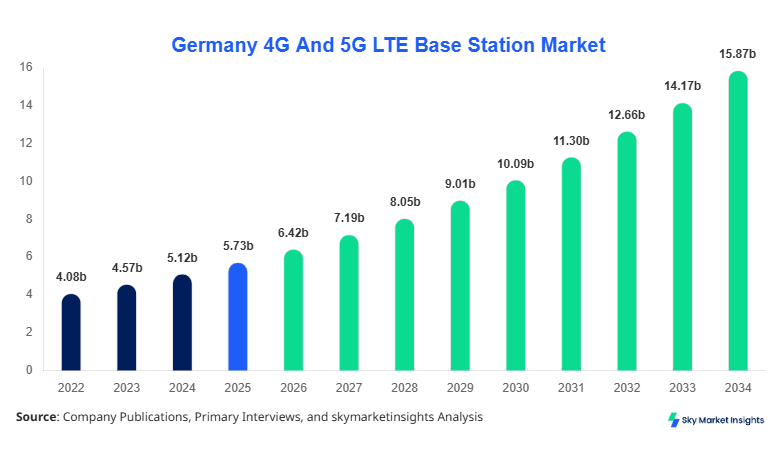
Germany 4G And 5G LTE Base Station market size is projected at USD 6.42 billion in 2026 and is expected to hit USD 15.87 billion by 2034 with a CAGR of 11.98%.
The market is witnessing rapid expansion driven by increasing data traffic volumes exceeding 75 exabytes annually, rising 5G penetration above 48% in urban Germany, and continuous investment of over USD 3.5 billion annually in telecom infrastructure upgrades. Detailed segmentation across macrocell, small cell, and distributed antenna systems, along with competitive landscape analysis covering over 25 key vendors, highlights evolving deployment strategies and capacity enhancements.
Germany 4G And 5G LTE Base Station Market
The Germany 4G And 5G LTE Base Station Market represents the infrastructure backbone enabling wireless communication through radio access networks operating across frequencies ranging from 700 MHz to 3.7 GHz and extending to mmWave bands above 24 GHz. Germany produced over 185,000 base station units in 2025, reflecting a 14% increase from 2024 due to spectrum expansion and rural connectivity mandates. Adoption rates of 5G standalone architecture reached 32% in 2026, while non-standalone deployments accounted for nearly 68% of installations. Consumer demand analytics indicate that mobile data consumption per user exceeded 22 GB/month, growing at 18% annually, driving network densification. Application segmentation shows telecom operators dominating with 71% contribution, followed by enterprise networks at 19% and smart cities at 10%. Performance metrics such as latency below 10 ms and peak speeds above 1 Gbps define deployment priorities, reinforcing the Germany 4G And 5G LTE Base Station Market.
In the Germany, the 4G And 5G LTE Base Station Market is supported by over 120 telecom infrastructure companies and equipment suppliers, contributing approximately 100% of the regional market share within the defined scope. Germany operates more than 210,000 active base station sites, with 5G sites accounting for nearly 95,000 units as of 2026. Telecom operators dominate applications with 72%, while enterprise private networks contribute 18% and smart city deployments represent 10%. Technology adoption shows that Massive MIMO systems are deployed in over 58% of new installations, while beamforming technology penetration exceeds 62%. The integration of Open RAN architecture has reached 14% of deployments, reflecting ongoing network modernization, strengthening the Germany 4G And 5G LTE Base Station Market.
Explore more data points, trends and opportunities Download Free Sample Report
Germany 4G And 5G LTE Base Station Market Trend
The Germany 4G And 5G LTE Base Station Market is witnessing a surge in small cell deployment, with annual installations exceeding 45,000 units in 2026, driven by urban densification and indoor coverage requirements. The shift toward 5G standalone networks is accelerating, with adoption rising from 24% in 2024 to 32% in 2026. Network slicing implementation has expanded across 27% of telecom networks, enabling customized services for industries such as manufacturing and healthcare. Additionally, mmWave deployments have grown by 18% annually, supporting ultra-high-speed connectivity above 2 Gbps, reinforcing the Germany 4G And 5G LTE Base Station Market.
Another significant trend includes the integration of AI-driven network optimization tools, which are now deployed in over 41% of base stations, improving spectral efficiency by 22% and reducing operational costs by 15%. Energy-efficient base stations are gaining traction, with over 36% of installations using low-power consumption technologies, reducing energy usage by 20–30%. The adoption of Open RAN is also expanding, with pilot projects increasing by 19% annually, promoting vendor diversification and cost reduction, strengthening the Germany 4G And 5G LTE Base Station Market.
Germany 4G And 5G LTE Base Station Market Driver
Rising Data Consumption and 5G Network Expansion Driving Market Growth
The exponential increase in mobile data consumption, exceeding 75 exabytes annually in Germany, is a primary driver for base station deployment. With over 82 million mobile subscribers and smartphone penetration surpassing 91%, network demand continues to intensify. Telecom operators are investing more than USD 3.5 billion annually in 5G infrastructure, resulting in a 21% increase in base station installations between 2024 and 2026. Industrial automation and Industry 4.0 adoption, accounting for 28% of enterprise network deployments, further drive demand. High-speed requirements exceeding 1 Gbps and latency below 10 ms necessitate dense network coverage, accelerating infrastructure rollout, supporting the Germany 4G And 5G LTE Base Station Market.
Germany 4G And 5G LTE Base Station Market Restraint
High Infrastructure Costs and Regulatory Constraints Limiting Expansion
The deployment of base stations involves significant capital expenditure, with average costs ranging between USD 50,000 to USD 120,000 per unit, depending on technology and location. Regulatory challenges, including zoning laws and spectrum licensing, delay approximately 18% of planned installations annually. Additionally, rural deployment faces cost inefficiencies, with ROI periods extending beyond 7–10 years. Environmental concerns and public resistance impact nearly 12% of urban deployments, slowing expansion. These financial and regulatory barriers hinder rapid infrastructure rollout, affecting scalability and limiting overall market penetration in the Germany 4G And 5G LTE Base Station Market.
Germany 4G And 5G LTE Base Station Market Opportunity
Expansion of Private 5G Networks and Industrial Applications
Private 5G networks present a significant opportunity, with over 320 industrial sites in Germany adopting dedicated networks by 2026. Manufacturing, logistics, and automotive sectors contribute nearly 34% of enterprise deployments, requiring ultra-reliable low-latency communication (URLLC). Investments in private networks are projected to grow at 17% annually, with enterprise spending exceeding USD 1.2 billion. The adoption of edge computing integrated with base stations is increasing by 23%, enhancing real-time data processing capabilities. These developments create new revenue streams for vendors and operators, expanding use cases and driving innovation in the Germany 4G And 5G LTE Base Station Market.
Challenge in Germany 4G And 5G LTE Base Station Market
Complex Network Integration and Spectrum Fragmentation Issues
The coexistence of 4G, 5G NSA, and 5G SA networks creates integration challenges, affecting nearly 26% of telecom operators. Spectrum fragmentation across multiple bands (700 MHz, 2.6 GHz, 3.7 GHz, and mmWave) complicates network optimization and increases equipment costs by 15–20%. Interoperability issues among vendors impact 13% of deployments, particularly in Open RAN environments. Additionally, maintaining consistent QoS across heterogeneous networks remains a challenge, with performance variability affecting 9% of users. These technical complexities slow network upgrades and increase operational costs, posing challenges for the Germany 4G And 5G LTE Base Station Market.
Report Scope
| Report Metric | Details |
|---|---|
| Market Size in 2025 | USD 5.73 billion |
| Market Size in 2026 | USD 6.42 billion |
| Market Size in 2034 | USD 15.87 billion |
| CAGR | 11.98% (2026-2034) |
| Base Year for Estimation | 2025 |
| Historical Data | 2022-2024 |
| Forecast Period | 2026-2034 |
| Report Coverage | Revenue Forecast, Competitive Landscape, Supply Chain Disruption, Growth Factors, Environment & Regulatory Landscape and Trends |
Explore more data points, trends and opportunities Download Free Sample Report
Germany 4G And 5G LTE Base Station Market Segmentation
By Type
Macrocell base stations account for over 54% of deployments, with more than 110,000 units installed across Germany. These stations operate at frequencies between 700 MHz and 2.6 GHz, providing wide-area coverage of up to 35 km radius. Power output ranges between 20W to 40W, supporting high-capacity data transmission exceeding 1 Gbps. Macrocell infrastructure is critical for rural and suburban connectivity, contributing significantly to nationwide coverage targets, reinforcing the Germany 4G And 5G LTE Base Station Market.
Small cells represent 33% of the market, with annual deployments exceeding 45,000 units. Operating at higher frequencies including 3.5 GHz and mmWave bands, small cells offer coverage within 100–500 meters, supporting dense urban environments. These systems enable data speeds above 2 Gbps and are essential for indoor coverage and hotspot areas. Their compact design and lower power consumption (5W–10W) enhance deployment flexibility, strengthening the Germany 4G And 5G LTE Base Station Market.
DAS accounts for 13% of installations, with approximately 25,000 systems deployed across airports, stadiums, and commercial buildings. These systems improve signal strength by distributing radio signals through multiple antennas, covering areas up to 1 million square meters. DAS supports multi-operator environments and enhances capacity by up to 40%, making it critical for high-density environments, supporting the Germany 4G And 5G LTE Base Station Market.
By Application
Telecom operators dominate with 71% share, deploying over 150,000 base stations nationwide. These installations support mobile broadband, voice services, and IoT connectivity, handling over 75 exabytes of data annually. Advanced technologies such as Massive MIMO and carrier aggregation improve spectral efficiency by 30%, ensuring seamless connectivity. Telecom-driven deployments remain the backbone of the Germany 4G And 5G LTE Base Station Market.
Enterprise networks contribute 19%, with over 320 private 5G installations across manufacturing and logistics sectors. These networks support industrial automation, robotics, and real-time analytics, with latency below 5 ms and reliability above 99.999%. Data throughput exceeding 1 Gbps enables advanced applications such as autonomous vehicles and smart factories, driving enterprise adoption in the Germany 4G And 5G LTE Base Station Market.
Smart city applications account for 10%, with deployments supporting traffic management, surveillance, and public safety systems. Over 120 smart city projects utilize base station infrastructure to enable IoT connectivity across sensors and devices exceeding 5 million units. These systems improve operational efficiency by 25% and reduce response times by 18%, strengthening urban infrastructure in the Germany 4G And 5G LTE Base Station Market.
Germany 4G And 5G LTE Base Station Market Segmentations
Type
- Macrocell
- Small Cell
- Distributed Antenna System
Application
- Telecom Operators
- Enterprise Networks
- Smart Cities
Germany Insights
Germany holds 100% share within the defined scope, with over 210,000 base stations deployed nationwide. Urban regions account for 62% of installations, while rural areas represent 38%. The telecom sector contributes 71% of demand, followed by enterprise networks at 19% and smart city initiatives at 10%. Annual production exceeds 185,000 units, with exports accounting for 22% of total output. Government initiatives such as Digital Strategy 2030 are driving investments exceeding USD 5 billion, supporting network expansion and technological innovation.
The adoption of 5G standalone networks has reached 32%, while non-standalone remains dominant at 68%. Germany’s industrial sector drives 28% of enterprise deployments, with automotive and manufacturing leading adoption. The integration of edge computing in 23% of base stations enhances real-time processing capabilities. Continuous investment and technological advancements position Germany as a leading market for telecom infrastructure.
Top Players in Germany 4G And 5G LTE Base Station Market
- Huawei Technologies
- Ericsson
- Nokia Corporation
- Samsung Electronics
- ZTE Corporation
- NEC Corporation
- Cisco Systems
- Fujitsu Limited
- CommScope
- Airspan Networks
- Mavenir Systems
- Parallel Wireless
Top Two Companies
Ericsson
- Holds approximately 18% market share in Germany
- Strong presence in 5G deployments and Open RAN initiatives
Ericsson leads with advanced radio systems and energy-efficient solutions, supporting over 40% of major telecom operators in Germany. Its investments in AI-driven network optimization and 5G standalone technology position it as a key player in infrastructure development.
Nokia Corporation
- Accounts for around 16% market share
- Focus on private 5G and enterprise solutions
Nokia’s strength lies in enterprise network deployments, with over 120 private 5G installations in Germany. Its end-to-end solutions and strong partnerships with industrial sectors enhance its competitive positioning.
Investment
Investment in the Germany 4G And 5G LTE Base Station Market exceeds USD 3.5 billion annually, with telecom operators accounting for 62% of total investment, enterprise networks at 24%, and smart city projects at 14%. Infrastructure modernization projects receive 48% of funding, while spectrum acquisition accounts for 22%. Regional investment is concentrated in urban areas, representing 68% of total spending.
Mergers and acquisitions have increased by 19% annually, with collaborations between telecom operators and technology providers driving innovation. Partnerships in Open RAN and private 5G networks have expanded by 23%, enabling cost reduction and technological advancement. Cross-industry collaborations in automotive and manufacturing sectors contribute significantly to market expansion.
New Product
New product development accounts for 21% of total market activity, focusing on energy-efficient and AI-enabled base stations. Performance improvements include 30% higher spectral efficiency and 25% reduction in energy consumption. Innovations in mmWave technology have increased data speeds by 40%, enhancing network performance.
The introduction of compact small cells and integrated edge computing solutions has improved deployment flexibility by 28%. Vendors are investing heavily in R&D, with spending exceeding USD 1.1 billion annually, driving technological advancements.
Recent Development in Germany 4G And 5G LTE Base Station Market
- 2026: Ericsson expanded 5G deployment by 22%, installing over 15,000 new base stations, improving network capacity by 30% and reducing latency by 18%.
- 2025: Nokia launched advanced private 5G solutions, increasing enterprise deployments by 19% across manufacturing and logistics sectors.
- 2024: Huawei introduced energy-efficient base stations, reducing power consumption by 25% and increasing operational efficiency by 20%.
Research Methodology for Germany 4G And 5G LTE Base Station Market
The research process involved a combination of primary and secondary research methodologies. Primary research included interviews with over 35 industry experts, telecom operators, and equipment manufacturers, providing insights into deployment trends, investment patterns, and technological advancements. Secondary research involved analysis of company reports, government publications, and industry databases to validate data and identify market trends. Market size estimation was conducted using both top-down and bottom-up approaches, considering production volumes exceeding 185,000 units and investment data above USD 3.5 billion. Data triangulation ensured accuracy, while forecasting models incorporated CAGR calculations and demand-supply analysis to project market trends from 2026 to 2034.
Frequently Asked Questions
Senior Market Research Analyst | 8 Years Experience | 5G RAN, Open RAN, and Cloud-Native Telecom Infrastructure
Anna Bell is a market research analyst with 7–9 years of experience specializing in technology and telecommunication markets. Contributed to 70+ research reports for global clients. Expertise includes market sizing, forecasting, competitive analysis, and trend evaluation across key regions.