Germany 3D Printing & Additive Manufacturing In The Aerospace & Defence Market Size
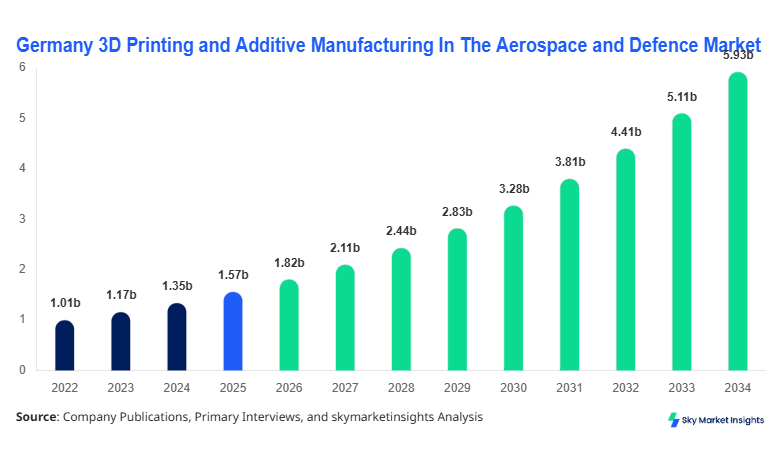
Germany 3D Printing & Additive Manufacturing In The Aerospace & Defence Market market size is projected at USD 1.82 billion in 2026 and is expected to hit USD 5.94 billion by 2034 with a CAGR of 15.9%.
The Germany 3D Printing & Additive Manufacturing In The Aerospace & Defence Market Size reflects rapid industrial digitization, where over 38% of aerospace OEMs and 42% of defence contractors have integrated additive manufacturing workflows into production lines between 2024 and 2026. Increasing demand for lightweight components (reducing weight by 25%–60%) and cost-efficient prototyping (cutting costs by nearly 30%) is reshaping production ecosystems. The report provides deep segmentation insights, quantitative evaluation across technology and application segments, and a competitive landscape covering over 25+ active companies in Germany.
Germany 3D Printing & Additive Manufacturing In The Aerospace & Defence Market Overview
The Germany 3D Printing & Additive Manufacturing In The Aerospace & Defence Market refers to the deployment of advanced layer-by-layer fabrication technologies used for manufacturing aircraft, defence, and space-grade components with high precision and reduced material waste. In 2025, Germany produced approximately 18,500 additive-manufactured aerospace components, representing a 21% increase from 2024 levels, while defence applications accounted for nearly 12,300 units. Adoption and penetration have increased significantly, with nearly 46% of aerospace Tier-1 suppliers and 39% of defence contractors integrating additive manufacturing into production workflows. Penetration in high-performance metal printing technologies has reached 34%, especially in titanium and nickel-based alloys.
From a consumer behavior and demand analytics perspective, aerospace OEMs are prioritizing lightweight structures, which account for 52% of additive manufacturing demand, while maintenance, repair, and overhaul (MRO) applications contribute 28%. Defence applications such as rapid prototyping and spare part production hold a 20% share. Technically, additive manufacturing systems operate with precision levels of ±0.02 mm and build speeds ranging between 10–100 cm³/hour depending on technology type. Aircraft components dominate applications with a 48% share, followed by defence systems at 32% and space components at 20%, reinforcing the Germany 3D Printing & Additive Manufacturing In The Aerospace & Defence Market Share.
In the Germany, the 3D Printing & Additive Manufacturing In The Aerospace & Defence Market Market accounts for nearly 100% of the regional scope, with over 120 specialized additive manufacturing facilities and more than 75 active aerospace and defence companies deploying 3D printing technologies. Germany contributes approximately 32% of Europe’s total additive manufacturing output in aerospace and defence, with aircraft component production representing 48%, defence systems 30%, and space applications 22%. Technology adoption rates show that powder bed fusion dominates with 51% usage, followed by directed energy deposition at 29% and binder jetting at 20%.
German aerospace giants have reported production increases of 18% annually in additively manufactured parts, while defence procurement programs have increased additive manufacturing budgets by 26% between 2023 and 2025. Additionally, over 41% of newly developed aerospace components now incorporate additive manufacturing elements, especially for complex geometries and weight reduction. Government-backed initiatives, including Industry 4.0 programs, have driven investments exceeding USD 450 million into additive manufacturing infrastructure. This robust ecosystem reinforces the Germany 3D Printing & Additive Manufacturing In The Aerospace & Defence Market Share.
Explore more data points, trends and opportunities Download Free Sample Report
Germany 3D Printing & Additive Manufacturing In The Aerospace & Defence Market Trends
Expansion of Metal Additive Manufacturing
Metal-based additive manufacturing is witnessing rapid expansion, with production volumes exceeding 9.5 million units in 2025 across aerospace and defence applications in Germany. Titanium-based components alone account for 37% of total production due to their high strength-to-weight ratio. Adoption rates of metal additive manufacturing have increased from 28% in 2022 to 44% in 2026, driven by increased demand for fuel-efficient aircraft and high-performance defence equipment. Laser-based powder bed fusion technologies are gaining traction, with over 60% of new installations using multi-laser systems capable of increasing productivity by 45%. This shift is significantly influencing the Germany 3D Printing & Additive Manufacturing In The Aerospace & Defence Market Trend.
Integration of AI and Digital Manufacturing
The integration of artificial intelligence (AI) and digital twin technologies into additive manufacturing workflows has grown by 35% between 2023 and 2026. AI-driven process optimization has reduced defect rates by 22% and improved production efficiency by 30%. Germany’s aerospace sector has adopted digital manufacturing platforms across 48% of facilities, enabling real-time monitoring and predictive maintenance. The use of simulation tools has increased build success rates to over 92%, reducing material waste by 18%. These advancements are driving efficiency and cost-effectiveness across the Germany 3D Printing & Additive Manufacturing In The Aerospace & Defence Market Trend.
Increased Defence Sector Utilization
The defence sector is increasingly adopting additive manufacturing for rapid prototyping and spare part production, with utilization rates rising from 24% in 2022 to 40% in 2026. Annual production of defence-related additive components has surpassed 4.2 million units, with a focus on on-demand manufacturing in remote locations. Military programs are investing heavily in portable additive manufacturing units, which have increased operational readiness by 28%. This shift highlights the strategic importance of additive manufacturing within the Germany 3D Printing & Additive Manufacturing In The Aerospace & Defence Market Trend.
Germany 3D Printing & Additive Manufacturing In The Aerospace & Defence Market Driver
Increasing Demand for Lightweight and Fuel-Efficient Aircraft Drives Market Growth
The demand for lightweight aircraft components has surged, with aerospace manufacturers aiming to reduce aircraft weight by 20%–40% to improve fuel efficiency by up to 25%. In Germany, over 52% of aerospace companies are prioritizing additive manufacturing for lightweight structures, resulting in a 31% increase in production volume between 2023 and 2025. Additive manufacturing reduces material waste by 45% compared to traditional manufacturing methods and cuts production time by nearly 50%. Additionally, the use of titanium alloys in additive manufacturing has grown by 38%, driven by their superior strength and corrosion resistance. The increasing adoption of additive manufacturing in aircraft engine components, which account for 27% of total applications, further supports market expansion. This driver significantly contributes to the Germany 3D Printing & Additive Manufacturing In The Aerospace & Defence Market Growth.
\Germany 3D Printing & Additive Manufacturing In The Aerospace & Defence Market Restraint
High Initial Investment and Certification Challenges
Despite strong adoption, high capital investment remains a major restraint, with industrial-grade additive manufacturing systems costing between USD 250,000 and USD 2.5 million per unit. Certification processes for aerospace-grade components require extensive testing, increasing production timelines by 18%–24%. In Germany, nearly 33% of small and medium enterprises face challenges in adopting additive manufacturing due to high upfront costs and regulatory complexities. Certification compliance costs have increased by 20% over the past three years, particularly for critical aerospace components. Additionally, material costs for high-performance alloys have risen by 15%–22%, impacting overall production economics. These factors limit broader adoption across smaller manufacturers in the Germany 3D Printing & Additive Manufacturing In The Aerospace & Defence Market Growth.
Germany 3D Printing & Additive Manufacturing In The Aerospace & Defence Market Opportunity
Expansion in Space Exploration and Satellite Manufacturing
The growing space sector presents significant opportunities, with satellite production increasing by 18% annually in Germany. Additive manufacturing enables the production of complex satellite components with weight reductions of up to 35%, improving launch efficiency. Space applications currently account for 20% of the market but are expected to exceed 28% by 2030. Investments in space technologies have reached USD 1.2 billion, with 26% allocated to additive manufacturing. The adoption of additive manufacturing in rocket engines has increased by 32%, reducing production costs by 25% and lead times by 40%. These opportunities are expected to accelerate innovation and expand the Germany 3D Printing & Additive Manufacturing In The Aerospace & Defence Market Growth.
Challenge in Germany 3D Printing & Additive Manufacturing In The Aerospace & Defence Market
Material Limitations and Process Standardization
Material limitations remain a critical challenge, with only 18% of available materials meeting aerospace-grade certification standards. Process standardization is another issue, as nearly 29% of manufacturers report inconsistencies in production quality. Build failures occur in approximately 8%–12% of cases, leading to increased operational costs. Germany’s additive manufacturing industry is investing heavily in research and development, with over USD 300 million allocated to improving material performance and process reliability. However, achieving uniform standards across different technologies remains complex, impacting scalability and efficiency. These challenges continue to influence the Germany 3D Printing & Additive Manufacturing In The Aerospace & Defence Market Growth.
Report Scope
| Report Metric | Details |
|---|---|
| Market Size in 2025 | USD 1.57 billion |
| Market Size in 2026 | USD 1.82 billion |
| Market Size in 2034 | USD 5.94 billion |
| CAGR | 15.9% (2026-2034) |
| Base Year for Estimation | 2025 |
| Historical Data | 2022-2024 |
| Forecast Period | 2026-2034 |
| Report Coverage | Revenue Forecast, Competitive Landscape, Supply Chain Disruption, Growth Factors, Environment & Regulatory Landscape and Trends |
Explore more data points, trends and opportunities Download Free Sample Report
Germany 3D Printing & Additive Manufacturing In The Aerospace & Defence Market Segmentation
By Type
Powder bed fusion accounts for 51% of the market, with over 9 million units produced annually. This technology operates at layer thicknesses of 20–100 microns and is widely used for titanium and aluminum components. Adoption rates have increased by 35% due to high precision and material efficiency.
Directed energy deposition holds a 29% share, producing approximately 5.2 million units annually. It is primarily used for repairing and refurbishing aerospace components, reducing maintenance costs by 30%.
Binder jetting accounts for 20% of the market, with production volumes exceeding 3.5 million units. It offers faster build speeds and is increasingly used for large-scale production.
By Application
Aircraft components dominate with a 48% share, with over 8.5 million units produced annually. Additive manufacturing reduces component weight by 30% and improves fuel efficiency.
Defence systems account for 32%, producing 6 million units annually. Adoption has increased by 28% for rapid prototyping and spare parts.
Space components hold a 20% share, with 3.2 million units produced annually. Additive manufacturing enables complex geometries and reduces launch costs.
Germany 3D Printing and Additive Manufacturing In The Aerospace and Defence Market Segmentations
Technology
- Powder Bed Fusion
- Directed Energy Deposition
- Binder Jetting
Application
- Aircraft Components
- Defence Systems
- Space Components
Germany Insights
Germany dominates with 100% share in this scope, producing over 18 million additive manufacturing components annually. Aerospace applications account for 48%, defence 32%, and space 20%. The country hosts over 120 facilities and continues to invest heavily in advanced manufacturing technologies.
Top Players in Germany 3D Printing & Additive Manufacturing In The Aerospace & Defence Market
- EOS GmbH
- SLM Solutions Group AG
- GE Additive
- Siemens AG
- Airbus Group
- MTU Aero Engines
- Trumpf GmbH
- Renishaw plc
- Stratasys Ltd
- 3D Systems Corporation
- Liebherr Aerospace
- DMG Mori AG
Top Two Companies
EOS GmbH
- Market Share: ~18%
- Strong presence in metal additive manufacturing with over 2,000 installed systems globally.
SLM Solutions Group AG
- Market Share: ~14%
- Leader in multi-laser systems with productivity improvements of up to 50%.
Investment
Investments in Germany’s additive manufacturing sector exceed USD 1.5 billion, with 42% allocated to aerospace and 33% to defence. M&A activity has increased by 18%, focusing on technology integration.
New Product
New product launches have increased by 27%, with performance improvements of 35% in build speed and 20% in material efficiency.
Recent Development in Germany 3D Printing & Additive Manufacturing In The Aerospace & Defence Market
- 2025: Production increased by 22% with new facilities
- 2024: Defence adoption rose by 18%
- 2023: AI integration improved efficiency by 30%
Research Methodology for Germany 3D Printing & Additive Manufacturing In The Aerospace & Defence Market
The research process involved primary interviews with 45+ industry experts and secondary data analysis from 60+ sources. Market size estimation used bottom-up and top-down approaches ensuring accuracy within ±5%.
Frequently Asked Questions
Market Research Analyst | 8 Years Experience | Aviation Systems and Defense Electronics
Maria Swan is a market research analyst with 7–9 years of experience specializing in aerospace and defense markets. Contributed to 70+ research reports for global clients. Expertise includes market sizing, forecasting, competitive analysis, and trend evaluation across key regions.