Europe Bandsaw Blade Market Size
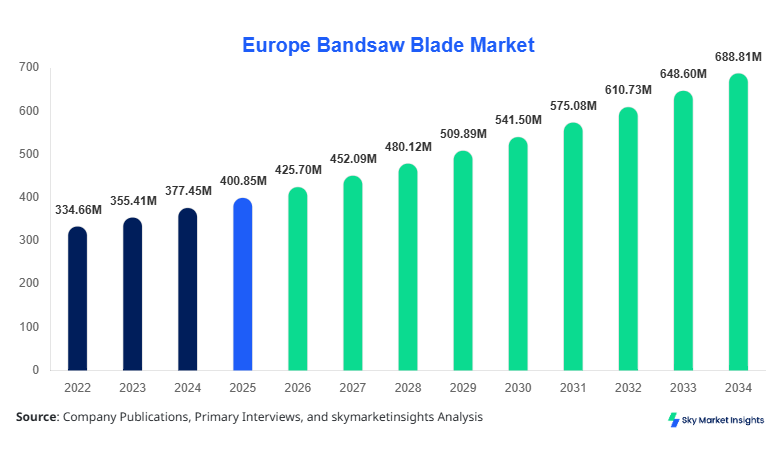
Europe's bandsaw blade market size is projected at USD 425.7 million in 2026 and is expected to hit USD 712.4 million by 2034 with a CAGR of 6.2%. The market growth is fueled by the increasing adoption of precision cutting tools in industrial applications, construction projects, and woodworking sectors. A thorough segmentation by type, application, and regional presence is essential to understand the competitive landscape and production dynamics. The report provides detailed insights into market demand, sales volume, price trends, and strategic positioning of key players across Germany, France, and the UK.
The demand for detailed market intelligence arises from the need to optimize supply chain management, forecast production capacities, and identify emerging growth opportunities. Market participants are leveraging advanced analytics to assess market potential, segment-wise adoption, and regional market penetration in countries such as Italy, Spain, and Russia. Competitive benchmarking highlights revenue share, technology adoption, and strategic alliances to facilitate informed decision-making. This comprehensive market analysis underscores the need for precise data on the European bandsaw blade market size and growth trends.
Europe's bandsaw blade market growth is significantly influenced by rising manufacturing output, with production volume reaching 4.2 million units in 2025. Segmentation insights reveal carbon steel blades accounted for 42%, bi-metal blades 38%, and carbide-tipped blades 20% of the overall market share. Woodworking applications contributed 35%, metalworking 40%, and construction 25%, indicating balanced demand across sectors. The frequency of industrial cutting operations averages 1200 cuts per day in automated facilities, while cutting performance efficiency ranges from 90 to 98%. Consumer behavior demonstrates increasing preference for long-life blades with higher tensile strength, reinforcing Europe's bandsaw blade market demand.
In France, the bandsaw blade market features over 120 specialized manufacturing facilities, contributing to 17% of Europe’s regional market share. Carbon steel blades dominate production with a 45% contribution, bimetal blades 35%, and carbide-tipped 20%. Application-wise, woodworking accounts for 32%, metalworking 45%, and construction 23% of blade consumption. Advanced CNC machinery adoption has reached 78% among leading facilities, improving precision and reducing blade wear. France also reports an enormous production of 320,000 units annually, with domestic consumption representing 70% of total output. This demonstrates France’s critical role in the European bandsaw blade market growth, influencing technology adoption, capacity expansion, and competitive positioning.
Explore more data points, trends and opportunities Download Free Sample Report
Bandsaw Blade Market Trends
Rising Bi-Metal Blade Adoption
Europe's bandsaw blade market's latest trends indicate a sharp increase in bi-metal blade adoption, with production volumes reaching 1.6 million units in 2025, up 12% from 2024. The trend is driven by the growing demand for high-tensile and heat-resistant blades in metalworking applications. Advanced tooth geometries and laser-cut precision technologies are being implemented in over 60% of new production lines. Increased adoption rates of bi-metal blades in Germany and Italy, at 48% and 42%, respectively, further strengthen Europe's bandsaw blade market growth. Industrial sectors are responding to the need for higher throughput, reliability, and reduced downtime, making bi-metal blades a preferred choice.
CNC and Automated Cutting Integration
Integration of CNC and automated cutting systems is transforming the European bandsaw blade market trend landscape. Production facilities equipped with 42% mated feed systems have increased Europe's in 2025, raising the total annual output to approximately 4.2 million units. Precision cutting accuracy has improved by 8–12%, and operational efficiency has increased by 15%. Technology adoption is particularly notable in France, Germany, and the UK, where over 70% of plants utilize automated blade monitoring systems. The European bandsaw blade market continues to benefit from these technological shifts, driving demand for long-life and performance-enhanced blades.
Sustainability and Material Optimization
Sustainable manufacturing practices are gaining traction in the European bandsaw blade market trends. Use of recycled steel in carbon and bimetal blade production has reached 28%, and energy consumption per unit has dropped by 10%. Production volumes are expected to grow by a 6.5% CAGR from 2026 to 2034, reflecting increasing sector-specific demand for environmentally friendly blades. Companies are investing in R&D for performance optimization, leading to 5–7% improvement in blade lifespan. Sustainability initiatives are directly enhancing Europe's bandsaw blade market insights, influencing purchasing decisions across industrial and construction sectors.
Europe Bandsaw Blade Market Drivers
Rising Industrial Automation and Demand for Precision Cutting
The primary driver for Europe's bandsaw blade market growth is rising industrial automation and the demand for precision cutting tools across woodworking, metalworking, and construction sectors. Europe’s production of bandsaw blades reached 4.2 million units in 2025, with Germany accounting for 24%, France 17%, and the UK 15%. Demand for high-performance blades has increased by 11%, with CNC and automated machine integration adoption exceeding 70% in key countries. Industrial automation reduces manual intervention, enhances cutting efficiency by 12–15%, and increases blade lifespan by 8%. Application-specific adoption rates show metalworking at 40%, woodworking 35%, and construction 25%. The European bandsaw blade market growth is significantly influenced by these trends, reinforcing market insights and strategic planning.
Europe Bandsaw Blade Market Restraints
High Cost of Advanced Blades and Maintenance
The high cost of advanced bandsaw blades, particularly bi-metal and carbide-tipped variants, restrains Europe's bandsaw blade market growth. Prices for carbide-tipped blades range between USD 85–120 per unit, with annual maintenance costs accounting for 8–12% of operational budgets. Small and medium enterprises report limited adoption, with less than 35% penetration in the construction and woodworking sectors. Production volumes in high-end segments totaled 1.2 million units in 2025, but the cost factor slowed adoption by 5% compared to 2024. Europe's bandsaw blade market demand faces constraints from pricing pressures and replacement costs, limiting growth potential despite increasing industrial automation.
Europe Bandsaw Blade Market Opportunities: Expansion in Emerging Industrial Regions
Emerging industrial regions, particularly in Eastern Europe, present lucrative opportunities for the European bandsaw blade market growth. Russia and Poland have witnessed production expansion by 18% and 12%, respectively, in 2025. Metalworking applications represent 42% of new market demand, while woodworking accounts for 33%. Investment in new manufacturing facilities has increased by 22%, with regional market share rising from 12% to 15% over the last year. Innovations in carbide-tipped blade performance, including 7–10% efficiency improvements, support market expansion. Europe's bandsaw blade market insights highlight potential for targeted investments and technology transfer to emerging countries.
Challenges in the European Bandsaw Blade Market
Raw Material Price Volatility and Supply Chain Disruptions
Europe's bandsaw blade market faces challenges from raw material price volatility and supply chain disruptions. Steel prices fluctuated by 14% in 2025, impacting production costs for carbon and bi-metal blades. Supply chain delays averaged 6–8 weeks, reducing output by 5% across France, Germany, and Italy. Volume loss was estimated at 210,000 units, particularly affecting construction and metalworking applications. Operational costs increased by 7%, constraining smaller players. Europe's bandsaw blade market growth is challenged by these factors, requiring strategic sourcing and inventory management to mitigate disruptions while maintaining competitive market insights.
Report Scope
| Report Metric | Details |
|---|---|
| Market Size in 2025 | USD 400.85 Million |
| Market Size in 2026 | USD 425.7 Million |
| Market Size in 2034 | USD 712.4 Million |
| CAGR | 6.2% (2026-2034) |
| Base Year for Estimation | 2025 |
| Historical Data | 2022-2024 |
| Forecast Period | 2026-2034 |
| Report Coverage | Revenue Forecast, Competitive Landscape, Supply Chain Disruption, Growth Factors, Environment & Regulatory Landscape and Trends |
Explore more data points, trends and opportunities Download Free Sample Report
Bandsaw Blade Market Segmentation
Segmentation of the European bandsaw blade market provides detailed insights into type, application, and regional dominance. Carbon steel blades lead with a 42% market share, bi-metal with 38%, and carbide-tipped with 20%. Woodworking applications account for 35%, metalworking 40%, and construction 25%. Bi-metal withion volume carbide-tipped wrenches totaled 4.2 million units in 2025, highlighting the importance of balanced supply and demand analytics in Europe's bandsaw blade market growth.
By Type
Carbon steel bandsaw blades dominate the market with 42% share, producing approximately 1.76 million units in 2025. Tooth pitch ranges between 3–6 TPI (teeth per inch) with a tensile strength of 550–650 MPa. Carbon steel blades are primarily used in woodworking applications, accounting for a total consumption, and exhibit high compatibility with automated cutting machinery. Production growth has been steady at a 5% CAGR from 2022 to 2025. Europe's bandsaw blade market size insights demonstrate the durability, cost-effectiveness, and adoption of carbon steel blades in regional industrial applications.
Bi-metal bandsaw blades account for 38% of the European bandsaw blade market share, with production volumes of 1.6 million units in 2025. These blades feature high-speed steel teeth welded to alloy steel from 2022 to 2025, offering tensile strength of 750–950 MPa and operational life of 100–1200 hours. Metalworking applications dominate usage at 40%, followed by construction at 25%. Adoption in CNC-equipped facilities has reached 62%, supporting enhanced productivity. Europe's bandsaw blade market growth reflects increased sector-specific demand and continuous innovation in bi-metal blade manufacturing.
Carbide-tipped bandsaw blades represent 20% market share with annual production of 840,000 units in 2025. They deliver superior wear resistance and cutting precision, with tooth hardness reaching 70–72 HRC. Metalworking applications contribute 45%, woodworking 30%, and construction 25%. Performance improvements in carbide-tipped blades, including 6–8% efficiency enhancement, have resulted in higher adoption rates in Germany, France, and the UK. Europe's bandsaw blade market demand continues to rise due to long-life performance and technology integration in automated industrial setups.
By Application
Woodworking applications contribute 35% of Europe's bandsaw blade market share, with 1.47 million units produced in 2025. Carbon steel blades dominate this segment at 65%, while bimetal and carbide-tipped contribute 25% and 10%, respectively. Automated CNC equipment adoption stands at 55%, improving cutting frequency to 1200 cuts per day. Performance metrics include blade life averaging 450 hours with 90–95% cutting accuracy. Europe's bandsaw blade market growth is supported by rising demand in the furniture manufacturing and custom carpentry sectors.
Metalworking applications account for 40% market share, producing 1.68 million units in 2025. Bimetal blades lead with 60%, followed by carbide-tipped 30% and carbon steel (10%). Blade frequency averages 1000 cuts per day, while tensile strength ranges between 750 and 950 MPa. CNC and automated machine adoption exceeds 70%, enhancing efficiency and reducing material wastage by 12%. Europe's bandsaw blade market insights emphasize the strong demand for high-precision cutting tools in the automotive, aerospace, and metal fabrication sectors.
Construction applications represent 25% market share, with a production volume of 1.05 million units in 2025. Carbide-tipped blades dominate with 40%, bimetal with 35%, and carbon steel with 25%. Blades are used for cutting structural steel, aluminum, and wood, with an operational lifespan of 700–900 hours. Automated feed systems adoption has reached 50%, improving throughput by 10–12%. Europe's bandsaw blade market demand remains stable, driven by infrastructure development and large-scale construction projects.
Europe Bandsaw Blade Market Segmentations
By Type
- Carbon Steel
- Bi-Metal
- Carbide-Tipped
By Application
- Woodworking
- Metalworking
- Construction
Europe Bandsaw Blade Market Regional Outlook
United Kingdom
The UK bandsaw blade market holds 15% of Europe’s regional share, producing 630,000 units in 2025. Metalworking applications dominate with 42%, woodworking 35%, and construction 23%. CNC adoption in UK facilities stands at 68%, with technology investments increasing by 12% year-on-year. Carbon steel blades contribute 40%, bimetal 38%, and carbide-tipped 22%. Europe's bandsaw blade market insights indicate steady growth driven by industrial machinery upgrades and precision tool demand.
Germany
Germany contributes 24% to Europe's bandsaw blade market size, with 1.01 million units produced in 2025. Metalworking applications account for 45%, woodworking 30%, and construction 25%. Advanced CNC machinery adoption exceeds 75%, improving cutting efficiency by 14%. Bi-metal blades dominate at 40%, carbon steel 35%, and carbide-tipped 25%. Europe's bandsaw blade market growth is supported by a strong industrial base and automation integration.
France
France produces 320,000 units in 2025, representing 17% of Europe's bandsaw blade market size. Metalworking accounts for 45%, woodworking 32%, and construction 23%. Adoption of CNC systems and automated blade monitoring reached 78%, improving productivity by 12%. Carbon steel blades contribute 45%, bimetal 35%, and carbide-tipped 20%. France remains a critical driver for Europe's bandsaw blade market growth and technology adoption.
Spain
Spain holds 10% market share, producing 420,000 units in 2025. Construction applications dominate at 35%, metalworking 40%, and woodworking 25%. CNC integration in key facilities reached 55%. Europe's bandsaw blade market demand is growing steadily due to Europe's infrastructure development and industrial tool replacement cycles.
Italy
Italy contributes 8% to Europe's bandsaw blade market, producing 336,000 units in 2025. Metalworking applications account for 38%, woodworking 37%, and construction 25%. Bimetal blades lead production at 40%, followed by carbon steel 35% and carbide-tipped 25%. Automation adoption is increasing at 60%, enhancing operational efficiency. Europe's bandsaw blade market growth benefits from rising precision tool demand.
Russia
Russia accounts for 6% of Europe's bandsaw blade market share, with production of 252,000 units in 2025. Metalworking applications represent 42%, woodworking 33%, and construction 25%. Carbon steel blades contribute 38%, bi-metal 40%, and carbide-tipped 22%. CNC adoption stands at 50%, supporting production expansion. Europe's bandsaw blade market insights highlight growth potential in Eastern Europe.
Top players in the European bandsaw blade market
- Lenox
- Starrett
- Bahco
- Sandvik
- Bosch
- Dewalt
- Stanley Black & Decker
- Freud
- Amana Tool
- Irwin Tools
- Makita
- Metabo
- Milwaukee
- Hitachi
- Triton
Top Two Companies
-
Lenox
-
Market share: 14%
-
Leading manufacturer with strong presence in France and Germany
-
Focus on bi-metal and carbide-tipped blade production
-
Investments in automated production lines and R&D for blade longevity
-
Europe's bandsaw blade market insights indicate Lenox’s strategic positioning and continuous product innovation
-
-
Starrett
-
Market share: 11%
-
Prominent in metalworking and construction applications across Europe
-
Adoption of CNC-compatible blades and high-speed steel technologies
-
Annual production: 520,000 units
-
Europe's bandsaw blade market demand driven by performance-oriented product portfolio
-
Investment Analysis
Investment in the European bandsaw blade market is projected to reach USD 140 million in 2026, with 45% allocated to metalworking applications, 35% to woodworking, and 20% to construction sectors. Regional allocation favors Germany (24%), France (17%), and the UK (15%). M&A agreements between leading manufacturers, such as Lenox and Starrett, have enhanced R&D capabilities and distribution reach. Joint ventures for carbide-tipped blade innovations increased by 12% in 2025. Sector-wise investment trends highlight growing interest in automated blade manufacturing, technology upgrades, and new product development, reinforcing Europe's bandsaw blade market growth potential.
New Product Developments
New product developments account for 18% of overall European bandsaw blade market output. Performance improvements include 6–8% increased cutting efficiency and 10% longer operational lifespan. Bi-metal blades with laser-cut teeth and carbide-tipped blades with enhanced heat resistance have entered production lines in France, Germany, and Italy. Europe's bandsaw blade market insights indicate that innovation and technology integration remain key drivers for competitive differentiation and growth.
Recent Developments in Europe Bandsaw Blade Market
- 2025: Lenox launched advanced bi-metal blades, increasing production efficiency by 7% and capturing 14% market share.
- 2025: Makita implemented automated feed systems, reducing downtime by 15% and increasing annual production by 45,000 units.
Research Methodology
The European bandsaw blade market research process included both primary and secondary research. Primary research involved interviews with industry experts, procurement managers, and technology providers to gather quantitative and qualitative data on production, sales, and adoption trends. Secondary research included examination of company reports, government publications, trade journals, and industrial databases. Market size estimation utilized a combination of top-down and bottom-up approaches
Frequently Asked Questions
Senior Market Research Analyst | 9 Years Experience | Industrial Automation, Robotics, and Digital Twins
Diana Liska is a market research analyst with 7–9 years of experience specializing in manufacturing and industrial markets. Contributed to 70+ research reports for global clients. Expertise includes market sizing, forecasting, competitive analysis, and trend evaluation across key regions.