Europe's Assisted Reproductive Technology Market Size
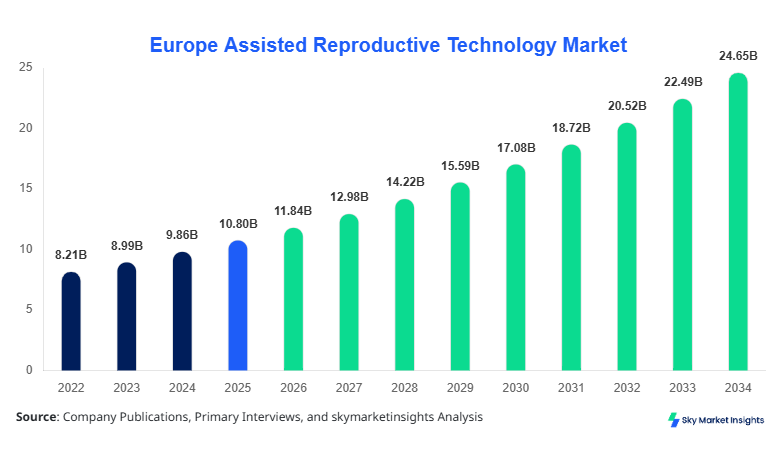
Europe Assisted Reproductive Technology market size is projected at USD 11.84 billion in 2026 and is expected to hit USD 24.67 billion by 2034 with a CAGR of 9.6%.
The Europe-assisted reproductive technology industry is witnessing strong expansion due to rising infertility prevalence, delayed parenthood trends, increasing fertility tourism, and technological advancements in embryo screening and cryopreservation. More than 1.2 million assisted reproductive cycles are performed annually across Europe, with IVF procedures accounting for nearly 71% of the total treatment volume. The market evaluation includes detailed segmentation by treatment type and end-use application along with comprehensive assessment of clinic infrastructure, treatment success rates, reimbursement frameworks, and competitive positioning among leading fertility service providers and equipment manufacturers.
The assisted reproductive technology industry refers to medical procedures and technologies used to address infertility and enable conception through clinical intervention. These technologies include in vitro fertilization, intracytoplasmic sperm injection, sperm donation, egg freezing, embryo cryopreservation, and fertility surgeries. Europe accounts for approximately 31% of global fertility treatment procedures, with over 8,000 specialized fertility centers operating across the region in 2025. The United Kingdom, Germany, and France collectively contributed nearly 58% of regional treatment cycles due to strong healthcare expenditure and advanced fertility infrastructure.
Adoption and penetration of fertility procedures have increased substantially across Europe, particularly among women aged 30–42 years. IVF penetration reached 18.6 cycles per 1,000 women of reproductive age in 2025 compared to 13.2 cycles in 2022. Egg freezing procedures increased by 22% annually owing to growing career-oriented lifestyles and rising awareness regarding fertility preservation. Approximately 63% of European fertility clinics integrated AI-based embryo grading systems in 2025, while genetic screening utilization crossed 47% across premium fertility treatment centers. Frozen embryo transfer procedures represented nearly 41% of total IVF cycles due to improved implantation outcomes and reduced hormonal stimulation requirements.
Consumer behavior patterns indicate increasing willingness to spend on fertility preservation and reproductive healthcare. Around 54% of fertility patients in Europe opted for private treatment pathways due to waiting periods in public healthcare systems. Treatment success rates ranging from 32% to 48% per cycle for women below 35 years have encouraged repeated treatment adoption. Fertility clinics represented nearly 64% of procedure volume, while hospitals accounted for 24% and surgical centers held approximately 12% share. IVF remained the dominant procedure with nearly 71% contribution, followed by artificial insemination at 18% and fertility surgeries at 11%, reinforcing long-term Assisted Reproductive Technology market expansion.
Explore more data points, trends and opportunities Download Free Sample Report
Assisted Reproductive Technology Market Trends
Rising Adoption of AI-Integrated Fertility Platforms
Artificial intelligence integration across embryo assessment and treatment planning platforms has emerged as a major transformation trend in European fertility clinics. More than 3,400 fertility laboratories implemented AI-supported embryo grading systems during 2025, representing nearly 63% adoption among advanced fertility centers. Time-lapse embryo imaging systems improved embryo selection precision by approximately 22%, while predictive analytics reduced failed implantation cycles by 17%. Digital fertility management platforms processed over 14 million patient records annually, supporting personalized hormonal stimulation protocols and reproductive diagnostics. AI-based sperm quality analysis systems improved detection accuracy by 26% compared to conventional microscopy procedures. Germany, the UK, and France collectively represented nearly 61% of AI fertility technology deployments across Europe, strengthening the Assisted Reproductive Technology market expansion.
Expansion of Fertility Preservation Procedures
Fertility preservation has emerged as one of the fastest-growing procedural categories due to delayed pregnancies and increasing oncology-linked fertility preservation requirements. Egg freezing procedures exceeded 320,000 annual cycles across Europe in 2025, recording a 24% increase compared to 2023 levels. Women below the age of 35 represented approximately 58% of social egg freezing demand, while cancer-related fertility preservation accounted for 18% of procedures. Cryogenic storage facilities expanded by nearly 29% across fertility networks to support long-term gamete preservation requirements. Advanced vitrification technologies improved oocyte survival rates to nearly 92%, compared to 78% with older freezing techniques. Spain and the United Kingdom collectively accounted for more than 37% of fertility preservation procedures due to liberal reproductive regulations and rising awareness regarding reproductive planning, supporting assisted reproductive technology market development.
Increasing Cross-Border Fertility Tourism
Cross-border reproductive treatment demand continues to expand due to varying reimbursement structures, donor regulations, and treatment accessibility across European countries. Fertility tourism procedures crossed 145,000 annual treatment cycles in 2025, with Spain accounting for nearly 32% of international fertility patients. Donor egg cycles represented approximately 41% of fertility tourism demand, while surrogacy-linked reproductive arrangements increased by 13% annually. Average spending per international fertility patient ranged between USD 8,000 and USD 18,000 depending on treatment complexity and genetic testing requirements. International patient inflows to fertility clinics in Greece, Spain, and the UK contributed significantly to procedural volumes and infrastructure expansion. Increasing multilingual fertility consultation services and digital telemedicine integration continue to accelerate assisted reproductive technology market penetration.
Europe's Assisted Reproductive Technology Market Drivers
Increasing Infertility Rates and Delayed Parenthood
Rising infertility prevalence across Europe remains one of the strongest growth stimulators for reproductive healthcare procedures. Nearly 25 million couples across Europe experience infertility-related complications, with male infertility contributing to around 42% of diagnosed cases. Delayed parenthood trends have significantly influenced fertility treatment demand, as the average maternal age at first childbirth reached 31.4 years in 2025 compared to 29.8 years in 2020. Women above 35 years represented approximately 46% of IVF treatment demand due to declining ovarian reserve and increased pregnancy complications. Lifestyle-related disorders, including obesity, stress, alcohol consumption, and smoking, have further elevated infertility incidence rates by nearly 18% during the last five years. More than 1.2 million assisted reproductive procedures were conducted annually across Europe, with IVF cycles increasing at 11% yearly growth. Public healthcare investments and broader insurance reimbursement for infertility treatments continue to improve accessibility among middle-income populations, accelerating assisted reproductive technology market expansion.
Europe's Assisted Reproductive Technology Market Restraints
High Treatment Costs and Regulatory Limitations
Despite increasing demand, high treatment expenditure remains a major barrier for widespread fertility treatment adoption across Europe. Average IVF cycle costs range between USD 4,500 and USD 9,000 depending on country-specific regulations and genetic testing requirements. Approximately 38% of fertility patients discontinue treatment after one failed cycle due to financial constraints. Advanced procedures, including preimplantation genetic testing and donor egg programs, can increase total treatment expenditure by nearly 45%. Variability in reimbursement policies across Europe creates unequal access to fertility care, particularly in Eastern European countries where public healthcare support remains limited. Regulatory restrictions related to embryo storage, donor anonymity, and surrogacy procedures further impact treatment accessibility. Around 27% of fertility clinics reported delays in expansion due to stringent laboratory licensing requirements and compliance costs. Workforce shortages involving embryologists and reproductive endocrinologists also restrict procedural capacity, limiting Assisted Reproductive Technology market penetration.
Europe's Assisted Reproductive Technology Market Opportunities
Expansion of Fertility Preservation and Personalized Reproductive Care
The growing preference for fertility preservation and precision reproductive medicine is creating substantial long-term business opportunities across Europe. Social egg freezing demand increased by nearly 24% annually between 2022 and 2025, while embryo cryopreservation procedures surpassed 510,000 cycles annually. Personalized fertility treatment protocols using genomic testing and AI-supported hormone optimization improved implantation outcomes by approximately 19%. Oncology-linked fertility preservation programs are expanding rapidly, with nearly 110,000 cancer patients opting for reproductive preservation services annually. Digital reproductive health platforms and teleconsultation services increased fertility patient engagement by nearly 31%, especially among women aged between 28 and 38 years. Investment inflows into fertility startups exceeded USD 2.1 billion across Europe during 2025, particularly in AI embryo analysis, cryogenic storage, and genetic diagnostics technologies. Expanding same-sex parenting procedures and donor programs continue to widen assisted reproductive technology market opportunities.
Challenges in Europe Assisted Reproductive Technology Market
Ethical Concerns and Limited Skilled Workforce Availability
Ethical and workforce-related concerns remain significant operational challenges within the reproductive healthcare ecosystem. Regulatory differences across Europe regarding embryo research, donor anonymity, and genetic screening procedures create operational complexity for multinational fertility providers. Approximately 21% of fertility treatment providers reported delays in obtaining procedural approvals due to ethical review requirements. Public concerns regarding embryo selection technologies and genetic manipulation continue to influence policy debates in Germany, France, and Italy. Simultaneously, Europe faces a shortage of qualified embryologists and reproductive specialists, with nearly 14% vacancy rates reported across advanced fertility laboratories. Training periods for embryologists exceed 5 years in several European countries, slowing workforce replenishment. Rising operational expenditure related to laboratory automation, cryogenic systems, and compliance monitoring further pressures clinic profitability. These structural limitations continue to challenge Assisted Reproductive Technology market scalability across the region.
Report Scope
| Report Metric | Details |
|---|---|
| Market Size in 2025 | USD 10.80 Billion |
| Market Size in 2026 | USD 11.84 Billion |
| Market Size in 2034 | USD 24.67 Billion |
| CAGR | 9.6% (2026-2034) |
| Base Year for Estimation | 2025 |
| Historical Data | 2022-2024 |
| Forecast Period | 2026-2034 |
| Report Coverage | Revenue Forecast, Competitive Landscape, Supply Chain Disruption, Growth Factors, Environment & Regulatory Landscape and Trends |
Explore more data points, trends and opportunities Download Free Sample Report
Assisted Reproductive Technology Market Segmentation
The assisted reproductive technology industry is segmented by type and application, with IVF procedures dominating approximately 71% of regional treatment volume due to higher success rates and broader adoption across fertility clinics. Fertility clinics represented nearly 64% of total procedural demand owing to specialized reproductive laboratories and advanced embryo handling capabilities.
By Type
In vitro fertilization remained the largest procedural segment, contributing nearly 71% of regional procedure volume in 2025. More than 870,000 IVF cycles were performed annually across Europe, supported by improved implantation technologies and wider reimbursement coverage. Frozen embryo transfer procedures represented approximately 41% of IVF treatments, while intracytoplasmic sperm injection accounted for nearly 58% of advanced IVF interventions. IVF laboratory incubation systems maintained temperature stability within ±0.1°C and humidity control above 95% for embryo preservation efficiency. AI-supported embryo grading technologies improved embryo viability assessment by approximately 22%, enhancing clinical pregnancy rates. Women aged between 32 and 39 years represented nearly 52% of IVF treatment recipients. Spain, the United Kingdom, and Germany collectively accounted for over 57% of total IVF cycles performed across Europe.
Artificial insemination represented approximately 18% of the procedural mix owing to lower treatment costs and simplified clinical requirements. More than 215,000 insemination cycles were conducted during 2025, primarily involving intrauterine insemination procedures. Procedure success rates ranged between 12% and 18% per cycle depending on patient age and fertility conditions. Donor sperm programs represented nearly 37% of insemination procedures, particularly among single-parent and same-sex family groups. Digital semen analysis systems improved motility assessment precision by nearly 19%, while automated sperm washing systems reduced contamination risk by approximately 15%. France and the UK collectively contributed nearly 44% of insemination procedures across Europe.
Fertility surgery procedures accounted for approximately 11% of treatment volume due to rising adoption of minimally invasive reproductive interventions. More than 128,000 fertility surgeries including laparoscopy, hysteroscopy, and varicocele correction were performed across Europe during 2025. Robotic-assisted fertility surgeries improved precision by nearly 21% while reducing recovery time by approximately 28%. Endometriosis-related fertility surgeries represented 39% of total surgical interventions, followed by tubal reconstruction at 24%. Italy and Germany accounted for substantial fertility surgery demand owing to advanced surgical infrastructure and reimbursement support.
By Application
Fertility clinics dominated the application landscape with nearly 64% regional share due to specialized reproductive laboratories and integrated embryology services. Europe operated over 8,000 fertility clinics and assisted reproduction facilities in 2025. These clinics processed approximately 930,000 treatment cycles annually, supported by advanced cryogenic systems, genetic testing laboratories, and AI-based embryo monitoring platforms. Average embryo implantation success rates at specialized fertility clinics ranged between 36% and 48% for women under 35 years. More than 67% of fertility clinics integrated digital patient monitoring systems and teleconsultation platforms for treatment optimization. Private fertility chains accounted for nearly 58% of clinic revenue generation due to premium treatment packages and donor programs.
Hospitals represented approximately 24% of assisted reproductive technology procedure volume owing to integrated reproductive surgery capabilities and multidisciplinary infertility management. More than 1,700 hospital-based fertility units operated across Europe during 2025, conducting nearly 310,000 fertility-related procedures annually. Public hospitals contributed significantly to IVF reimbursement-supported cycles in France, Germany, and Italy. Hospitals maintained advanced surgical reproductive care capabilities, including robotic laparoscopy and hysteroscopic interventions. Male infertility management procedures represented approximately 29% of hospital fertility services due to integrated urology departments and reproductive endocrinology programs.
Surgical centers accounted for nearly 12% of the market due to growing demand for outpatient reproductive surgeries and minimally invasive fertility procedures. Approximately 126,000 fertility surgeries and outpatient reproductive interventions were performed at dedicated surgical centers during 2025. These facilities improved patient turnover efficiency by nearly 31% compared to hospital-based surgical units. Advanced robotic surgery systems and precision imaging technologies improved procedural success rates while reducing post-operative complications by approximately 18%. Spain and Italy represented strong adoption centers for outpatient fertility surgical procedures.
Europe Assisted Reproductive Technology Market Segmentations
Type
- In Vitro Fertilization
- Artificial Insemination
- Fertility Surgery
Application
- Fertility Clinics
- Hospitals
- Surgical Centers
Europe Assisted Reproductive Technology Market Country Outlook
United Kingdom
The United Kingdom accounted for approximately 28% of the Europe Assisted Reproductive Technology industry revenue during 2025 due to advanced fertility infrastructure and strong private healthcare participation. More than 92,000 IVF cycles and 18,000 insemination procedures were conducted annually across over 480 licensed fertility centers. Women aged 35–40 years represented nearly 48% of fertility treatment demand, while donor-assisted procedures accounted for approximately 19% of total cycles. Private fertility chains controlled nearly 57% of treatment volume, supported by AI-enabled embryo selection and expanded cryogenic preservation services. The UK also represented one of the leading fertility tourism destinations in Europe.
Germany
Germany contributed nearly 19% of regional fertility treatment procedures owing to advanced reproductive diagnostics and strong healthcare expenditure. More than 220 fertility clinics operated across the country, performing approximately 145,000 assisted reproductive cycles annually. IVF procedures accounted for nearly 69% of treatment demand, while fertility surgeries represented around 14%. Germany maintained high adoption of automated embryo culture systems and genetic screening technologies. Public-private healthcare reimbursement models supported approximately 43% of fertility procedures performed annually.
France
France represented approximately 16% of the regional procedural landscape due to strong public reimbursement frameworks and broad fertility accessibility. More than 170,000 assisted reproductive procedures were conducted annually across public hospitals and private fertility centers. IVF cycles represented nearly 72% of total procedures, while insemination procedures accounted for 20%. Government-supported fertility coverage significantly increased treatment accessibility among middle-income households. France also demonstrated strong donor program participation and high utilization of embryo cryopreservation technologies.
Spain
Spain accounted for nearly 15% of regional revenue and remained Europe’s largest fertility tourism destination. More than 150,000 reproductive treatment cycles were conducted annually, with donor egg programs contributing approximately 34% of procedural demand. Spain maintained liberal reproductive regulations and advanced donor matching infrastructure, attracting international fertility patients from across Europe and the Middle East. AI-assisted embryo analysis systems achieved penetration rates above 61% among premium fertility clinics.
Italy
Italy represented approximately 12% of the regional fertility treatment ecosystem due to increasing infertility prevalence and rising private clinic investments. More than 110,000 reproductive treatment cycles were performed annually, with IVF accounting for nearly 68% of procedures. Fertility surgery demand remained strong owing to high endometriosis prevalence and expanding robotic surgical infrastructure. Private fertility operators contributed nearly 63% of treatment volume across the country.
Russia
Russia accounted for nearly 10% of the Europe Assisted Reproductive Technology procedural volume due to expanding fertility clinic infrastructure and rising infertility awareness. More than 95,000 assisted reproductive cycles were conducted annually, supported by increasing adoption of IVF and embryo freezing technologies. Fertility treatment demand increased by approximately 13% annually between 2022 and 2025. Moscow and Saint Petersburg represented major fertility treatment hubs with advanced reproductive laboratories and donor programs.
Top players in Europe Assisted Reproductive Technology Market
- Vitrolife AB
- CooperSurgical Inc.
- Merck KGaA
- Ferring Pharmaceuticals
- Irvine Scientific
- Cook Medical
- FUJIFILM Irvine Scientific
- NidaCon International
- Hamilton Thorne Ltd.
- Genea Limited
- Bloom Fertility Centre
- IVI RMA Global
- CARE Fertility Group
- Virtus Health
- Thermo Fisher Scientific
Vitrolife AB
- Vitrolife AB accounted for approximately 11% of the regional fertility technology supply ecosystem in 2025.
- The company maintains strong positioning in embryo culture media, time-lapse imaging systems, and cryopreservation technologies.
- Vitrolife supported more than 320,000 IVF cycles annually through laboratory consumables and embryo management systems.
- Its AI-integrated embryo selection technologies improved implantation precision by nearly 18%.
- The company expanded its European fertility laboratory network partnerships by approximately 14% during 2025.
CooperSurgical Inc.
- CooperSurgical Inc. represented nearly 9% of the European fertility equipment and consumables segment.
- The company maintains extensive presence across IVF media, reproductive genetics, and embryo incubation technologies.
- CooperSurgical products supported over 270,000 annual fertility procedures across Europe.
- Its reproductive genetic testing platforms improved embryo screening efficiency by nearly 21%.
- Strategic acquisitions and fertility clinic collaborations strengthened the company’s procedural ecosystem integration across the UK, Germany, and Spain.
Investment Analysis
Investment inflows into European fertility healthcare infrastructure increased significantly during 2025, crossing USD 4.8 billion in annual allocation. Fertility clinics accounted for approximately 46% of total investment allocation, followed by reproductive diagnostics at 24%, cryogenic storage infrastructure at 17%, and AI fertility technologies at 13%. Private equity participation in fertility clinic consolidation increased by nearly 29%, particularly in the United Kingdom, Spain, and Germany. Venture capital investments into digital fertility management platforms surpassed USD 820 million.
Mergers, acquisitions, and strategic collaborations remain highly active within the reproductive healthcare ecosystem. Approximately 38 fertility clinic acquisition transactions were completed across Europe during 2025, with private fertility groups expanding cross-border operational networks. Spain represented nearly 27% of fertility clinic acquisition activity due to rising international treatment demand. Technology collaborations between AI software providers and embryology laboratories increased by 22%, enabling improved embryo analytics and personalized treatment optimization. Pharmaceutical companies also expanded partnerships with fertility clinics for hormone therapy distribution and reproductive diagnostics integration.
Institutional investors allocated approximately 34% of reproductive healthcare funding toward IVF laboratory automation and embryo cryopreservation technologies. Germany and the UK collectively attracted nearly 49% of fertility technology investment due to advanced healthcare infrastructure and high treatment volumes. Public healthcare systems also increased reimbursement support for fertility preservation and donor programs, enhancing treatment accessibility and encouraging the Assisted Reproductive Technology industry expansion.
New Product Developments
Fertility technology companies accelerated innovation across AI embryo monitoring systems, cryogenic preservation platforms, and reproductive genetic testing solutions during 2025. More than 31% of newly launched fertility products focused on automation and digital workflow optimization. AI-integrated embryo grading systems improved embryo selection accuracy by approximately 24%, while next-generation incubators reduced contamination risk by nearly 17%.
Advanced vitrification media and ultra-rapid freezing systems improved oocyte survival rates above 92%, compared to older generation preservation systems operating below 80%. Reproductive genetic testing kits demonstrated nearly 28% faster embryo analysis turnaround times. More than 42% of fertility clinics across Europe adopted at least one new digital reproductive technology platform during 2025, reflecting accelerating innovation across the Assisted Reproductive Technology ecosystem.
Recent Developments in Europe Assisted Reproductive Technology Market
- In 2025, Vitrolife AB expanded its AI embryo imaging platform deployment across 140 European fertility clinics, improving embryo viability prediction accuracy by approximately 20% and supporting over 95,000 annual IVF cycles. The expansion significantly increased laboratory automation efficiency and strengthened digital fertility workflow adoption across the region.
- In 2025, IVI RMA Global invested more than USD 180 million into fertility clinic expansion across Spain and Italy, increasing annual procedural capacity by approximately 18%. The company also enhanced donor egg banking capabilities and expanded fertility tourism services, supporting international patient inflows.
- In 2025, Merck KGaA expanded reproductive hormone therapy production capacity by approximately 21% to support rising IVF treatment demand across Europe. The expansion strengthened pharmaceutical supply chain stability and improved treatment accessibility among fertility clinics operating high-volume reproductive programs.
Research Methodology
The research methodology for the Europe Assisted Reproductive Technology industry combines extensive primary and secondary research approaches to ensure high data accuracy and analytical reliability. The research process included comprehensive analysis of fertility clinic databases, reproductive healthcare publications, IVF registries, annual reports, government healthcare records, and reproductive medicine associations across Europe. Primary research involved interviews with fertility specialists, embryologists, reproductive endocrinologists, hospital procurement managers, fertility technology providers, and healthcare policy experts to validate treatment volume, pricing structures, and technology adoption trends.
Secondary research incorporated data extraction from healthcare journals, fertility treatment statistics, corporate filings, investment reports, and international reproductive medicine databases. Market size estimation was conducted using bottom-up and top-down analytical frameworks considering annual procedure volume, fertility treatment expenditure, equipment penetration rates, and country-level healthcare infrastructure analysis. Forecasting models evaluated demographic trends, infertility prevalence, reimbursement developments, fertility tourism growth, and technological innovation rates across the European reproductive healthcare ecosystem. Data triangulation and validation techniques were applied to ensure consistency and reliability of quantitative estimates and strategic insights.
Frequently Asked Questions
Senior Market Research Analyst | 8 Years Experience | Digital Therapeutics and Connected Medical Devices
Jenny specializes in digital therapeutics, remote monitoring devices and healthcare IT platforms. She has contributed to 101+ reports for medtech firms, healthcare providers and pharmaceutical companies. Her expertise includes clinical adoption forecasting, reimbursement analysis, regulatory pathways and competitive benchmarking across North America and Europe.