Europe Aspiration & Biopsy Needle Market Size
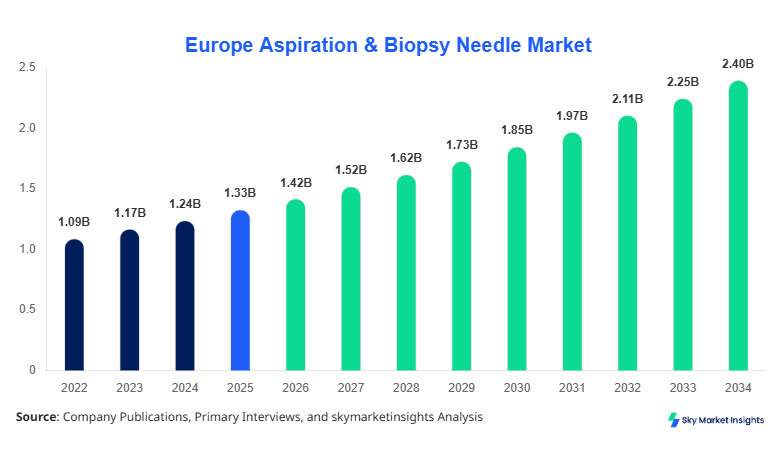
Europe Aspiration & Biopsy Needle market size is projected at USD 1.42 billion in 2026 and is expected to hit USD 2.41 billion by 2034 with a CAGR of 6.8%. The increasing prevalence of cancer diagnostics, rising image-guided biopsy procedures, and expansion of minimally invasive diagnostic technologies are accelerating revenue generation across Europe. More than 18.5 million aspiration and biopsy procedures are estimated to be performed annually across European healthcare facilities, while over 62% of hospitals have integrated ultrasound-guided biopsy systems into oncology workflows. The competitive landscape is characterized by the presence of multinational device manufacturers, regional distributors, and specialized needle technology providers focusing on precision sampling efficiency and reduced tissue trauma.
The aspiration and biopsy needle industry comprises medical devices designed for tissue extraction and cytological analysis in cancer diagnostics, infectious disease evaluation, and organ pathology assessments. Europe produced more than 245 million biopsy and aspiration needles in 2025, with Germany, France, and the United Kingdom accounting for nearly 58% of regional manufacturing capacity. Adoption rates for minimally invasive diagnostic procedures increased by 11.4% between 2023 and 2025 due to rising cancer screening programs and improved reimbursement frameworks. Fine needle aspiration procedures represented approximately 39% of total diagnostic interventions, while core biopsy techniques contributed 44% owing to higher tissue retrieval accuracy.
Consumer behavior and demand analytics indicate that hospitals accounted for nearly 53% of total procurement volumes in 2025, while diagnostic laboratories represented 29% and ambulatory surgical centers held 18%. Breast cancer biopsy applications contributed 31% of total procedural demand, followed by lung biopsy at 24%, prostate biopsy at 19%, liver biopsy at 11%, and other applications at 15%. Needle gauge sizes ranging from 14G to 22G represented over 67% of total unit sales, while ultrasound-guided aspiration systems achieved procedural accuracy rates exceeding 92%. Increasing patient preference for shorter recovery durations and lower post-procedural complications continues to reinforce Europe's aspiration & biopsy needle market expansion.
Explore more data points, trends and opportunities Download Free Sample Report
Europe Aspiration & Biopsy Needle Market Trends
Rising Adoption of Image-Guided Biopsy Procedures
The increasing integration of image-guided biopsy systems across Europe is significantly transforming procedural accuracy and patient outcomes. More than 71% of tertiary hospitals in Europe adopted ultrasound-guided biopsy platforms in 2025 compared with 58% in 2022. CT-guided biopsy procedures increased by 14.2% annually due to rising demand for lung and liver cancer diagnostics. Approximately 8.7 million image-guided biopsy interventions were conducted across Europe during 2025, with Germany and the United Kingdom collectively accounting for over 41% of procedure volumes. Digital navigation-assisted biopsy technologies reduced sampling errors by nearly 22% while decreasing procedure duration from 45 minutes to 28 minutes on average. The integration of robotic needle placement systems increased procedural precision rates beyond 95%, strengthening Europe's aspiration & biopsy needle market development.
Expansion of Disposable and Safety-Enhanced Needle Technologies
Manufacturers are increasingly focusing on disposable aspiration and biopsy needle technologies to reduce infection risks and improve clinical workflow efficiency. Disposable products represented approximately 84% of regional unit sales in 2025 compared with 73% in 2021. Safety-engineered biopsy needles featuring retractable cannulas and anti-contamination coatings witnessed adoption growth of 17.5% annually. Europe produced more than 206 million disposable biopsy needle units in 2025, while stainless-steel precision needle manufacturing expanded by 9.3%. Single-use aspiration needles reduced cross-contamination risks by nearly 68%, supporting procurement preference among hospitals and ambulatory centers. These advancements continue reinforcing Europe's aspiration & biopsy needle market modernization.
Increasing Oncology Screening Programs and Diagnostic Volumes
National cancer screening programs across Europe are increasing biopsy procedure volumes substantially. More than 124 million oncology screening tests were conducted across the region in 2025, resulting in nearly 19 million follow-up aspiration and biopsy interventions. Breast cancer screening represented 38% of total screening programs, while colorectal and lung cancer programs contributed 22% and 17%, respectively. Diagnostic center utilization rates increased from 64% in 2022 to 78% in 2025 due to growing patient awareness and government funding support. Advanced vacuum-assisted biopsy systems improved tissue retrieval volumes by approximately 33%, enabling more accurate pathology analysis and supporting Europe Aspiration & Biopsy Needle market expansion.
Europe Aspiration & Biopsy Needle Market Drivers
Rising Cancer Incidence and Demand for Early Diagnostic Procedures
The increasing burden of cancer across Europe is driving strong demand for aspiration and biopsy needle technologies. More than 4.6 million new cancer cases were reported in Europe during 2025, with breast, lung, colorectal, and prostate cancers representing nearly 63% of diagnoses. Early-stage cancer detection rates improved by 18% between 2022 and 2025 due to expanding biopsy-based diagnostic programs. Hospitals conducted over 11.2 million minimally invasive biopsy procedures in 2025, while diagnostic laboratories processed approximately 26 million tissue samples annually. Fine needle aspiration techniques reduced patient recovery durations by 42% compared with traditional surgical biopsies, enhancing adoption rates across outpatient facilities. Government-supported screening initiatives covering over 68% of eligible European populations are accelerating procedural volumes and procurement of disposable biopsy needles. The growing prevalence of chronic inflammatory diseases and infectious disorders requiring cytological examination further contributes to rising device utilization. Continuous expansion of oncology diagnostics continues strengthening Europe's aspiration & biopsy needle market performance.
Europe Aspiration & Biopsy Needle Market Restraints
High Equipment Costs and Procedural Reimbursement Limitations
Despite increasing demand, high capital investment requirements for advanced biopsy guidance systems remain a significant barrier for smaller healthcare institutions. Integrated robotic biopsy platforms cost between USD 180,000 and USD 420,000 per unit, while advanced vacuum-assisted biopsy systems require annual maintenance expenses exceeding USD 24,000. Nearly 27% of small diagnostic centers in Southern and Eastern Europe reported delays in upgrading biopsy infrastructure due to budget limitations. Reimbursement disparities across regional healthcare systems further restrict adoption rates, particularly in Spain and Italy, where reimbursement coverage for advanced biopsy procedures remains below 72%. Additionally, disposable aspiration needle costs increased by approximately 9.8% between 2023 and 2025 due to raw material inflation and supply chain disruptions. Hospitals also face procurement pressure from rising stainless-steel and polymer costs, which increased manufacturing expenses by 11.3%. These economic limitations continue constraining Europe's aspiration & biopsy needle market expansion.
Europe Aspiration & Biopsy Needle Market Opportunities
Expansion of AI-Assisted Diagnostics and Personalized Oncology
The integration of artificial intelligence and precision oncology diagnostics presents substantial growth opportunities for manufacturers and healthcare providers. AI-assisted biopsy guidance systems improved lesion targeting efficiency by nearly 29% and reduced repeat procedures by 17%. More than 420 European healthcare institutions implemented AI-enabled pathology and biopsy analysis software during 2025. Personalized medicine programs focusing on genomic profiling and molecular diagnostics increased tissue sample demand by 21%, particularly for breast and lung cancer testing. The adoption of vacuum-assisted biopsy systems capable of retrieving larger tissue samples increased by 14.7% annually due to expanding biomarker testing requirements. Investments in smart biopsy platforms and digital pathology exceeded USD 1.3 billion across Europe during 2025, while collaborative partnerships between medical device manufacturers and oncology research institutes increased by 18%. These advancements are expected to create substantial Europe Aspiration & Biopsy Needle market opportunities over the forecast period.
Challenges in Europe Aspiration & Biopsy Needle Market
Shortage of Skilled Professionals and Procedural Complexity
The shortage of trained radiologists, pathologists, and interventional specialists remains a critical challenge for healthcare providers across Europe. Nearly 22% of hospitals in rural regions reported insufficient biopsy-trained personnel during 2025. Image-guided aspiration procedures require precision accuracy exceeding 90%, yet procedural variability continues affecting diagnostic consistency in smaller facilities. Training costs for advanced robotic biopsy systems exceed USD 12,000 per specialist annually, limiting workforce expansion. In addition, approximately 14% of biopsy procedures require repeat sampling due to inadequate tissue extraction or targeting inaccuracies. Complex procedures involving lung and liver biopsies also increase the risk of complications such as bleeding and pneumothorax, affecting nearly 6% of interventions. Supply chain interruptions for precision stainless-steel components and sterilization materials further delayed product deliveries by up to 11 weeks in certain European markets. These operational barriers continue impacting Europe's aspiration & biopsy needle market efficiency.
Report Scope
| Report Metric | Details |
|---|---|
| Market Size in 2025 | USD 1.33 Billion |
| Market Size in 2026 | USD 1.42 Billion |
| Market Size in 2034 | USD 2.41 Billion |
| CAGR | 6.8% (2026-2034) |
| Base Year for Estimation | 2025 |
| Historical Data | 2022-2024 |
| Forecast Period | 2026-2034 |
| Report Coverage | Revenue Forecast, Competitive Landscape, Supply Chain Disruption, Growth Factors, Environment & Regulatory Landscape and Trends |
Explore more data points, trends and opportunities Download Free Sample Report
Europe Aspiration & Biopsy Needle Market Segmentation
The market is segmented by product type and application, with core biopsy needles accounting for nearly 44% of total revenue due to superior tissue retrieval capabilities. Hospitals dominated the application landscape with a 53% share owing to rising oncology admissions and high-volume diagnostic interventions.
By Type
Fine needle aspiration needles accounted for approximately 39% of regional unit demand in 2025 due to widespread utilization in cytology-based diagnostics and minimally invasive procedures. More than 95 million fine needle aspiration units were manufactured across Europe during the year, primarily in Germany and France. Needle sizes between 20G and 25G represented nearly 61% of product utilization due to improved patient comfort and lower tissue trauma. Ultrasound-guided fine needle aspiration procedures achieved diagnostic accuracy rates exceeding 88% in thyroid and breast cancer evaluations. Hospitals increasingly adopted disposable aspiration systems with anti-corrosion coatings and enhanced lumen designs to improve fluid extraction efficiency. Lung and lymph node biopsy applications collectively represented 43% of total fine needle aspiration demand. Continuous integration of ergonomic needle handle designs and safety-locking mechanisms is supporting procedural efficiency across Europe.
Core biopsy needles represented nearly 44% of total market revenue owing to their superior tissue sampling capability for histopathological examination. More than 78 million core biopsy needles were consumed across Europe during 2025, with breast cancer diagnostics accounting for 37% of procedural demand. Needle gauges ranging from 14G to 18G contributed nearly 58% of product sales due to their effectiveness in retrieving intact tissue cores. Automated spring-loaded biopsy systems reduced procedural time by 24% and improved sampling precision beyond 93%. Core biopsy technologies are increasingly utilized for prostate, liver, and kidney cancer diagnostics, supported by expanding MRI-guided biopsy adoption. Advanced stainless-steel cannula manufacturing and vacuum-enhanced sampling systems improved tissue retrieval volumes by nearly 31%, reinforcing clinical adoption.
Vacuum-assisted biopsy needles accounted for approximately 17% of total procedural demand but demonstrated the fastest adoption growth among advanced diagnostic technologies. More than 28 million vacuum-assisted biopsy units were produced in Europe during 2025. These systems are primarily utilized in breast cancer diagnostics, where they reduce repeat biopsy procedures by 26% through larger tissue acquisition. Vacuum-assisted technologies improved lesion localization accuracy to more than 95% while reducing patient discomfort by approximately 18%. Disposable vacuum systems represented nearly 88% of total sales due to infection control regulations. Increasing integration with stereotactic imaging systems and robotic guidance platforms continues driving product penetration across tertiary hospitals and oncology centers.
By Application
Hospitals represented the largest application segment with approximately 53% revenue contribution in 2025 due to the high volume of oncology admissions and advanced diagnostic infrastructure. More than 9.8 million biopsy procedures were conducted in European hospitals during the year, with breast and lung cancer diagnostics accounting for nearly 46% of interventions. Tertiary hospitals increasingly adopted robotic-assisted biopsy platforms, improving targeting accuracy by 21% and reducing procedure times by 17 minutes on average. Hospitals also accounted for over 62% of advanced vacuum-assisted biopsy system installations due to rising demand for personalized oncology diagnostics. Disposable aspiration needles represented 79% of procurement volumes in hospital settings because of infection prevention requirements and procedural efficiency.
Diagnostic centers accounted for nearly 29% of total application demand, supported by rising outpatient biopsy procedures and increasing adoption of imaging-guided diagnostics. More than 4.2 million biopsy interventions were performed in independent diagnostic laboratories during 2025. Ultrasound-guided fine needle aspiration procedures represented approximately 48% of diagnostic center volumes due to lower operational costs and rapid turnaround times. Advanced digital pathology integration improved diagnostic workflow efficiency by 27%, while AI-assisted lesion analysis systems reduced interpretation errors by nearly 14%. Diagnostic laboratories also increased procurement of automated core biopsy systems capable of supporting high-volume tissue sampling for oncology screening programs.
Ambulatory surgical centers contributed approximately 18% of total application revenue due to increasing preference for outpatient minimally invasive procedures. More than 2.6 million aspiration and biopsy interventions were conducted in ambulatory centers during 2025, reflecting annual growth exceeding 9%. These facilities increasingly adopted compact image-guided biopsy platforms and disposable needle kits to reduce operational complexity and improve patient throughput. Breast and prostate biopsy applications together represented 57% of ambulatory procedural demand. Reduced patient recovery durations and lower hospitalization costs contributed to growing adoption of ambulatory biopsy procedures across the United Kingdom, Germany, and Spain.
Europe Aspiration & Biopsy Needle Market Segmentations
Product Type
- Fine Needle Aspiration Needles
- Core Biopsy Needles
- Vacuum-Assisted Biopsy Needles
Application
- Hospitals
- Diagnostic Centers
- Ambulatory Surgical Centers
Europe Aspiration & Biopsy Needle Country Outlook
United Kingdom
The United Kingdom accounted for approximately 19% of the European regional revenue in 2025 due to strong NHS-supported cancer screening initiatives and advanced diagnostic infrastructure. More than 2.9 million biopsy procedures were performed annually across UK healthcare facilities, with breast cancer diagnostics contributing nearly 34% of total interventions. Over 410 specialized oncology diagnostic centers operate across the country, while image-guided biopsy systems are installed in nearly 72% of tertiary hospitals. Fine needle aspiration procedures represented 38% of total procedural demand owing to their lower invasiveness and shorter recovery periods. Government healthcare expenditure exceeded USD 390 billion in 2025, supporting procurement of advanced robotic-assisted biopsy technologies and digital pathology systems.
Germany
Germany remained the dominant regional contributor with approximately 28% market share and more than 48 million biopsy needles consumed during 2025. The country hosts over 65 specialized medical device manufacturing facilities focused on precision needle production and advanced biopsy systems. Core biopsy procedures represented 47% of total interventions due to increasing demand for histopathological diagnostics. AI-assisted imaging technologies were adopted by nearly 32% of oncology centers, while robotic biopsy systems penetrated 18% of tertiary hospitals. Breast and lung cancer screening programs collectively accounted for nearly 49% of procedural volumes. Rising healthcare investments and domestic manufacturing capabilities continue strengthening Germany’s position in the regional industry landscape.
France
France represented approximately 16% of regional revenue due to increasing adoption of minimally invasive diagnostic procedures and strong public healthcare coverage. More than 2.4 million biopsy interventions were conducted in 2025, with vacuum-assisted biopsy systems demonstrating annual adoption growth of 13.8%. Breast cancer diagnostics represented 36% of total procedures, followed by prostate cancer at 18%. The country operates more than 290 advanced diagnostic laboratories equipped with image-guided biopsy technologies. Disposable aspiration needles accounted for nearly 82% of procurement volumes due to strict infection prevention regulations. Investments in AI-assisted pathology and digital imaging platforms increased by approximately 19% during 2025.
Spain
Spain accounted for nearly 11% of the European market due to rising oncology screening participation and increasing diagnostic center expansion. More than 1.7 million biopsy procedures were conducted during 2025, with ultrasound-guided aspiration techniques representing 42% of procedural demand. Hospitals contributed approximately 57% of total product procurement, while ambulatory surgical centers represented 17%. Advanced vacuum-assisted biopsy adoption increased by 12.5% annually, particularly in breast cancer diagnostics. Government initiatives focused on expanding regional oncology infrastructure resulted in a 9% increase in diagnostic laboratory installations between 2023 and 2025.
Italy
Italy contributed approximately 13% of regional revenue, supported by increasing cancer prevalence and rising adoption of minimally invasive procedures. More than 2.1 million biopsy interventions were performed during 2025, with core biopsy technologies accounting for 46% of total procedural demand. MRI-guided prostate biopsy procedures increased by nearly 16% annually due to improved reimbursement support. The country operates over 340 oncology-focused hospitals equipped with digital pathology and image-guided biopsy systems. Disposable needle systems represented 77% of procurement volumes because of infection control requirements and growing outpatient procedure adoption.
Russia
Russia represented approximately 9% of the regional market owing to expanding healthcare infrastructure and increasing cancer diagnostic investments. More than 1.5 million aspiration and biopsy procedures were conducted in 2025, with lung and liver biopsy applications accounting for 31% of total interventions. Government-funded healthcare modernization programs increased procurement of ultrasound-guided biopsy systems by 14% annually. Domestic production facilities manufactured nearly 18 million biopsy needles during the year, while imports from Germany and China supplemented regional demand. Increasing adoption of automated biopsy technologies and expanding oncology centers continue supporting long-term market penetration.
Top players in Europe's aspiration & biopsy needle market
- BD
- Cook Medical
- Boston Scientific Corporation
- Medtronic plc
- Argon Medical Devices
- Cardinal Health
- Merit Medical Systems
- Hologic Inc.
- Olympus Corporation
- Conmed Corporation
- INRAD Inc.
- Devicor Medical Products
- PAJUNK GmbH
- Möller Medical GmbH
- SOMATEX Medical Technologies GmbH
BD
- Estimated regional share: 17%
- Strong positioning in disposable aspiration and core biopsy needle technologies
- Operates manufacturing and distribution networks across more than 22 European countries
- Supplies over 38 million biopsy-related devices annually across oncology and pathology applications
BD maintains a dominant presence through broad product portfolios covering fine needle aspiration systems, automated core biopsy devices, and image-guided accessories. The company focuses heavily on safety-engineered disposable products, which accounted for nearly 84% of its European biopsy product sales in 2025. BD expanded robotic-compatible biopsy systems and AI-assisted guidance partnerships, improving procedural precision rates above 93%. Strong procurement relationships with public healthcare systems in Germany, France, and the United Kingdom further strengthen competitive positioning.
Hologic Inc.
- Estimated regional share: 12%
- Leading provider of vacuum-assisted breast biopsy technologies
- Installed advanced biopsy systems in more than 1,400 European hospitals and diagnostic centers
- Generated significant procedural growth in stereotactic and image-guided biopsy applications
Hologic maintains strong leadership in breast cancer diagnostics through advanced vacuum-assisted biopsy platforms and digital imaging integration. The company’s vacuum-assisted systems improved tissue retrieval efficiency by approximately 33% while reducing repeat procedures by nearly 26%. Hologic expanded AI-enabled breast imaging partnerships across Europe, increasing product penetration in oncology centers and ambulatory facilities. The company also invested heavily in disposable biopsy consumables and compact outpatient biopsy technologies, supporting long-term competitive expansion.
Investment Analysis
- Investment activity across the European aspiration and biopsy needle sector increased substantially during 2025, with total healthcare diagnostic investments exceeding USD 4.8 billion. Approximately 37% of investments were directed toward robotic-assisted biopsy systems and AI-enabled diagnostic imaging technologies. Germany accounted for nearly 31% of regional investment allocation, followed by the United Kingdom at 22% and France at 16%. Venture capital participation in minimally invasive oncology diagnostics increased by 18.7%, while public healthcare funding for cancer screening infrastructure expanded by approximately 14%.
- Medical device manufacturers increasingly allocated resources toward advanced vacuum-assisted biopsy technologies and disposable aspiration systems. More than 41% of private-sector investment focused on breast cancer diagnostics, while lung and prostate oncology applications together represented 29%. Collaborative partnerships between imaging companies and biopsy device manufacturers increased by nearly 21%, enabling integration of AI-guided lesion targeting systems and digital pathology platforms. Mergers and acquisitions in the oncology diagnostics segment exceeded USD 1.2 billion during 2025, with companies focusing on expanding minimally invasive procedure capabilities and strengthening regional manufacturing operations.
- Healthcare institutions across Europe also increased procurement budgets for image-guided biopsy infrastructure. Nearly 44% of tertiary hospitals planned investment upgrades for robotic-assisted biopsy technologies between 2026 and 2028. Public-private collaborations supporting precision oncology and genomic testing contributed to rising demand for advanced tissue sampling systems. These investment trends are expected to accelerate technological innovation and strengthen long-term procedural capacity across Europe.
New Product Developments
- Manufacturers introduced several next-generation aspiration and biopsy needle systems during 2025 focused on improving procedural precision and patient safety. More than 29% of newly launched products incorporated AI-assisted imaging compatibility and automated targeting features. Advanced vacuum-assisted biopsy devices improved tissue retrieval volumes by approximately 35%, while enhanced ergonomic needle handle designs reduced operator fatigue by nearly 18%. Disposable aspiration needle innovations featuring anti-microbial coatings and retractable cannulas increased by 22% compared with 2024.
- Companies also launched ultra-thin core biopsy needles designed for reduced tissue trauma and improved outpatient procedural efficiency. Robotic-compatible biopsy systems achieved procedural precision exceeding 95% in clinical evaluations, while integrated digital pathology connectivity reduced sample processing times by nearly 14%. Approximately 31% of newly commercialized products targeted breast and lung oncology diagnostics due to increasing screening participation rates across Europe.
Recent Developments in Europe Aspiration & Biopsy Needle Market
- 2025: BD expanded its disposable biopsy needle production capacity in Germany by approximately 16%, increasing annual manufacturing output beyond 42 million units to support growing oncology diagnostic demand across Europe.
- 2025: Hologic introduced an advanced vacuum-assisted breast biopsy platform with AI-guided lesion targeting, improving sampling accuracy by nearly 28% and reducing repeat procedures by approximately 21%.
Research Methodology
The research methodology for the Europe aspiration and biopsy needle industry involved a combination of primary and secondary research processes designed to ensure high data accuracy and market validation. Primary research included interviews with hospital procurement managers, oncology specialists, diagnostic laboratory executives, medical device manufacturers, and healthcare distributors across Germany, France, the United Kingdom, Spain, Italy, and Russia. More than 85 industry participants contributed qualitative and quantitative insights regarding production volumes, procedural demand, pricing structures, and technology adoption trends.
Secondary research involved evaluation of healthcare databases, oncology screening statistics, annual reports, regulatory publications, trade journals, and medical device procurement records. Market size estimation utilized bottom-up and top-down analytical models integrating procedure volumes, regional pricing trends, unit shipments, and manufacturing capacities. Forecast analysis considered variables such as cancer incidence rates, healthcare investments, reimbursement structures, and adoption of minimally invasive diagnostics. Data triangulation methods were implemented to validate market estimates and ensure consistency across segment-level and regional analyses. Statistical forecasting tools and historical trend evaluations from 2022 to 2025 supported the development of long-term market projections through 2034.
Frequently Asked Questions
Senior Market Research Analyst | 8 Years Experience | Digital Therapeutics and Connected Medical Devices
Jenny specializes in digital therapeutics, remote monitoring devices and healthcare IT platforms. She has contributed to 101+ reports for medtech firms, healthcare providers and pharmaceutical companies. Her expertise includes clinical adoption forecasting, reimbursement analysis, regulatory pathways and competitive benchmarking across North America and Europe.