Europe Aspheric Lenses Market Size
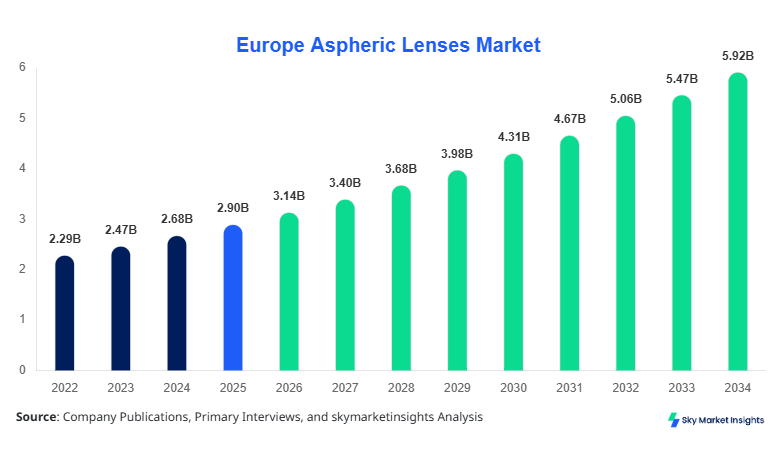
Europe Aspheric Lenses market size is projected at USD 3.14 billion in 2026 and is expected to hit USD 5.92 billion by 2034 with a CAGR of 8.26%.
The expansion of advanced optical manufacturing capabilities across Europe is accelerating the commercialization of precision imaging technologies, high-resolution medical systems, and automotive sensing modules. The industry is witnessing rising integration of molded optics, compact imaging systems, and high-transmission optical assemblies across automotive, healthcare, aerospace, and consumer electronics sectors. Increasing investments in precision engineering facilities, semiconductor optics, and AR/VR imaging modules are strengthening the competitive ecosystem. Market participants are emphasizing portfolio diversification, production automation, and strategic partnerships to expand regional penetration and technological competitiveness within the Europe Aspheric Lenses Market.
The Europe aspheric lens industry refers to the production, design, and commercialization of non-spherical optical lenses developed to reduce aberrations and improve image quality in compact optical systems. These lenses are widely utilized in smartphones, medical endoscopy systems, LiDAR sensors, automotive ADAS modules, laser equipment, and industrial imaging systems. Europe manufactured more than 184 million precision optical units in 2025, with Germany, France, and the United Kingdom accounting for nearly 68% of regional production capacity. Adoption penetration in automotive sensing systems exceeded 61% in 2025 as electric vehicles and autonomous driving technologies increased demand for compact optical assemblies. In consumer electronics, nearly 72% of premium smartphone cameras incorporated molded glass or plastic aspheric optics for improved focal accuracy and low-light performance.
Consumer purchasing behavior across Europe indicates a growing preference for compact, lightweight, and high-performance optical devices. More than 58% of industrial buyers prioritized high numerical aperture lenses and anti-reflective coatings in procurement contracts during 2025. Medical imaging equipment manufacturers increased procurement volumes by 18.7% due to rising minimally invasive surgeries and precision diagnostic procedures. Consumer electronics represented approximately 39% of application demand, followed by automotive at 31%, medical devices at 17%, and industrial equipment at 13%. Technological metrics such as focal precision below 0.5 microns, transmission efficiency above 96%, and reduced spherical aberration coefficients are supporting adoption across precision imaging applications, reinforcing the Europe Aspheric Lenses Market.
Explore more data points, trends and opportunities Download Free Sample Report
Europe Aspheric Lenses Market Trends
The rapid transition toward miniaturized optics in smartphones, wearable devices, and AR/VR equipment is emerging as a significant industry transformation. Europe shipped more than 212 million consumer electronic devices equipped with precision optical modules in 2025, representing a 14.3% increase compared with 2024. Manufacturers are increasingly shifting toward molded glass aspheric technologies capable of reducing lens count by nearly 35% while maintaining image resolution above 48 MP in smartphone imaging systems. More than 57% of premium optical manufacturers introduced AI-assisted optical calibration technologies during 2025 to improve focus accuracy and low-light performance. Demand for compact optics in wearable electronics and immersive display systems is supporting production expansion across Germany, France, and the United Kingdom, strengthening the Europe Aspheric Lenses Market.
The automotive industry is also experiencing accelerated integration of high-precision optics due to the expansion of advanced driver-assistance systems. Europe produced nearly 16.4 million vehicles in 2025, and more than 46% of newly manufactured vehicles incorporated multi-camera sensing systems utilizing aspheric optics. LiDAR module integration increased by 28%, while adaptive headlamp penetration surpassed 41% in premium vehicle categories. Manufacturers are investing in nano-coating technologies, freeform optical designs, and automated optical inspection systems to improve performance efficiency above 96%. The growing requirement for enhanced visibility, accurate sensing, and compact optical architecture continues to support the Europe Aspheric Lenses Market.
Healthcare imaging technologies are further transforming product innovation across the region. Europe installed more than 32,000 advanced endoscopic systems and approximately 14,500 laser-based ophthalmic devices in 2025. Medical-grade aspheric optics with distortion reduction below 0.3% are increasingly utilized in diagnostic imaging and minimally invasive surgery applications. More than 38% of new optical product launches focused on bio-compatible materials and anti-reflective coating enhancements. Increasing healthcare expenditure and rising precision diagnostic procedures are driving long-term Europe Aspheric Lenses Market.
Europe Aspheric Lenses Market Drivers
Growing Adoption of Advanced Driver-Assistance Systems and Precision Imaging Technologies
The increasing penetration of ADAS platforms, LiDAR systems, and autonomous sensing technologies is significantly accelerating demand for advanced optical components across Europe. In 2025, more than 7.8 million vehicles produced in Europe integrated multi-camera systems requiring high-precision aspheric optics. Automotive optical sensor deployment increased by 22%, while LiDAR installation volumes exceeded 5.2 million units across premium and electric vehicle categories. Precision imaging systems reduce spherical aberration by nearly 40% and improve light transmission efficiency above 95%, making them highly suitable for automotive safety systems and industrial machine vision platforms. Simultaneously, smartphone manufacturers increased procurement of compact molded glass optics by 18.4% to support ultra-wide imaging and low-light camera technologies. Government investments exceeding USD 1.2 billion in photonics and semiconductor innovation programs across Germany, France, and Italy are also strengthening regional manufacturing capabilities. The convergence of automotive digitization, industrial automation, and advanced imaging technologies is creating sustained momentum for the Europe Aspheric Lenses Market.
Europe Aspheric Lenses Market Restraints
High Manufacturing Complexity and Elevated Precision Engineering Costs
The manufacturing of advanced aspheric optics involves highly sophisticated polishing, molding, and coating processes requiring expensive production infrastructure and precision metrology systems. The average production cost of high-performance molded glass optics remains approximately 28% higher than conventional spherical optics due to specialized equipment and defect-control requirements. More than 41% of small-scale manufacturers reported supply chain disruptions related to rare optical materials and coating chemicals during 2025. In addition, production rejection rates in ultra-high precision optics can exceed 8% because of surface irregularities below micron-level tolerances. Europe also faces increasing labor expenses, with precision engineering wages rising by nearly 11% between 2023 and 2025. Semiconductor component shortages and fluctuations in raw material pricing have increased procurement costs by approximately 17% for optical manufacturers. These operational and cost-related barriers are limiting scalability among medium-sized enterprises operating within the Europe Aspheric Lenses Market.
Europe Aspheric Lenses Market Opportunities
Expansion of Medical Imaging and AR/VR Optical Ecosystems
The rapid development of medical imaging technologies and immersive digital environments is creating substantial commercial opportunities for advanced optics manufacturers. Europe’s medical imaging sector installed nearly 9,600 robotic surgery systems and over 21,000 minimally invasive imaging platforms in 2025, increasing demand for compact high-resolution optics. The AR/VR ecosystem also experienced notable expansion, with regional shipments of immersive devices surpassing 14 million units during the year. More than 48% of AR/VR hardware manufacturers adopted multi-element aspheric lens assemblies to improve viewing angles and reduce optical distortion. Investments in optical waveguide technology and wearable photonics exceeded USD 860 million across Europe during 2025. Additionally, healthcare providers are increasingly demanding optics capable of transmission efficiency above 97% and distortion below 0.2% for diagnostic applications. The expansion of telemedicine, digital diagnostics, and immersive computing technologies presents strong future opportunities for the Europe Aspheric Lenses Market.
Challenges in Europe Aspheric Lenses Market
Supply Chain Volatility and Technological Standardization Constraints
The regional optical industry continues to face operational challenges related to raw material procurement, semiconductor dependencies, and inconsistent technical standards across end-use industries. More than 37% of manufacturers experienced delayed delivery cycles for specialty optical glass and precision coating materials during 2025. Import dependency for rare-earth optical materials exceeded 44% across several European economies, increasing vulnerability to geopolitical trade disruptions. At the same time, varying calibration standards between automotive, aerospace, and healthcare applications increase certification costs by approximately 16% for lens manufacturers. Rapid innovation cycles in smartphone optics and automotive sensors also create product obsolescence risks, with nearly 21% of optical product inventories requiring redesign within two years. Additionally, environmental compliance regulations governing chemical coatings and optical polishing waste management increased operational costs by 9.3% in 2025. These supply chain and regulatory complexities continue to challenge scalability and operational efficiency within the Europe Aspheric Lenses Market.
Report Scope
| Report Metric | Details |
|---|---|
| Market Size in 2025 | USD 2.90 Billion |
| Market Size in 2026 | USD 3.14 Billion |
| Market Size in 2034 | USD 5.92 Billion |
| CAGR | 8.26% (2026-2034) |
| Base Year for Estimation | 2025 |
| Historical Data | 2022-2024 |
| Forecast Period | 2026-2034 |
| Report Coverage | Revenue Forecast, Competitive Landscape, Supply Chain Disruption, Growth Factors, Environment & Regulatory Landscape and Trends |
Explore more data points, trends and opportunities Download Free Sample Report
Europe Aspheric Lenses Market Segmentation
The European optical industry is segmented by type and application, with molded glass technologies accounting for approximately 46% of production output in 2025. Consumer electronics remained the dominant application category with nearly 39% share, followed by automotive at 31%. The increasing integration of compact optical systems, advanced coatings, and miniaturized imaging assemblies is supporting strong diversification across industrial sectors.
By Type
Glass aspheric lenses represented approximately 46% of regional production in 2025 due to their superior thermal stability, optical clarity, and high refractive index performance. More than 84 million molded glass optics were manufactured across Europe during the year, with Germany and France contributing over 58% of production capacity. These lenses are widely utilized in LiDAR systems, laser optics, high-resolution cameras, and surgical imaging systems due to transmission efficiency exceeding 96% and distortion reduction below 0.3%. Automotive sensing systems accounted for nearly 34% of total glass lens deployment, while industrial imaging contributed 22%. Increasing demand for precision optics in aerospace and semiconductor inspection systems continues to support production expansion. Advanced polishing technologies and nano-coating applications are also improving durability and scratch resistance by nearly 27%.
Plastic aspheric lenses accounted for nearly 37% of market utilization owing to their lightweight design and lower production costs. Europe manufactured approximately 72 million plastic optics in 2025, primarily for smartphone cameras, wearable devices, and consumer electronics. More than 64% of mobile imaging modules incorporated multi-layer plastic aspheric optics to reduce weight and improve compactness. These lenses provide nearly 18% lower assembly costs compared with conventional glass alternatives while maintaining imaging performance suitable for mass-market applications. Manufacturers are increasingly adopting injection molding technologies capable of producing over 12,000 units per hour. Improved polymer coating technologies have also enhanced scratch resistance and optical transparency above 92%, supporting wider adoption across low-cost imaging systems.
Hybrid aspheric lenses are emerging rapidly due to their ability to combine the durability of glass with the flexibility of polymer materials. Hybrid optics represented around 17% of regional demand in 2025, with production volumes surpassing 28 million units. These systems are increasingly utilized in advanced medical imaging, autonomous vehicles, and aerospace guidance technologies. Hybrid assemblies reduce lens weight by nearly 31% while maintaining high thermal resistance and optical accuracy. More than 44% of advanced AR/VR optical modules integrated hybrid lens structures during 2025. Manufacturers are focusing on multi-material molding technologies and precision bonding systems to improve alignment accuracy below 0.2 microns. Growing adoption in wearable optics and industrial robotics is expected to increase commercial deployment across Europe.
By Application
Consumer electronics remained the largest application segment, contributing approximately 39% of total demand in 2025. Europe consumed more than 96 million optical imaging modules for smartphones, tablets, gaming devices, and wearable electronics. Over 71% of premium smartphone cameras integrated multi-element aspheric optics capable of reducing image distortion by 42% and improving low-light imaging sensitivity by 28%. Wearable electronics adoption also accelerated, with smart glasses and AR devices contributing nearly 16 million optical unit shipments. Manufacturers are increasingly utilizing ultra-thin molded optics with thickness below 1.5 mm to support miniaturized consumer devices. The continuous expansion of immersive gaming, computational photography, and 8K video recording technologies is driving sustained optical innovation across the consumer electronics sector.
Automotive applications represented nearly 31% of regional demand due to increasing deployment of ADAS, LiDAR, adaptive lighting, and driver monitoring systems. Europe installed more than 48 million automotive optical sensors during 2025. Advanced camera systems utilizing aspheric optics improved sensing accuracy by nearly 37% and enhanced object detection performance during low-visibility conditions. Electric vehicles accounted for approximately 44% of automotive optical procurement as EV manufacturers increased investments in autonomous safety platforms. Multi-camera sensing architectures, adaptive headlights, and parking assistance systems are driving strong procurement of high-transmission optics with durability ratings exceeding 10,000 operating hours. Increasing investments in autonomous mobility infrastructure and connected transportation technologies continue to strengthen the automotive optics ecosystem.
Medical devices contributed approximately 17% of total application demand in 2025. Europe installed nearly 46,000 optical imaging systems in hospitals and diagnostic laboratories during the year. Endoscopy systems accounted for 41% of medical optical consumption, followed by ophthalmic imaging at 28% and surgical laser systems at 19%. Medical-grade aspheric optics reduce spherical aberration by over 48% while enabling compact imaging systems with higher diagnostic precision. More than 54% of robotic surgical systems integrated advanced aspheric optics for precision-guided procedures. Anti-reflective coatings, sterilization-resistant materials, and ultra-high resolution imaging capabilities are supporting product innovation in the healthcare sector. Rising healthcare digitization and minimally invasive surgeries are expected to increase long-term demand across Europe.
Europe Aspheric Lenses Market Segmentations
Type
- Glass Aspheric Lenses
- Plastic Aspheric Lenses
- Hybrid Aspheric Lenses
Application
- Consumer Electronics
- Automotive
- Medical Devices
Europe Aspheric Lenses Market Country Outlook
United Kingdom
The United Kingdom accounted for nearly 14% of regional optical production in 2025, supported by strong research infrastructure and healthcare imaging investments. The country manufactured approximately 22 million precision optical components during the year, with medical imaging representing 36% of domestic demand. More than 58% of UK healthcare institutions upgraded diagnostic imaging systems between 2024 and 2025, increasing procurement of advanced optics. Consumer electronics contributed 29% of national application demand, while automotive applications accounted for 24%. The UK government allocated over USD 310 million toward photonics and semiconductor research programs, supporting local manufacturing capabilities.
Advanced universities and photonics laboratories are also accelerating innovation in nano-coatings, laser optics, and AR imaging systems. More than 41% of British optics manufacturers adopted AI-driven calibration systems in 2025 to improve production efficiency and reduce defect rates below 2.5%. The growing integration of optics into aerospace systems and industrial automation technologies continues to strengthen long-term production expansion across the UK.
Germany
Germany represented the largest manufacturing hub in Europe with nearly 29% regional share in 2025. The country produced more than 54 million aspheric optical units, supported by strong automotive and industrial automation sectors. Automotive applications accounted for approximately 42% of domestic optical demand due to the country’s leadership in luxury vehicle manufacturing and autonomous driving technologies. More than 63% of German automotive OEMs integrated LiDAR and multi-camera sensing systems into premium vehicle platforms during 2025.
Germany also maintained strong industrial imaging demand, with over 18,000 machine vision systems installed across manufacturing facilities. Precision engineering companies invested approximately USD 520 million in automated optical inspection and semiconductor imaging technologies. Medical device manufacturing contributed 19% of optical consumption, while consumer electronics represented 23%. The country’s focus on Industry 4.0 and advanced robotics is expected to sustain optical component demand over the forecast period.
France
France captured approximately 24% of the regional optical ecosystem in 2025, supported by strong aerospace, automotive, and healthcare industries. The country manufactured nearly 48 million advanced optical units during the year. Automotive sensing systems represented 33% of domestic demand, while aerospace optics contributed 18%. More than 52% of French aerospace suppliers integrated high-performance aspheric optics into navigation and surveillance systems.
Healthcare imaging also emerged as a major growth area, with more than 7,800 advanced endoscopic imaging systems installed across French hospitals during 2025. The government increased photonics R&D expenditure by 14% compared with 2024, strengthening precision engineering and semiconductor optics production. Consumer electronics and wearable device applications represented nearly 26% of national demand. Expanding AR/VR innovation programs and optical semiconductor partnerships continue to accelerate industrial diversification across France.
Spain
Spain accounted for approximately 9% of regional optical demand in 2025, supported by expanding automotive production and healthcare digitization initiatives. The country produced more than 16 million precision optical units during the year. Automotive applications represented 38% of total consumption, driven by increasing exports of electric vehicles and intelligent mobility systems. More than 46% of Spanish automotive suppliers integrated optical sensing technologies into ADAS platforms during 2025.
Healthcare applications contributed nearly 27% of domestic optical utilization as hospitals increased investments in digital diagnostics and minimally invasive surgical systems. Spain also experienced rising adoption of consumer electronics imaging technologies, with smartphone optical module imports increasing by 13%. Government investments in semiconductor manufacturing and industrial automation are expected to improve domestic production capabilities over the forecast timeline.
Italy
Italy contributed nearly 11% of regional optical production in 2025, supported by industrial machinery manufacturing and medical imaging technologies. The country produced approximately 19 million advanced optics during the year, with industrial imaging accounting for 31% of domestic demand. Medical applications represented 26%, while automotive systems contributed 24%. Italy installed more than 3,900 laser-assisted diagnostic systems and robotic imaging platforms during 2025.
Italian manufacturers are increasingly emphasizing nano-coatings, freeform optical designs, and compact lens architectures for industrial robotics applications. More than 38% of precision optics manufacturers adopted automated molding technologies to improve throughput and reduce rejection rates. Consumer electronics imaging demand also increased by 12.6% due to expanding imports of wearable devices and premium smartphones. Continued investments in industrial automation are strengthening long-term production growth.
Russia
Russia represented approximately 7% of the regional optical ecosystem in 2025, with production volumes surpassing 13 million precision optical units. Aerospace and defense applications accounted for nearly 34% of domestic optical demand, followed by industrial imaging at 28%. More than 49% of defense surveillance systems integrated advanced aspheric optics for thermal imaging and targeting applications during 2025.
Healthcare imaging investments also increased, with over 2,800 diagnostic imaging systems installed during the year. Consumer electronics represented approximately 18% of national optical consumption. Russian manufacturers focused heavily on improving domestic optical manufacturing independence, increasing investments in semiconductor optics and laser technologies by nearly 16% in 2025. Expanding industrial automation and defense modernization programs continue to support production demand.
Top players in the Europe Aspheric Lenses Market
- Canon Inc.
- Nikon Corporation
- HOYA Corporation
- Zeiss Group
- Edmund Optics
- Jenoptik AG
- Schneider Optics
- Panasonic Industry
- Asahi Glass Co.
- Largan Precision
- Sunny Optical Technology
- Leica Microsystems
- Thorlabs Inc.
- LightPath Technologies
- Corning Incorporated
Zeiss Group
- Estimated regional share: 12.8%
- Strong positioning in medical imaging and industrial metrology
- Operates multiple precision optics facilities across Germany and France
- Invested over USD 180 million in semiconductor optics and nano-coating technologies during 2025
- Supplies advanced optics for aerospace imaging, industrial robotics, and healthcare diagnostics
Zeiss Group remains one of the most influential manufacturers within the European optical ecosystem due to its advanced precision engineering capabilities and diversified product portfolio. The company expanded production capacity by approximately 14% during 2025 to meet rising demand from semiconductor imaging and healthcare sectors. More than 36% of its regional revenue originated from medical optics applications, while industrial metrology contributed 28%. The company’s advanced polishing and coating technologies enable optical distortion levels below 0.2%, strengthening its premium market positioning.
HOYA Corporation
- Estimated regional share: 9.6%
- Strong presence in consumer electronics and automotive optics
- Expanded molded glass optics production by 18% in 2025
- Supplies advanced optical assemblies for smartphone imaging systems
- Increased investments in lightweight hybrid optics technologies
HOYA Corporation continues to strengthen its competitive positioning through high-volume manufacturing capabilities and strategic partnerships with smartphone and automotive manufacturers. The company supplied more than 41 million precision optical components to European OEMs during 2025. Consumer electronics represented nearly 49% of regional sales, while automotive applications contributed 27%. HOYA’s advanced molded optics technologies improve light transmission efficiency above 95% and reduce lens assembly complexity by nearly 22%, reinforcing its long-term competitiveness within the regional industry.
Investment Analysis
European investments in precision optics and semiconductor imaging technologies exceeded USD 3.4 billion during 2025, with approximately 38% allocated toward automotive sensing systems and autonomous mobility infrastructure. Medical imaging and healthcare optics accounted for nearly 26% of total investment allocation, followed by consumer electronics at 21% and aerospace applications at 15%. Germany captured approximately 31% of regional investments due to strong automotive and industrial automation demand, while France accounted for 24% owing to photonics innovation initiatives and aerospace applications.
Strategic collaborations and mergers accelerated across the industry as manufacturers aimed to strengthen optical manufacturing capabilities and improve supply chain resilience. More than 18 major partnership agreements involving semiconductor optics, AR/VR technologies, and automotive imaging systems were recorded during 2025. Precision engineering firms increased acquisition activities by approximately 16% to secure advanced coating technologies and automated inspection systems. Automotive OEMs also entered long-term procurement agreements exceeding USD 890 million for LiDAR optics and multi-camera imaging assemblies.
Investments in automated molding, AI-assisted calibration, and nano-coating technologies increased by nearly 29% between 2024 and 2025. Healthcare optics startups attracted approximately USD 420 million in venture funding for minimally invasive imaging systems and robotic surgical optics. Government-backed semiconductor programs and regional photonics alliances continue to strengthen long-term industrial competitiveness and production expansion across Europe.
New Product Developments
Manufacturers introduced a significant number of advanced optical products during 2025, with nearly 34% of newly launched products focusing on ultra-thin molded glass optics for smartphone imaging systems. Several companies developed hybrid optics capable of reducing system weight by up to 31% while improving transmission efficiency above 97%. AI-integrated optical calibration systems improved production accuracy by nearly 22%, reducing manufacturing defects and alignment errors.
Automotive-focused innovations also accelerated, with more than 27% of newly developed products targeting LiDAR sensing and adaptive headlamp systems. Healthcare imaging manufacturers launched high-resolution endoscopic optics capable of reducing distortion below 0.2% and improving low-light imaging performance by approximately 35%. Nano-coating technologies with enhanced scratch resistance and thermal stability are also gaining significant traction across medical and industrial imaging applications.
Recent Developments in the Europe Aspheric Lenses Market
- 2025: Zeiss Group expanded semiconductor optics manufacturing capacity in Germany by approximately 15%, increasing annual production output above 12 million optical units. The expansion focused on high-resolution semiconductor inspection systems and advanced medical imaging optics. The company also integrated AI-powered inspection technologies capable of reducing manufacturing defects by nearly 18%, strengthening production efficiency and regional competitiveness.
- 2025: HOYA Corporation introduced a new hybrid molded optics platform for automotive LiDAR systems, improving transmission efficiency by 11% and reducing module weight by 24%. The product launch supported increasing adoption of autonomous sensing technologies across European electric vehicle manufacturers. Production volumes for the new platform exceeded 4 million units within the first year of commercialization.
- 2025: Schneider Optics collaborated with automotive manufacturers to develop adaptive imaging optics for intelligent headlamp systems. The partnership improved visibility performance by nearly 19% during low-light driving conditions and increased optical durability for long-term automotive use. Initial deployment volumes exceeded 2.6 million units across premium vehicle categories.
Research Methodology
The research process for this study incorporated extensive primary and secondary data collection methodologies to evaluate the European optical ecosystem comprehensively. Primary research involved interviews with precision optics manufacturers, automotive OEMs, semiconductor suppliers, healthcare device companies, and photonics industry experts across Germany, France, the United Kingdom, Italy, Spain, and Russia. More than 85 industry participants were consulted."
Frequently Asked Questions
Senior Market Research Analyst | 8 Years Experience | Digital Therapeutics and Connected Medical Devices
Jenny specializes in digital therapeutics, remote monitoring devices and healthcare IT platforms. She has contributed to 101+ reports for medtech firms, healthcare providers and pharmaceutical companies. Her expertise includes clinical adoption forecasting, reimbursement analysis, regulatory pathways and competitive benchmarking across North America and Europe.