Europe Aseptic (Sterile) Connectors Market Size
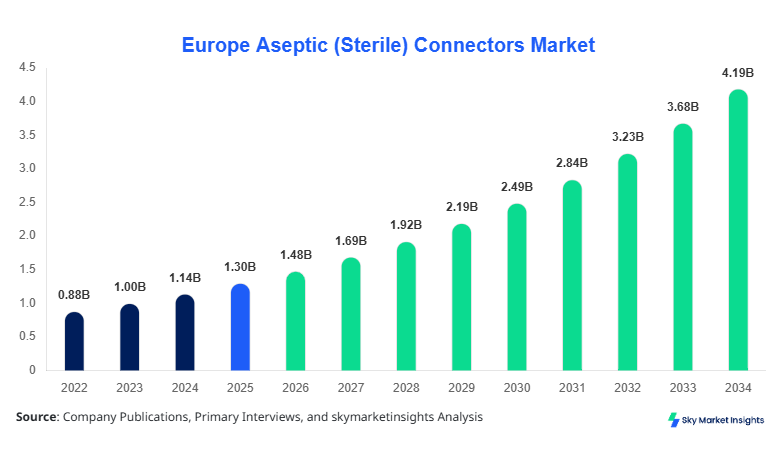
Europe Aseptic (Sterile) Connectors market size is projected at USD 1.48 billion in 2026 and is expected to hit USD 3.92 billion by 2034 with a CAGR of 12.9%.
The increasing adoption of sterile fluid transfer technologies across pharmaceutical manufacturing, biotechnology production, and laboratory automation is accelerating demand across Europe. More than 8,400 pharmaceutical production facilities and nearly 3,200 biotechnology laboratories across the region are integrating closed-system transfer technologies to minimize contamination risks and improve process reliability. Growing investments in biologics manufacturing, expansion of single-use systems, and stringent European Medicines Agency sterilization regulations are strengthening the competitive landscape. Market participants are focusing on advanced connector designs, automated aseptic transfer systems, and high-pressure sterile coupling solutions to enhance operational efficiency and contamination control within the Europe Aseptic (Sterile) Connectors Market Size ecosystem.
The aseptic (sterile) connectors industry comprises specialized fluid transfer devices designed to maintain sterile conditions during disconnection and reconnection processes in pharmaceutical, biotechnology, medical, and laboratory applications. Europe produced over 510 million sterile connectors in 2025, with Germany, the United Kingdom, and France collectively accounting for nearly 63% of regional output. Adoption rates among biopharmaceutical manufacturers exceeded 74% in 2025 due to rising biologics production volumes and stricter contamination-control standards. Penetration across vaccine production facilities reached 81%, while utilization in cell and gene therapy manufacturing lines surpassed 58%.
Consumer behavior within pharmaceutical manufacturing has shifted toward automated single-use processing technologies, resulting in a 36% increase in demand for disposable aseptic connectors between 2023 and 2025. Biopharmaceutical firms are prioritizing low-risk fluid management systems capable of operating under pressures above 60 psi and temperatures ranging from -80°C to 140°C. Single-use systems contributed approximately 57% of total application deployment, while reusable systems accounted for 43%. Biopharmaceutical manufacturing represented nearly 48% of total application share, followed by medical devices at 31% and laboratory processes at 21%. The integration of sterile transfer technologies in vaccine filling lines, fermentation units, and high-purity chemical processing is strengthening the Europe Aseptic (Sterile) Connectors Market Share across the region.
Explore more data points, trends and opportunities Download Free Sample Report
Europe Aseptic (Sterile) Connectors Market Trends
Rising Adoption of Single-Use Bioprocessing Technologies
The rapid transition toward single-use bioprocessing systems is emerging as one of the most significant industry trends in Europe. In 2025, more than 62% of biologics manufacturing facilities across Europe integrated disposable sterile transfer technologies into their production workflows. Production of single-use aseptic connectors surpassed 290 million units, representing a 19% increase compared with 2023 levels. Pharmaceutical manufacturers are increasingly replacing stainless-steel transfer systems with disposable assemblies to reduce cleaning validation costs by nearly 34% and minimize downtime by approximately 27%.
The growth of cell and gene therapy manufacturing is further strengthening demand for sterile fluid management solutions. Over 240 advanced therapy medicinal product facilities across Europe adopted closed-system sterile transfer mechanisms to comply with stringent contamination prevention protocols. Adoption within vaccine manufacturing increased by 18%, while utilization in monoclonal antibody production exceeded 71%. Enhanced compatibility with gamma sterilization, operating pressure thresholds above 50 psi, and leak-proof transfer capabilities are supporting the Europe Aseptic (Sterile) Connectors Market Demand.
Expansion of Automated and Digitally Integrated Sterile Systems
Automation and digital integration are transforming sterile transfer operations throughout pharmaceutical production facilities. Nearly 41% of large-scale pharmaceutical manufacturers in Europe deployed digitally monitored aseptic transfer systems in 2025, compared with 24% in 2022. Automated sterile connectors equipped with RFID tracking, pressure monitoring sensors, and contamination detection capabilities experienced a production increase of 22% year-over-year. Integration of smart manufacturing technologies reduced contamination incidents by approximately 31% and improved operational throughput by 26%.
The expansion of continuous bioprocessing technologies is also accelerating demand for advanced sterile connection systems. More than 185 European bioprocessing facilities transitioned toward continuous manufacturing operations in 2025, requiring highly reliable sterile fluid transfer infrastructure capable of maintaining process integrity for extended production cycles exceeding 30 days. Demand from contract development and manufacturing organizations rose by 21%, while laboratory automation applications increased by 17%. These developments are strengthening the Europe Aseptic (Sterile) Connectors Market Trend across pharmaceutical and biotechnology sectors.
Europe Aseptic (Sterile) Connectors Market Drivers
Rising Biologics Manufacturing and Vaccine Production Capacity
The rapid expansion of biologics and vaccine manufacturing infrastructure across Europe is significantly accelerating market adoption. More than 38% of pharmaceutical investments in Europe during 2025 were directed toward biologics manufacturing facilities utilizing sterile fluid transfer technologies. Europe produced nearly 4.8 billion vaccine doses and over 19 million liters of biologic formulations in 2025, creating substantial demand for contamination-free transfer systems. Nearly 79% of biologics manufacturers implemented aseptic connectors within upstream and downstream processing operations to maintain sterility during media transfer and product handling. The increasing production of monoclonal antibodies, recombinant proteins, and cell therapies is driving demand for connectors capable of withstanding pressures above 60 psi and operating temperatures ranging from cryogenic levels to high-heat sterilization conditions. Adoption in continuous manufacturing facilities increased by 24%, while deployment in single-use bioprocessing systems grew by 33% between 2023 and 2025. Government support for pharmaceutical self-sufficiency and expansion of vaccine manufacturing facilities across Germany, France, and the United Kingdom continue to strengthen the Europe Aseptic (Sterile) Connectors Market Growth.
Europe Aseptic (Sterile) Connectors Market Restraints
High Initial Integration Costs and Complex Validation Procedures
The substantial capital expenditure associated with advanced sterile transfer systems remains a major restraint for small and medium-scale manufacturers. Installation costs for automated aseptic transfer infrastructure in pharmaceutical facilities can exceed USD 2.5 million per production line, while validation and compliance expenses contribute an additional 18% to 24% of total project costs. Nearly 37% of medium-sized pharmaceutical companies in Europe delayed sterile connector upgrades due to high implementation costs and complex regulatory documentation requirements. Validation procedures for sterile connectors often require multiple integrity tests, microbial challenge studies, and compatibility assessments, extending deployment timelines by 6 to 12 months. Reusable aseptic systems additionally require periodic sterilization validation and cleaning verification processes that can increase operational costs by approximately 21%. Supply chain disruptions affecting medical-grade polymers and stainless-steel components have also increased production costs by nearly 14% since 2023. These financial and operational challenges continue to restrain broader deployment within the Europe Aseptic (Sterile) Connectors Market Share.
Europe Aseptic (Sterile) Connectors Market Opportunities
Expansion of Cell and Gene Therapy Manufacturing Facilities
The rapid development of advanced therapy medicinal products across Europe presents substantial growth opportunities for sterile connector manufacturers. More than 320 cell and gene therapy clinical programs were active in Europe during 2025, driving demand for highly specialized contamination-free fluid transfer systems. Approximately 58% of advanced therapy facilities adopted genderless sterile connectors due to their reduced contamination risks and enhanced flexibility in closed-system manufacturing. Investments in cell therapy production infrastructure surpassed USD 3.4 billion across Europe between 2024 and 2025, with Germany, France, and the United Kingdom accounting for nearly 64% of total spending. Demand for cryogenic-compatible connectors increased by 29%, while adoption of sterile transfer technologies for personalized medicine manufacturing rose by 34%. Integration of modular manufacturing platforms and automated sterile transfer systems is enabling manufacturers to reduce contamination incidents by more than 28% and improve production efficiency by nearly 23%. These developments are expected to create long-term expansion opportunities within the Europe Aseptic (Sterile) Connectors Market Demand.
Challenges in the Europe Aseptic (Sterile) Connectors Market
Material Compatibility and Supply Chain Constraints
Maintaining compatibility between sterile connectors and diverse pharmaceutical formulations remains a critical operational challenge. Approximately 26% of pharmaceutical manufacturers reported issues associated with polymer degradation, extractables, or leachables during extended processing cycles. High-purity biologics and aggressive chemical compounds often require specialized connector materials capable of resisting corrosion, pressure fluctuations, and temperature extremes. Supply chain disruptions affecting medical-grade thermoplastics increased procurement lead times by nearly 32% in 2025, impacting production schedules across Europe. Nearly 18% of connector manufacturers experienced delays in raw material sourcing, while transportation costs for sterile medical components increased by approximately 15% year-over-year. Ensuring compatibility with gamma irradiation, autoclave sterilization, and cryogenic storage conditions further complicates product development and validation processes. Rising pressure to maintain sustainability standards and reduce single-use plastic waste is also encouraging manufacturers to invest in recyclable materials and eco-friendly production technologies. These factors continue to create operational complexities for the Europe Aseptic (Sterile) Connectors Market Growth.
Report Scope
| Report Metric | Details |
|---|---|
| Market Size in 2025 | USD 1.31 Billion |
| Market Size in 2026 | USD 1.48 Billion |
| Market Size in 2034 | USD 3.92 Billion |
| CAGR | 13.9% (2026-2034) |
| Base Year for Estimation | 2025 |
| Historical Data | 2022-2024 |
| Forecast Period | 2026-2034 |
| Report Coverage | Revenue Forecast, Competitive Landscape, Supply Chain Disruption, Growth Factors, Environment & Regulatory Landscape and Trends |
Explore more data points, trends and opportunities Download Free Sample Report
Europe Aseptic (Sterile) Connectors Market Segmentation
The market is segmented based on type and application, with single-use sterile connectors dominating nearly 57% of total revenue due to increased deployment in biologics manufacturing and vaccine production. Biopharmaceutical manufacturing remained the leading application segment with approximately 48% market contribution in 2025, followed by medical devices at 31% and laboratory processes at 21%.
By Type
Single-use aseptic connectors accounted for nearly 57% of total market volume in 2025 due to widespread deployment in disposable bioprocessing systems. Production exceeded 290 million units across Europe, supported by increasing demand from vaccine production and monoclonal antibody manufacturing facilities. These connectors are designed for operating pressures ranging from 30 psi to 60 psi and are typically manufactured using gamma-stable thermoplastics compatible with sterilization procedures exceeding 25 kGy. Nearly 72% of biopharmaceutical facilities adopted disposable sterile transfer systems to reduce cleaning validation costs and minimize contamination risks. Germany and the United Kingdom collectively contributed more than 61% of regional single-use connector production. The increasing utilization of flexible manufacturing systems and modular cleanroom environments continues to support this segment.
Multiple-use aseptic connectors represented approximately 28% of market share in 2025 and remained widely utilized in high-volume pharmaceutical processing environments requiring durable stainless-steel transfer assemblies. Production volume exceeded 145 million units annually, with significant deployment in continuous fermentation systems and bulk chemical transfer operations. These systems are capable of operating under pressures exceeding 90 psi and temperatures above 140°C, making them suitable for repeated sterilization cycles. Nearly 44% of large pharmaceutical companies continued to utilize reusable sterile transfer systems due to long operational lifecycles and reduced waste generation. Demand remained particularly strong in Germany, France, and Italy, where large-scale pharmaceutical manufacturing infrastructure supports reusable processing technologies.
Genderless aseptic connectors accounted for nearly 15% of total deployment and experienced strong adoption within cell and gene therapy production environments. These connectors eliminate the need for gender-specific interfaces, reducing operational errors by approximately 21% and contamination incidents by nearly 18%. Production exceeded 72 million units in 2025, supported by increasing demand for flexible closed-system manufacturing. Compatibility with cryogenic storage temperatures below -80°C and integration with automated fluid handling systems contributed to rising adoption rates. The increasing focus on personalized medicine and advanced therapy manufacturing continues to strengthen demand for this connector category.
By Application
Biopharmaceutical manufacturing represented the largest application segment with nearly 48% market contribution in 2025. More than 3,000 biologics production lines across Europe integrated sterile fluid transfer systems into upstream and downstream processing operations. Production of biologic formulations exceeded 19 million liters annually, driving substantial demand for high-performance sterile connectors capable of maintaining contamination-free transfer environments. Approximately 74% of vaccine manufacturing facilities utilized disposable sterile transfer technologies to improve flexibility and reduce cleaning downtime. Connectors utilized within this segment commonly operate at flow rates above 15 liters per minute and support compatibility with CIP/SIP sterilization systems. Growing investments in monoclonal antibody manufacturing, recombinant protein production, and continuous bioprocessing continue to support application growth.
Medical device manufacturing accounted for approximately 31% of total application share due to increasing deployment in sterile assembly operations and fluid management systems. More than 1,600 medical device manufacturing facilities across Europe integrated aseptic transfer technologies into catheter production, dialysis systems, and infusion therapy equipment. Production volumes exceeded 210 million medical fluid transfer assemblies annually, while adoption of sterile transfer systems in minimally invasive device manufacturing increased by nearly 23% between 2023 and 2025. High-pressure compatibility, leak-proof sealing capabilities, and reduced microbial ingress remain critical performance requirements supporting demand in this segment.
Laboratory processes represented nearly 21% of market demand and experienced increasing adoption within pharmaceutical research laboratories, diagnostic testing facilities, and biotechnology research centers. More than 3,200 European laboratories integrated sterile transfer systems for media preparation, sample transfer, and analytical processing operations. Utilization rates increased by approximately 17% year-over-year due to expansion in molecular diagnostics and advanced therapeutic research activities. Laboratory-grade sterile connectors support low-volume transfer operations with precision flow control and contamination resistance levels exceeding ISO Class 5 standards. Rising investments in pharmaceutical R&D and laboratory automation continue to strengthen segment demand.
Europe Aseptic (Sterile) Connectors Market Segmentations
Type
- Single-use Aseptic Connectors
- Multiple-use Aseptic Connectors
- Genderless Aseptic Connectors
Application
- Biopharmaceutical Manufacturing
- Medical Devices
- Laboratory Processes
Europe Aseptic (Sterile) Connectors Market Country Outlook
United Kingdom
The United Kingdom accounted for nearly 18% of the European market in 2025 due to strong pharmaceutical research infrastructure and biologics manufacturing investments. More than 620 pharmaceutical and biotechnology production facilities across the country utilized sterile transfer technologies for vaccine production, monoclonal antibody manufacturing, and advanced therapy development. Production volume exceeded 88 million connector units annually, while adoption within cell and gene therapy facilities increased by 27% between 2023 and 2025. Biopharmaceutical manufacturing represented nearly 52% of total application demand, followed by medical devices at 29% and laboratory applications at 19%.
The United Kingdom also demonstrated strong adoption of automated sterile fluid transfer systems integrated with digital monitoring technologies. Approximately 46% of large pharmaceutical facilities implemented RFID-enabled contamination tracking systems to optimize manufacturing reliability. Government funding for life sciences exceeded USD 2.1 billion in 2025, supporting expansion of advanced biologics production infrastructure. The increasing deployment of modular cleanrooms and disposable bioprocessing technologies continues to reinforce regional demand.
Germany
Germany remained the dominant regional contributor with approximately a 29% share of the European market in 2025. The country produced more than 145 million sterile connector units annually and maintained one of the region’s largest biologics manufacturing ecosystems. Nearly 68% of application deployment was associated with pharmaceutical production, while medical devices accounted for 22% and laboratory processes represented 10%. More than 76% of pharmaceutical companies integrated automated sterile transfer systems into production workflows.
The expansion of vaccine production and biosimilar manufacturing significantly contributed to market expansion. Germany accounted for nearly 34% of total European biologics exports in 2025, driving continued investment in sterile processing infrastructure. Production facilities increasingly adopted smart manufacturing technologies capable of reducing contamination incidents by more than 30%. These developments continue to position Germany as the primary driver of regional expansion.
France
France accounted for approximately 15% of regional demand due to strong pharmaceutical manufacturing capacity and rising biotechnology investments. More than 540 pharmaceutical production facilities and 260 biotechnology laboratories deployed sterile transfer technologies in 2025. Production exceeded 71 million connector units annually, while utilization in vaccine manufacturing operations increased by 18% year-over-year. Single-use systems represented nearly 59% of total installations due to increased demand for contamination-free processing.
French pharmaceutical firms increasingly invested in continuous bioprocessing and advanced therapy production capabilities. More than 38% of pharmaceutical capital expenditure in France during 2025 was directed toward biologics infrastructure expansion. Adoption of genderless sterile connectors in cell therapy production facilities increased by approximately 24%, supporting operational flexibility and contamination reduction. Expansion of research activities within biotechnology clusters continues to support long-term market penetration.
Spain
Spain represented nearly 11% of total European revenue contribution in 2025 due to increasing pharmaceutical production and expanding healthcare manufacturing infrastructure. More than 390 pharmaceutical and medical device manufacturing facilities integrated sterile transfer systems across the country. Production volume exceeded 52 million connector units, while demand from vaccine filling operations increased by approximately 19% between 2023 and 2025.
Medical device manufacturing represented nearly 34% of Spanish application demand due to rising production of infusion systems and diagnostic equipment. Government healthcare modernization initiatives and increasing investments in pharmaceutical exports are accelerating deployment of contamination-free processing technologies. Adoption of disposable sterile connectors increased by 26% in 2025 due to operational efficiency benefits and reduced sterilization costs.
Italy
Italy accounted for approximately 13% of the regional market and maintained strong pharmaceutical manufacturing output in 2025. More than 470 pharmaceutical production facilities utilized sterile connector technologies across vaccine production, injectable drug manufacturing, and biotechnology processing. Production exceeded 63 million connector units annually, while utilization in laboratory applications increased by 15% year-over-year.
Italian pharmaceutical manufacturers increasingly adopted automated sterile transfer systems to support export-oriented biologics production. Approximately 43% of large facilities integrated digitally monitored fluid transfer technologies capable of improving process reliability and reducing contamination incidents. Strong growth in biosimilar manufacturing and contract development services continues to support increasing demand for sterile transfer systems.
Russia
Russia represented nearly 9% of regional market demand in 2025 due to expanding domestic pharmaceutical production and healthcare infrastructure investments. More than 310 pharmaceutical facilities integrated sterile fluid transfer technologies into injectable drug manufacturing and vaccine production operations. Production exceeded 41 million connector units annually, while government-supported pharmaceutical localization initiatives increased adoption by approximately 17%.
Biopharmaceutical manufacturing accounted for nearly 46% of total application deployment in Russia, followed by medical devices at 33% and laboratory processes at 21%. Investments in local vaccine manufacturing and biologics self-sufficiency programs accelerated demand for contamination-free transfer systems. Increasing modernization of pharmaceutical production facilities continues to support regional market expansion.
Top players in Europe Aseptic (Sterile) Connectors Market
- CPC (Colder Products Company)
- Sartorius AG
- Merck KGaA
- Saint-Gobain
- Thermo Fisher Scientific
- Danaher Corporation
- Pall Corporation
- GEA Group
- Avantor Inc.
- Watson-Marlow Fluid Technology Solutions
- Corning Incorporated
- Nordson Corporation
- Tekni-Plex
- Foxx Life Sciences
- BioPharma Dynamics
Sartorius AG
- Estimated regional market share: 16%
- Strong positioning in biopharmaceutical fluid management systems
- Extensive manufacturing presence in Germany and France
- Focus on single-use sterile transfer technologies and biologics processing
Sartorius AG remains one of the leading participants in the European market due to its strong biotechnology processing portfolio and extensive integration across biologics manufacturing facilities. The company supplies sterile transfer systems to more than 1,200 pharmaceutical and biotechnology clients across Europe. Nearly 62% of its connector-related revenue originates from single-use bioprocessing technologies utilized in vaccine and monoclonal antibody manufacturing. Continuous investment in automated sterile transfer systems and digital contamination monitoring technologies has strengthened the company’s regional leadership position.
Merck KGaA
- Estimated regional market share: 13%
- Strong presence in pharmaceutical filtration and sterile transfer systems
- Significant investment in advanced therapy manufacturing technologies
- Expanding production capacity in Germany and the United Kingdom
Merck KGaA continues to strengthen its regional presence through investments in biologics processing infrastructure and advanced fluid management technologies. The company increased sterile connector production capacity by approximately 21% between 2023 and 2025 to support rising pharmaceutical demand. More than 48% of its sterile transfer product deployment is associated with vaccine and cell therapy manufacturing operations. Strategic collaborations with biotechnology firms and contract manufacturing organizations continue to enhance market penetration throughout Europe.
Investment Analysis
Investment activity across the Europe aseptic connector industry increased significantly in 2025 due to rising demand for biologics manufacturing and contamination-free processing systems. Nearly 42% of total sector investment was allocated toward single-use bioprocessing infrastructure, while automated sterile transfer technologies accounted for approximately 28% of capital expenditure. Germany represented nearly 31% of regional investment allocation, followed by the United Kingdom at 21% and France at 17%. Pharmaceutical companies collectively invested more than USD 6.8 billion in sterile manufacturing upgrades between 2024 and 2025.
Mergers, acquisitions, and strategic collaborations continued to reshape the competitive landscape. Approximately 24% of market participants entered collaborative agreements focused on advanced therapy manufacturing and contamination-control technologies. Multiple pharmaceutical firms partnered with sterile connector manufacturers to improve integration within continuous bioprocessing systems. Strategic acquisitions involving fluid management technology companies increased by nearly 19% year-over-year. Investments in sustainable and recyclable connector materials also accelerated, with nearly 14% of R&D budgets allocated toward eco-friendly production technologies.
Private equity and venture capital participation within the European bioprocessing sector expanded considerably during 2025. Biotechnology-focused investors increased funding for contamination-free manufacturing technologies by approximately 22%, particularly within cell and gene therapy applications. Expansion of modular manufacturing facilities and digitally integrated sterile transfer systems is expected to attract continued investment throughout the forecast period.
New Product Developments
Manufacturers increasingly focused on advanced sterile transfer systems capable of improving operational flexibility and contamination control. Nearly 31% of new product launches in 2025 involved genderless sterile connectors designed for advanced therapy manufacturing. Performance enhancements included approximately 27% improvement in leak resistance and 18% higher pressure tolerance compared with previous-generation products. More than 36% of newly introduced products supported compatibility with automated bioprocessing systems and real-time contamination monitoring platforms.
Innovation activity also focused on sustainable and recyclable material technologies. Approximately 21% of newly launched sterile connectors incorporated environmentally optimized thermoplastics capable of reducing production waste by nearly 15%. Integration of RFID-enabled monitoring systems and sensor-based contamination detection technologies increased by approximately 24% among new product launches. These developments continue to support technological advancement across the regional market.
Recent Developments in Europe Aseptic (Sterile) Connectors
- 2025: Sartorius AG expanded its sterile connector production facility in Germany, increasing annual manufacturing capacity by approximately 18% to support rising biologics demand. The expansion added more than 22 million units of annual output capacity and strengthened supply chain capabilities across European pharmaceutical manufacturers.
- 2025: Merck KGaA introduced a new gamma-stable aseptic connector series designed for cell and gene therapy applications. The new platform improved contamination resistance by nearly 26% and enhanced cryogenic compatibility for storage temperatures below -80°C
Frequently Asked Questions
Senior Market Research Analyst | 8 Years Experience | Digital Therapeutics and Connected Medical Devices
Jenny specializes in digital therapeutics, remote monitoring devices and healthcare IT platforms. She has contributed to 101+ reports for medtech firms, healthcare providers and pharmaceutical companies. Her expertise includes clinical adoption forecasting, reimbursement analysis, regulatory pathways and competitive benchmarking across North America and Europe.