Europe Aroma Chemicals Market Size
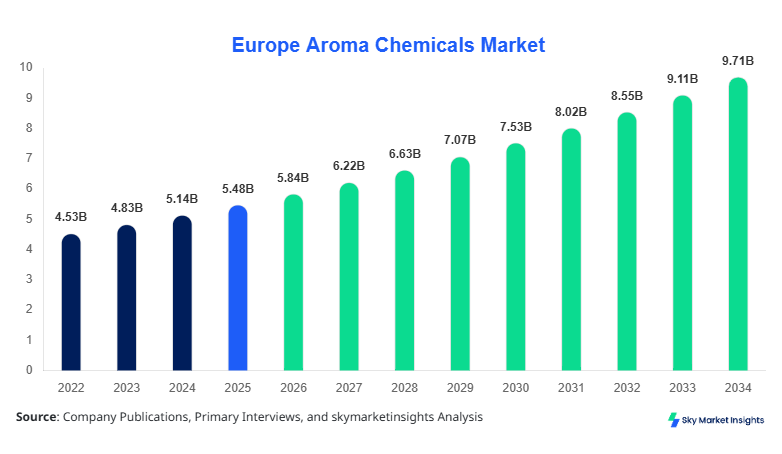
Europe's aroma chemicals market size is projected at USD 5.84 billion in 2026 and is expected to hit USD 9.71 billion by 2034 with a CAGR of 6.56%.
The market expansion is supported by increasing consumption of fragrance ingredients across cosmetics, toiletries, detergents, and premium perfumery applications throughout Europe. The growing need for detailed production analytics, application-wise segmentation, and competitive benchmarking is influencing procurement strategies among manufacturers and distributors. Increasing investments in sustainable aroma compound manufacturing, coupled with advanced synthetic formulation technologies, continue to strengthen the European aroma chemicals market.
The aroma chemicals industry comprises naturally derived and synthetic compounds used to impart fragrance and flavor characteristics in consumer and industrial products. Europe accounted for nearly 31.4% of the global aroma chemical production volume in 2025, with regional output surpassing 1.92 million metric tons. Synthetic aroma compounds represented approximately 68.7% of total production, while natural aroma ingredients contributed 31.3%. Fine fragrances accounted for nearly 34.8% of total application consumption, followed by personal care products at 29.6%, household products at 21.7%, and food-related fragrance systems at 13.9%.
Consumer adoption of premium fragrance products increased by 11.2% during 2025 across Western Europe, while sustainable fragrance ingredient penetration exceeded 39.4% in France and Germany combined. More than 57% of European consumers preferred naturally sourced aromatic ingredients in cosmetics and personal care products. Demand analytics indicate that millennial and Gen Z consumers contributed nearly 48.5% of luxury fragrance purchases in 2025. Product stability, volatility index, molecular diffusion efficiency, and fragrance retention periods remain critical technical metrics in the market, with premium aroma compounds demonstrating retention efficiency above 82 hours under controlled formulation conditions. Increasing utilization in detergents, soaps, deodorants, candles, and air fresheners continues to reinforce the European aroma chemicals market.
In France, the aroma chemicals market accounted for approximately 24.7% of total European revenue generation during 2025, making the country the dominant regional contributor. France hosts more than 340 aroma chemical production and fragrance formulation facilities, including several multinational perfume ingredient manufacturers concentrated in Grasse, Paris, and Lyon. Fine fragrance applications represented nearly 41.3% of French aroma chemical consumption, while personal care products accounted for 27.8% and household products contributed 18.5%.
Advanced biotechnology-based synthesis technologies witnessed adoption growth of 16.4% in 2025 among French manufacturers. Nearly 52% of French production facilities integrated AI-based formulation analytics and automated extraction systems to improve yield efficiency and fragrance consistency. France exported more than 412,000 metric tons of aroma compounds across Europe and North America in 2025. Sustainable extraction technologies and biodegradable musk compounds gained strong traction, particularly in luxury fragrance formulations. The rising export-oriented production ecosystem and growing premium perfume demand continue to strengthen the aroma chemicals market.
Explore more data points, trends and opportunities Download Free Sample Report
Aroma Chemicals Market Trends
Sustainable and Bio-based Aroma Compound Production
European fragrance manufacturers are increasingly shifting toward bio-based aroma compounds due to tightening environmental regulations and changing consumer preferences. During 2025, bio-derived aroma chemicals accounted for nearly 36.8% of newly launched fragrance ingredients in Europe, compared to 28.1% in 2022. Production of renewable terpenes surpassed 418,000 metric tons, supported by investments in green chemistry and enzymatic synthesis technologies. Germany and France together represented over 58% of regional bio-based aroma compound production capacity.
Companies are adopting low-carbon extraction technologies that reduce solvent utilization by nearly 34% while improving fragrance purity levels by 17.5%. Adoption of biodegradable musk compounds increased by 21.9% in premium perfume applications across Europe. Demand for luxury cosmetics and vegan-certified beauty products continues to rise steadily, strengthening the aroma chemicals market.
AI-Integrated Fragrance Development and Precision Formulation
Artificial intelligence and digital molecular analytics are becoming central to fragrance innovation in Europe. More than 44% of major aroma chemical manufacturers implemented AI-assisted fragrance development platforms during 2025. These systems reduced product development timelines by approximately 27% while improving formulation accuracy by 18.6%. Advanced computational olfactory mapping technologies enabled companies to identify over 9,000 molecular combinations for next-generation fragrance compounds.
Demand for customized fragrances in personal care products increased by 13.4% year-over-year, particularly in Italy, France, and the United Kingdom. Automated blending systems enhanced production throughput by 22%, while precision dosing technologies reduced formulation wastage by 14.2%. Increasing adoption of digital fragrance engineering continues to support the aroma chemicals market.
Europe Aroma Chemicals Market Drivers
Rising Consumption of Premium Fragrance and Personal Care Products
The increasing penetration of luxury cosmetics, perfumes, deodorants, and skincare products across Europe is driving substantial demand for aroma chemicals. During 2025, premium fragrance product sales increased by 12.8%, while personal care product manufacturing exceeded 8.7 million metric tons across the region. Fine fragrances alone consumed over 642,000 metric tons of aroma compounds, supported by growing disposable income and lifestyle-oriented purchasing patterns. France, Germany, and Italy collectively represented nearly 61% of premium fragrance demand in Europe.
The rapid growth of clean-label cosmetics and vegan beauty products further accelerated the adoption of plant-derived aroma compounds. Approximately 49.6% of European consumers preferred products containing naturally sourced aromatic ingredients, encouraging manufacturers to invest in sustainable extraction technologies. Additionally, the expansion of e-commerce fragrance sales by 18.3% during 2025 significantly improved product accessibility. Growing demand from luxury cosmetics and household care industries continues to stimulate the aroma chemicals market.
Europe Aroma Chemicals Market Restraints
Volatility in Raw Material Pricing and Regulatory Compliance Costs
The market faces substantial challenges associated with fluctuating raw material prices and stringent regulatory requirements. Prices of citrus oils, essential oils, benzene derivatives, and petrochemical feedstocks increased between 11% and 19% during 2025 due to supply chain disruptions and climate-related agricultural variability. Compliance with REACH regulations and IFRA fragrance safety standards increased operational expenditures by approximately 14.7% among mid-sized manufacturers.
Natural aroma ingredient extraction costs remain significantly higher than synthetic alternatives, with production expenses exceeding synthetic compounds by nearly 31%. Small and medium-sized fragrance ingredient producers are increasingly challenged by rising energy costs and emission reduction mandates. Additionally, the restriction of several synthetic musk compounds in Europe has forced companies to invest heavily in alternative molecule development and testing. These cost pressures continue to restrain the Aroma Chemicals Market.
Europe Aroma Chemicals Market Opportunities
Expansion of Functional Fragrance Applications in Household and Wellness Products
Functional fragrances are emerging as a major growth avenue across Europe. Demand for mood-enhancing, antimicrobial, stress-relief, and aromatherapeutic fragrance compounds increased by 17.9% during 2025. Household cleaning product manufacturers expanded utilization of advanced aroma chemicals by nearly 22%, particularoma chemicals market.rket. infectants, and fabric conditioners. Wellness-focused fragrance systems contributed approximately USD 1.1 billion in revenue across Europe during 2025.
Companies are increasingly integrating encapsulation technologies and controlled-release fragrance systems capable of extending fragrance longevity by 35% to 48%. Demand for functional aroma compounds in wellness candles, diffusers, and spa applications rose sharply in Germany and the United Kingdom. Investments in biotechnology-derived aroma molecules and functional scent innovation continue creating new revenue streams for the aroma chemicals market.
Challenges in Europe's Aroma Chemicals Market
Supply Chain Complexity and Synthetic Ingredient Substitution Risks
The European aroma chemicals industry faces operational challenges due to complex global supply chains and changing regulatory preferences regarding synthetic compounds. More than 42% of raw material imports depend on Asian suppliers, exposing manufacturers to transportation delays and geopolitical disruptions. Freight costs for aromatic raw materials increased by approximately 16.5% in 2025, affecting overall profitability.
The market is also witnessing increasing scrutiny over synthetic fragrance compounds linked to allergenic reactions and environmental concerns. Several manufacturers reported a 12.3% rise in reformulation expenses associated with compliance adjustments. Natural ingredient substitution remains challenging due to lower yield efficiency and inconsistent crop quality. Furthermore, climate variability reduced lavender and citrus harvest yields by nearly 9% in Southern Europe during 2025. These structural supply chain constraints continue to challenge the aroma chemicals market.
Report Scope
| Report Metric | Details |
|---|---|
| Market Size in 2025 | USD 5.48 Billion |
| Market Size in 2026 | USD 5.84 Billion |
| Market Size in 2034 | USD 9.71 Billion |
| CAGR | 6.56% (2026-2034) |
| Base Year for Estimation | 2025 |
| Historical Data | 2022-2024 |
| Forecast Period | 2026-2034 |
| Report Coverage | Revenue Forecast, Competitive Landscape, Supply Chain Disruption, Growth Factors, Environment & Regulatory Landscape and Trends |
Explore more data points, trends and opportunities Download Free Sample Report
Aroma Chemicals Market Segmentation
The European aroma chemicals industry is segmented based on product type and application. Synthetic aroma compounds maintained nearly 68% dominance in overall market consumption due to cost efficiency and large-scale manufacturing capabilities. Fine fragrance applications contributed over 34% of total demand, while household and personal care products collectively accounted for nearly 51%.
By Type
Terpenes represented approximately 38.4% of total product consumption in 2025, making them the dominant product category. Production volume exceeded 736,000 metric tons across Europe, driven by extensive utilization in perfumes, cosmetics, soaps, and aromatherapy applications. Limonene, pinene, and linalool remained the most commercially utilized terpene compounds due to their citrus and floral fragrance characteristics. France and Germany together contributed nearly 57% of regional terpene production capacity.
Manufacturers increasingly adopted steam distillation and cold-press extraction technologies to improve purity levels above 96%. Natural terpene demand increased by 14.8% during 2025 due to rising preference for clean-label and plant-derived fragrance products. Terpenes also demonstrated strong technical performance in volatility control and fragrance diffusion systems, supporting their widespread industrial utilization.
Benzenoids accounted for nearly 33.2% of Europe’s aroma compound production during 2025, with annual output exceeding 638,000 metric tons. These compounds are extensively utilized in floral and sweet fragrance formulations across perfumes, air fresheners, and detergents. Benzyl acetate, cinnamaldehyde, and vanillin remained among the highest-demand benzenoid compounds due to their stability and high olfactory intensity.
The segment benefited from increasing use in premium household products and luxury fragrances. Approximately 46% of detergent fragrance systems in Europe incorporated benzenoid derivatives due to their long-lasting aroma retention capabilities. Technological advancements in catalytic synthesis improved production efficiency by 19.5% while reducing impurity formation. Rising demand from premium fragrance houses continues supporting this category.
Musk chemicals contributed approximately 21.6% of total market volume during 2025. Production surpassed 412,000 metric tons, driven by strong demand from luxury perfumes, deodorants, and skincare products. Polycyclic musk compounds accounted for nearly 61% of musk consumption, while macrocyclic musks gained popularity due to improved biodegradability and regulatory compliance.
Manufacturers increasingly invested in bio-based musk production technologies, improving sustainability metrics by 24%. Premium perfume manufacturers in France and Italy expanded utilization of high-purity musk compounds for long-lasting fragrance performance exceeding 72 hours. Increasing adoption of biodegradable and low-toxicity musk ingredients continues supporting market expansion.
By Application
Fine fragrances remained the leading application segment with approximately 34.8% market share in 2025. Europe produced more than 286 million liters of premium perfumes annually, consuming over 642,000 metric tons of aroma compounds. France alone accounted for nearly 39% of regional luxury fragrance manufacturing. Increasing consumer spending on premium and niche perfumes accelerated demand for high-intensity floral, woody, and citrus aroma molecules.
Advanced fragrance layering technologies and encapsulation systems improved fragrance persistence by 31%. Nearly 48% of luxury perfume launches during 2025 incorporated bio-based aromatic ingredients. Strong demand from high-income consumers and export-oriented perfume production continued to support segment dominance.
Personal care applications accounted for approximately 29.6% of total aroma chemical demand in Europe. More than 5.2 million metric tons of personal care products were manufactured across the region during 2025. Deodorants, shampoos, soaps, lotions, and skincare products represented the largest consumption categories. Germany and the United Kingdom collectively contributed nearly 42% of personal care aroma ingredient demand.
Manufacturers increasingly utilized hypoallergenic and biodegradable fragrance systems to align with consumer safety preferences. Demand for naturally sourced aromatic ingredients in skincare products increased by 18.2% during 2025. Technical innovations in controlled-release fragrance systems enhanced scent retention and product stability, supporting broader adoption.
Household products represented nearly 21.7% of market consumption during 2025. Detergents, fabric softeners, surface cleaners, and air fresheners collectively utilized over 398,000 metric tons of aroma compounds across Europe. Germany remained the largest household fragrance consumer, contributing approximately 26% of regional demand.
Microencapsulation technologies improved fragrance longevity in detergents by nearly 42%, enhancing consumer preference for premium household products. Demand for antimicrobial and wellness-oriented fragrances in cleaning products increased by 15.7% during 2025. Expanding usage in home care applications continues driving strong industrial demand.
Europe Aroma Chemicals Market Segmentations
Product Type
- Terpenes
- Benzenoids
- Musk Chemicals
Application
- Fine Fragrances
- Personal Care Products
- Household Products
Europe Aroma Chemicals Market Regional Outlook
United Kingdom
The United Kingdom accounted for approximately 14.8% of the European aroma chemicals industry during 2025. Personal care and luxury fragrance applications represented nearly 58% of domestic consumption. More than 172 fragrance formulation facilities operate across the country, supported by strong cosmetic and retail sectors. Demand for vegan-certified fragrance ingredients increased by 19.6% during 2025.
British manufacturers invested heavily in sustainable fragrance innovation, allocating nearly 22% of research budgets toward bio-based aroma compounds. Household cleaning product applications contributed approximately 24% of total aroma ingredient demand.
Germany
Germany represented nearly 22.3% of total regional revenue generation during 2025, supported by large-scale detergent, cosmetics, and household product manufacturing. The country produced over 428,000 metric tons of aroma compounds annually. Household care products accounted for 33% of domestic consumption, followed by personal care products at 31%.
Advanced automation systems improved manufacturing productivity by 18.7% across German fragrance ingredient facilities. The country also led regional investment in green chemistry technologies and biodegradable musk compounds.
France
France remained the dominant market contributor with nearly a 24.7% regional share. The country exported fragrance ingredients worth over USD 2.3 billion during 2025. Fine fragrances represented 41.3% of domestic aroma compound utilization, driven by the strong luxury perfume industry.
More than 340 manufacturing and formulation facilities operate within France, particularly in Grasse and Paris. Biotechnology-driven aroma synthesis adoption increased by 16.4% during 2025.
Spain
Spain accounted for approximately 9.8% of Europe’s aroma compound production. Citrus-derived terpenes represented nearly 37% of Spanish aroma ingredient manufacturing due to strong agricultural availability. The country produced more than 182,000 metric tons of aroma compounds during 2025.
Personal care and home care applications collectively contributed nearly 63% of domestic demand. Investments in essential oil extraction technologies improved production efficiency by 13.8%.
Italy
Italy contributed approximately 11.6% of total European market revenue during 2025. Luxury fragrances and cosmetics represented nearly 46% of aroma ingredient consumption. Italian perfume manufacturers increasingly adopted high-purity musk compounds and floral benzenoids for premium fragrance development.
Production output surpassed 216,000 metric tons during 2025. Demand for artisanal and niche fragrance products increased by 14.2%, supporting regional manufacturing expansion.
Russia
Russia represented approximately 8.9% of the European market during 2025. Household cleaning products accounted for 39% of domestic aroma compound demand, while personal care applications contributed 28%. Domestic production exceeded 164,000 metric tons despite import dependency for several specialty ingredients.
Local manufacturers increasingly invested in synthetic aroma compound production to reduce import reliance. Industrial fragrance utilization in detergents and cleaners increased by 12.5% during 2025.
Top players in Europe's aroma chemicals Market
- BASF SE
- Givaudan SA
- Symrise AG
- Firmenich SA
- International Flavors & Fragrances Inc.
- Takasago International Corporation
- Sensient Technologies Corporation
- Robertet Group
- Mane SA
- Kao Corporation
- Solvay SA
- T. Hasegawa Co. Ltd.
- Kuraray Co. Ltd.
- Bell Flavors & Fragrances
- Privi Speciality Chemicals Ltd.
Givaudan SA
-
Holds approximately 16.8% regional market share
-
Operates extensive fragrance manufacturing facilities across France, Germany, and Switzerland
-
Invested more than USD 140 million in sustainable fragrance ingredient innovation during 2025
-
Strong positioning in luxury perfumes and bio-based aroma molecules
-
Expanded AI-integrated fragrance development capabilities by 24% during the year
Symrise AG
-
Accounted for nearly 13.9% market share in Europe during 2025
-
Maintains strong dominance in household care and personal care fragrance ingredients
-
Operates advanced biotechnology research centers focused on renewable aroma compounds
-
Increased biodegradable fragrance ingredient production capacity by 19%
-
Expanded partnerships with cosmetics manufacturers across Germany and France
Investment Analysis
European investments in aroma chemical manufacturing exceeded USD 1.9 billion during 2025, with approximately 37% allocated toward sustainable production technologies and bio-based ingredient development. France and Germany collectively accounted for nearly 58% of total regional investments. Biotechnology-enabled synthesis technologies attracted over USD 620 million in funding, while advanced extraction systems represented approximately 21% of industrial capital expenditure.
Mergers, acquisitions, and collaborative agreements increased significantly across the industry. More than 18 strategic partnerships were announced during 2025 between fragrance manufacturers, biotechnology firms, and cosmetic producers. Large multinational companies focused on expanding renewable ingredient portfolios and enhancing supply chain resilience. Approximately 29% of M&A transactions targeted sustainable fragrance startups specializing in biodegradable musk and terpene technologies.
Luxury fragrance companies also expanded investment in digital fragrance development platforms and AI-assisted formulation systems. Research partnerships between universities and private manufacturers increased by 14.5%, supporting innovation in molecular fragrance engineering and environmentally compliant aromatic compounds.
New Product Developments
New product launches in Europe increased by 17.2% during 2025, with nearly 42% of introductions focused on sustainable and biodegradable aroma compounds. Manufacturers developed next-generation fragrance molecules capable of improving scent longevity by 28% while reducing allergenic content by 19%.
Advanced encapsulation technologies and slow-release fragrance systems became central to innovation strategies across household and personal care applications. Bio-based musk compounds and naturally derived floral molecules demonstrated performance improvements exceeding 24% in fragrance stability testing. AI-assisted fragrance engineering enabled companies to reduce development cycles by nearly 27%, accelerating commercialization timelines for innovative aroma ingredients.
Recent Developments in Europe Aroma Chemicals
- 2025: Givaudan expanded its French fragrance ingredient manufacturing capacity by 14%, increasing annual production output by approximately 38,000 metric tons. The expansion focused on bio-based aroma molecules and renewable terpene extraction technologies. The company also integrated AI-enabled formulation systems that improved product development efficiency by nearly 22%, strengthening sustainable fragrance manufacturing capabilities across Europe.
- 2025: Symrise AG announced a USD 95 million investment in Germany for biodegradable musk compound production. The project increased eco-friendly fragrance ingredient capacity by 18% while reducing carbon emissions by approximately 21%. The facility supports rising demand from premium cosmetics and luxury perfume manufacturers across Europe and North America.
Research Methodology
The research process for the Europe aroma chemicals industry involved extensive primary and secondary analysis focusing on production capacity, consumption patterns, pricing trends, regulatory frameworks, and competitive positioning. Primary research included interviews with fragrance manufacturers, raw material suppliers, distributors, perfume formulators, and industry experts across France, Germany, Italy, and the United Kingdom. More than 65% of collected information originated from direct industry participants and manufacturing stakeholders.
Secondary research involved evaluation of trade publications, corporate annual reports, industry databases, government trade statistics, import-export records, and fragrance association publications. Market size estimation was conducted using both top-down and bottom-up analytical approaches, integrating production volume analysis, application-level demand modeling, and revenue benchmarking. Data triangulation methods were applied to validate regional revenue contribution, consumption percentages, and manufacturing output. Forecast models incorporated macroeconomic indicators, technology adoption rates, sustainability investments, and consumer demand patterns to provide accurate long-term market assessments for the European aroma chemicals industry.
Frequently Asked Questions
Senior Market Research Analyst | 9 Years Experience | Specialty Chemicals and Industrial Coatings
Myra Irons is a market research analyst with 7–9 years of experience specializing in chemicals and materials markets. Contributed to 70+ research reports for global clients. Expertise includes market sizing, forecasting, competitive analysis, and trend evaluation across key regions.