Europe Aortic Stents Grafts Market Size
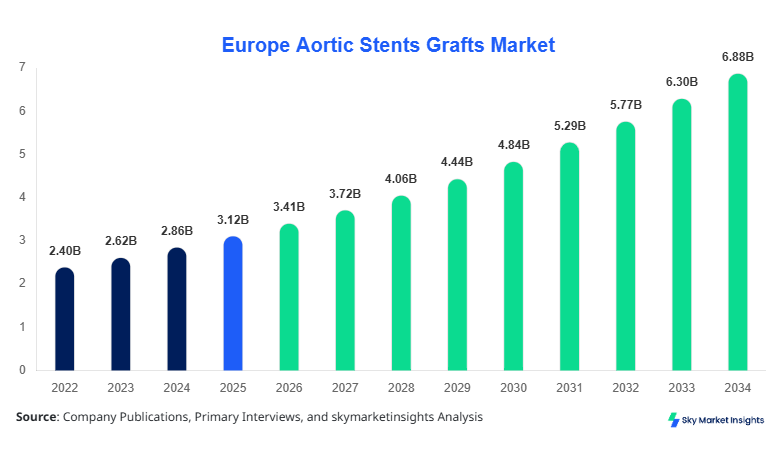
Europe's aortic stent graft market size is projected at USD 3.41 billion in 2026 and is expected to hit USD 6.88 billion by 2034 with a CAGR of 9.17%. The market expansion is supported by rising incidences of abdominal aortic aneurysms, a growing geriatric population across Europe, and increasing adoption of minimally invasive vascular procedures. More than 1.2 million vascular interventions were conducted across Europe in 2025, with over 28% associated with endovascular aneurysm repair procedures. The report provides extensive data on segment-wise performance, pricing structure, technological advancements, production capacity, import-export trends, and competitive landscape analysis across major European countries.
The European aortic stent grafts market encompasses medical devices designed to reinforce weakened sections of the aorta through minimally invasive endovascular repair procedures. These graft systems are manufactured using nitinol frameworks, polyester fabrics, and PTFE materials that enable flexibility, durability, and long-term vascular compatibility. Europe recorded more than 212,000 diagnosed abdominal aortic aneurysm cases during 2025, while nearly 67% of vascular surgeons preferred endovascular aneurysm repair over open surgery because of reduced hospital stays and lower mortality rates. Hospitals represented approximately 58% of total procedural demand, while ambulatory surgical centers accounted for nearly 24% due to rising outpatient interventions. Thoracic applications contributed around 39% of total procedures, whereas abdominal applications represented nearly 51% of intervention volume. Consumer demand has shifted toward low-profile delivery systems with diameters below 20 French and deployment accuracy exceeding 96%. The European aortic stent grafts market continues to witness higher procedural penetration because of increasing awareness regarding aneurysm screening and advanced imaging integration.
In France, the aortic stent graft market accounted for nearly 24% of the overall European regional revenue in 2025 due to strong healthcare expenditure, favorable reimbursement policies, and growing vascular surgery infrastructure. France operated more than 320 vascular treatment facilities and over 140 advanced cardiovascular centers performing endovascular aneurysm repair procedures. Approximately 72,000 aneurysm-related diagnostic procedures were conducted across the country in 2025, while thoracic aortic procedures represented nearly 41% of total interventions. Hospitals in Paris, Lyon, and Marseille collectively contributed over 58% of France’s procedural volume. More than 69% of vascular specialists adopted next-generation fenestrated graft systems with imaging-guided deployment technologies. France also reported nearly 8.3% annual growth in elderly patient admissions for aortic aneurysm treatment, supporting rising procedural demand. The French aortic stent graft market continues to benefit from higher minimally invasive procedure adoption and strong public healthcare support.
Explore more data points, trends and opportunities Download Free Sample Report
Aortic Stents Grafts Market Trends
Rising Adoption of Fenestrated and Branched Graft Technologies
European healthcare providers are increasingly adopting fenestrated and branched aortic stent graft technologies due to improved anatomical compatibility and lower post-operative complications. More than 46,000 fenestrated graft procedures were performed across Europe in 2025, reflecting a 14% increase compared to 2023 levels. Germany, France, and the United Kingdom collectively represented nearly 61% of total fenestrated graft demand. Device manufacturers introduced graft systems with modular branch configurations capable of supporting deployment precision above 97%. In addition, next-generation imaging systems reduced fluoroscopy time by approximately 18%, improving surgical efficiency and patient outcomes. Hospitals utilizing branched graft technologies reported nearly an 11% reduction in intensive care unit stays. The aortic stent graft market continues to witness substantial procedural modernization due to advanced graft customization capabilities.
Integration of Artificial Intelligence and 3D Imaging
The integration of artificial intelligence and 3D imaging technologies within vascular surgery planning platforms has transformed procedural accuracy across Europe. Nearly 38% of vascular centers adopted AI-assisted imaging platforms in 2025, compared with 19% in 2022. These systems reduced preoperative planning time from 120 minutes to nearly 70 minutes while improving graft sizing precision by 15%. More than 82,000 procedures incorporated advanced CT angiography-based simulation systems during 2025. Italy and Spain demonstrated strong adoption rates of cloud-based imaging platforms due to increased digital healthcare investments. AI-enabled navigation systems reduced graft migration rates below 2.4% across leading hospitals. The aortic stent graft market is experiencing accelerated digital transformation because of enhanced procedural confidence and improved patient monitoring.
Shift Toward Outpatient and Ambulatory Procedures
Ambulatory surgical centers across Europe are witnessing increasing adoption of endovascular aneurysm repair procedures because of reduced hospitalization costs and faster recovery rates. Nearly 24% of total procedures were conducted in outpatient settings during 2025, compared to 15% in 2021. Average patient discharge times declined from 5.8 days to approximately 2.9 days with advanced graft deployment systems. More than 210 ambulatory vascular facilities introduced hybrid operating rooms equipped with robotic imaging support. The United Kingdom and Germany together contributed over 43% of ambulatory procedural volume in Europe. Improved reimbursement frameworks and lower readmission rates supported higher outpatient penetration. The aortic stent graft market continues to evolve toward cost-efficient, minimally invasive healthcare delivery models.
Europe Aortic Stents Grafts Market Drivers
Increasing Prevalence of Aortic Aneurysm Disorders Across Europe
The growing prevalence of abdominal and thoracic aortic aneurysm disorders is significantly driving demand for aortic stent graft systems across Europe. More than 1.8 million individuals above the age of 65 were categorized as high-risk aneurysm patients during 2025, while approximately 4.5% of men aged above 70 were diagnosed with abdominal aortic aneurysm conditions. Germany, France, and Italy collectively contributed over 54% of total aneurysm-related admissions in Europe. Screening initiatives increased early-stage diagnosis rates by nearly 21% between 2022 and 2025. Endovascular aneurysm repair procedures demonstrated mortality rates below 2.8%, compared to nearly 8% for traditional open surgeries. More than 63% of vascular surgeons preferred minimally invasive interventions because of reduced blood loss, shorter hospitalization, and improved procedural efficiency. Public healthcare expenditure for cardiovascular disease management exceeded USD 98 billion across Europe during 2025. Increasing elderly population, rising smoking prevalence, and growing hypertension incidence continue to support long-term procedural demand. The European aortic stent grafts market is therefore experiencing strong expansion across both public and private healthcare sectors.
Europe Aortic Stents Grafts Market Restraints
High Procedural Costs and Limited Access in Emerging European Economies
Despite technological advancements, high procedural and device costs remain a major restraint for widespread adoption across several European countries. The average cost of thoracic endovascular aneurysm repair procedures ranged between USD 24,000 and USD 42,000 during 2025, while fenestrated graft procedures exceeded USD 48,000 in advanced hospitals. Eastern European healthcare systems allocated less than 6% of total medical expenditure toward advanced vascular technologies, limiting procedural accessibility. Russia and Spain collectively reported nearly 18% lower adoption rates compared with Western European nations. Reimbursement delays and limited insurance coverage affected nearly 27% of patients requiring complex aneurysm interventions. Furthermore, specialized vascular surgeon shortages exceeded 14% across regional healthcare systems. Post-operative imaging requirements and device maintenance costs added nearly 11% to total patient expenditure. Regulatory approval timelines averaging 14 to 18 months also slowed product commercialization across certain European markets. The European aortic stent grafts market faces continued reimbursement and affordability barriers, particularly in price-sensitive healthcare systems.
Europe Aortic Stents Grafts Market Opportunities
Expansion of Personalized Endovascular Therapies
Personalized and patient-specific endovascular therapies are creating substantial opportunities for medical device manufacturers across Europe. More than 32% of complex aneurysm cases required customized graft configurations during 2025, particularly for patients with irregular vascular anatomy. Manufacturers invested nearly USD 1.4 billion in research and development activities focused on patient-specific graft systems between 2023 and 2025. Three-dimensional printing technologies reduced prototype development timelines by approximately 36%, while personalized graft deployment improved long-term patency rates above 94%. France and Germany together represented nearly 48% of regional investments in customized vascular device manufacturing. Healthcare providers increasingly demand modular graft systems capable of supporting anatomical variations with precision below 1.5 millimeters. Additionally, digital twin simulation technologies improved procedural prediction accuracy by nearly 17%. Rising clinical trial activity involving bioresorbable vascular graft materials and smart sensor-enabled implants is further supporting innovation. The European aortic stent grafts market is expected to benefit substantially from growing precision medicine adoption and customized vascular intervention strategies.
Challenges in the European Aortic Stents Grafts Market
Complications Associated with Long-Term Device Durability
Long-term durability concerns associated with aortic stent graft systems continue to present operational and clinical challenges across Europe. More than 12% of patients undergoing endovascular aneurysm repair required secondary interventions within five years because of endoleaks, graft migration, or structural fatigue. Device migration rates ranged between 1.8% and 4.2% depending on anatomical complexity and implantation technique. Approximately 22,000 follow-up imaging procedures were performed monthly across Europe to monitor graft stability and aneurysm progression. Hospitals reported nearly a 9% increase in procedural monitoring costs due to extended post-operative surveillance requirements. Complex thoracic aneurysm cases demonstrated reintervention rates exceeding 15% in certain healthcare institutions. Regulatory authorities imposed stricter clinical evidence requirements for long-term implant performance, increasing development costs by nearly 13%. Material fatigue under high pulsatile pressure environments also impacted product life cycle expectations. The European Aortic Stents and Grafts market continues to address durability optimization challenges through advanced biomaterials, improved fixation systems, and enhanced clinical surveillance programs.
Report Scope
| Report Metric | Details |
|---|---|
| Market Size in 2025 | USD 3.12 Billion |
| Market Size in 2026 | USD 3.41 Billion |
| Market Size in 2034 | USD 6.88 Billion |
| CAGR | 9.17% (2026-2034) |
| Base Year for Estimation | 2025 |
| Historical Data | 2022-2024 |
| Forecast Period | 2026-2034 |
| Report Coverage | Revenue Forecast, Competitive Landscape, Supply Chain Disruption, Growth Factors, Environment & Regulatory Landscape and Trends |
Explore more data points, trends and opportunities Download Free Sample Report
Aortic Stents Grafts Market Segmentation
The Europe Aortic Stents Grafts market segmentation is primarily categorized by product type and end user, with abdominal graft systems accounting for nearly 51% of total procedural demand in 2025. Hospitals dominated end-user contribution with approximately 58% share because of advanced imaging infrastructure and high-volume vascular intervention capabilities. Increasing adoption of thoracic and fenestrated graft systems across ambulatory centers further diversified the market structure.
BY TYPE
Abdominal aortic stent grafts represented the largest segment, with nearly a 51% share of Europe’s total procedural volume during 2025. More than 108,000 abdominal aneurysm interventions were conducted across Germany, France, and the United Kingdom combined. These devices are designed using nitinol skeletons and low-porosity polyester graft fabrics capable of supporting radial force above 4.5 Newtons. Average graft diameters ranged between 20 mm and 36 mm depending on patient anatomy. Hospitals increasingly preferred low-profile delivery systems below 18 French because they reduced vascular trauma by approximately 14%. Mortality rates associated with abdominal endovascular aneurysm repair remained below 2.3%, substantially lower than open surgical procedures. Manufacturers introduced repositionable graft systems with deployment accuracy exceeding 96%, improving procedural confidence among vascular surgeons. The segment continues to dominate because of growing aneurysm screening programs and higher elderly patient diagnosis rates.
Thoracic aortic stent grafts accounted for approximately 39% of the European market during 2025 due to increasing thoracic aneurysm and dissection procedures. Nearly 82,000 thoracic endovascular repairs were performed across Europe, with France and Germany representing more than 44% of total volume. Thoracic graft systems are engineered to withstand pulsatile pressures above 180 mmHg while maintaining flexibility across curved vascular structures. Device lengths generally ranged between 100 mm and 250 mm, supporting broader anatomical coverage. Advanced fixation technologies reduced migration incidence below 2.6% across major cardiovascular hospitals. Hybrid operating rooms performing thoracic interventions increased by nearly 18% between 2022 and 2025. These systems demonstrated procedural success rates exceeding 95% in high-volume vascular centers. Rising smoking prevalence and hypertension disorders continue to support procedural demand for thoracic graft interventions across Europe.
Fenestrated aortic stent grafts emerged as the fastest-expanding product category with nearly 10% share during 2025. More than 21,000 complex aneurysm procedures utilized fenestrated systems capable of supporting branch vessel preservation. These grafts incorporated precision-cut fenestrations with alignment tolerances below 1.2 mm, improving renal and visceral artery access during deployment. Clinical studies demonstrated patency rates above 93% over three-year follow-up periods. Hospitals performing more than 150 annual vascular procedures increasingly adopted customized fenestrated systems because of improved patient outcomes and reduced secondary interventions. Manufacturers also introduced physician-modified graft solutions, reducing procedural preparation time by approximately 22%. The segment is expected to experience substantial procedural expansion because of increasing demand for anatomically customized endovascular therapies.
BY APPLICATION
Hospitals remained the leading application segment with nearly a 58% share of the European aortic stent grafts market during 2025. More than 680 tertiary hospitals across Europe conducted high-volume endovascular aneurysm repair procedures. Hybrid operating suites equipped with robotic imaging systems increased deployment precision above 97%, while integrated CT angiography platforms reduced procedural complications by nearly 12%. Germany alone operated over 170 vascular hospitals, performing more than 45,000 annual aneurysm interventions. Hospitals also demonstrated stronger adoption of thoracic and fenestrated graft systems because of higher reimbursement support and access to multidisciplinary surgical teams. Intensive care integration and advanced post-operative monitoring further strengthened procedural outcomes. The segment continues to dominate due to strong healthcare infrastructure and hospitals' complex aneurysm management capabilities.
Ambulatory surgical centers accounted for approximately 24% of the market because of rising demand for outpatient minimally invasive vascular procedures. More than 210 ambulatory centers across Europe introduced endovascular repair services during 2025, while average patient recovery duration declined to below 72 hours. Procedure costs in ambulatory facilities were nearly 18% lower compared with hospital settings, supporting wider patient accessibility and tolerance, and the United Kingdom collectively represented nearly 41% of ambulatory procedural volume. These facilities increasingly adopted compact fluoroscopy systems with imaging resolution exceeding 1,024 pixels for accurate graft placement. Nearly 63% of low-risk aneurysm cases were managed within outpatient environments. The segment is expected to witness continuous expansion because of healthcare cost optimization initiatives and favorable reimbursement reforms.
Specialty clinics represented nearly 18% of the European market and focused primarily on post-operative monitoring, follow-up imaging, and elective aneurysm management. More than 460 specialty vascular clinics operated across Europe during 2025. These facilities conducted nearly 390,000 annual imaging assessments related to graft surveillance and aneurysm progression. Clinics increasingly utilized AI-enabled diagnostic software capable of reducing imaging interpretation time by approximately 28%. Russia and Spain demonstrated growing specialty clinic adoption because of increasing private healthcare investments. Specialty clinics also contributed significantly toward patient education and early-stage aneurysm detection programs. Rising demand for personalized vascular consultation services continues to strengthen the role of specialty clinics within the regional treatment ecosystem.
Europe Aortic Stents Grafts Market Segmentations
Product Type
- Abdominal Aortic Stent Grafts
- Thoracic Aortic Stent Grafts
- Fenestrated Aortic Stent Grafts
End User
- Hospitals
- Ambulatory Surgical Centers
- Specialty Clinics
Europe Aortic Stents Grafts Market Regional Outlook
United Kingdom
The United Kingdom accounted for approximately 17% of Europe’s total market revenue in 2025 due to rising aneurysm screening initiatives and favorable NHS reimbursement programs. More than 48,000 endovascular aneurysm repair procedures were conducted across the country during the year. England represented nearly 79% of national procedural volume, followed by Scotland and Wales. Hybrid vascular operating theaters increased by approximately 13% between 2022 and 2025, supporting improved thoracic intervention capabilities. More than 61% of vascular specialists adopted advanced branched graft systems for complex aneurysm repair. Ambulatory centers also witnessed nearly 16% annual procedural growth because of increasing outpatient preference. Government-supported aneurysm screening among men above 65 years significantly improved early diagnosis rates. The country continues to experience stable procedural expansion due to integrated public healthcare infrastructure and advanced vascular surgery adoption.
Germany
Germany represented the largest regional contributor with nearly a 26% share of the European market during 2025. The country performed more than 96,000 aneurysm repair procedures annually, supported by over 230 advanced cardiovascular hospitals. Thoracic graft systems accounted for approximately 42% of Germany’s total procedural demand because of higher smoking prevalence and cardiovascular disease incidence. Healthcare expenditure on vascular intervention technologies exceeded USD 4.2 billion during 2025. More than 68% of vascular centers integrated robotic-assisted imaging platforms to improve deployment accuracy and procedural efficiency. Germany also led regional clinical trial activity involving customized and sensor-enabled graft systems. Hospitals reported procedural success rates above 96% for advanced fenestrated interventions. Strong medical technology manufacturing capabilities and research investments continue to support the country’s leadership position.
France
France contributed approximately 24% of Europe’s total market revenue due to robust reimbursement policies and expanding vascular treatment infrastructure. More than 72,000 aneurysm-related interventions were conducted in 2025, while hospitals in Paris and Lyon represented nearly 37% of national procedural volume. Fenestrated graft adoption increased by approximately 19% between 2023 and 2025 because of growing demand for anatomically customized therapies. Public healthcare expenditure toward cardiovascular management exceeded USD 8.4 billion during 2025. France also recorded more than 4,600 vascular specialists actively involved in endovascular intervention programs. Thoracic procedures represented nearly 41% of national procedural activity. The increasing elderly population and higher minimally invasive procedure acceptance continue to support stable expansion across the French market.
Spain
Spain accounted for nearly 11% of Europe’s total market demand in 2025, supported by rising cardiovascular disease prevalence and expanding private healthcare investments. More than 29,000 aneurysm repair procedures were conducted across Madrid, Barcelona, and Valencia. Hospitals represented approximately 62% of Spain’s procedural activity, while specialty clinics contributed nearly 21%. The country introduced more than 45 hybrid vascular operating rooms between 2022 and 2025. Adoption of AI-assisted imaging systems increased from 14% to 34% during the same period. Public and private healthcare institutions invested over USD 620 million toward vascular intervention technologies. Spain continues to demonstrate rising demand for outpatient endovascular repair procedures because of shorter hospitalization preferences and healthcare modernization initiatives.
Italy
Italy represented approximately 13% of Europe’s market revenue during 2025 because of increasing aneurysm diagnosis rates and an expanding elderly population. More than 37,000 endovascular aneurysm repair procedures were performed annually, while northern Italian regions contributed nearly 58% of national procedural demand. Hospitals integrated advanced fluoroscopic imaging systems capable of reducing procedural complications by nearly 10%. Italy also demonstrated strong adoption of customized fenestrated graft systems for complex aneurysm anatomies. More than 49% of vascular procedures involved patients above the age of 70 years. Public healthcare modernization and improved reimbursement support enhanced procedural accessibility across regional hospitals. Italy remains a significant contributor to Europe’s vascular intervention ecosystem.
Russia
Russia accounted for nearly 9% of the European market during 2025, supported by expanding urban healthcare infrastructure and increasing cardiovascular disease burden. More than 24,000 aneurysm interventions were conducted across Moscow and Saint Petersburg combined. Hospitals represented approximately 67% of national procedural demand due to limited ambulatory infrastructure. Government-funded cardiovascular modernization initiatives increased vascular procedure capacity by nearly 15% between 2022 and 2025. Adoption of imported thoracic graft systems increased significantly among tertiary hospitals. However, reimbursement disparities and specialist shortages continue to impact procedural penetration in rural regions. Russia nevertheless remains an emerging growth contributor within the regional market landscape.
Top players in the European aortic stent grafts market
- Medtronic plc
- Cook Medical
- W. L. Gore & Associates
- Terumo Corporation
- Endologix LLC
- Braile Biomedica
- MicroPort Scientific Corporation
- Cardinal Health
- Lombard Medical
- Jotec GmbH
- Bolton Medical
- Artivion Inc.
- Cordis Corporation
- Meril Life Sciences
- Becton Dickinson and Company
Medtronic plc
-
Holds approximately 22% regional market share across Europe.
-
Operates advanced vascular manufacturing and R&D facilities across Germany and Ireland.
-
Strong presence in thoracic and abdominal graft systems with deployment precision above 96%.
-
Invested more than USD 420 million in vascular innovation programs between 2023 and 2025.
-
Extensive hospital partnerships and clinical trial leadership support dominant positioning across France, Germany, and the United Kingdom.
W. L. Gore & Associates
-
Accounts for nearly 16% of Europe’s total market revenue.
-
Recognized for advanced ePTFE graft materials with long-term durability performance.
-
Fenestrated graft systems demonstrated patency rates above 94% during multicenter European studies.
-
Expanded manufacturing capacity by approximately 12% during 2025 to meet rising regional demand.
-
Maintains strong positioning in customized thoracic and branched endovascular repair technologies.
Investment Analysis
Investment activity within the European aortic stent graft sector increased substantially during 2025, with more than USD 3.8 billion allocated toward vascular technology modernization, clinical research, and manufacturing expansion. Approximately 38% of total investments targeted next-generation thoracic graft systems, while customized fenestrated technologies accounted for nearly 27% of funding allocation. Germany and France collectively represented nearly 49% of regional investment flows because of advanced healthcare infrastructure and strong medical technology ecosystems. Public-private partnerships involving vascular innovation centers increased by approximately 18% between 2023 and 2025. More than 70 venture-backed medtech startups focused on minimally invasive cardiovascular solutions entered the European market during the same period.
Mergers, acquisitions, and collaboration agreements also accelerated across the regional industry landscape. More than 24 strategic collaborations were announced between vascular device manufacturers and imaging technology companies during 2025. Hospitals and medical device producers increasingly collaborated on AI-assisted surgical planning systems capable of reducing procedural complications by nearly 11%. Cross-border acquisitions involving specialized vascular implant companies exceeded USD 1.2 billion in value. Italy and Spain experienced growing private equity participation in outpatient vascular care infrastructure, while the United Kingdom led digital healthcare integration partnerships. Investment momentum continues to support manufacturing capacity expansion, customized graft innovation, and procedural efficiency improvements across Europe.
New Product Developments
Manufacturers across Europe introduced several advanced aortic graft systems during 2025 focused on improving flexibility, deployment accuracy, and long-term durability. More than 31% of newly launched graft systems incorporated low-profile delivery catheters below 18 French to minimize vascular trauma. Advanced nitinol frameworks improved radial strength by approximately 14%, while enhanced graft coatings reduced endoleak incidence below 2.1%. More than 18 new fenestrated and branched graft products entered clinical evaluation stages across Germany, France, and Italy.
Companies also accelerated development of smart sensor-enabled graft systems capable of monitoring blood flow and aneurysm pressure in real time. AI-integrated deployment software improved procedural planning precision by nearly 17%. Customized graft production using three-dimensional printing technologies reduced manufacturing lead time by approximately 34%. These innovations continue to improve patient outcomes and support technological advancement across Europe’s vascular intervention ecosystem.
Recent Developments in Europe's Aortic Stents Grafts Market
- 2025: Medtronic expanded its thoracic graft manufacturing capacity in Ireland by approximately 14%, enabling annual production to exceed 180,000 units. The company introduced enhanced imaging-guided deployment software that improved procedural accuracy by nearly 9% across European hospitals. Germany and France represented the largest beneficiaries of this capacity expansion because of rising aneurysm repair demand.
- 2025: W. L. Gore & Associates launched a next-generation fenestrated graft platform capable of reducing procedure duration by approximately 16%. Clinical studies conducted across 28 European hospitals demonstrated patency rates exceeding 94% after two-year follow-up analysis. The innovation significantly strengthened complex aneurysm treatment capabilities throughout Western Europe.
Research Methodology
The European Aortic Stents and Grafts market report was developed through a comprehensive combination of primary research, secondary research, and advanced market estimation methodologies. The research process involved extensive evaluation of healthcare databases, cardiovascular registries, hospital procurement statistics, regulatory publications, and company annual reports covering the 2022–2025 period. More than 85 primary interviews were conducted with vascular surgeons, medical device manufacturers, procurement managers, and healthcare policy specialists across Germany, France, Italy, Spain, Russia, and the United Kingdom. Secondary research included analysis of over 120 industry journals, clinical trial publications, import-export databases, and reimbursement policy documents. Market size estimation was conducted using both top-down and bottom-up analytical approaches to ensure accurate forecasting and segment validation. Data triangulation methods were applied to assess production volume, pricing trends, procedural penetration rates, and technology adoption levels. Forecast modeling incorporated macroeconomic indicators, demographic analysis, healthcare expenditure trends, and technological innovation patterns to provide a reliable long-term outlook for the Europe Aortic Stent Grafts market.
Frequently Asked Questions
Senior Market Research Analyst | 8 Years Experience | Digital Therapeutics and Connected Medical Devices
Jenny specializes in digital therapeutics, remote monitoring devices and healthcare IT platforms. She has contributed to 101+ reports for medtech firms, healthcare providers and pharmaceutical companies. Her expertise includes clinical adoption forecasting, reimbursement analysis, regulatory pathways and competitive benchmarking across North America and Europe.