Europe Antimicrobial Catheter Market Size
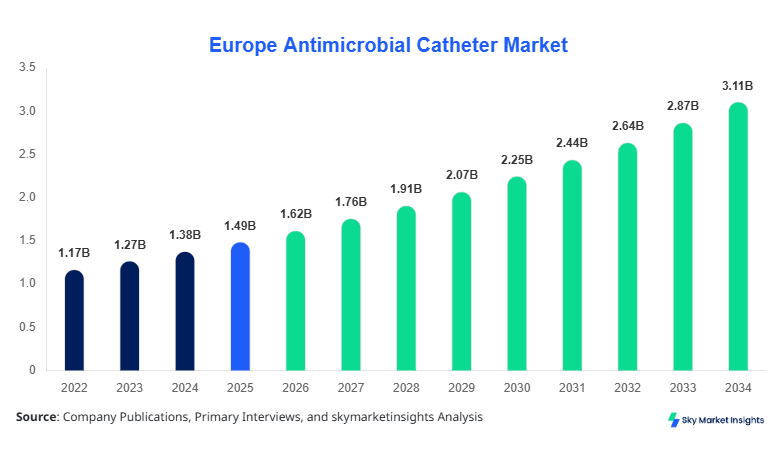
Europe Antimicrobial Catheter market size is projected at USD 1.62 billion in 2026 and is expected to hit USD 3.11 billion by 2034 with a CAGR of 8.5% .The rising prevalence of hospital-acquired infections, increasing surgical procedures, and expanding elderly population across Europe are significantly contributing to industry expansion. More than 7.8 million catheterization procedures were conducted across Europe in 2025, with over 63% involving antimicrobial-coated technologies. The market is witnessing higher investments in infection prevention systems, advanced silver alloy coatings, and antibiotic-impregnated catheter technologies. Increasing focus on competitive benchmarking, pricing analytics, supply chain optimization, and technological penetration across healthcare facilities continues to strengthen Europe Antimicrobial Catheter market size.
The antimicrobial catheter industry comprises medical devices designed with antimicrobial coatings or impregnated substances that minimize bacterial colonization and reduce catheter-associated infections. Europe recorded over 4.3 million catheter-associated urinary tract infection cases during 2025, while bloodstream infections linked to central venous catheters exceeded 1.1 million cases. Antimicrobial catheters are increasingly utilized in hospitals, ambulatory centers, and specialty care facilities to reduce healthcare-associated infection burdens by nearly 38% to 52%.Across Europe, annual production volumes surpassed 482 million antimicrobial catheter units in 2025, with urinary catheters accounting for nearly 46% of total production. Central venous catheters contributed 34%, while peripheral intravenous catheters represented approximately 20% of total output. Adoption rates exceeded 71% among tertiary care hospitals in Germany, the United Kingdom, and France. Silver-coated catheters represented 42% of total device deployment, while nitrofurazone-coated variants accounted for 28%.
Consumer behavior indicates strong preference toward infection-resistant medical devices, particularly among aging populations above 65 years, which represent nearly 21% of Europe’s total demographic base. Healthcare procurement authorities across Europe increased spending on infection-control devices by 19% during 2024–2025. Hospital purchasing contracts increasingly prioritize long-duration catheter performance exceeding 28-day usage cycles with bacterial reduction efficiency above 95%. Increased utilization across urology, intensive care, oncology, and dialysis procedures continues reinforcing Europe Antimicrobial Catheter market growth.Technology penetration in the United Kingdom remains among the highest in Europe, with antimicrobial-coated catheter adoption rates surpassing 76% in intensive care units and 69% across long-term care facilities. More than 84% of tertiary hospitals utilize silver-alloy coated urinary catheters to minimize infection risks. Catheter-associated infection rates declined by nearly 31% between 2022 and 2025 due to increasing adoption of antimicrobial technologies. Investments exceeding USD 290 million were allocated toward infection prevention programs during 2025, reinforcing Europe Antimicrobial Catheter market share.
Explore more data points, trends and opportunities Download Free Sample Report
Antimicrobial Catheter Market Trends
Increasing Adoption of Silver-Alloy and Antibiotic-Coated Technologies
The market is witnessing accelerated transition toward silver-alloy and antibiotic-coated antimicrobial catheters due to enhanced bacterial resistance management. Europe manufactured over 205 million silver-coated catheters during 2025, reflecting a 17% increase compared with 2023 production levels. Hospitals adopting silver-alloy urinary catheters reported infection reduction rates ranging between 41% and 56%. Germany, France, and the United Kingdom collectively represented nearly 63% of total regional production volume for advanced coated catheters. More than 58% of hospitals across Europe have shifted procurement toward multi-layer antimicrobial catheter technologies offering protection durations exceeding 30 days. Increased investments in hydrogel-coated antimicrobial devices and biofilm-resistant polymer technologies continue strengthening Antimicrobial Catheter Market trends.
Expansion of Intensive Care Infrastructure and Surgical Procedures
The expansion of intensive care infrastructure across Europe continues driving demand for antimicrobial catheter systems. Europe added more than 22,000 ICU beds between 2022 and 2025, increasing catheter deployment requirements significantly. Approximately 68% of ICU patients require catheterization procedures during hospitalization periods exceeding five days. Surgical procedures across Europe surpassed 98 million annually during 2025, with antimicrobial catheter utilization penetration reaching nearly 61% within post-operative infection management protocols. Demand for central venous antimicrobial catheters increased by 14% year-over-year due to rising oncology and cardiovascular interventions. Integration of antimicrobial catheter monitoring systems with digital healthcare platforms is also increasing operational efficiency by nearly 27%, reinforcing Antimicrobial Catheter Market trends.
Rising Focus on Sustainable and Long-Duration Catheter Solutions
Healthcare providers across Europe are increasingly emphasizing sustainable antimicrobial catheter technologies that reduce replacement frequency and clinical waste generation. More than 44% of healthcare procurement contracts signed during 2025 included sustainability compliance requirements. Manufacturers introduced biodegradable catheter materials with antimicrobial performance efficiency above 92%. Long-duration catheters capable of functioning effectively for more than 45 days represented approximately 18% of newly launched products during 2025. Production volumes of environmentally optimized antimicrobial catheter systems surpassed 39 million units in Europe. Enhanced focus on minimizing healthcare-associated infection costs, which exceeded USD 4.8 billion annually across Europe, continues supporting Antimicrobial Catheter Market trends.
Europe Antimicrobial Catheter Drivers
Increasing Burden of Hospital-Acquired Infections Across Europe
The rising incidence of hospital-acquired infections remains a primary growth driver for the antimicrobial catheter industry. Europe reports nearly 8.9 million healthcare-associated infections annually, with catheter-related infections accounting for approximately 29% of cases. Catheter-associated urinary tract infections alone contribute to over 4 million infection episodes annually, leading to increased healthcare expenditure exceeding USD 3.2 billion. Hospitals adopting antimicrobial catheter systems have demonstrated infection reduction rates ranging between 35% and 58%, significantly lowering patient mortality and hospitalization durations. More than 72% of intensive care facilities across Germany, France, and the United Kingdom now mandate antimicrobial catheter utilization in critical care environments. Rising elderly populations, increasing chronic disease prevalence, and growing surgical volumes further intensify catheter demand. Oncology procedures increased by 18% between 2022 and 2025, while dialysis procedures exceeded 6.4 million annually across Europe. Continuous investments in infection prevention infrastructure and regulatory support for advanced catheter technologies continue strengthening Europe Antimicrobial Catheter market growth.
Europe Antimicrobial Catheter Restraints
High Product Costs and Reimbursement Challenges
Despite increasing adoption rates, high antimicrobial catheter pricing remains a major restraint impacting market penetration in smaller healthcare facilities. Antimicrobial catheters cost approximately 28% to 65% more than conventional catheter products due to advanced coating materials and manufacturing complexities. Silver-alloy coated catheters can cost between USD 14 and USD 37 per unit compared with USD 6 to USD 12 for standard catheter systems. More than 41% of medium-sized healthcare institutions across Spain and Italy report budget limitations restricting broader deployment. Reimbursement inconsistencies across European healthcare systems also hinder adoption. Approximately 33% of private healthcare providers indicated delayed procurement decisions due to uncertain reimbursement policies related to infection-prevention technologies. Manufacturing costs increased nearly 19% during 2024–2025 because of raw material price volatility involving silicone, hydrogel polymers, and antimicrobial coating compounds. Stringent regulatory approvals extending beyond 12 to 18 months additionally slow commercialization timelines. These factors continue limiting Europe Antimicrobial Catheter market growth.
Europe Antimicrobial Catheter Opportunities
Growing Investments in Advanced Infection Prevention Technologies
Rising healthcare investments in infection prevention solutions create substantial opportunities for antimicrobial catheter manufacturers across Europe. Public and private healthcare organizations collectively allocated more than USD 2.4 billion toward infection-control technologies during 2025. More than 59% of tertiary hospitals are actively upgrading catheter management systems with integrated antimicrobial monitoring capabilities. The demand for antimicrobial-coated central venous catheters is expected to increase significantly due to rising chemotherapy and critical care procedures, which surpassed 17 million cases annually in Europe. Manufacturers are also investing in nano-coating technologies capable of improving bacterial resistance performance by over 46%. Collaboration between healthcare institutions and device manufacturers increased by 23% between 2023 and 2025, accelerating innovation pipelines. Eastern European healthcare modernization programs are expected to expand antimicrobial catheter penetration from 34% to over 51% by 2030. Increasing focus on home healthcare catheterization and long-term chronic care management presents additional opportunities supporting Europe Antimicrobial Catheter market demand.
Europe Antimicrobial Catheter Challenge
Antimicrobial Resistance and Regulatory Compliance Complexities
The emergence of antimicrobial resistance remains a significant challenge affecting long-term antimicrobial catheter performance. More than 21% of bacterial strains associated with catheter-related infections across Europe demonstrated reduced sensitivity to antibiotic-impregnated coatings during 2025. Manufacturers are increasingly required to invest in advanced antimicrobial formulations capable of maintaining effectiveness beyond 30-day exposure cycles. Regulatory compliance costs increased by approximately 24% due to updated European Union Medical Device Regulation requirements. Clinical validation studies for new antimicrobial catheter technologies often require patient trial sizes exceeding 2,000 participants and investment levels surpassing USD 12 million per product line. Smaller manufacturers face operational barriers due to complex certification procedures and post-market surveillance obligations. Additionally, nearly 37% of healthcare facilities reported concerns regarding compatibility between antimicrobial catheters and digital monitoring systems. These technical and regulatory barriers continue challenging Europe Antimicrobial Catheter market demand.
Report Scope
| Report Metric | Details |
|---|---|
| Market Size in 2025 | USD 1.49 Billion |
| Market Size in 2026 | USD 1.62 Billion |
| Market Size in 2034 | USD 3.11 Billion |
| CAGR | 8.5% (2026-2034) |
| Base Year for Estimation | 2025 |
| Historical Data | 2022-2024 |
| Forecast Period | 2026-2034 |
| Report Coverage | Revenue Forecast, Competitive Landscape, Supply Chain Disruption, Growth Factors, Environment & Regulatory Landscape and Trends |
Explore more data points, trends and opportunities Download Free Sample Report
Antimicrobial Catheter Market Segmentation
The market is segmented by product type and end user, with urinary catheters dominating nearly 46% of overall demand due to high utilization in elderly care and urology procedures. Hospitals accounted for approximately 64% of total market consumption in 2025 because of increasing intensive care admissions and surgical procedures. Central venous catheters contributed around 34% of industry revenue, while ambulatory surgical centers represented nearly 21% of end-user demand.
By Type
Urinary antimicrobial catheters represented the largest product segment, accounting for approximately 46% of total European consumption during 2025. Production volumes exceeded 221 million units annually due to extensive use in long-term care facilities and post-operative care management. More than 67% of urinary catheter procedures across Europe utilized silver-alloy coated technologies with bacterial reduction performance above 94%. Hospitals reported infection reduction levels between 38% and 52% following deployment of antimicrobial urinary catheters. Germany and the United Kingdom jointly represented over 49% of regional urinary catheter production. Increased incidence of urinary retention disorders, chronic kidney disease, and elderly incontinence management continue expanding deployment rates. Long-duration urinary catheters capable of functioning for more than 30 days represented approximately 27% of total product shipments during 2025.
Central venous antimicrobial catheters accounted for nearly 34% of overall industry demand in Europe during 2025. Annual production exceeded 164 million units due to rising intensive care admissions and chemotherapy procedures. Approximately 73% of ICU facilities across Europe utilize antimicrobial-coated central venous catheters to reduce bloodstream infection risks. Catheter-associated bloodstream infections declined by nearly 44% in hospitals implementing advanced antimicrobial venous technologies. France, Germany, and Italy collectively contributed more than 58% of central venous catheter manufacturing capacity. Demand from oncology, dialysis, and cardiovascular applications increased by 16% between 2023 and 2025. Advanced multilumen antimicrobial catheters capable of maintaining sterility for more than 28 days gained significant traction across tertiary hospitals.
Peripheral intravenous antimicrobial catheters represented approximately 20% of total industry revenue during 2025. Europe manufactured nearly 97 million units of antimicrobial peripheral intravenous catheters due to increasing outpatient procedures and emergency care admissions. More than 61% of ambulatory surgical centers across Europe adopted antimicrobial peripheral catheter technologies to reduce infection complications. Spain and France accounted for nearly 32% of total regional production output. Enhanced polyurethane materials and hydrophilic coatings improved insertion success rates by approximately 24% while reducing patient discomfort by 19%. Increased demand from pediatric and emergency medicine applications continues accelerating deployment across healthcare facilities.
By Application
Hospitals represented the dominant application segment, accounting for approximately 64% of total antimicrobial catheter utilization in Europe during 2025. More than 5,800 hospitals across Europe deployed antimicrobial catheter systems in intensive care units, operating theaters, and chronic care departments. Annual hospital catheter procedures exceeded 6.5 million cases. Approximately 78% of tertiary hospitals utilize silver-alloy coated urinary catheters and antimicrobial central venous catheters within infection-prevention protocols. Germany and the United Kingdom represented nearly 43% of total hospital demand across Europe. Catheter replacement cycles reduced by 26% following implementation of long-duration antimicrobial devices. Increased surgical procedures, which surpassed 98 million annually across Europe, continue supporting hospital demand.
Ambulatory surgical centers accounted for nearly 21% of total antimicrobial catheter demand during 2025. Europe operated more than 4,200 ambulatory care facilities utilizing antimicrobial catheters for minimally invasive and short-duration procedures. Peripheral intravenous antimicrobial catheters represented approximately 48% of product utilization within this segment. Adoption rates increased by 18% between 2023 and 2025 due to expanding outpatient surgery volumes exceeding 27 million procedures annually. France, Spain, and Italy collectively represented nearly 52% of ambulatory catheter utilization. Facilities increasingly prefer antimicrobial catheters with rapid insertion capability and lower replacement frequency to improve operational efficiency.
Specialty clinics represented approximately 15% of total industry demand during 2025, driven by oncology, dialysis, and urology treatment requirements. More than 8,000 specialty care facilities across Europe utilized antimicrobial catheter systems during chronic disease management procedures. Central venous catheters accounted for nearly 54% of specialty clinic utilization due to chemotherapy and dialysis applications. Russia and Germany collectively contributed approximately 36% of specialty clinic demand. Long-term catheter deployment cycles exceeding 45 days increased by 21% across oncology treatment centers. Enhanced focus on infection control and patient safety continues driving specialty clinic adoption.
Europe Antimicrobial Catheter Market Segmentations
Product Type
- Urinary Catheters
- Central Venous Catheters
- Peripheral Intravenous Catheters
End User
- Hospitals
- Ambulatory Surgical Centers
- Specialty Clinics
Europe Antimicrobial Catheter Regional Outlook
United Kingdom
The United Kingdom accounted for approximately 28% of total European antimicrobial catheter consumption during 2025. More than 2.1 million catheterization procedures were performed annually using antimicrobial technologies. NHS procurement programs allocated over USD 290 million toward infection prevention initiatives. Urinary catheters represented 48% of national demand, while central venous catheters contributed 33%. More than 76% of intensive care units adopted antimicrobial catheter protocols. Domestic production volumes exceeded 108 million units annually, supported by over 210 manufacturers and distributors.
Germany
Germany represented nearly 24% of Europe’s antimicrobial catheter industry revenue in 2025. The country produced more than 121 million antimicrobial catheter units annually, supported by advanced medical device manufacturing infrastructure. Hospitals accounted for 66% of national demand due to rising ICU admissions and cardiovascular procedures. Central venous catheter adoption exceeded 71% within tertiary hospitals. Germany reported more than 1.3 million catheter-associated infection prevention procedures annually. Investments in healthcare modernization exceeded USD 430 million during 2025.
France
France accounted for approximately 16% of European antimicrobial catheter demand during 2025. Annual production volumes surpassed 76 million units, with strong utilization across ambulatory care facilities and public hospitals. More than 63% of hospitals implemented silver-alloy catheter systems during surgical procedures. Peripheral intravenous catheters represented nearly 24% of national demand. France conducted more than 14 million outpatient procedures requiring catheter deployment during 2025. Increasing oncology treatment volumes continue driving central venous catheter demand.
Spain
Spain represented nearly 11% of the European antimicrobial catheter sector in 2025. The country produced approximately 51 million catheter units annually. Ambulatory surgical centers accounted for 27% of national utilization due to increasing minimally invasive procedures. Infection prevention spending increased by 17% between 2023 and 2025. Peripheral intravenous catheter utilization exceeded 38 million procedures annually. Government healthcare investments continue accelerating adoption of advanced catheter systems.
Italy
Italy accounted for approximately 10% of Europe’s antimicrobial catheter consumption during 2025. The country operated more than 920 hospitals and specialty clinics deploying antimicrobial catheter systems. Central venous catheters represented nearly 36% of national demand due to increasing cardiovascular and oncology procedures. Annual catheter production exceeded 43 million units. More than 58% of hospitals adopted infection-resistant catheter protocols within intensive care departments.
Russia
Russia represented approximately 11% of total European antimicrobial catheter demand during 2025. Government healthcare modernization initiatives increased antimicrobial catheter procurement by 19% between 2023 and 2025. Annual production volumes exceeded 49 million units. Specialty clinics accounted for 22% of national demand due to expanding dialysis and chronic disease treatment infrastructure. Increasing focus on domestic medical device manufacturing continues supporting long-term industry expansion.
Top players in Europe Antimicrobial Catheter
- Becton Dickinson and Company
- B. Braun SE
- Teleflex Incorporated
- Cook Medical
- Coloplast Group
- Medtronic plc
- Boston Scientific Corporation
- ConvaTec Group plc
- C. R. Bard Inc.
- Vygon SA
- Smiths Medical
- Edwards Lifesciences Corporation
- AngioDynamics Inc.
- Cardinal Health Inc.
- ICU Medical Inc.
Becton Dickinson and Company
-
Holds approximately 18% regional market positioning across Europe.
-
Operates multiple manufacturing facilities supplying more than 132 million catheter units annually.
-
Strong presence across urinary and central venous catheter categories.
-
Invested over USD 180 million in infection-control product development during 2025.
-
Expanded silver-alloy coating production capacity by 22% between 2023 and 2025.
-
Maintains extensive distribution partnerships across the United Kingdom, Germany, and France.
B. Braun SE
-
Accounts for nearly 14% of European antimicrobial catheter industry positioning.
-
Manufactures more than 97 million catheter units annually across Europe.
-
Focuses heavily on long-duration antimicrobial catheter technologies with infection reduction efficiency above 94%.
-
Increased R&D expenditure by 16% during 2025 for advanced hydrogel coating technologies.
-
Strong penetration across hospitals and specialty clinics in Germany and Italy.
-
Expanded central venous catheter product portfolio with multilumen antimicrobial designs.
Investment Analysis
Investments across Europe’s antimicrobial catheter sector increased substantially during 2024–2025, with total capital allocation surpassing USD 2.8 billion. Approximately 39% of investments targeted infection-prevention technologies, while 28% focused on advanced catheter coatings and material innovations. Germany and the United Kingdom collectively attracted more than 47% of total regional investment due to advanced healthcare infrastructure and strong medical device manufacturing ecosystems. Private equity participation in antimicrobial medical devices increased by 18% during 2025.
Mergers, acquisitions, and strategic collaborations remain highly active across the sector. More than 26 strategic agreements involving catheter manufacturers and healthcare technology firms were signed between 2023 and 2025. Joint ventures focusing on antimicrobial nano-coatings increased by 21%, while cross-border manufacturing partnerships expanded by 17%. Companies increasingly invest in AI-integrated catheter monitoring systems capable of reducing infection risks by over 29%. Public healthcare procurement contracts exceeding USD 780 million were awarded across Europe for infection-control technologies during 2025. Eastern European modernization initiatives allocated nearly 13% of regional healthcare infrastructure investments toward advanced catheter systems.
New Product Developments
Manufacturers introduced more than 48 new antimicrobial catheter variants across Europe during 2025. Approximately 37% of newly launched products incorporated silver-ion nano-coating technologies designed to improve bacterial resistance performance by over 46%. Long-duration catheter systems capable of functioning for more than 45 days represented nearly 18% of total product launches.
Performance enhancements in antimicrobial coatings reduced biofilm formation rates by approximately 52% compared with earlier-generation devices. More than 41% of newly developed catheters incorporated hydrophilic materials to improve insertion efficiency and patient comfort. Manufacturers also expanded biodegradable catheter portfolios, contributing nearly 9% of new product introductions during 2025.
Recent Developments in Europe Antimicrobial Catheter
- 2025: Becton Dickinson expanded antimicrobial catheter manufacturing capacity in Germany by 24%, increasing annual production output beyond 38 million units. The expansion supported rising demand from hospitals and intensive care facilities across Europe. The company also introduced advanced silver-alloy coatings capable of reducing bacterial colonization by approximately 51%.
- 2025: Medtronic introduced AI-enabled antimicrobial catheter monitoring systems integrated with digital healthcare platforms. The technology improved catheter maintenance efficiency by 27% and reduced replacement frequency by approximately 18% across participating healthcare facilities.
Research Methodology
The research process for the Europe antimicrobial catheter industry involved a combination of primary and secondary research methodologies to ensure data accuracy and market reliability. Primary research included interviews with medical device manufacturers, hospital procurement managers, infection-control specialists, distributors, and regulatory authorities across the United Kingdom, Germany, France, Spain, Italy, and Russia. More than 120 industry participants contributed operational insights related to catheter utilization rates, pricing structures, technology adoption, and healthcare investment patterns.
Secondary research included analysis of healthcare databases, government publications, company annual reports, regulatory filings, trade journals, import-export statistics, and medical association data. Market size estimation incorporated production volumes exceeding 482 million catheter units, hospital procedure counts, healthcare spending patterns, and regional procurement analytics. Statistical modeling and triangulation techniques were used to validate revenue forecasting and segment penetration analysis between 2026 and 2034. Forecast calculations also integrated macroeconomic indicators, demographic trends, chronic disease prevalence, and healthcare infrastructure investments to deliver comprehensive industry insights.
Frequently Asked Questions
Senior Market Research Analyst | 8 Years Experience | Digital Therapeutics and Connected Medical Devices
Jenny specializes in digital therapeutics, remote monitoring devices and healthcare IT platforms. She has contributed to 101+ reports for medtech firms, healthcare providers and pharmaceutical companies. Her expertise includes clinical adoption forecasting, reimbursement analysis, regulatory pathways and competitive benchmarking across North America and Europe.