Europe Antibody Drug Conjugates Contract Manufacturing Market Size
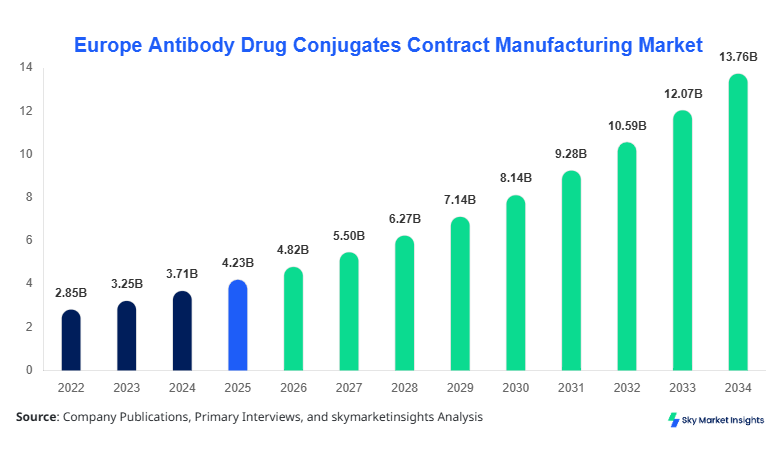
The Europe Antibody Drug Conjugates Contract Manufacturing market size is projected at USD 4.82 billion in 2026 and is expected to hit USD 13.76 billion by 2034 with a CAGR of 14.01%.
The European Antibody Drug Conjugates Contract Manufacturing Market is witnessing rapid expansion due to rising biologics outsourcing activities, increasing oncology drug approvals, and the growing requirement for high-potency active pharmaceutical ingredient (HPAPI) handling facilities across Europe. More than 68% of biopharmaceutical developers in Europe outsourced at least one stage of antibody drug conjugate manufacturing in 2025, while over 124 ADC pipeline products were under clinical development in the region. The market analysis includes detailed evaluation of service type, end-user penetration, production capacity utilization, and competitive benchmarking among major contract manufacturing organizations operating across the United Kingdom, Germany, France, Spain, Italy, and Russia.
The antibody-drug conjugate contract manufacturing ecosystem refers to outsourced manufacturing services involving monoclonal antibody production, linker synthesis, payload conjugation, purification, sterile fill-finish operations, and commercial-scale production for ADC therapeutics. Europe accounted for approximately 28.4% of global ADC manufacturing output in 2025, supported by more than 210 biologics production facilities and nearly 75 dedicated HPAPI manufacturing units. ADC manufacturing adoption increased by 18.7% year-over-year in 2025 due to increasing oncology prevalence and growing demand for targeted therapies with reduced systemic toxicity. Nearly 61% of antibody drug conjugates produced in Europe were utilized in breast cancer and hematological malignancy treatment applications, while lung cancer therapeutics contributed approximately 19% of demand. Commercial manufacturing represented nearly 42% of total service utilization, followed by process development at 34% and fill-finish services at 24%.
Consumer behavior across the European Antibody-Drug Conjugates Contract Manufacturing Market is shifting toward long-term outsourcing agreements and integrated end-to-end manufacturing partnerships. Around 57% of European biotech firms preferred multi-service ADC manufacturing contracts in 2025 to reduce operational expenditure and accelerate time-to-market by nearly 22%. Demand analytics indicate that small and mid-sized biotech firms contributed 48% of total outsourcing spending, while large pharmaceutical companies accounted for 52%. ADC manufacturing processes require high containment systems operating at occupational exposure bands below 10 ng/m³, and more than 73% of newly established facilities adopted automated conjugation technologies for precise payload attachment. Continuous bioprocessing systems improved manufacturing efficiency by 16% and reduced batch contamination risks by 11%, strengthening the European Antibody-Drug Conjugates Contract Manufacturing Market.
In the United Kingdom, the Antibody Drug Conjugates Contract Manufacturing Market accounted for nearly 31.2% of the European regional revenue contribution in 2025, making it the leading country in Europe. The country hosted more than 46 biologics manufacturing facilities and 18 dedicated ADC development and conjugation facilities, primarily concentrated in Cambridge, London, and Manchester biotechnology clusters. Approximately 63% of ADC manufacturing demand in the UK originated from oncology therapeutics, while autoimmune and rare disease applications contributed 21% and 9%, respectively. The United Kingdom also recorded over USD 1.2 billion in biologics manufacturing investments during 2024–2025, supporting expansion in commercial-scale ADC production.
Technology adoption across UK-based ADC contract manufacturers remained among the highest in Europe, with nearly 74% of facilities utilizing single-use bioreactor systems and 66% implementing AI-enabled quality monitoring systems. Payload conjugation throughput improved by 19% due to automation integration, while sterile fill-finish operations expanded by 14% in annual production volume. The country exported more than 39 million ADC-related biologic units during 2025, with Germany and France accounting for 41% of regional trade consumption. Strong clinical trial activity, advanced containment infrastructure, and growing partnerships between pharmaceutical innovators and CMOs continue to reinforce the European Antibody-Drug Conjugates Contract Manufacturing Market.
Explore more data points, trends and opportunities Download Free Sample Report
Antibody Drug Conjugates Contract Manufacturing Market Trends
Expansion of High-Potency Manufacturing Infrastructure
ADC manufacturing companies across Europe are heavily investing in high-potency manufacturing infrastructure to accommodate increasing oncology therapeutic demand. More than 22 new HPAPI facilities were announced across Europe between 2023 and 2025, increasing regional ADC payload production capacity by approximately 27%. Germany, the United Kingdom, and France collectively represented 71% of new facility investments, while automated containment technologies achieved adoption rates exceeding 69%. Contract manufacturers increasingly adopted modular cleanroom systems capable of reducing setup times by 24% and operational costs by nearly 13%. In 2025 alone, European ADC contract manufacturers produced more than 142 million biologic dosage units, representing a 16.8% increase compared to 2024 production levels. Growing regulatory approvals for HER2-targeted and hematologic ADC therapies are accelerating demand for scalable commercial manufacturing capabilities, positively influencing the Antibody Drug Conjugates Contract Manufacturing Market.
Adoption of Integrated End-to-End Manufacturing Platforms
Integrated end-to-end manufacturing platforms are emerging as a dominant operational trend across the market. Approximately 58% of ADC developers preferred single-vendor outsourcing models in 2025 compared to 44% in 2022 due to reduced supply chain complexity and improved regulatory coordination. End-to-end manufacturing solutions covering monoclonal antibody production, linker-payload synthesis, conjugation, purification, analytical testing, and fill-finish services improved project completion timelines by nearly 21%. More than 47% of European CMOs adopted digital batch monitoring systems and predictive maintenance software, reducing process deviations by 17%. Commercial ADC manufacturing batch sizes expanded from an average of 1,800 liters in 2022 to nearly 2,600 liters in 2025 due to rising therapeutic demand. These operational enhancements continue to accelerate the antibody-drug conjugate contract manufacturing market.
Rising Adoption of Single-Use Bioprocessing Systems
Single-use technologies are significantly transforming ADC manufacturing efficiency across Europe. Nearly 72% of newly commissioned biologics manufacturing lines integrated disposable bioreactors and tubing systems in 2025. These systems reduced cleaning validation time by approximately 34% and lowered contamination risks by 18%. ADC developers increasingly favored flexible manufacturing systems capable of supporting multiple clinical-stage compounds simultaneously, particularly for orphan oncology therapies with smaller production volumes. The use of disposable technologies also reduced water consumption by 26% and energy usage by 14% across European facilities. Continuous investments in smart manufacturing, robotic filling systems, and AI-driven quality assurance are further strengthening production scalability and operational reliability across the antibody drug conjugates contract manufacturing market.
Europe Antibody Drug Conjugates Contract Manufacturing Market Drivers
Increasing Oncology Pipeline and Targeted Therapy Approvals
The expanding oncology drug pipeline is a major factor driving market expansion across Europe. More than 420 oncology biologics were under active clinical development across Europe in 2025, including over 124 ADC candidates targeting breast cancer, leukemia, ovarian cancer, and lung cancer. Oncology represented approximately 79% of total ADC therapeutic demand in Europe, while HER2-targeted therapies alone contributed 36% of commercial production contracts. Regulatory approvals for next-generation ADC therapeutics increased by 18% between 2023 and 2025, encouraging pharmaceutical companies to outsource manufacturing to specialized CMOs with high-containment expertise. Nearly 64% of biotech companies lacked internal conjugation and fill-finish capabilities, leading to higher outsourcing dependence. European contract manufacturers expanded production capacity by over 31% during the past three years, with annual ADC payload manufacturing volumes exceeding 850 metric tons in 2025. The increasing prevalence of cancer, which surpassed 4.7 million diagnosed cases across Europe in 2025, continues to stimulate therapeutic development and biologics outsourcing activities, accelerating the European Antibody Drug Conjugates Contract Manufacturing Market.
Europe Antibody Drug Conjugates Contract Manufacturing Market Restraints
High Capital Investment and Complex Regulatory Requirements
ADC manufacturing requires highly specialized containment systems, aseptic production lines, and toxic payload handling infrastructure, creating significant financial barriers for market participants. Establishing a commercial-scale ADC manufacturing facility in Europe requires investments ranging between USD 120 million and USD 350 million depending on production scale and containment requirements. Approximately 42% of small biotechnology companies cited high outsourcing costs as a major operational challenge during 2025. Regulatory compliance costs also increased by nearly 14% due to stricter European Medicines Agency guidelines concerning HPAPI handling, sterility assurance, and cross-contamination prevention. Batch failure rates for ADC conjugation processes remained around 5.8% in 2025 due to payload instability and linker degradation risks. Additionally, average validation timelines for commercial ADC production facilities exceeded 18 months across several European countries. These operational and compliance complexities continue to create barriers for emerging market entrants and moderately restrain the European Antibody Drug Conjugates Contract Manufacturing Market.
Europe Antibody Drug Conjugates Contract Manufacturing Market Opportunities
Expansion of Biosimilar ADC Development and Personalized Medicine
The emergence of biosimilar ADC therapeutics and personalized oncology treatments presents substantial growth opportunities for European contract manufacturers. More than 36 biosimilar ADC candidates entered preclinical and clinical development stages across Europe in 2025, creating increasing demand for cost-efficient manufacturing services. Personalized oncology therapies requiring small-batch, high-precision production represented nearly 22% of new outsourcing agreements signed during 2024–2025. Contract manufacturers capable of flexible production scheduling and rapid changeover systems achieved approximately 19% higher client retention rates. Germany, the United Kingdom, and France collectively accounted for nearly 68% of personalized medicine manufacturing investments within Europe. Additionally, over USD 2.6 billion in venture capital funding was directed toward ADC-focused biotechnology firms across Europe between 2023 and 2025. Advanced analytics, AI-enabled process optimization, and precision conjugation systems are enabling faster commercialization of customized therapeutics, creating significant opportunities for the Europe Antibody Drug Conjugates Contract Manufacturing Market.
Challenges in Europe Antibody Drug Conjugates Contract Manufacturing Market
Supply Chain Constraints and Skilled Workforce Shortages
The ADC manufacturing industry faces persistent supply chain and workforce-related challenges across Europe. More than 39% of European CMOs reported shortages of specialized linker-payload raw materials in 2025, resulting in production delays averaging 6–8 weeks. High-potency cytotoxic compounds require controlled transportation environments below 8°C and strict handling protocols, increasing logistics costs by approximately 17%. Skilled workforce shortages also remain a major concern, particularly in bioconjugation engineering, aseptic processing, and analytical testing operations. Europe faced a deficit of nearly 8,500 biologics manufacturing professionals during 2025, while employee turnover rates in ADC manufacturing facilities exceeded 14%. Nine percent of manufacturing firms increased training expenditures to address operational competency gaps. Furthermore, fluctuating energy prices across Europe increased biologics production expenses by approximately 11% year-over-year. These operational challenges continue to impact scalability and production efficiency within the European Antibody Drug Conjugates Contract Manufacturing Market.
Report Scope
| Report Metric | Details |
|---|---|
| Market Size in 2025 | USD 4.23 Billion |
| Market Size in 2026 | USD 4.82 Billion |
| Market Size in 2034 | USD 13.76 Billion |
| CAGR | 14.01% (2026-2034) |
| Base Year for Estimation | 2025 |
| Historical Data | 2022-2024 |
| Forecast Period | 2026-2034 |
| Report Coverage | Revenue Forecast, Competitive Landscape, Supply Chain Disruption, Growth Factors, Environment & Regulatory Landscape and Trends |
Explore more data points, trends and opportunities Download Free Sample Report
Antibody Drug Conjugates Contract Manufacturing Market Segmentation
The European Antibody Drug Conjugates Contract Manufacturing Market is segmented by service type and end user. Commercial manufacturing dominated the service category with approximately 42% share in 2025 due to increasing late-stage clinical and approved ADC therapies. Biopharmaceutical companies accounted for nearly 58% of end-user demand because of rising outsourcing preferences and large-scale biologics development activities.
By Type
Process development accounted for approximately 34% of total market demand in 2025. More than 78 ADC candidates across Europe required process optimization and analytical testing services before large-scale manufacturing. Contract manufacturers processed nearly 1,240 development batches annually, with average batch sizes ranging between 100 and 500 liters. Advanced conjugation technologies improved payload attachment efficiency by nearly 16%, while automated chromatography systems reduced purification times by 21%. Germany and the United Kingdom collectively represented over 57% of process development outsourcing demand due to strong oncology research ecosystems.
Fill-finish services represented around 24% of total market revenue in 2025. European ADC fill-finish facilities produced approximately 63 million sterile biologic units during the year, supported by increasing regulatory approvals for injectable oncology therapeutics. More than 67% of facilities adopted robotic vial filling systems capable of maintaining sterility assurance levels below 10^-6 contamination probability. Single-use filling systems reduced turnaround time by nearly 28% while lowering operational waste generation by 19%.
Commercial manufacturing remained the dominant service segment with nearly a 42% share. Annual commercial ADC production exceeded 142 million dosage units across Europe in 2025, driven by rising demand for HER2-targeted and hematologic therapies. Facilities operating at commercial scale utilized bioreactor capacities ranging from 2,000 liters to 15,000 liters. Continuous manufacturing technologies improved production throughput by 23% and reduced operational downtime by 14%.
By Application
Biopharmaceutical companies accounted for approximately 58% of end-user demand in 2025. Large pharmaceutical firms outsourced nearly 64% of ADC conjugation activities and 51% of sterile fill-finish operations to specialized CMOs. Oncology biologics represented more than 81% of production contracts signed by pharmaceutical companies. Advanced automation systems enabled commercial manufacturers to reduce batch release timelines by approximately 18%.
Research institutes contributed around 18% of total market demand. More than 210 oncology-focused research collaborations involving ADC development were active across Europe during 2025. Academic laboratories outsourced small-scale conjugation and analytical testing services for nearly 46 preclinical ADC programs. Funding support exceeding USD 740 million was allocated toward biologics research across Europe.
Contract research organizations represented nearly 24% of total demand. CROs increasingly partnered with ADC manufacturers to support clinical trial material production, analytical testing, and toxicology evaluation services. Approximately 38% of ADC clinical trial batches produced in Europe during 2025 were handled through CRO-manufacturer collaborations. Integrated service platforms improved project turnaround time by nearly 20%.
Europe Antibody Drug Conjugates Contract Manufacturing Market Segmentations
Service Type
- Process Development
- Fill-Finish Services
- Commercial Manufacturing
End User
- Biopharmaceutical Companies
- Research Institutes
- Contract Research Organizations
Europe Antibody Drug Conjugates Contract Manufacturing Market Regional Outlook
United Kingdom
The United Kingdom remained the largest regional contributor with approximately 31.2% market share in 2025. The country hosted more than 46 biologics manufacturing facilities and generated over 39 million ADC-related dosage units annually. Oncology applications represented 63% of total manufacturing demand, while hematologic cancer therapies contributed 22%. The UK accounted for nearly 34% of Europe’s biologics R&D expenditure, supported by strong government funding and university-industry collaborations. AI-enabled manufacturing systems improved quality compliance rates by 16% across British facilities.
Germany
Germany accounted for nearly 24% of the regional market in 2025. The country operated more than 38 high-containment biologics manufacturing facilities and produced approximately 31 million ADC dosage units annually. Commercial manufacturing contributed 46% of local market revenue, while process development services represented 29%. Germany led Europe in industrial automation adoption, with over 71% of facilities integrating robotic process control systems.
France
France contributed approximately 16% of the European market revenue in 2025. The country hosted nearly 22 ADC-focused contract manufacturing facilities and exported biologics worth over USD 890 million during the year. Oncology applications represented 69% of local demand, while autoimmune therapeutics accounted for 14%. France invested nearly USD 420 million in biologics manufacturing expansion projects between 2023 and 2025.
Spain
Spain held around a 10% regional share in 2025. The country recorded approximately 14 ADC manufacturing and analytical testing facilities focused on clinical-stage production. Fill-finish services contributed nearly 28% of Spain’s ADC outsourcing revenue. Production output exceeded 11 million biologic units annually, while oncology therapeutics represented more than 61% of demand.
Italy
Italy accounted for approximately 11% market share in 2025. More than 19 biologics manufacturing facilities operated across Milan, Rome, and Turin biotechnology clusters. Commercial manufacturing represented 44% of total demand, while contract research services accounted for 21%. Italy increased ADC-related manufacturing investments by nearly 17% during 2024–2025.
Russia
Russia represented approximately 8% of the regional market in 2025. The country focused heavily on domestic oncology therapeutic manufacturing and government-supported biologics development programs. Nearly 9 dedicated ADC-related facilities operated within the country, producing approximately 7 million dosage units annually. Local production initiatives increased biologics self-sufficiency by 13% during 2025.
Top players in Europe Antibody Drug Conjugates Contract Manufacturing Market
- Lonza Group
- Catalent Inc.
- Samsung Biologics
- WuXi Biologics
- Recipharm AB
- Thermo Fisher Scientific
- Piramal Pharma Solutions
- Boehringer Ingelheim BioXcellence
- Merck KGaA
- Rentschler Biopharma
- Axplora
- AGC Biologics
- AbbVie Contract Manufacturing
- CordenPharma
- EuroAPI
Lonza Group
-
Lonza Group accounted for approximately 14% of Europe's ADC contract manufacturing capacity in 2025.
-
The company operated multiple high-containment manufacturing facilities across Europe with integrated conjugation and fill-finish capabilities.
-
Lonza processed over 220 commercial and clinical ADC manufacturing batches during 2025.
-
Automated process control systems improved operational efficiency by nearly 18%, while ongoing investments exceeding USD 500 million strengthened biologics production infrastructure.
-
The company maintained strong positioning in oncology-focused manufacturing partnerships and commercial-scale production contracts.
Catalent Inc.
-
Catalent Inc. represented nearly 11% of regional ADC outsourcing revenue in 2025.
-
The company specialized in sterile fill-finish services and commercial biologics manufacturing operations.
-
Catalent’s European facilities produced approximately 19 million ADC dosage units annually with contamination rates below 0.002%.
-
Strategic acquisitions and manufacturing expansions increased operational throughput by nearly 21% between 2023 and 2025.
-
The company maintained strong relationships with biotechnology innovators and large pharmaceutical manufacturers across Europe.
Investment Analysis
Investment activity across the European Antibody Drug Conjugates Contract Manufacturing market increased substantially during 2023–2025 due to rising oncology biologics demand and expanding ADC clinical pipelines. Approximately 41% of total manufacturing investments were allocated toward commercial-scale production facilities, while process development infrastructure represented 29% of spending. The United Kingdom accounted for nearly 34% of total regional investments, followed by Germany at 26% and France at 17%. More than USD 4.8 billion was invested in biologics manufacturing expansion projects across Europe between 2023 and 2025.
Private equity firms and pharmaceutical companies increasingly pursued mergers, acquisitions, and long-term collaboration agreements to secure ADC manufacturing capacity. More than 26 strategic collaborations involving biologics manufacturers and ADC developers were announced during 2024–2025. Approximately 38% of partnership agreements focused on integrated end-to-end manufacturing platforms, while 24% emphasized fill-finish expansion. Venture capital investment into ADC-focused biotechnology startups exceeded USD 2.6 billion across Europe during the period.
Contract manufacturers increasingly invested in AI-enabled quality monitoring systems, automated payload conjugation technologies, and modular cleanroom expansion projects. Germany and the United Kingdom collectively represented nearly 61% of all biologics infrastructure investments due to strong pharmaceutical ecosystems and regulatory support.
New Product Developments
European ADC manufacturers significantly increased investment in innovative conjugation technologies and next-generation payload development. More than 32% of newly launched manufacturing platforms in 2025 incorporated site-specific conjugation systems capable of improving payload stability by 18%. Automated chromatography purification systems improved product recovery rates by approximately 14% while reducing impurity levels below 0.5%.
Several European manufacturers introduced single-use bioprocessing platforms supporting multi-product manufacturing flexibility. Nearly 46% of newly commissioned facilities adopted disposable filling systems and AI-driven sterility monitoring tools. Smart manufacturing integration improved batch traceability accuracy by 21% and reduced production downtime by 13%. Ongoing innovation in linker technologies, precision payload delivery, and scalable manufacturing systems continues to strengthen European ADC production capabilities.
Recent Developments in Europe: Antibody-Drug Conjugates Contract Manufacturing Market
- 2025: Lonza expanded its European ADC manufacturing capacity by nearly 22% through the addition of new high-containment suites in the United Kingdom, increasing annual production output by approximately 11 million dosage units. The expansion supported rising oncology therapeutic demand and improved commercial manufacturing throughput across Europe.
- 2025: Catalent announced advanced sterile fill-finish line modernization projects across European facilities, improving operational efficiency by 17% and increasing vial processing capacity by approximately 14 million units annually. Automated robotics integration reduced contamination risks below 0.0015%.
Research Methodology
The research process for the European Antibody-Drug Conjugates Contract Manufacturing Market involved comprehensive data collection, industry validation, and statistical forecasting techniques. Primary research included interviews with biologics manufacturers, oncology therapeutic developers, contract manufacturing executives, supply chain managers, and regulatory specialists across the United Kingdom, Germany, France, Spain, Italy, and Russia. More than 120 industry participants contributed operational and production-related insights during the study.
Secondary research involved evaluation of annual reports, biologics manufacturing databases, clinical trial registries, pharmaceutical investment reports, government healthcare publications, and regulatory filings. Market size estimation was conducted using bottom-up and top-down analytical approaches involving facility-level production capacities, outsourcing expenditure analysis, ADC pipeline assessment, and regional biologics demand trends. Forecast modeling incorporated historical production data from 2022–2024, current market performance in 2026, pricing trends, adoption rates, technology penetration levels, and commercial manufacturing expansion projects. Quantitative and qualitative validation techniques ensured data accuracy and reliable forecasting for the Europe Antibody Drug Conjugates Contract Manufacturing Market.
Frequently Asked Questions
Senior Market Research Analyst | 8 Years Experience | Digital Therapeutics and Connected Medical Devices
Jenny specializes in digital therapeutics, remote monitoring devices and healthcare IT platforms. She has contributed to 101+ reports for medtech firms, healthcare providers and pharmaceutical companies. Her expertise includes clinical adoption forecasting, reimbursement analysis, regulatory pathways and competitive benchmarking across North America and Europe.