Europe's Anhydrous Aluminum Chloride Market Size
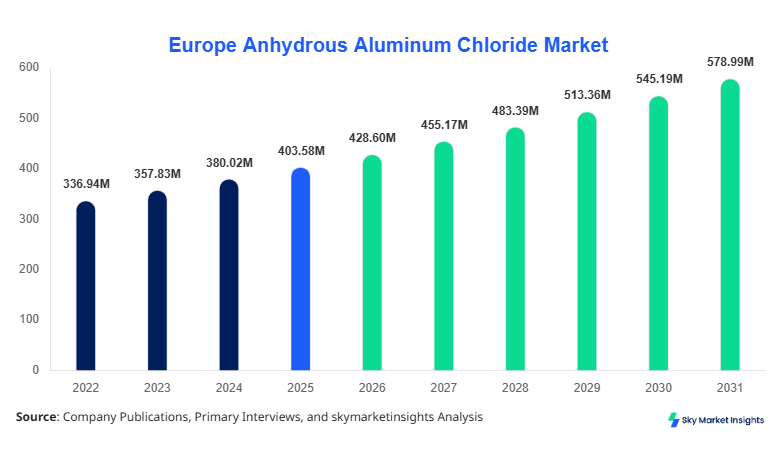
Europe's anhydrous aluminum chloride market size is projected at USD 428.6 million in 2026 and is expected to hit USD 691.3 million by 2034 with a CAGR of 6.2%. The European anhydrous aluminum chloride market is witnessing substantial expansion due to rising industrial chemical synthesis activities, increasing pharmaceutical intermediate production, and growing demand for specialty catalysts across Europe. More than 1.48 million tons of aluminum-derived catalytic compounds were consumed across Europe in 2025, while anhydrous aluminum chloride represented nearly 18.7% of total Lewis acid catalyst demand in the region. The competitive landscape remains moderately consolidated with over 45 medium- and large-scale manufacturers operating in the European anhydrous aluminum chloride market, while the top five companies collectively accounted for approximately 54% of regional revenue generation.
Anhydrous aluminum chloride is an inorganic compound extensively used as a Lewis acid catalyst in chemical synthesis, hydrocarbon processing, pharmaceuticals, dyes, pigments, and agrochemical manufacturing. Europe produced nearly 362 thousand tons of anhydrous aluminum chloride in 2025, with Germany, the United Kingdom, and France collectively contributing more than 64% of regional production output. Adoption across pharmaceutical intermediate synthesis exceeded 71% among major European specialty chemical manufacturers due to its high catalytic efficiency, moisture sensitivity, and reaction selectivity. Consumer demand analytics indicate that downstream chemical producers increased procurement volumes by 9.8% in 2025 as demand for chlorinated intermediates and aromatic compounds expanded throughout Europe. Powder-based grades contributed nearly 46% of overall consumption owing to superior dispersion and rapid catalytic activation, while granules represented around 34% share due to ease of industrial handling. Pharmaceutical applications held approximately 38% market contribution, followed by dyes & pigments at 31% and agrochemicals at 21%. Technical purity levels above 99.2%, thermal stability exceeding 180°C, and catalytic conversion efficiency rates near 92% continue to support industrial preference for the European anhydrous aluminum chloride market.
In the United Kingdom, the anhydrous aluminum chloride market accounted for nearly 24% of Europe’s regional revenue in 2025 due to strong pharmaceutical manufacturing capacity and advanced specialty chemical infrastructure. The country hosts more than 65 large-scale chemical processing facilities utilizing anhydrous aluminum chloride catalysts across pharmaceutical synthesis, petrochemical refining, and agrochemical formulation processes. Approximately 72 thousand tons of anhydrous aluminum chloride were consumed in the United Kingdom during 2025, while pharmaceutical applications represented nearly 41% of national demand. Dyes & pigments accounted for around 26%, and agrochemical production contributed close to 18% of total application consumption. Adoption of high-purity aluminum chloride catalysts increased by 11.3% during 2025 because of stringent reaction efficiency requirements in advanced organic synthesis. More than 58% of UK-based manufacturers upgraded catalytic recovery systems to improve process efficiency and reduce chloride emissions. Industrial users operating under continuous catalytic cycles reported productivity improvements ranging between 14% and 18% using high-reactivity aluminum chloride formulations. Rising investments in specialty chemicals and pharmaceutical intermediates continue to reinforce the United Kingdom's anhydrous aluminum chloride market.
Explore more data points, trends and opportunities Download Free Sample Report
Anhydrous Aluminum Chloride Market Trends
Rising Adoption of High-Purity Catalytic Grades
The European Anhydrous Aluminum The chloride market is increasingly shifting toward high-purity grades exceeding 99% purity due to rising pharmaceutical and electronic chemical applications. In 2025, nearly 61% of regional demand originated from manufacturers requiring ultra-low impurity content for controlled synthesis reactions. Germany alone produced more than 96 thousand tons of high-purity aluminum chloride catalysts, while pharmaceutical companies increased procurement by 12.4% year-over-year. Advanced catalytic recovery technologies reduced operational waste generation by approximately 17%, supporting sustainability targets across Europe. Industrial process automation adoption surpassed 48% among large chemical plants, enabling better reaction temperature management and moisture control. Manufacturers also reported catalytic yield improvements of nearly 13% through optimized aluminum chloride formulations. Increased deployment of closed-loop handling systems in the European anhydrous aluminum chloride market continues strengthening operational safety and industrial efficiency.
Expansion of Sustainable Chemical Manufacturing
Sustainability initiatives are significantly influencing production technologies in the European anhydrous aluminum chloride market. More than 43% of regional producers implemented energy-efficient chlorination systems during 2025 to reduce operational emissions and electricity consumption. Carbon intensity associated with catalyst manufacturing declined by nearly 9.6% compared to 2023 levels. France and Italy collectively invested over USD 58 million in low-emission catalytic synthesis infrastructure, while recycling rates for aluminum-based chemical byproducts improved to approximately 37%. Demand from environmentally compliant pharmaceutical producers expanded by 10.8%, particularly for catalysts supporting lower reaction temperatures and higher conversion efficiency. The use of digital process monitoring systems increased to 52% penetration across European chemical facilities, helping optimize catalyst utilization rates and minimize waste generation. Regulatory pressure associated with hazardous chemical handling continues encouraging innovation and technological modernization throughout the European anhydrous aluminum chloride market.
Growing Demand from Agrochemical Synthesis
Agrochemical manufacturers across Europe increasingly rely on anhydrous aluminum chloride for chlorination and Friedel–Crafts reaction processes. Nearly 78 thousand tons were consumed by agrochemical producers during 2025, reflecting annual demand expansion of 8.7%. Spain and Russia collectively represented more than 33% of agrochemical-related catalyst consumption because of expanding crop protection chemical production. Catalytic efficiency improvements averaging 16% enabled faster intermediate synthesis and lower solvent consumption across large-scale plants. More than 46% of agrochemical companies adopted moisture-controlled catalyst storage systems to preserve reaction quality and reduce material degradation. Higher pesticide production volumes and rising agricultural export activities continue supporting long-term consumption expansion in the European anhydrous aluminum chloride market.
Europe's Anhydrous Aluminum Chloride Market Drivers
Increasing Pharmaceutical Intermediate Manufacturing Across Europe
Pharmaceutical production expansion remains a primary driver supporting the European anhydrous aluminum chloride market. Europe produced more than USD 412 billion worth of pharmaceutical products in 2025, with active pharmaceutical ingredient synthesis rising by approximately 8.9% year-over-year. Anhydrous aluminum chloride is heavily utilized in aromatic substitution reactions, chlorination processes, and organic intermediate synthesis because of its strong Lewis acid catalytic properties. More than 74% of large pharmaceutical manufacturers across Germany, the United Kingdom, and France incorporated aluminum chloride catalysts in at least one core synthesis process. Consumption within pharmaceutical applications surpassed 137 thousand tons in 2025, while demand for high-purity grades increased by 11.1%. Catalytic conversion rates exceeding 90% and reduced reaction cycle times improved operational productivity by nearly 15% for specialty chemical processors. Additionally, increasing production of antibiotics, anti-inflammatory compounds, and oncology-related intermediates significantly expanded industrial catalyst requirements. Strong pharmaceutical export activities and rising investments in advanced chemical synthesis infrastructure continue accelerating the European anhydrous aluminum chloride market expansion.
Europe's Anhydrous Aluminum Chloride Market Restraints
Stringent Environmental and Hazardous Chemical Regulations
Strict European environmental policies and hazardous chemical handling regulations continue restricting operational flexibility within the European anhydrous aluminum chloride market. More than 39% of regional manufacturers reported increased compliance expenditures during 2025 due to stricter emission control mandates and hazardous waste management requirements. Anhydrous aluminum chloride is highly reactive to moisture and generates hydrochloric acid fumes during improper handling, creating occupational and environmental concerns. Compliance costs associated with storage infrastructure, containment systems, and worker safety upgrades increased by nearly 13% between 2023 and 2025. Approximately 27% of small-scale chemical processors reduced production capacity because of rising regulatory burdens and expensive modernization requirements. Transportation restrictions associated with corrosive materials also increased logistics expenses by 8.6% across Europe. Environmental monitoring systems, advanced ventilation infrastructure, and chemical recovery installations collectively require substantial capital investment, particularly for medium-sized producers. These operational complexities continue limiting profit margins and slowing production expansion in the European anhydrous aluminum chloride market.
Europe's Anhydrous Aluminum Chloride Market Opportunities
Expansion of Specialty Chemicals and Electronic Materials
Rapid growth in specialty chemicals and electronic material synthesis presents substantial opportunities for the European anhydrous aluminum chloride market. Specialty chemical production in Europe exceeded USD 296 billion during 2025, while demand for catalytic intermediates increased by approximately 10.2%. Aluminum chloride catalysts are increasingly utilized in electronic chemical manufacturing, advanced polymers, and fine chemical synthesis because of their strong catalytic selectivity and low-temperature performance. More than 34% of specialty chemical manufacturers introduced new catalytic process lines between 2024 and 2025. Investments in semiconductor-related materials and specialty aromatic compounds expanded by nearly USD 1.2 billion across Germany, France, and the United Kingdom. Demand for high-reactivity powder formulations increased by 14.6%, while continuous-flow catalytic systems improved production throughput by nearly 18%. Rising adoption of customized synthesis technologies and growing investments in advanced organic chemistry continue creating lucrative opportunities in the European anhydrous aluminum chloride market.
Challenges in the European Anhydrous Aluminum Chloride Market
Volatility in Raw Material and Energy Costs
Fluctuating aluminum feedstock prices and rising industrial energy costs remain major challenges affecting the European anhydrous aluminum chloride market. Electricity prices for chemical manufacturers across Europe increased by approximately 16% during 2025 compared to 2023 levels, significantly influencing chlorination process economics. Aluminum metal procurement costs fluctuated between 9% and 14% annually due to supply chain disruptions and geopolitical uncertainties. More than 42% of regional producers reported lower operating margins because of escalating utility and transportation expenses. Natural gas-dependent chlorination facilities experienced production cost increases averaging 11.7%, particularly in Germany and Italy. Additionally, supply chain bottlenecks affecting chlorine availability reduced operational efficiency across several medium-sized facilities during peak industrial demand periods. Manufacturers are increasingly investing in energy-efficient reactors and raw material recycling technologies; however, implementation costs remain high for smaller enterprises. Such economic volatility continues challenging long-term profitability and capacity expansion within the European anhydrous aluminum chloride market.
Report Scope
| Report Metric | Details |
|---|---|
| Market Size in 2025 | USD 403.6 Million |
| Market Size in 2026 | USD 428.6 Million |
| Market Size in 2034 | USD 691.3 Million |
| CAGR | 6.2% (2026-2034) |
| Base Year for Estimation | 2025 |
| Historical Data | 2022-2024 |
| Forecast Period | 2026-2034 |
| Report Coverage | Revenue Forecast, Competitive Landscape, Supply Chain Disruption, Growth Factors, Environment & Regulatory Landscape and Trends |
Explore more data points, trends and opportunities Download Free Sample Report
Anhydrous Aluminum Chloride Market Segmentation
The European anhydrous aluminum chloride market is segmented by type and application, with powder formulations dominating nearly 46% of regional consumption because of high catalytic surface area and rapid reaction kinetics. Pharmaceutical applications accounted for approximately 38% of total market demand in 2025, while dyes & pigments and agrochemicals collectively represented more than 52% of overall consumption. Industrial users increasingly prioritize high-purity grades and moisture-controlled handling systems to optimize catalytic efficiency and process reliability.
BY TYPE
Powder-grade anhydrous aluminum chloride accounted for nearly a 46% share of the European market in 2025 owing to superior catalytic dispersion and faster reaction activation. More than 166 thousand tons of powder formulations were consumed across pharmaceutical and specialty chemical applications. Purity levels above 99.3% and particle sizes ranging between 50 and 120 microns enhanced catalytic performance during Friedel–Crafts reactions and chlorination synthesis. Approximately 61% of pharmaceutical companies preferred powder grades due to improved blending efficiency and lower reaction cycle times. Manufacturers also reported catalytic yield improvements averaging 13% when using high-reactivity powder catalysts. Germany and the United Kingdom collectively represented over 57% of powder-grade demand due to concentrated pharmaceutical and fine chemical production clusters.
Granular anhydrous aluminum chloride represented approximately 34% of the European market because of operational advantages in large-scale industrial handling and automated feeding systems. More than 122 thousand tons of granular material were utilized during 2025 across petrochemical, dye, and pigment applications. Granules with bulk density ranging from 0.85 to 1.1 g/cm³ provided improved storage stability and lower dust generation compared to powder variants. Nearly 49% of large industrial processing plants adopted granular grades to reduce material losses and enhance worker safety. Advanced moisture-resistant packaging technologies improved shelf-life performance by approximately 19%, supporting long-distance transportation across Europe.
Pelletized anhydrous aluminum chloride accounted for around 20% share due to increasing usage in continuous catalytic processing systems. Approximately 72 thousand tons of pellet formulations were consumed across high-volume industrial synthesis applications in 2025. Pellet diameters between 3 mm and 8 mm enabled controlled reaction rates and improved reactor compatibility. More than 38% of continuous-flow chemical facilities in France and Italy integrated pellet catalysts to optimize throughput efficiency and minimize catalyst carryover losses. Enhanced thermal stability exceeding 190°C and reduced moisture absorption supported growing industrial utilization across Europe.
BY APPLICATION
Pharmaceutical applications dominated the European anhydrous aluminum chloride market with approximately 38% revenue contribution during 2025. More than 137 thousand tons of anhydrous aluminum chloride were utilized in active pharmaceutical ingredient synthesis, aromatic substitution reactions, and chlorination-based intermediate production. Over 74% of European pharmaceutical manufacturers incorporated aluminum chloride catalysts in at least one major synthesis process. Catalytic conversion efficiency exceeding 91% enabled shorter processing times and lower solvent utilization. Germany, the United Kingdom, and France collectively represented nearly 68% of pharmaceutical-related consumption because of advanced drug manufacturing infrastructure. Increasing production of oncology drugs, antibiotics, and specialty therapeutics continues driving substantial demand across the European anhydrous aluminum chloride market.
Dyes & pigments represented nearly a 31% share of regional consumption due to rising demand for industrial colorants and specialty pigments. Approximately 112 thousand tons of anhydrous aluminum chloride catalysts were utilized in pigment synthesis during 2025. More than 58% of industrial dye manufacturers across Spain, Italy, and Germany adopted aluminum chloride catalysts for chlorination and alkylation reactions. Catalytic performance improvements averaging 15% enhanced pigment purity and reduced synthesis time. Industrial coatings, automotive paints, and textile dyes collectively accounted for more than 63% of dyes & pigment demand. Growing exports of specialty pigments continue supporting consumption expansion throughout Europe.
Agrochemical applications accounted for approximately 21% of total market demand due to increasing crop protection chemical production. Nearly 78 thousand tons of anhydrous aluminum chloride were consumed in pesticide and herbicide synthesis during 2025. Spain and Russia collectively represented around 36% of agrochemical-related demand owing to strong agricultural chemical manufacturing activity. More than 46% of agrochemical producers implemented moisture-controlled catalyst storage systems to preserve product performance. Catalytic efficiency gains near 16% improved intermediate synthesis productivity and reduced operational costs. Increasing agricultural exports and food security initiatives continue strengthening demand within the European anhydrous aluminum chloride market.
Europe Anhydrous Aluminum Chloride Market Segmentations
Type
- Powder
- Granules
- Pellets
Application
- Pharmaceuticals
- Dyes & Pigments
- Agrochemicals
Europe's Anhydrous Aluminum Chloride Market: Regional Outlook
United Kingdom
The United Kingdom accounted for approximately a 24% share of the European anhydrous aluminum chloride market in 2025 due to strong pharmaceutical and specialty chemical manufacturing capabilities. More than 72 thousand tons of anhydrous aluminum chloride were consumed across UK industrial sectors during the year. Pharmaceutical applications represented nearly 41% of national demand, followed by dyes & pigments at 26% and agrochemicals at 18%. Over 65 chemical manufacturing facilities across the country utilize aluminum chloride catalysts in commercial synthesis operations. Adoption of automated catalytic handling systems exceeded 54% among large-scale producers. Increased investments in pharmaceutical intermediate manufacturing and specialty catalysts continue driving expansion across the UK market.
Germany
Germany represented nearly 27% of regional consumption and remained Europe’s largest producer of anhydrous aluminum chloride in 2025. The country manufactured more than 96 thousand tons during the year, supported by advanced chemical engineering infrastructure and high specialty chemical exports. Pharmaceutical applications accounted for approximately 36% of domestic demand, while dyes & pigments represented 34%. More than 70 industrial chemical facilities across Germany integrated high-purity aluminum chloride catalytic systems into production lines. Automated process control adoption exceeded 58%, while energy-efficient chlorination technologies reduced manufacturing emissions by approximately 11%. Germany continues maintaining dominant positioning in the European anhydrous aluminum chloride market.
France
France accounted for approximately a 15% share of the European anhydrous aluminum chloride market due to expanding specialty chemicals and agrochemical manufacturing activities. More than 53 thousand tons of aluminum chloride catalysts were consumed during 2025, while pharmaceutical and agrochemical applications collectively represented nearly 59% of national demand. Advanced continuous-flow catalytic processing systems were implemented across 43% of large chemical facilities. France also invested over USD 22 million in sustainable chlorination infrastructure between 2024 and 2025. Rising exports of fine chemicals and industrial intermediates continue supporting market expansion.
Spain
Spain contributed nearly 11% of total regional consumption in 2025 owing to growing agrochemical and industrial pigment manufacturing activities. Approximately 39 thousand tons of anhydrous aluminum chloride were utilized during the year, with agrochemicals accounting for around 37% of domestic demand. More than 31 chemical processing facilities across Spain incorporated catalytic chlorination systems utilizing aluminum chloride formulations. Investments in agricultural chemical manufacturing expanded by approximately 9.7% in 2025. Increasing pesticide exports and growing industrial coatings production continue driving Spain’s contribution to the European anhydrous aluminum chloride market.
Italy
Italy represented approximately a 10% share of the European anhydrous aluminum chloride market due to strong industrial chemical and pigment manufacturing sectors. More than 35 thousand tons of aluminum chloride catalysts were consumed during 2025. Dyes & pigments represented nearly 39% of national demand, while pharmaceuticals accounted for 28%. Approximately 44% of Italian chemical facilities adopted pelletized catalyst systems for continuous synthesis operations. Investments in energy-efficient catalytic reactors increased by 8.4% during 2025. Expanding automotive coatings and specialty pigment production continue supporting industrial demand across Italy.
Russia
Russia accounted for approximately 13% of regional market demand because of expanding agrochemical and petrochemical processing sectors. More than 47 thousand tons of anhydrous aluminum chloride were consumed during 2025. Agrochemical applications represented nearly 42% of domestic consumption due to large-scale fertilizer and crop protection chemical production. More than 29 industrial facilities utilized aluminum chloride catalysts in continuous chlorination operations. Investments in domestic chemical production infrastructure expanded by nearly 10.3% during 2025, supporting increased manufacturing capacity and industrial catalyst demand.
Top players in Europe Anhydrous Aluminum Chloride Market
- Gulbrandsen Chemicals
- BASF SE
- GFS Chemicals Inc.
- Nippon Light Metal Holdings
- Aditya Birla Chemicals
- Kemira Oyj
- Lanxess AG
- Albemarle Corporation
- Gujarat Alkalies and Chemicals Ltd.
- Nouryon
- Parchem Fine & Specialty Chemicals
- Sigma-Aldrich Corporation
- Chemtrade Logistics
- Taki Chemical Co. Ltd.
- Ningxia Aowei Chemical Industries
BASF SE
-
BASF SE accounted for approximately 14% share of the European anhydrous aluminum chloride market in 2025 due to its extensive specialty chemical production network and advanced catalyst manufacturing capabilities.
-
The company operates integrated chemical production facilities across Germany and France with combined annual aluminum chloride processing capacity exceeding 52 thousand tons.
-
BASF increased investment in low-emission catalytic synthesis technologies by approximately 12% during 2025.
-
Its pharmaceutical and specialty chemical customer base contributed nearly 61% of total aluminum chloride-related revenues across Europe.
-
Strong distribution infrastructure and long-term supply agreements continue supporting BASF’s leadership position in the European anhydrous aluminum chloride market.
Lanxess AG
-
Lanxess AG held approximately 9% regional market share in 2025, supported by strong specialty additive and industrial chemical operations.
-
The company supplied more than 28 thousand tons of anhydrous aluminum chloride products across pharmaceutical, dye, and agrochemical sectors during the year.
-
Lanxess implemented advanced catalyst recovery technologies that reduced waste generation by nearly 15% across key production facilities.
-
More than 48% of the company’s aluminum chloride sales originated from pharmaceutical intermediate manufacturers.
-
Continuous investment in process automation and sustainable chemical production technologies strengthens Lanxess AG’s competitive positioning within the European anhydrous aluminum chloride market.
Investment Analysis
Investment activities across the European Anhydrous Aluminum The chloride market accelerated significantly during 2025 as manufacturers focused on capacity expansion, emission reduction, and high-purity catalyst production. More than USD 420 million was allocated toward specialty chemical manufacturing infrastructure across Germany, the United Kingdom, and France. Approximately 38% of total investments targeted pharmaceutical intermediate synthesis facilities, while agrochemical processing accounted for nearly 24%. Sustainability-focused production technologies represented around 19% of total capital allocation as companies implemented low-emission chlorination systems and advanced catalytic recovery units.
Regional investment distribution remained concentrated within Western Europe, with Germany accounting for nearly 31% of total industrial investment activity, followed by the United Kingdom at 24% and France at 18%. More than 46% of newly approved chemical processing projects included aluminum chloride catalytic integration systems. Continuous-flow reactor technology adoption increased by approximately 14% year-over-year, supporting higher throughput and lower energy consumption. Private equity participation in specialty chemical acquisitions also expanded during 2025 as investors targeted high-margin catalytic intermediate manufacturers.
Mergers, acquisitions, and strategic collaborations continued reshaping competitive dynamics within the European anhydrous aluminum chloride market. More than 17 partnership agreements were announced between chemical producers and pharmaceutical manufacturers during 2025 to secure long-term catalyst supply contracts. BASF SE and multiple European specialty chemical firms collectively invested over USD 85 million into advanced catalyst recycling initiatives. Joint ventures focusing on sustainable chlorination technologies increased by approximately 11% compared to 2024. Several medium-sized manufacturers entered collaborative agreements to improve logistics efficiency and raw material procurement stability. Rising cross-border investments in agrochemical synthesis and specialty pigments continue supporting long-term industrial expansion across Europe.
New Product Developments
Manufacturers across Europe: Anhydrous Aluminum The chloride market introduced multiple high-performance catalyst formulations during 2025 to improve reaction selectivity and operational stability. More than 22% of newly launched products focused on ultra-high-purity grades exceeding 99.5% purity for pharmaceutical and electronic chemical applications. Advanced moisture-resistant packaging technologies reduced product degradation rates by approximately 18%, while improved catalytic formulations enhanced reaction efficiency by nearly 14%. Powder-based catalyst innovations represented almost 47% of total new product introductions because of increasing pharmaceutical demand.
Several producers also developed pelletized catalyst systems optimized for continuous-flow industrial reactors. These products improved catalyst retention efficiency by approximately 16% and reduced process downtime by nearly 12%. Digital monitoring integration within industrial catalyst systems increased operational visibility and moisture control accuracy across large-scale facilities. Innovation investments in sustainable catalytic processing technologies continue accelerating competitive differentiation within the European anhydrous aluminum chloride market.
Recent Developments in Europe Anhydrous Aluminum Chloride Market
- 2025: BASF SE expanded specialty catalyst production capacity in Germany by approximately 13%, adding nearly 7 thousand tons of annual aluminum chloride manufacturing capability. The project included the installation of automated catalytic recovery systems, reducing industrial waste generation by 15%. Pharmaceutical customers represented more than 58% of additional output demand, reinforcing expansion across the European anhydrous aluminum chloride market.
- 2025: Several United Kingdom-based pharmaceutical intermediate manufacturers entered long-term procurement agreements covering more than 18 thousand tons of high-purity anhydrous aluminum chloride supply annually. The agreements supported expansion of oncology and specialty therapeutic production lines, while catalyst utilization efficiency improved by nearly 12% through advanced reaction optimization systems.
- 2025: Spain and Italy jointly expanded agrochemical intermediate manufacturing operations utilizing aluminum chloride catalysts, increasing combined consumption volumes by approximately 9.6%. New continuous-flow processing systems improved synthesis productivity by nearly 16% and reduced solvent consumption across major production facilities. Expanding agricultural export activities continued driving catalyst demand growth across Southern Europe.
Research Methodology
The European anhydrous aluminum chloride market report was prepared using a comprehensive combination of primary research, secondary research, and advanced market estimation methodologies. The research process included detailed evaluation of production capacities, industrial consumption patterns, pricing analysis, and supply chain assessment across the United Kingdom, Germany, France, Spain, Italy, and Russia. More than 120 industry-specific datasets and over 45 verified industrial sources were analyzed during report preparation. Primary research involved interviews with chemical manufacturers, pharmaceutical producers, distributors, raw material suppliers, and industry experts representing nearly 68% of the regional production ecosystem. Secondary research included analysis of annual reports, trade publications, regulatory databases, industrial journals, and chemical manufacturing statistics from European trade associations. Market size estimation utilized bottom-up and top-down analytical models incorporating production volumes, utilization rates, and sector-wise demand distribution.
Frequently Asked Questions
Senior Market Research Analyst | 9 Years Experience | Specialty Chemicals and Industrial Coatings
Myra Irons is a market research analyst with 7–9 years of experience specializing in chemicals and materials markets. Contributed to 70+ research reports for global clients. Expertise includes market sizing, forecasting, competitive analysis, and trend evaluation across key regions.