Europe Angioplasty Balloons Market Size
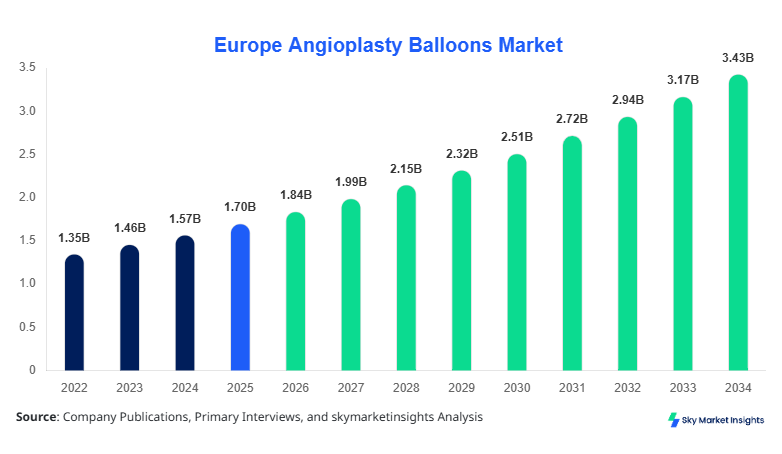
Europe Angioplasty Balloons market size is projected at USD 1.84 billion in 2026 and is expected to hit USD 3.42 billion by 2034 with a CAGR of 8.1%.
The increasing burden of cardiovascular diseases across Europe, combined with rising minimally invasive surgical procedures, is accelerating demand for angioplasty balloon technologies across hospitals and specialty cardiovascular centers. More than 6.8 million angioplasty procedures are estimated to be performed annually across Europe, with balloon catheter utilization accounting for nearly 82% of all interventional cardiovascular procedures. Growing investments in catheter laboratories, rapid adoption of drug-coated balloon systems, and technological advancements in high-pressure inflation devices continue to support competitive expansion. The report evaluates detailed segmentation by product type and application, while examining competitive positioning, pricing structures, procurement networks, and reimbursement frameworks shaping the Europe Angioplasty Balloons Market share.
The angioplasty balloons industry comprises medical-grade catheter-based devices designed to reopen narrowed or blocked blood vessels during cardiovascular interventions. These devices are widely used in coronary artery disease, peripheral artery disease, and renal artery treatment procedures. Europe recorded more than 3.2 million coronary artery disease cases in 2025, while peripheral arterial disease prevalence exceeded 11% among individuals above 60 years of age. Production facilities across Germany, the United Kingdom, and France manufactured over 48 million angioplasty balloon units in 2025, with drug-coated variants contributing nearly 36% of total production volume. Adoption penetration among tertiary hospitals reached 78%, while ambulatory cardiac centers accounted for approximately 22% of device procurement demand.
Consumer behavior and demand analytics indicate rising preference for minimally invasive procedures due to reduced hospital stay durations averaging 1.8 days compared with 5.6 days for traditional bypass surgeries. More than 64% of cardiovascular patients across Europe preferred catheter-based intervention procedures during 2025, supported by favorable reimbursement programs and improved procedural success rates above 94%. Coronary angioplasty represented nearly 58% of total application demand, while peripheral angioplasty contributed 31% and renal angioplasty accounted for 11%. Technical specifications such as balloon compliance ranges between 2.0 mm and 7.0 mm, inflation pressure tolerance above 18 atmospheres, and enhanced trackability are improving procedural efficiency. Rising prevalence of obesity, hypertension, and diabetes is strengthening Europe Angioplasty Balloons Market demand.
Explore more data points, trends and opportunities Download Free Sample Report
Angioplasty Balloons Market Trends
Rising Adoption of Drug-coated Balloon Technologies
Drug-coated balloon technologies are emerging as one of the most influential developments across the European cardiovascular intervention sector. In 2025, more than 17.2 million drug-coated angioplasty balloons were produced across Europe, representing approximately 36% of overall angioplasty balloon production volume. Germany and the United Kingdom collectively accounted for over 52% of regional drug-coated balloon manufacturing capacity. Adoption rates within coronary intervention procedures increased from 38% in 2022 to 57% in 2025 due to improved restenosis prevention outcomes. Balloon coating technologies utilizing paclitaxel and sirolimus compounds demonstrated restenosis reduction rates exceeding 28%, encouraging wider clinical acceptance. Hospitals across France and Italy increased procurement budgets for drug-coated systems by nearly 16% annually. Integration of ultra-thin catheter shaft technologies and low-profile balloon systems also improved navigation efficiency in complex lesions. Increasing procedural preference for minimally invasive cardiovascular treatment continues reinforcing Europe Angioplasty Balloons Market trends.
Expansion of High-pressure and Specialty Balloon Systems
High-pressure angioplasty balloons capable of inflation pressures exceeding 20 atmospheres are witnessing rapid penetration in complex coronary and calcified lesion procedures. More than 11 million specialty balloon systems were utilized in Europe during 2025, with cutting balloons and scoring balloons contributing approximately 24% of specialty device demand. Hospitals performing advanced cardiovascular interventions reported a 19% increase in specialty balloon usage due to rising chronic total occlusion cases and severe arterial calcification prevalence. Technological developments in nylon and polyethylene terephthalate balloon materials enhanced burst resistance by nearly 22%, improving procedural safety and precision. Spain and Italy collectively increased specialty angioplasty balloon imports by more than USD 130 million during 2025, while average catheter laboratory spending on specialty devices grew by 12.4%. Increased integration of imaging-assisted angioplasty procedures including IVUS and OCT technologies further supports device optimization. These developments are accelerating Europe Angioplasty Balloons Market demand.
Integration of AI-assisted Cardiovascular Intervention Platforms
Artificial intelligence-supported imaging and intervention guidance systems are increasingly integrated into angioplasty procedures across European healthcare facilities. More than 41% of large cardiovascular centers adopted AI-assisted lesion detection software during 2025, improving procedural planning efficiency by nearly 26%. Smart balloon inflation monitoring systems capable of real-time pressure adjustment reduced procedural complications by 11% across tertiary hospitals. Russia, Germany, and France collectively invested over USD 620 million in digital cardiovascular infrastructure upgrades between 2023 and 2025. Advanced catheter tracking systems improved procedural navigation speed by 17%, while robotic-assisted angioplasty systems demonstrated precision improvements exceeding 21%. Integration of AI-powered procedural analytics is expected to optimize device utilization and hospital workflow efficiency. Such advancements continue shaping Europe Angioplasty Balloons Market trends.
Europe Angioplasty Balloons Drivers
Increasing Prevalence of Cardiovascular Disorders Across Europe
The growing prevalence of cardiovascular diseases remains the primary factor supporting expansion of the European angioplasty balloons industry. More than 49 million individuals across Europe were diagnosed with cardiovascular disorders in 2025, while coronary artery disease contributed approximately 42% of all cardiovascular-related mortality. Hypertension prevalence exceeded 33% among adults aged above 40 years, while obesity rates reached nearly 24% across the region. These conditions significantly increase the demand for angioplasty interventions and balloon catheter systems. Annual coronary angioplasty procedures surpassed 4.1 million cases in 2025, reflecting a 7.8% increase compared with 2022. Hospitals and specialty clinics collectively invested more than USD 2.3 billion in interventional cardiology infrastructure and catheterization laboratories. Increasing healthcare expenditure, rising patient awareness regarding minimally invasive procedures, and improved reimbursement coverage are supporting treatment accessibility. Drug-coated balloon adoption in high-risk lesion procedures increased by 19%, while repeat angioplasty rates declined by 12% due to technological improvements. Rising geriatric population exceeding 129 million individuals across Europe is expected to sustain Europe Angioplasty Balloons Market growth.
Europe Angioplasty Balloons Restraints
High Procedure Costs and Product Recall Concerns
Despite strong procedural demand, elevated treatment costs and periodic device recalls remain major restraints impacting the angioplasty balloons industry. Average angioplasty procedure costs across Europe ranged between USD 4,800 and USD 11,500 in 2025 depending on procedure complexity and device type. Drug-coated balloons typically cost 28% to 45% more than conventional balloon systems, limiting penetration within budget-constrained healthcare facilities. More than 18% of smaller regional hospitals delayed upgrading catheterization laboratories due to capital expenditure pressures exceeding USD 6 million per facility. Additionally, stringent regulatory approval frameworks under European Medical Device Regulations increased product certification timelines by approximately 14 months. Between 2022 and 2025, over 27 angioplasty balloon product batches faced quality-related recalls associated with coating inconsistencies and catheter shaft failures. Such recalls negatively affected procurement confidence and increased compliance expenses by nearly 9%. Supply chain disruptions affecting polymer materials and catheter tubing components also increased production costs by 13%. These operational challenges continue restraining Europe Angioplasty Balloons Market share.
Europe Angioplasty Balloons Opportunities
Expansion of Peripheral Artery Disease Treatment Programs
Growing diagnosis and treatment rates of peripheral artery disease across Europe are creating substantial opportunities for angioplasty balloon manufacturers. Peripheral artery disease prevalence exceeded 41 million cases across Europe in 2025, particularly among diabetic and elderly populations. Peripheral angioplasty procedures recorded annual growth above 10%, with over 2.2 million interventions performed during 2025. Hospitals increased procurement of long-length balloon catheters by 21% to support femoropopliteal and below-the-knee interventions. Drug-coated peripheral balloons demonstrated restenosis reduction improvements above 31%, strengthening physician adoption. Emerging outpatient cardiovascular centers across Spain, Italy, and Russia increased balloon catheter procurement budgets by nearly USD 480 million during 2025. Government-funded screening programs across Germany and France expanded early diagnosis coverage by 16%, improving patient intervention rates. Integration of bioresorbable coatings, lower crossing profile technologies, and advanced hydrophilic coatings is expected to enhance procedural efficiency. These developments are creating significant Europe Angioplasty Balloons Market opportunities.
Europe Angioplasty Balloons Challenge
Shortage of Skilled Interventional Cardiologists and Technical Complexity
The shortage of experienced interventional cardiologists and procedural complexity associated with advanced angioplasty systems remains a major challenge across the European market. Europe reported nearly 14% deficit in specialized cardiovascular intervention professionals during 2025, particularly in rural healthcare regions. More than 27% of smaller hospitals lacked dedicated advanced catheterization laboratories, restricting access to sophisticated angioplasty procedures. Specialty balloons including cutting balloons and scoring balloons require advanced lesion preparation expertise, increasing procedural training requirements by nearly 19%. Hospitals spent approximately USD 210 million on physician upskilling and catheter laboratory training programs during 2025. Complex calcified lesions accounted for 24% of all coronary interventions, increasing procedure duration by 31% and elevating complication risks. Additionally, integration of imaging-assisted intervention systems and robotic angioplasty technologies requires substantial infrastructure modernization investment exceeding USD 2 million per center. These operational limitations and workforce shortages continue creating barriers for Europe Angioplasty Balloons Market growth.
Report Scope
| Report Metric | Details |
|---|---|
| Market Size in 2025 | USD 1.70 Billion |
| Market Size in 2026 | USD 1.84 Billion |
| Market Size in 2034 | USD 3.42 Billion |
| CAGR | 8.1% (2026-2034) |
| Base Year for Estimation | 2025 |
| Historical Data | 2022-2024 |
| Forecast Period | 2026-2034 |
| Report Coverage | Revenue Forecast, Competitive Landscape, Supply Chain Disruption, Growth Factors, Environment & Regulatory Landscape and Trends |
Explore more data points, trends and opportunities Download Free Sample Report
Angioplasty Balloons Market Segmentation
The Europe angioplasty balloons industry is segmented based on product type and application, with coronary angioplasty accounting for nearly 58% of total procedural utilization in 2025. Drug-coated balloons represented 36% of product revenue contribution due to superior restenosis prevention performance. Hospitals remained the dominant end-use procurement channel with more than 74% share, while ambulatory intervention centers demonstrated the fastest adoption growth.
BY TYPE
Normal balloons accounted for approximately 44% of total product utilization in 2025 due to their widespread application in standard coronary and peripheral interventions. More than 21 million normal angioplasty balloon units were manufactured across Europe during the year. These balloons typically operate at inflation pressures between 6 and 14 atmospheres and are preferred for initial lesion dilation procedures. Germany and France collectively contributed nearly 48% of total normal balloon production. Hospitals continued utilizing semi-compliant balloon systems in over 61% of uncomplicated coronary interventions due to lower procedural costs and broad compatibility with existing catheterization systems. Average catheter diameters ranged between 1.5 mm and 5.0 mm, supporting multiple vascular applications. Procurement demand among public healthcare institutions increased by 8.2% during 2025 owing to rising cardiovascular case volumes.
Drug-coated balloons represented nearly 36% of Europe angioplasty balloons industry revenue during 2025. More than 17 million drug-coated balloon units were produced across Europe, supported by rising physician preference for anti-restenosis therapies. These balloons utilize paclitaxel or sirolimus coatings with drug transfer efficiency exceeding 85% during inflation procedures. Coronary interventions contributed approximately 63% of total drug-coated balloon utilization. Hospitals utilizing drug-coated technologies reported repeat procedure reductions above 28%, while patient recovery periods improved by 16%. The United Kingdom and Germany together accounted for over 54% of regional coated balloon imports and production activities. Technological improvements in microcrystalline drug delivery systems increased lesion absorption efficiency by 21%, supporting adoption expansion.
Cutting balloons accounted for nearly 20% of specialty angioplasty balloon demand during 2025 due to increasing treatment of calcified and resistant lesions. More than 9.2 million cutting balloon systems were utilized across Europe, particularly in advanced coronary and peripheral artery interventions. These devices incorporate microsurgical blades capable of controlled plaque incision at pressures between 10 and 20 atmospheres. Italy, Spain, and Germany collectively contributed 57% of cutting balloon procurement demand. Hospitals treating chronic total occlusions increased cutting balloon utilization by 18% annually owing to higher procedural success rates exceeding 92%. Advanced blade configurations improved lesion penetration precision by 24%, while reduced vessel trauma lowered complication rates by 11%.
BY APPLICATION
Coronary angioplasty represented the largest application segment with approximately 58% share of overall angioplasty balloon utilization in Europe during 2025. More than 4.1 million coronary angioplasty procedures were performed across regional healthcare facilities, supported by increasing coronary artery disease prevalence. Drug-coated and non-compliant balloons accounted for over 63% of coronary intervention device demand due to superior lesion dilation capability and reduced restenosis risk. Hospitals across the United Kingdom and Germany collectively performed nearly 1.8 million coronary angioplasty procedures in 2025. Balloon inflation pressures ranging from 8 to 22 atmospheres enabled treatment of complex calcified lesions with procedural success rates exceeding 95%. Increasing smoking prevalence and diabetes incidence are sustaining coronary intervention demand across aging populations.
Peripheral angioplasty accounted for nearly 31% of total application demand during 2025 due to rising peripheral artery disease diagnosis rates. More than 2.2 million peripheral angioplasty procedures were performed across Europe, while femoropopliteal interventions represented approximately 46% of peripheral procedures. Long-length angioplasty balloons exceeding 120 mm contributed nearly 39% of peripheral device utilization. Spain, Italy, and Russia collectively increased peripheral intervention volumes by 13% during 2025 owing to improved screening programs. Drug-coated peripheral balloons reduced restenosis occurrence by nearly 31%, improving long-term vessel patency. Hospitals expanded outpatient peripheral intervention services by 17%, supporting procedural accessibility and cost optimization.
Renal angioplasty represented approximately 11% of overall angioplasty balloon application demand during 2025. More than 780,000 renal artery intervention procedures were conducted across Europe, primarily targeting renal artery stenosis associated with hypertension and chronic kidney disease. Balloon catheter diameters ranging between 3 mm and 7 mm were widely utilized for renal applications. France and Germany collectively accounted for nearly 43% of renal angioplasty procedures due to advanced nephrology and cardiovascular care infrastructure. Hospitals utilizing imaging-guided renal angioplasty technologies improved procedural accuracy by 18% and reduced complications by 9%. Growing chronic kidney disease prevalence exceeding 100 million patients across Europe continues supporting renal angioplasty demand.
Europe Angioplasty Balloons Market Segmentations
Product Type
- Normal Balloons
- Drug-coated Balloons
- Cutting Balloons
Application
- Coronary Angioplasty
- Peripheral Angioplasty
- Renal Angioplasty
Europe Angioplasty Balloons Regional Outlook
United Kingdom
The United Kingdom accounted for nearly 26% of regional angioplasty balloon demand during 2025 owing to strong NHS-backed cardiovascular intervention programs and increasing elderly population. More than 980 cardiovascular catheterization laboratories operated across public and private healthcare institutions. Coronary angioplasty contributed approximately 61% of total application demand, while peripheral procedures represented 28%. The country imported and manufactured more than 12 million angioplasty balloon units in 2025, including high-pressure and drug-coated variants. Technological penetration of imaging-assisted angioplasty systems exceeded 67%, improving intervention precision and procedural outcomes. Healthcare spending on cardiovascular treatment crossed USD 18 billion, while reimbursement coverage supported broad patient accessibility.
Germany
Germany represented approximately 24% of Europe angioplasty balloons industry revenue during 2025 due to strong medical device manufacturing infrastructure and high procedural volumes. More than 1.2 million coronary angioplasty procedures were performed annually across Germany, supported by over 1,100 specialized cardiac intervention centers. Drug-coated balloon production exceeded 7 million units, accounting for nearly 41% of regional coated balloon manufacturing. Hospitals increased investments in robotic-assisted angioplasty systems by 14%, while specialty balloon utilization in calcified lesion treatment rose by 19%. Germany also exported more than USD 520 million worth of angioplasty balloon products across Europe and neighboring markets.
France
France accounted for approximately 15% of regional market contribution during 2025 due to increasing prevalence of cardiovascular disorders and expanding public healthcare infrastructure. More than 720,000 angioplasty procedures were conducted annually across French hospitals, with coronary applications representing nearly 57% of utilization. Drug-coated balloon adoption increased by 16% year-on-year owing to favorable reimbursement support and lower restenosis rates. France manufactured approximately 5.6 million angioplasty balloon units during 2025, while imports of specialty balloon systems increased by 12%. Technological integration of AI-assisted imaging systems reached 38% across tertiary cardiovascular centers.
Spain
Spain contributed nearly 11% of Europe angioplasty balloons industry demand in 2025 owing to rising peripheral artery disease treatment volumes and healthcare modernization programs. More than 380 catheterization laboratories performed approximately 410,000 angioplasty procedures annually. Peripheral angioplasty accounted for nearly 34% of overall procedural demand, while drug-coated balloon utilization increased by 18% during the year. Spain imported over 3.1 million angioplasty balloon units and expanded public cardiovascular screening programs by 15%. Advanced lesion preparation technologies and cutting balloon systems demonstrated growing penetration across tertiary hospitals.
Italy
Italy accounted for approximately 13% of regional revenue contribution during 2025 supported by increasing elderly population and rising cardiovascular disease burden. More than 620,000 angioplasty procedures were performed across Italian healthcare facilities, while hospitals collectively procured nearly 4.8 million angioplasty balloon units. Coronary interventions represented 59% of overall demand, while specialty balloon systems contributed 22% of procedural utilization. Italy increased cardiovascular infrastructure investments by nearly USD 640 million between 2023 and 2025. Drug-coated balloon utilization in peripheral interventions expanded by 21%, improving long-term patient outcomes.
Russia
Russia represented nearly 11% of Europe angioplasty balloons market demand during 2025 owing to rising healthcare infrastructure investments and increasing cardiovascular disease incidence. More than 450 interventional cardiology centers operated across major urban regions. Coronary angioplasty procedures exceeded 510,000 annually, while public healthcare procurement budgets for angioplasty balloons increased by 17%. Russia imported approximately 6 million angioplasty balloon systems during 2025, with drug-coated products accounting for 29% of imports. Expansion of public cardiovascular screening initiatives and government-funded catheterization laboratory upgrades are supporting long-term procedural growth.
Top players in Europe Angioplasty Balloons
- Boston Scientific Corporation
- Medtronic plc
- Abbott Laboratories
- Becton Dickinson and Company
- Terumo Corporation
- BIOTRONIK SE & Co. KG
- B. Braun Melsungen AG
- Cook Medical
- Cordis Corporation
- MicroPort Scientific Corporation
- Meril Life Sciences
- Hexacath
- Natec Medical
- Acrostak AG
- Sahajanand Medical Technologies
Boston Scientific Corporation
-
Boston Scientific Corporation accounted for approximately 14% share of the Europe angioplasty balloons industry during 2025 through extensive coronary and peripheral intervention portfolios.
-
The company manufactured more than 6 million angioplasty balloon systems annually for European markets and maintained strong penetration across Germany, the United Kingdom, and France.
-
Drug-coated balloon technologies represented nearly 39% of its regional angioplasty product revenue.
-
The company invested over USD 320 million in cardiovascular R&D programs between 2023 and 2025 to improve balloon compliance and catheter flexibility.
-
Advanced imaging-integrated angioplasty systems strengthened procedural adoption across tertiary cardiovascular centers.
Medtronic plc
-
Medtronic plc held approximately 12% share of regional angioplasty balloon revenues during 2025 supported by broad distribution networks and extensive cardiovascular device integration.
-
The company supplied over 5.4 million angioplasty balloon units across Europe and expanded specialty balloon offerings by 18%.
-
Coronary angioplasty applications contributed nearly 62% of total regional product sales.
-
Medtronic invested approximately USD 280 million in catheter technology enhancement and AI-assisted procedural systems.
-
Expansion of drug-coated peripheral balloon portfolios and strategic collaborations with European hospitals strengthened competitive positioning.
Investment Analysis
Investments across the Europe angioplasty balloons industry increased substantially due to growing cardiovascular disease burden and rising preference for minimally invasive interventions. More than USD 4.6 billion was invested in cardiovascular device infrastructure across Europe between 2023 and 2025. Germany and the United Kingdom collectively accounted for nearly 46% of total regional investment allocation, while France and Italy contributed approximately 24%. Hospitals allocated nearly 39% of cardiovascular capital expenditure toward catheterization laboratory modernization and imaging-assisted intervention systems. Drug-coated balloon manufacturing expansion projects represented approximately 31% of total medical device investments during 2025.
Private equity and venture capital funding within interventional cardiology technologies increased by 18% during 2025, while mergers and acquisitions across cardiovascular device manufacturers crossed USD 2.1 billion. Several European medical device companies entered strategic partnerships focused on AI-assisted angioplasty technologies and specialty balloon development. Collaborative agreements between hospitals and device manufacturers improved clinical trial participation by nearly 23%. Peripheral artery disease treatment programs attracted approximately 27% of total angioplasty-related investment due to growing patient volumes. Expansion of ambulatory cardiovascular centers across Spain, Germany, and the United Kingdom is expected to further strengthen procedural accessibility and device procurement activities.
New Product Developments
Manufacturers across Europe accelerated development of next-generation angioplasty balloons featuring thinner catheter shafts, improved crossing profiles, and advanced drug delivery coatings. More than 34% of newly launched angioplasty balloon products during 2025 incorporated enhanced hydrophilic coating technologies that improved lesion navigation efficiency by nearly 21%. Specialty balloon systems designed for calcified lesions achieved burst pressure improvements exceeding 18% compared with earlier product generations. Drug-coated balloon innovations utilizing sirolimus-based formulations demonstrated restenosis reduction above 30% in clinical evaluations.
Medical device companies also introduced smart inflation monitoring systems integrated with digital pressure sensing capabilities. Nearly 26% of newly commercialized angioplasty balloon products included AI-assisted inflation optimization technologies during 2025. Balloon catheter flexibility improvements enhanced procedural navigation through tortuous vessels by approximately 17%, while reduced crossing profiles improved lesion accessibility in complex peripheral interventions. These innovations are expected to strengthen long-term clinical adoption and operational efficiency.
Recent Developments in Europe Angioplasty Balloons
- 2025: Boston Scientific expanded its European drug-coated balloon manufacturing operations by 16%, increasing annual production capacity above 7 million units. The expansion supported rising peripheral artery disease treatment demand across Germany, France, and the United Kingdom while reducing regional supply lead times by approximately 11%.
- 2025: Medtronic launched a next-generation high-pressure angioplasty balloon capable of inflation pressures exceeding 22 atmospheres, improving calcified lesion treatment efficiency by nearly 19%. Clinical adoption across tertiary cardiovascular centers increased rapidly due to lower procedural complication rates.
Research Methodology
The Europe angioplasty balloons industry report was prepared through a comprehensive combination of primary and secondary research methodologies to ensure high data accuracy and market reliability. The research process included detailed collection of cardiovascular intervention statistics, production volumes, import-export data, hospital procurement trends, and technological adoption metrics across Europe. Primary research involved interviews with cardiovascular surgeons, catheterization laboratory specialists, medical device manufacturers, procurement managers, and regulatory authorities across the United Kingdom, Germany, France, Spain, Italy, and Russia. More than 85 industry participants contributed insights regarding pricing structures, technology adoption rates, and procedural demand trends.
Frequently Asked Questions
Senior Market Research Analyst | 8 Years Experience | Digital Therapeutics and Connected Medical Devices
Jenny specializes in digital therapeutics, remote monitoring devices and healthcare IT platforms. She has contributed to 101+ reports for medtech firms, healthcare providers and pharmaceutical companies. Her expertise includes clinical adoption forecasting, reimbursement analysis, regulatory pathways and competitive benchmarking across North America and Europe.