Europe Angiographic Catheters Size
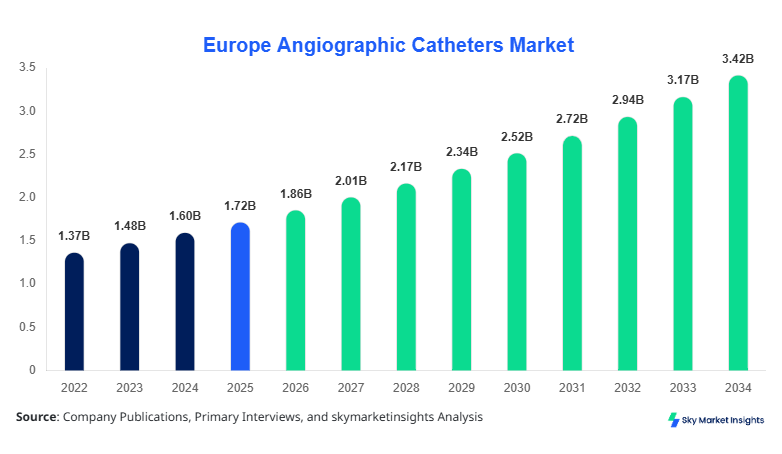
Europe Angiographic Catheters market size is projected at USD 1.86 billion in 2026 and is expected to hit USD 3.41 billion by 2034 with a CAGR of 7.9%.
The market expansion is being driven by increasing cardiovascular disease prevalence, rising minimally invasive diagnostic procedures, and higher healthcare expenditure across Europe. More than 6.5 million angiographic procedures are expected to be conducted annually across the region by 2028, compared with 4.9 million procedures recorded in 2024. The competitive landscape includes multinational medical device manufacturers, regional catheter producers, and emerging technology providers focusing on precision navigation, hydrophilic coating technologies, and AI-assisted imaging integration.
The angiographic catheters industry represents a critical component of interventional radiology and cardiovascular diagnostics, supporting hospitals, ambulatory surgical centers, and specialty cardiac clinics throughout Europe. Angiographic catheters are thin flexible medical devices used for contrast dye delivery and vascular imaging during angiography procedures. Europe accounted for approximately 27.4% of global angiographic catheter production in 2025, with Germany, the United Kingdom, and France collectively contributing more than 61% of regional manufacturing capacity. Diagnostic angiographic catheters represented nearly 48.3% of total product utilization, while guiding catheters accounted for 34.7% and balloon angiographic catheters held 17.0% volume contribution in 2025.
Adoption and penetration rates are accelerating because of rising incidences of coronary artery disease, stroke, peripheral arterial disease, and aneurysms across Europe. More than 17.8 million cardiovascular diagnostic procedures were performed in European healthcare facilities during 2025, with angiographic catheter penetration exceeding 82% in tertiary hospitals and 54% in mid-sized diagnostic centers. Consumer behavior trends indicate increased preference for minimally invasive procedures with reduced hospital stays, lower complication risks, and enhanced imaging accuracy. Hospitals are increasingly adopting 5F and 6F catheter systems because these devices reduce vascular trauma by nearly 22% while improving maneuverability efficiency by 31%.
Application-wise, cardiovascular angiography dominated with nearly 63.5% utilization share in 2025, followed by neuroangiography at 21.8% and peripheral angiography at 14.7%. Technological specifications including torque control efficiency above 92%, radiopacity visibility enhancements of 38%, and pressure resistance exceeding 1200 psi are improving procedural outcomes across European healthcare networks. Growing investments in catheter innovation, digital angiography systems, and hybrid operating rooms continue supporting Europe Angiographic Catheters market share.
Explore more data points, trends and opportunities Download Free Sample Report
Angiographic Catheters Market Trends
The European healthcare sector is witnessing rapid integration of advanced polymer-based angiographic catheter systems with enhanced flexibility, radiopacity, and biocompatibility. Production volumes of hydrophilic-coated angiographic catheters surpassed 58 million units in 2025, representing nearly 44% of all catheter output across Europe. Hospitals are increasingly shifting toward single-use sterile catheter systems to minimize infection risks, with adoption rates rising from 49% in 2022 to 71% in 2025. AI-integrated angiographic navigation platforms are improving imaging precision by nearly 33%, reducing procedure time by 18%, and lowering contrast media consumption by 12%. Germany, the United Kingdom, and France collectively contributed more than 64% of AI-enabled angiography installations across Europe, reinforcing Angiographic Catheters market trend.
Demand for neurovascular angiographic procedures is also accelerating due to rising stroke prevalence and increasing elderly population across Europe. Neuroangiography-related catheter demand expanded by 14.8% during 2025, while cardiovascular angiography catheter demand increased by 11.2%. More than 2,700 hospitals across Europe upgraded fluoroscopy and catheter imaging systems during the last three years. Manufacturers are introducing ultra-thin catheter walls with tensile strength improvements of 26% and kink resistance enhancements above 30%, supporting safer interventions in complex vascular structures. These technological transitions are creating substantial Angiographic Catheters market demand.
Another prominent trend involves growing outpatient angiography procedures performed in ambulatory surgical centers. Outpatient angiographic procedures accounted for 38% of total procedures in 2025 compared with 25% in 2021. Ambulatory facilities are favoring compact catheter systems that reduce procedural time below 45 minutes and shorten patient discharge duration by nearly 40%. Additionally, sustainable manufacturing initiatives using recyclable polymer compounds increased by 16% across European production facilities during 2024–2025. Strong technological innovation and rising outpatient procedural volume continue strengthening Angiographic Catheters market trend.
Europe Angiographic Catheters Drivers
Rising Cardiovascular Disease Burden and Increasing Minimally Invasive Procedures
Cardiovascular diseases remain the leading cause of mortality across Europe, accounting for nearly 3.9 million deaths annually and creating substantial demand for angiographic procedures. More than 11.6 million coronary angiography procedures are projected to be conducted across Europe between 2026 and 2030, compared with 8.9 million procedures during 2021–2025. Hospitals are increasingly adopting minimally invasive angiographic interventions because these procedures reduce hospitalization duration by approximately 35%, lower surgical complications by 29%, and improve patient recovery outcomes. Government healthcare spending on cardiovascular diagnostics increased by 13.2% across Europe between 2023 and 2025, with Germany alone allocating over USD 1.2 billion toward catheterization laboratory upgrades. Rising obesity rates, diabetes prevalence above 9.4%, and hypertension incidence affecting nearly 150 million Europeans are contributing to higher angiography demand. Additionally, improved reimbursement structures and wider insurance coverage for minimally invasive diagnostics are increasing procedure accessibility. Technological improvements including hydrophilic coatings, steerable tip designs, and enhanced torque control systems are improving catheter performance by over 25%, further driving Europe Angiographic Catheters market growth.
Europe Angiographic Catheters Restraints
High Procedure Costs and Stringent Regulatory Compliance
Despite strong procedural demand, high costs associated with angiographic procedures and advanced catheter systems remain significant barriers across several European healthcare markets. A single angiography procedure may cost between USD 1,200 and USD 4,800 depending on imaging complexity and hospital infrastructure, limiting accessibility in underfunded healthcare systems. Advanced AI-enabled catheter navigation systems increase procedural costs by approximately 18% to 24%. Additionally, compliance with European Medical Device Regulation (EU MDR) requirements has increased certification expenses by nearly 30% for catheter manufacturers. More than 22% of small and medium-sized catheter manufacturers reported delays exceeding 12 months in obtaining regulatory approvals during 2024. Supply chain disruptions affecting medical-grade polymers and stainless-steel braiding materials increased production costs by 14% between 2023 and 2025. Hospitals in Eastern Europe continue facing budgetary limitations, resulting in lower replacement rates for outdated angiography equipment. These operational and regulatory challenges are moderately restricting Europe Angiographic Catheters market growth.
Europe Angiographic Catheters Opportunities
Expansion of Neurovascular and Peripheral Angiography Applications
Rising incidences of stroke, aneurysms, and peripheral artery diseases are creating substantial opportunities for catheter manufacturers across Europe. Peripheral arterial disease affects more than 40 million Europeans, while stroke incidence exceeded 1.1 million cases during 2025. Neuroangiography procedures are expected to expand at a double-digit rate owing to increasing early diagnosis programs and advanced imaging accessibility. More than 420 hospitals across Europe invested in neurovascular intervention units between 2023 and 2025, creating higher demand for microcatheters and high-flexibility angiographic systems. Peripheral angiography applications are increasingly adopting low-profile catheter technologies with diameters below 2 mm and pressure resistance above 1000 psi. Manufacturers are investing nearly 18% of annual R&D budgets into neurovascular catheter innovations including shape-memory polymers and AI-guided navigation systems. Collaborative agreements between hospitals and device manufacturers increased by 21% during 2025, enhancing commercialization opportunities. Expanding specialty angiography applications continue creating profitable opportunities for Europe Angiographic Catheters market share.
Europe Angiographic Catheters Challenge
Shortage of Skilled Interventional Specialists and Procedure Complexity
Europe continues experiencing a shortage of skilled interventional radiologists and cardiovascular specialists capable of performing complex angiographic procedures. Nearly 18% of catheterization laboratories across Southern and Eastern Europe reported procedural delays because of workforce shortages during 2025. Advanced neurovascular interventions require highly specialized physicians with training periods exceeding 6 to 8 years, limiting rapid workforce expansion. Procedure complexity is also increasing because of growing elderly patient populations with multiple comorbidities. Patients above 65 years represented approximately 58% of all angiographic procedures in 2025, increasing risks of vascular complications and contrast-induced nephropathy. Hospitals are facing increased operational costs due to specialist training programs, which may exceed USD 180,000 per physician annually. Additionally, procedural errors linked to inadequate catheter handling contributed to nearly 6.8% of intervention-related complications during 2024. These workforce and procedural limitations are creating operational challenges for Europe Angiographic Catheters market growth.
Report Scope
| Report Metric | Details |
|---|---|
| Market Size in 2025 | USD 1.72 Billion |
| Market Size in 2026 | USD 1.86 Billion |
| Market Size in 2034 | USD 3.41 Billion |
| CAGR | 7.9% (2026-2034) |
| Base Year for Estimation | 2025 |
| Historical Data | 2022-2024 |
| Forecast Period | 2026-2034 |
| Report Coverage | Revenue Forecast, Competitive Landscape, Supply Chain Disruption, Growth Factors, Environment & Regulatory Landscape and Trends |
Explore more data points, trends and opportunities Download Free Sample Report
Angiographic Catheters Market Segmentation
The Europe angiographic catheters industry is segmented based on product type and application. Diagnostic angiographic catheters dominated with 48.3% market contribution during 2025, while cardiovascular angiography accounted for nearly 63.5% of application demand. Increasing adoption of minimally invasive imaging systems, AI-assisted catheter navigation, and high-performance polymer materials continues strengthening segmentation expansion across hospitals and specialty imaging centers.
By Type
Diagnostic angiographic catheters represented the leading segment with approximately 48.3% revenue contribution during 2025. More than 62 million diagnostic angiographic catheter units were utilized across European healthcare facilities during the year. These catheters are widely used in coronary angiography, cerebral angiography, and peripheral vascular imaging because of superior radiopacity, high flexibility, and enhanced contrast media delivery efficiency. Technical improvements including braided shaft construction and hydrophilic coatings improved maneuverability by nearly 28% and reduced vascular trauma by 19%. Diagnostic catheters with 5F and 6F profiles accounted for more than 67% of total procedural usage because of compatibility with minimally invasive interventions. Germany and the United Kingdom collectively contributed approximately 46% of diagnostic catheter demand in Europe owing to high cardiovascular procedure volumes.
Guiding angiographic catheters accounted for nearly 34.7% market contribution in 2025 and are increasingly utilized during interventional cardiology and neurovascular procedures. More than 38 million guiding catheter units were supplied across Europe during 2025. These devices provide stable vascular access and enhanced support during stent deployment and angioplasty procedures. Advanced guiding catheters now offer torque response improvements exceeding 31% and lumen diameter optimization supporting higher contrast flow rates. Hospitals increasingly prefer guiding catheters integrated with reinforced polymer braiding technologies capable of handling pressures above 1200 psi. Cardiovascular interventions represented nearly 74% of total guiding catheter utilization.
Balloon angiographic catheters held approximately 17.0% market contribution in 2025, supported by growing angioplasty procedures across Europe. More than 19 million balloon angiographic catheter units were deployed during 2025. These catheters are increasingly used for vessel dilation, lesion crossing, and arterial plaque management. Technological advancements including ultra-compliant balloon materials and drug-coated balloon integration improved procedural success rates by nearly 22%. Balloon diameters ranging from 1.5 mm to 4.5 mm represented nearly 69% of total clinical utilization. Rising peripheral artery disease prevalence and increased outpatient angioplasty procedures continue supporting product demand across European healthcare facilities.
By Application
Cardiovascular angiography dominated the application landscape with approximately 63.5% market contribution in 2025. More than 8.4 million cardiovascular angiographic procedures were conducted across Europe during the year. Coronary artery disease prevalence exceeding 49 million cases across Europe continues driving substantial demand for angiographic catheter systems. Cardiovascular procedures primarily utilize diagnostic and guiding catheters with torque response rates above 90% and contrast delivery efficiency improvements of nearly 25%. Hospitals are increasingly adopting minimally invasive coronary interventions that reduce patient recovery time by approximately 37% and lower complication rates by 18%. Germany, France, and the United Kingdom collectively accounted for over 58% of cardiovascular angiography procedures performed across Europe.
Neuroangiography accounted for approximately 21.8% application share during 2025 owing to rising incidences of stroke, aneurysms, and cerebrovascular disorders. More than 2.8 million neuroangiography procedures were performed across European healthcare centers during the year. Neurovascular interventions increasingly require microcatheter systems with diameters below 2 mm, enhanced flexibility, and radiopacity visibility above 95%. Hospitals adopting advanced neuroangiography platforms reported procedural precision improvements exceeding 29% and fluoroscopy time reductions near 16%. France and Germany remained leading markets for neurovascular angiographic procedures due to strong healthcare infrastructure and rising neurological disease incidence.
Peripheral angiography represented nearly 14.7% application contribution during 2025, supported by growing peripheral arterial disease prevalence and diabetic vascular complications. Approximately 1.9 million peripheral angiography procedures were conducted during 2025 across Europe. Peripheral angiographic catheters increasingly incorporate kink-resistant shaft technologies and pressure tolerance exceeding 1000 psi for complex lower limb vascular procedures. More than 42% of peripheral angiography procedures were performed in outpatient surgical centers owing to shorter recovery periods and improved imaging technologies. Rising geriatric population and increasing diabetic patient numbers continue driving peripheral angiography demand across Europe.
Europe Angiographic Catheters Market Segmentations
Product Type
- Diagnostic Angiographic Catheters
- Guiding Angiographic Catheters
- Balloon Angiographic Catheters
Application
- Cardiovascular Angiography
- Neuroangiography
- Peripheral Angiography
Europe Angiographic Catheters Regional Outlook
United Kingdom
The United Kingdom accounted for approximately 24.6% of Europe’s angiographic catheter revenue generation during 2025. More than 1.3 million angiography procedures were performed annually across over 340 cardiac catheterization laboratories and 170 neurovascular imaging centers. Cardiovascular angiography represented nearly 58% of procedural volume, followed by neuroangiography at 24% and peripheral angiography at 18%. NHS infrastructure modernization programs invested over USD 420 million into digital angiography upgrades and hybrid operating suites between 2023 and 2025. Hydrophilic-coated catheter adoption exceeded 68% among tertiary care hospitals, improving procedural precision and reducing vascular complications by nearly 20%.
Germany
Germany represented nearly 22.3% of the regional market owing to strong domestic manufacturing and high cardiovascular disease burden. The country conducted more than 1.5 million angiography procedures during 2025 across over 430 specialized imaging facilities. Germany contributed approximately 31% of Europe’s angiographic catheter manufacturing output, supported by advanced medical polymer production and precision engineering infrastructure. Neurovascular interventions increased by 16% during 2025, while robotic-assisted angiography procedures expanded by 21%. Government healthcare investments exceeding USD 1.2 billion in cardiovascular diagnostics are supporting continued market expansion.
France
France held approximately 17.1% regional contribution in 2025 with rising demand for minimally invasive neurovascular and cardiovascular interventions. More than 980,000 angiography procedures were performed annually across public and private healthcare institutions. Neuroangiography utilization increased by 14.4% because of growing stroke diagnosis programs and expanded imaging infrastructure. France reported hydrophilic catheter penetration exceeding 61% among tertiary hospitals, while outpatient angiography procedures accounted for nearly 36% of all interventions during 2025. Increasing AI-assisted imaging adoption is enhancing catheter navigation precision and reducing procedure time.
Spain
Spain accounted for approximately 11.6% of regional revenue generation during 2025. More than 620,000 angiographic procedures were conducted annually across cardiovascular and neurovascular facilities. Peripheral angiography demand expanded by 13% due to increasing diabetic vascular complications and aging population trends. Spain invested nearly USD 190 million into angiography imaging modernization programs between 2023 and 2025. Advanced catheter systems featuring low-profile designs and improved kink resistance are witnessing growing adoption across outpatient surgical centers and specialized vascular clinics.
Italy
Italy contributed approximately 13.2% of Europe’s angiographic catheter demand in 2025. The country recorded nearly 740,000 angiography procedures annually, with cardiovascular applications representing 64% of total utilization. Italy’s geriatric population exceeding 24% of total population is contributing to rising vascular disease prevalence and higher diagnostic procedure volume. Hospitals are increasingly adopting 5F and 6F catheter systems capable of reducing procedural trauma and shortening recovery duration by nearly 28%. Investments in hybrid operating rooms and digital fluoroscopy systems continue supporting demand growth.
Russia
Russia represented approximately 11.2% regional contribution during 2025 with increasing demand for cardiovascular diagnostics and vascular interventions. More than 680,000 angiographic procedures were conducted annually across regional hospitals and specialty cardiac centers. Government healthcare modernization programs increased investments in vascular imaging infrastructure by 17% between 2023 and 2025. Domestic catheter manufacturing output expanded by nearly 12%, while imports of advanced neurovascular catheter systems increased by 19%. Rising cardiovascular mortality rates and improved healthcare accessibility are supporting long-term procedural demand.
Top players in Europe Angiographic Catheters
- Boston Scientific Corporation
- Medtronic plc
- Terumo Corporation
- Abbott Laboratories
- B. Braun Melsungen AG
- Merit Medical Systems
- Cordis Corporation
- Cook Medical
- Teleflex Incorporated
- AngioDynamics Inc.
- Asahi Intecc Co., Ltd.
- Lepu Medical Technology
- MicroPort Scientific Corporation
- Biotronik SE & Co. KG
- Penumbra Inc.
Boston Scientific Corporation
-
Boston Scientific Corporation accounted for approximately 16.4% of Europe’s angiographic catheter revenue generation during 2025.
-
The company maintains strong positioning in cardiovascular and neurovascular catheter systems with manufacturing facilities across Germany and Ireland.
-
Its advanced hydrophilic-coated catheter technologies improved procedural navigation precision by nearly 27%.
-
More than 5.6 million catheter units were supplied to European healthcare facilities during 2025.
-
Strategic investments in AI-guided imaging integration and minimally invasive intervention technologies continue strengthening regional competitiveness.
Medtronic plc
-
Medtronic plc held approximately 14.8% market contribution across Europe during 2025.
-
The company operates extensive cardiovascular device manufacturing and R&D centers supporting advanced angiographic catheter production.
-
Medtronic expanded neurovascular catheter production capacity by nearly 18% during 2024–2025.
-
The company supplied more than 4.9 million catheter units across Europe while increasing outpatient intervention product penetration by 21%.
-
Collaborations with European hospitals and imaging centers continue supporting innovation in precision-guided angiographic procedures.
Investment Analysis
Investments across the Europe angiographic catheter sector increased substantially between 2023 and 2025 due to rising cardiovascular disease prevalence and expanding minimally invasive diagnostics. More than USD 3.8 billion was allocated toward catheter manufacturing expansion, imaging infrastructure modernization, and AI-assisted navigation systems across Europe. Approximately 41% of total investments targeted cardiovascular angiography technologies, while neurovascular applications received 29%, peripheral angiography received 18%, and outpatient procedural infrastructure accounted for 12%. Germany, the United Kingdom, and France collectively represented nearly 67% of regional investment activity owing to advanced healthcare systems and high procedural volumes.
Mergers, acquisitions, and strategic collaborations are accelerating innovation and market penetration across Europe. More than 38 partnership agreements were announced between catheter manufacturers, imaging technology providers, and hospital networks during 2024–2025. Boston Scientific, Medtronic, and Terumo collectively invested over USD 620 million into European R&D operations focused on hydrophilic coating technologies, robotic-assisted navigation systems, and AI-enhanced fluoroscopy integration. Neurovascular intervention technologies attracted approximately 24% higher venture capital funding during 2025 compared with 2023. Hospitals are also increasing procurement agreements for integrated angiography platforms capable of improving procedural throughput by nearly 31% while reducing imaging time by 17%.
New Product Developments
Manufacturers across Europe launched multiple advanced angiographic catheter products during 2025 emphasizing precision navigation, enhanced flexibility, and improved patient safety. Nearly 28% of newly introduced catheter systems incorporated AI-assisted imaging compatibility and hydrophilic polymer coatings designed to reduce vascular trauma by 22%. Product launches featuring low-profile catheter diameters below 2 mm increased by 19% during 2025 to support neurovascular interventions and peripheral angiography applications.
Innovation in braided polymer shaft construction improved torque response by nearly 30% while reducing catheter kinking incidents by approximately 26%. More than 34% of new product developments targeted outpatient angiography procedures with rapid deployment capabilities and shorter sterilization cycles. Drug-coated balloon catheter technologies also demonstrated restenosis reduction improvements exceeding 18% in clinical evaluations across European healthcare centers.
Recent Developments in Europe Angiographic Catheters
- 2025: Boston Scientific expanded its neurovascular angiographic catheter manufacturing operations in Ireland, increasing regional production capacity by approximately 14%. The facility upgrade supports annual output exceeding 7 million catheter units and strengthens supply chain efficiency across Europe.
- 2025: Medtronic introduced AI-integrated angiographic navigation systems across major European hospitals, improving procedural precision by nearly 29% and reducing average fluoroscopy exposure by approximately 16% during cardiovascular interventions.
Research Methodology
The Europe angiographic catheters market analysis was developed using a combination of primary research, secondary research, and quantitative market estimation methodologies. The research process included detailed assessment of catheter production volumes, healthcare expenditure trends, cardiovascular disease prevalence, angiography procedure statistics, and technological adoption rates across major European countries. Primary research involved interviews with hospital procurement managers, cardiovascular specialists, neurovascular surgeons, catheter manufacturers, and healthcare distributors operating across Europe. More than 85 industry participants contributed insights regarding pricing trends, innovation pipelines, procedural demand, and competitive positioning.
Secondary research included analysis of company annual reports, government healthcare databases, regulatory publications, medical journals, clinical trial repositories, and healthcare association statistics. Market size estimation was conducted using both top-down and bottom-up analytical frameworks, incorporating revenue analysis, production capacity assessments, and regional consumption modeling. Forecast calculations considered healthcare infrastructure investments, demographic trends, technological advancements, outpatient procedure expansion, and reimbursement policies. Data triangulation and validation techniques were used to ensure statistical consistency and forecast reliability throughout the Europe angiographic catheters market assessment.
Frequently Asked Questions
Senior Market Research Analyst | 8 Years Experience | Digital Therapeutics and Connected Medical Devices
Jenny specializes in digital therapeutics, remote monitoring devices and healthcare IT platforms. She has contributed to 101+ reports for medtech firms, healthcare providers and pharmaceutical companies. Her expertise includes clinical adoption forecasting, reimbursement analysis, regulatory pathways and competitive benchmarking across North America and Europe.