Europe Angiogenesis Assay Kit Market Size
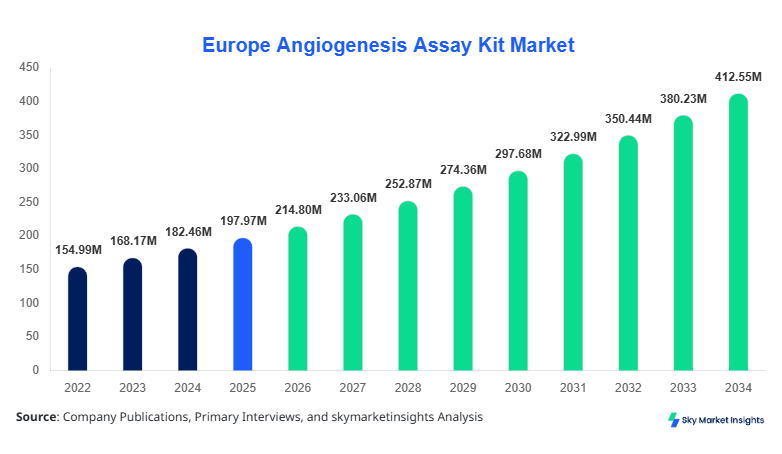
The Europe Angiogenesis Assay Kit market size is projected at USD 214.8 million in 2026 and is expected to hit USD 412.6 million by 2034 with a CAGR of 8.5%. The market expansion is being driven by increasing oncology research expenditure, rising demand for vascular biology studies, and accelerating pharmaceutical R&D activities across Germany, France, and the United Kingdom. More than 6.8 million angiogenesis-related assays are expected to be conducted across Europe in 2026, compared with 4.9 million procedures in 2022. The growing integration of automated imaging systems, AI-based analysis platforms, and high-throughput screening technologies is strengthening competitive intensity among assay kit manufacturers. The report further evaluates product segmentation, application analysis, country-level revenue contribution, production capacity, import-export statistics, and competitive benchmarking associated with the Europe Angiogenesis Assay Kit market size.
The angiogenesis assay kit market refers to the commercial ecosystem involved in the production, distribution, and utilization of laboratory kits designed to evaluate blood vessel formation, endothelial cell proliferation, migration, and tube formation during biological and pharmaceutical research. Europe accounted for nearly 28.4% of global angiogenesis research expenditure in 2025, with Germany contributing approximately 24.7% of regional laboratory spending. More than 2,900 research laboratories and 740 biotechnology companies across Europe utilized angiogenesis assay kits for oncology, tissue engineering, cardiovascular studies, and regenerative medicine applications in 2025. Adoption penetration within pharmaceutical oncology pipelines exceeded 63%, while academic institutes represented nearly 26% of total usage volume. Tube formation assay kits contributed around 38% of assay procedures, endothelial cell migration assay kits held 34%, and chick chorioallantoic membrane assay kits accounted for 28% of testing applications. Technical performance metrics improved significantly, with imaging sensitivity rising by 19% and assay reproducibility increasing by 22% between 2022 and 2025. Pharmaceutical companies generated nearly 48% of application demand, while CROs contributed 21% of laboratory purchases. Rising cancer prevalence, growing biomarker discovery programs, and increasing clinical research activities continue to reinforce Europe angiogenesis assay kit market share.
In Germany, the Angiogenesis Assay Kit market accounted for approximately 24.7% of the regional revenue contribution in 2025, supported by strong pharmaceutical manufacturing infrastructure and advanced biomedical research programs. Germany operated more than 620 biotechnology laboratories and over 110 oncology-focused pharmaceutical facilities utilizing angiogenesis assay technologies for vascular research, anti-cancer drug development, and regenerative medicine projects. Endothelial cell migration assay kits represented nearly 37% of domestic demand, while tube formation assay kits accounted for 41% of laboratory utilization. More than 1.6 million angiogenesis assays were performed in Germany during 2025, increasing by 14.2% compared with 2023. Adoption of automated imaging-based assay systems exceeded 58% among pharmaceutical research facilities, while high-throughput screening penetration crossed 46% within biotechnology companies. Public and private biomedical investments surpassed USD 1.4 billion in Germany during 2025, directly supporting angiogenesis-focused R&D activities. Increasing oncology trials, expansion of precision medicine initiatives, and rising laboratory automation continue to strengthen Europe's, Germany's, angiogenesis assay kit market growth.
Explore more data points, trends and opportunities Download Free Sample Report
Angiogenesis Assay Kit Market Trends
Rising Adoption of Automated and High-Content Screening Technologies
The integration of automated imaging platforms and high-content screening systems has significantly transformed the European angiogenesis assay kit industry. More than 51% of pharmaceutical laboratories in Europe adopted automated angiogenesis assay workflows in 2025 compared with 34% in 2022. Automated endothelial imaging reduced assay processing time by nearly 28%, while enhancing data reproducibility by approximately 24%. Production volumes of high-throughput compatible assay kits exceeded 2.1 million units across Europe in 2025. Germany and the United Kingdom collectively contributed nearly 44% of automated assay equipment installations across regional biotechnology laboratories. Integration of AI-supported vascular imaging systems improved data interpretation efficiency by 31%, accelerating oncology biomarker studies and regenerative medicine programs. Pharmaceutical oncology applications accounted for nearly 49% of automation, followed by tissue engineering applications at 21%. Increasing demand for scalable laboratory workflows and digital pathology integration continues to influence the angiogenesis assay kit market trend.
Increasing Oncology and Regenerative Medicine Research Activities
Oncology research expansion remains one of the strongest technology-driven trends across the European angiogenesis assay ecosystem. Cancer-focused angiogenesis studies represented approximately 56% of assay procedures performed in 2025, supported by more than 3,400 ongoing oncology research programs across Europe. Regenerative medicine and stem cell therapy studies contributed an additional 22% of assay consumption volume. The number of angiogenesis-related clinical trials increased by 18.6% between 2022 and 2025, while vascular biology publications rose by nearly 27%. Pharmaceutical firms increased angiogenesis-focused R&D budgets by approximately 16%, resulting in higher procurement of advanced endothelial migration kits and microfluidic assay platforms. France and Italy collectively accounted for nearly 29% of regenerative medicine assay consumption across Europe. Growing investments in angiogenesis medicine, precision oncology, and biologics research continue to support the long-term angiogenesis assay kit market trend.
Europe Angiogenesis Assay Kit Market Drivers
Rising Cancer Research Expenditure and Drug Discovery Activities
Increasing cancer incidence across Europe has accelerated investments in angiogenesis-focused pharmaceutical research and biomarker discovery. Europe recorded more than 4.2 million new cancer cases in 2025, resulting in increased demand for endothelial cell migration assays, tube formation kits, and vascular imaging platforms. Pharmaceutical R&D spending across Europe surpassed USD 54 billion in 2025, with nearly 11% allocated to oncology and vascular biology programs. More than 68% of biotechnology firms involved in anti-cancer drug development integrated angiogenesis assay technologies within preclinical workflows. Germany, the United Kingdom, and France collectively contributed over 61% of oncology-focused assets in the long-term purchases. Assay sensitivity improved by nearly 20%, while automated processing reduced experimental turnaround time by approximately 26%. Increasing clinical trial activity, expansion of targeted therapy programs, and rising biologics production capacity continue to support Europe angiogenesis assay kit growth.
Europe Angiogenesis Assay Kit Market Restraints
High Cost of Advanced Assay Systems and Technical Complexity
Despite strong adoption growth, the market faces limitations associated with the high cost of sophisticated angiogenesis assay platforms and laboratory automation systems. Automated imaging-compatible assay systems can cost between USD 18,000 and USD 120,000 per installation, limiting penetration among smaller academic laboratories and mid-sized biotechnology firms. Approximately 34% of research institutions in Eastern Europe reported budgetary constraints affecting procurement decisions in 2025. In addition, technical variability associated with endothelial culture conditions and imaging interpretation affects assay reproducibility by nearly 12% in some experimental environments. Skilled personnel shortages impacted around 21% of vascular biology laboratories across Europe during 2025. Import dependency for specialized reagents exceeded 39% in Russia and Spain, creating supply chain vulnerabilities and procurement delays. Regulatory validation requirements and operational complexity continue to moderately restrict Europe's angiogenesis assay kit market demand.
Europe Angiogenesis Assay Kit Market Opportunities
Expansion of Precision Medicine and Regenerative Therapeutics
The increasing commercialization of precision medicine and regenerative therapeutics presents substantial opportunities for assay kit manufacturers across Europe. Personalized oncology programs increased by approximately 23% between 2022 and 2025, generating higher demand for vascular response testing and endothelial profiling technologies. Regenerative medicine investments surpassed USD 3.2 billion across Europe in 2025, while stem-cell-focused clinical studies increased by nearly 19%. Microfluidic angiogenesis platforms and 3D vascular assay systems recorded adoption growth exceeding 27% among biotechnology companies. Academic collaborations with pharmaceutical firms expanded by 31%, accelerating commercialization of innovative angiogenesis testing technologies. More than 44% of newly established biotechnology startups across Germany and France incorporated angiogenesis screening capabilities into their preclinical platforms during 2025. Increasing use of organ-on-chip technologies and AI-driven imaging analytics is expected to create long-term Europe angiogenesis assay kit opportunities.
Challenges in Europe Angiogenesis Assay Kit Market
Standardization Issues and Reproducibility Concerns Across Laboratories
One of the major challenges affecting market scalability involves standardization inconsistencies across research institutions and pharmaceutical laboratories. More than 29% of European researchers reported variability in endothelial cell behavior, assay preparation protocols, and imaging analysis procedures during 2025. Reproducibility differences between manual and automated assay methods reached nearly 15% in multicenter studies. Variations in reagent quality and incubation environments affected experimental consistency across approximately 18% of oncology laboratories. Smaller research facilities often lack advanced imaging infrastructure, reducing the accuracy and scalability of vascular analysis programs. Cross-border procurement delays increased by 11% due to European requirements and regulatory documentation procedures. In addition, complex data interpretation processes associated with angiogenesis imaging increase operational training requirements by nearly 24%. These operational limitations continue to create implementation barriers within the European angiogenesis assay kit market demand.
Report Scope
| Report Metric | Details |
|---|---|
| Market Size in 2025 | USD 198.0 Million |
| Market Size in 2026 | USD 214.8 Million |
| Market Size in 2034 | USD 412.6 Million |
| CAGR | 8.5% (2026-2034) |
| Base Year for Estimation | 2025 |
| Historical Data | 2022-2024 |
| Forecast Period | 2026-2034 |
| Report Coverage | Revenue Forecast, Competitive Landscape, Supply Chain Disruption, Growth Factors, Environment & Regulatory Landscape and Trends |
Explore more data points, trends and opportunities Download Free Sample Report
Angiogenesis Assay Kit Market Segmentation
The European angiogenesis assay kit industry is segmented by type and application, with tube formation assay kits dominating nearly 38% of regional revenue contribution in 2025. Pharmaceutical and biotechnology companies represented approximately 48% of overall application demand, followed by academic and research institutes at 31%. Increasing oncology trials, vascular biology studies, and regenerative medicine investments continue to influence product adoption across all market segments.
BY TYPE
Chick chorioallantoic membrane assay kits accounted for nearly 28% of total European market consumption in 2025. These kits are extensively utilized in European vivo vascular growth studies, tumor angiogenesis analysis, and biomaterial testing applications. More than 1.7 million CAM assays were performed across Europe during 2025, with Germany and France contributing approximately 43% of total usage. Technical improvements in embryo viability and vascular imaging increased assay accuracy by nearly 17% between 2022 and 2025. Academic institutes represented around 46% of total CAM assay demand due to lower procedural costs and wider experimental flexibility. Pharmaceutical firms utilized CAM assays for anti-angiogenic drug validation and toxicity testing. Average assay throughput improved by 21%, while incubation efficiency increased by 14% through enhanced environmental control systems. The growing role of low-cost preclinical testing continues to support angiogenesis assay kit market share.
Endothelial Cell Migration Assay Kits represented approximately 34% of market demand in 2025, supported by increasing utilization within oncology and wound-healing studies. More than 2.3 million migration assays were conducted across European biotechnology and pharmaceutical laboratories during the year. Automated scratch wound assay systems increased by nearly 32%, significantly improving reproducibility and imaging consistency. Germany, the United Kingdom, and Italy collectively accounted for over 58% of migration assay procurement. Pharmaceutical firms represented 54% of application demand due to rising anti-cancer drug discovery programs. Imaging-based migration tracking improved analytical precision by 26%, while fluorescence-compatible systems increased assay sensitivity by nearly 18%. Expansion of regenerative medicine programs and vascular endothelial growth factor studies continues to support Europe's angiogenesis assay kit growth.
Tube formation assay kits dominated the regional market with approximately 38% revenue contribution in 2025. More than 2.8 million tube formation assays were conducted across Europe for vascular network analysis, endothelial differentiation studies, and oncology screening applications. Tube formation kits are widely preferred due to rapid processing capabilities, high reproducibility, and compatibility with automated imaging systems. Pharmaceutical companies accounted for nearly 49% of total consumption volume. Technical advancements improved network quantification accuracy by 24%, while 3D matrix integration enhanced endothelial stability by nearly 19%. France and Germany collectively contributed 41% of total tube formation assay demand. The growing integration of AI-based vascular image analysis and high-throughput oncology screening continues to accelerate angiogenesis assay kit market demand.
BY APPLICATION
Pharmaceutical & biotechnology companies accounted for nearly 48% of Europe's angiogenesis assay consumption in 2025. More than 3.2 million assay procedures were conducted by pharmaceutical companies for oncology drug discovery, regenerative medicine validation, and anti-angiogenic therapeutic development. Germany, the United Kingdom, and France collectively represented 63% of pharmaceutical assay expenditure across Europe. Automated assay adoption exceeded 61% among large pharmaceutical laboratories, improving experimental throughput by nearly 29%. Endothelial migration studies represented approximately 39% of pharmaceutical testing demand, followed by tube formation assays at 42%. Increasing biologics development, expansion of precision oncology, and rising clinical trial investments continue to strengthen angiogenesis assay kit market growth.
Academic & research institutes contributed approximately 31% of regional demand in 2025. More than 1,200 universities and biomedical institutes across Europe utilized angiogenesis assay kits for vascular biology, tissue engineering, and stem cell research programs. CAM assays accounted for nearly 44% of academic usage volume due to lower procedural costs and experimental adaptability. Public biomedical funding across Europe exceeded USD 18 billion in 2025, with approximately 9% allocated to vascular and oncology research. Research institutes in Germany, France, and Italy collectively represented 57% of academic assay procedures. Increasing collaboration between universities and biotechnology companies is accelerating adoption of high-content imaging platforms and AI-supported vascular analysis technologies.
Contract Research Organizations represented nearly 21% of total application demand across Europe in 2025. More than 420 CRO facilities provided angiogenesis testing services for pharmaceutical and biotechnology clients. Outsourced oncology screening procedures increased by approximately 24% between 2022 and 2025, while assay automation penetration crossed 47% among large CRO networks. The United Kingdom and Germany accounted for more than 52% of regional CRO assay revenues. Endothelial migration and tube formation assays collectively represented nearly 71% of outsourced testing demand. Expansion of pharmaceutical outsourcing models and increasing preclinical research complexity continue to enhance angiogenesis assay kit market size.
Europe Angiogenesis Assay Kit Market Segmentations
Type
- Chick Chorioallantoic Membrane Assay Kits
- Endothelial Cell Migration Assay Kits
- Tube Formation Assay Kits
Application
- Pharmaceutical & Biotechnology Companies
- Academic & Research Institutes
- Contract Research Organizations
Europe Angiogenesis Assay Kit Market Regional Outlook
United Kingdom
The United Kingdom accounted for approximately 21% of Europe's angiogenesis assay revenue contribution in 2025. More than 480 biotechnology firms and 170 oncology-focused pharmaceutical laboratories actively utilized angiogenesis assay platforms for preclinical drug development and vascular biology studies. Tube formation assays represented 39% of national demand, while endothelial migration assays accounted for nearly 35%. Public and private oncology research funding exceeded USD 3.4 billion in 2025. Automated high-content imaging adoption crossed 55% among major research institutions. London, Cambridge, and Manchester collectively contributed over 61% of domestic assay procurement. Increasing investments in biologics and precision medicine continue to support angiogenesis assay kit market share.
Germany
Germany remained the leading regional contributor with approximately 24.7% market share in 2025. The country conducted over 1.6 million angiogenesis assays during the year across pharmaceutical firms, academic institutes, and CROs. Pharmaceutical companies represented nearly 52% of domestic assay consumption, while regenerative medicine studies accounted for 19% of total demand. Automated imaging penetration exceeded 58%, and high-throughput assay deployment increased by 26% compared with 2023. Germany’s strong oncology pipeline, expanding biotechnology ecosystem, and increasing clinical trial infrastructure continue to accelerate angiogenesis assay kit market growth.
France
France contributed nearly 16% of Europe's market revenue during 2025, supported by increasing biomedical research investments and expansion of regenerative medicine programs. More than 320 research institutes utilized angiogenesis assays for oncology and vascular biology applications. Tube formation assay kits represented approximately 41% of national demand, while CAM assays accounted for 27%. Government-supported biomedical funding exceeded USD 2.1 billion in 2025. Adoption of fluorescence-compatible vascular imaging systems increased by nearly 22% between 2022 and 2025. Paris and Lyon represented the largest biotechnology research clusters driving angiogenesis assay kit demand.
Spain
Spain accounted for approximately 11% of Europe's market contribution in 2025. More than 190 biotechnology companies and research facilities conducted angiogenesis-focused studies for oncology and tissue engineering applications. Academic institutes represented 38% of national assay consumption volume. Import dependency for specialized reagents exceeded 41%, impacting procurement efficiency across smaller laboratories. High-content imaging adoption crossed 33%, while automated assay usage increased by nearly 18% between 2022 and 2025. Barcelona and Madrid remained major centers for biomedical research and oncology trials supporting angiogenesis assay kit market demand.
Italy
Italy represented nearly 13% of regional assay revenues in 2025, supported by increasing investments in regenerative medicine and cardiovascular research. More than 260 biomedical laboratories utilized angiogenesis assays across oncology, wound healing, and tissue engineering applications. Tube formation assay kits represented approximately 37% of national demand. Government and university biomedical research spending exceeded USD 1.6 billion during 2025. Collaborative oncology studies between academic institutions and biotechnology companies increased by 23% compared with 2023. Milan and Rome collectively contributed over 54% of the national assay procurement supporting the angiogenesis assay kit market size.
Russia
Russia accounted for nearly 9% of Europe angiogenesis assay revenues in 2025. More than 140 pharmaceutical and biomedical research facilities utilized angiogenesis assay technologies for oncology and vascular biology studies. Academic institutes represented 43% of total demand, while pharmaceutical companies contributed approximately 39%. Import dependency for assay reagents exceeded 46%, affecting supply stability and operational costs. Automated imaging adoption remained below 29%, although laboratory modernization investments increased by 17% in 2025. Expansion of domestic biotechnology manufacturing and rising oncology research activities continue to support the angiogenesis assay kit market trend.
Top players in Europe Angiogenesis Assay Kit Market
- Thermo Fisher Scientific
- Merck KGaA
- Abcam plc
- PromoCell GmbH
- Cell Biolabs Inc.
- Bio-Techne Corporation
- PerkinElmer Inc.
- Lonza Group
- Corning Incorporated
- Tebu-Bio
- Enzo Biochem
- AMS Biotechnology
- Creative Bioarray
- GenScript Biotech Corporation
- Miltenyi Biotec
Thermo Fisher Scientific
-
Estimated Europe market share: approximately 18%
-
Strong positioning across pharmaceutical and biotechnology laboratories
-
Extensive distribution network covering more than 32 European countries
-
Advanced high-throughput imaging-compatible angiogenesis platforms
-
Strong oncology and regenerative medicine research partnerships
Thermo Fisher Scientific maintained leadership in Europe through extensive vascular biology product portfolios, automated imaging integration, and strong pharmaceutical partnerships. The company supplied more than 820,000 angiogenesis assay kits across Europe during 2025. Approximately 61% of its regional sales originated from pharmaceutical companies, while academic institutes contributed nearly 24%. Continuous investment in AI-driven vascular analysis technologies and high-content screening systems strengthened the company’s competitive positioning in the Europe angiogenesis assay kit market.
Merck KGaA
-
Estimated Europe market share: approximately 14%
-
Strong manufacturing footprint in Germany and France
-
Focus on endothelial migration and tube formation assays
-
Expanding biologics and regenerative medicine collaborations
-
Increasing automation and imaging compatibility investments
Merck KGaA strengthened its market presence through extensive European medical research collaborations and advanced assay development capabilities. The company expanded production capacity by approximately 16% in 2025 to address increasing oncology research demand across Europe. Nearly 48% of Merck’s angiogenesis assay revenues originated from Germany and France. Enhanced assay sensitivity, automated imaging support, and expansion into regenerative medicine research applications continue to reinforce the company’s European angiogenesis assay kit market share.
Investment Analysis
Investment activity within the European angiogenesis assay ecosystem increased substantially between 2022 and 2025, supported by rising oncology research expenditure and regenerative medicine commercialization. More than USD 6.7 billion was invested into vascular biology and oncology-focused laboratory infrastructure across Europe in 2025. Pharmaceutical companies accounted for approximately 46% of total investment allocation, followed by biotechnology firms at 28%, academic institutes at 17%, and CROs at 9%. Germany represented nearly 29% of regional investment flows, while the United Kingdom and France collectively contributed 37%. Automated imaging systems and AI-supported vascular analytics attracted nearly 34% of technology-focused investments.
Mergers, acquisitions, and research collaborations accelerated across the market during 2025. More than 42 strategic partnerships were signed between biotechnology companies and pharmaceutical firms for angiogenesis-based oncology research. Approximately 18% of investment activity focused on high-throughput assay automation and organ-on-chip vascular platforms. Collaborative agreements between universities and biotechnology firms increased by nearly 26%, supporting innovation in endothelial imaging and vascular biomarker screening. Venture capital funding for regenerative medicine startups exceeded USD 1.1 billion in Europe during 2025. Expansion of oncology clinical trials and biologics manufacturing infrastructure continues to create long-term angiogenesis assay kit opportunities.
New Product Developments
Manufacturers increasingly focused on advanced assay systems with higher imaging sensitivity, improved reproducibility, and AI-supported vascular quantification. Nearly 31% of newly launched angiogenesis assay products introduced during 2025 incorporated automated image analysis capabilities. Tube formation assay kits with enhanced extracellular matrix stability improved endothelial network visualization by approximately 22%. More than 46 new angiogenesis-related products were commercially launched across Europe between 2024 and 2025.
Endothelial migration kits with fluorescence-compatible imaging technology improved analytical sensitivity by nearly 19% and reduced assay variability by approximately 14%. Several companies introduced 3D vascular assay systems designed for organ-on-chip applications and regenerative medicine studies. High-throughput assay formats increased screening efficiency by 27%, supporting pharmaceutical oncology workflows. The expansion of AI-assisted image interpretation and cloud-based vascular analytics platforms continues to strengthen the European angiogenesis assay kit market growth.
Recent Developments in Europe Angiogenesis Assay Kit Market
- 2025: Thermo Fisher Scientific expanded its angiogenesis assay production capacity in Germany by approximately 18%, increasing annual supply volume beyond 900,000 units. The expansion supported growing pharmaceutical demand for automated oncology screening technologies and improved regional distribution efficiency across Europe.
- 2025: Merck KGaA launched a next-generation endothelial migration assay platform with imaging sensitivity improvements exceeding 21%. The platform reduced experimental processing time by nearly 24% and strengthened adoption among biotechnology laboratories involved in precision oncology research.
Research Methodology
The research methodology for the European angiogenesis assay kit market involved a combination of primary and secondary research techniques supported by quantitative and qualitative assessment models. The research process included data collection from biotechnology companies, pharmaceutical manufacturers, CROs, academic institutes, regulatory databases, financial reports, and laboratory procurement records across Germany, the United Kingdom, France, Spain, Italy, and Russia. Primary research involved interviews with more than 85 industry executives, laboratory managers, oncology researchers, and biotechnology procurement specialists to evaluate production volumes, pricing trends, technology adoption rates, and competitive positioning. Secondary research included analysis of scientific journals, oncology publications, vascular biology databases, company annual reports, trade statistics, and healthcare investment records. Market size estimation was conducted using bottom-up and top-down analytical frameworks incorporating assay consumption volumes, regional production capacities, revenue benchmarking, and application penetration analysis. Forecast models considered technology adoption trends, oncology research investments, clinical trial expansion, laboratory automation rates, and regional biomedical funding allocations between 2026 and 2034.
Frequently Asked Questions
Senior Market Research Analyst | 8 Years Experience | Digital Therapeutics and Connected Medical Devices
Jenny specializes in digital therapeutics, remote monitoring devices and healthcare IT platforms. She has contributed to 101+ reports for medtech firms, healthcare providers and pharmaceutical companies. Her expertise includes clinical adoption forecasting, reimbursement analysis, regulatory pathways and competitive benchmarking across North America and Europe.