Europe Anesthesia Video Laryngoscope Market Size
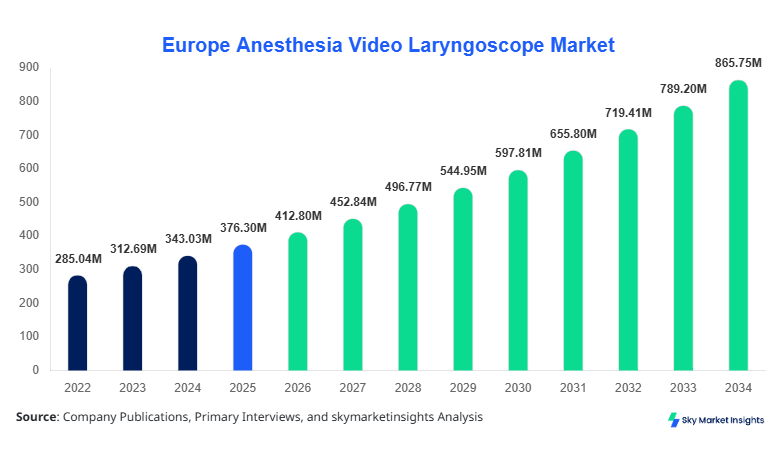
Europe Anesthesia Video Laryngoscope market size is projected at USD 412.8 million in 2026 and is expected to hit USD 865.4 million by 2034 with a CAGR of 9.7%. The market expansion is supported by increasing surgical volumes, rising demand for minimally invasive airway management systems, and higher adoption of technologically advanced anesthesia visualization devices across tertiary healthcare facilities in Europe. More than 6.2 million advanced airway management procedures were conducted across European healthcare institutions in 2025, while over 58% of anesthesia departments upgraded to digital airway visualization systems during the same period. The report evaluates detailed segmentation, competitive intensity, procurement analysis, and hospital purchasing behavior across key European countries to provide extensive Europe Anesthesia Video Laryngoscope market insights.
The anesthesia video laryngoscope market comprises advanced airway visualization devices integrated with high-definition imaging systems used during intubation and anesthesia administration. These systems improve glottic visualization accuracy by nearly 72% compared with traditional direct laryngoscopy and reduce failed intubation rates by approximately 38% in difficult airway procedures. Europe manufactured more than 1.9 million anesthesia visualization units in 2025, with Germany, France, and the United Kingdom contributing over 68% of regional production output. Adoption penetration in intensive care units exceeded 64% in 2025, while emergency care utilization reached 41% across major European trauma facilities. Consumer behavior analysis indicates that nearly 74% of hospitals prioritize portable and disposable systems due to infection prevention requirements and workflow efficiency. Hospitals represented 61% of total application demand, ambulatory surgical centers contributed 23%, and emergency care settings accounted for 16% of utilization. Increasing difficult airway incidence, aging populations, and higher surgical procedure frequency continue to accelerate Europe Anesthesia Video Laryngoscope market growth.
Explore more data points, trends and opportunities Download Free Sample Report
Anesthesia Video Laryngoscope Market Trends
Rising Integration of AI-Assisted Visualization Systems
Artificial intelligence-assisted airway visualization systems are emerging as a major transformation trend across the anesthesia video laryngoscope industry. More than 42% of newly procured systems in Europe during 2025 included AI-supported glottic identification and image enhancement technologies. Manufacturers introduced enhanced CMOS camera systems delivering visualization accuracy above 94%, while high-resolution displays exceeding 1080p penetration increased to 63% of installations. Production volumes of portable digital laryngoscope systems surpassed 680,000 units in Europe during 2025, reflecting increasing hospital preference for compact wireless systems. Hospitals performing over 10,000 annual surgeries reported a 36% reduction in difficult intubation complications after deploying AI-assisted systems. Demand from intensive care units expanded by 11.8% due to increased respiratory emergency admissions. The transition toward digital airway analytics and wireless integration continues to strengthen Europe Anesthesia Video Laryngoscope market trends.
Increasing Preference for Disposable Video Laryngoscopes
Disposable anesthesia video laryngoscope systems are witnessing rapid penetration due to heightened infection control awareness and regulatory compliance requirements. In 2025, disposable systems represented approximately 47% of unit shipments across Europe compared with 32% in 2022. More than 820,000 disposable blades and integrated visualization systems were distributed across European hospitals during the year. The United Kingdom and France collectively contributed 39% of disposable system procurement due to stringent sterilization standards. Single-use systems reduced cross-contamination risks by nearly 61% and lowered maintenance expenditures by 24% for high-volume hospitals. Manufacturers increased investments in lightweight polymer-based blades capable of supporting visualization resolutions above 720p while reducing production costs by 17%. Emergency care utilization of disposable systems increased by 14.5% annually because trauma centers preferred rapid deployment airway tools. Rising infection prevention mandates and faster procedural turnover are accelerating Europe Anesthesia Video Laryngoscope market trends.
Europe Anesthesia Video Laryngoscope Drivers
Increasing Surgical Procedure Volumes and Difficult Airway Cases
The rising number of surgical interventions across Europe is a primary growth driver for the anesthesia video laryngoscope sector. More than 89 million surgical procedures were conducted across European healthcare systems during 2025, reflecting a 7.1% increase compared with 2022 levels. Difficult airway prevalence among obese and geriatric patients exceeded 13% of total anesthesia procedures, significantly increasing the requirement for advanced airway visualization tools. Video laryngoscope-assisted intubation improved first-pass success rates to nearly 91%, compared with 68% for traditional direct laryngoscopy techniques. More than 57% of tertiary hospitals upgraded airway management infrastructure between 2023 and 2025 to improve patient safety metrics. Portable systems experienced 18.4% procurement growth among emergency departments due to rising respiratory emergencies and trauma admissions. Government-backed modernization programs across Germany, France, and Italy allocated over USD 340 million for anesthesia equipment upgrades. Increased awareness of airway safety standards and surgical modernization initiatives continue to accelerate Europe Anesthesia Video Laryngoscope market growth.
Europe Anesthesia Video Laryngoscope Restraints
High Equipment Costs and Budget Constraints Across Public Healthcare Systems
Despite growing adoption, elevated acquisition and maintenance costs remain major restraints for anesthesia video laryngoscope deployment across smaller healthcare institutions. Advanced reusable systems with HD imaging and wireless connectivity are priced between USD 4,000 and USD 11,000 per unit, limiting procurement among budget-constrained hospitals. Nearly 38% of public healthcare facilities in Eastern and Southern Europe delayed replacement cycles due to funding limitations during 2025. Sterilization and maintenance expenditures for reusable systems increased operational costs by approximately 16% annually. Smaller ambulatory surgical centers represented only 21% of advanced digital laryngoscope installations because capital allocation favored core surgical infrastructure investments. Import dependency for high-end optical components exceeded 44% in certain European countries, increasing supply chain vulnerabilities and procurement expenses. Currency volatility and healthcare reimbursement pressures also reduced procurement flexibility among regional healthcare providers. Cost sensitivity and uneven infrastructure development continue to challenge Europe Anesthesia Video Laryngoscope market growth.
Europe Anesthesia Video Laryngoscope Opportunities
Expansion of Emergency Airway Management and Prehospital Care Applications
Growing emphasis on emergency airway stabilization and prehospital critical care services is creating substantial opportunities for video laryngoscope manufacturers across Europe. More than 14 million emergency admissions involving respiratory compromise were recorded across European hospitals in 2025, increasing demand for rapid airway visualization systems. Portable anesthesia video laryngoscopes represented 32% of new installations in emergency response units and ambulance fleets. Emergency medical teams using portable video systems improved successful first-attempt intubation rates by nearly 29% in field conditions. Investments in smart ambulance modernization programs exceeded USD 120 million across Germany, the United Kingdom, and France during 2025. Integration of wireless connectivity, battery optimization exceeding 6-hour runtime, and lightweight ergonomic designs increased adoption among mobile emergency providers. Pediatric emergency applications grew by 12.6% annually due to improved airway visualization in difficult anatomical conditions. Rising emergency preparedness investments and expansion of advanced critical care services are generating strong Europe Anesthesia Video Laryngoscope market opportunities.
Challenges in Europe Anesthesia Video Laryngoscope
Training Limitations and Uneven Clinical Expertise
Insufficient operator training and inconsistent clinical competency remain major challenges for the anesthesia video laryngoscope industry across Europe. Nearly 34% of healthcare institutions reported inadequate structured training programs for advanced airway visualization procedures in 2025. While tertiary academic hospitals achieved device utilization rates above 82%, smaller regional facilities averaged below 39% utilization efficiency due to limited staff expertise. Incorrect blade positioning and improper visualization handling contributed to approximately 11% of procedural delays during emergency intubation scenarios. Simulation-based airway management training centers increased by 18% across Europe between 2023 and 2025; however, access disparities persist across rural healthcare systems. More than 46% of anesthesia trainees required additional supervised procedures before achieving competency with advanced digital airway systems. Technical integration challenges involving data recording compatibility and hospital IT systems also delayed implementation across several facilities. Workforce shortages and uneven clinical training continue to restrain Europe Anesthesia Video Laryngoscope market growth.
Report Scope
| Report Metric | Details |
|---|---|
| Market Size in 2025 | USD 376.3 Million |
| Market Size in 2026 | USD 412.8 Million |
| Market Size in 2034 | USD 865.4 Million |
| CAGR | 9.7% (2026-2034) |
| Base Year for Estimation | 2025 |
| Historical Data | 2022-2024 |
| Forecast Period | 2026-2034 |
| Report Coverage | Revenue Forecast, Competitive Landscape, Supply Chain Disruption, Growth Factors, Environment & Regulatory Landscape and Trends |
Explore more data points, trends and opportunities Download Free Sample Report
Anesthesia Video Laryngoscope Market Segmentation
The anesthesia video laryngoscope market is segmented by product type and end user, with reusable systems dominating approximately 43% of revenue contribution in 2025 due to longer operational lifecycles and advanced imaging performance. Hospitals remained the largest end-user category with 61% market penetration because high-volume surgical centers require continuous airway management capabilities. Disposable systems accounted for 47% of unit sales due to infection prevention priorities, while portable systems experienced the fastest adoption increase at 18.1% annually.
By Type
Reusable video laryngoscopes accounted for nearly 43% of Europe’s anesthesia airway visualization revenue in 2025 due to widespread deployment in tertiary hospitals and academic medical centers. More than 540,000 reusable systems remained operational across Europe during the year. These systems typically feature reusable blades with sterilization cycles exceeding 1,000 procedures and integrated HD monitors supporting 1080p visualization quality. Germany and France collectively represented 49% of reusable system demand because high surgical volumes favored long-term cost optimization. Hospitals conducting more than 15,000 annual procedures preferred reusable systems due to reduced per-procedure operational costs by nearly 21%. Enhanced battery performance exceeding 8-hour operation and anti-fog optical technology improved clinical efficiency during difficult airway procedures. Reusable systems demonstrated intubation success rates above 90% in obese and geriatric patient populations. Continuous technological upgrades and integration of digital recording capabilities continue to support Europe Anesthesia Video Laryngoscope market demand.
Disposable video laryngoscopes represented approximately 47% of total unit shipments across Europe in 2025 because healthcare facilities increasingly emphasized infection control and procedural efficiency. More than 820,000 disposable airway visualization units were distributed across hospitals, emergency centers, and ambulatory surgical facilities. These systems utilize lightweight polymer blades integrated with single-use optical channels and compact digital displays supporting visualization resolutions above 720p. The United Kingdom contributed nearly 24% of regional disposable demand due to aggressive hospital infection reduction programs. Single-use systems reduced sterilization turnaround times by nearly 67% and minimized contamination risks by over 61%. Emergency departments and intensive care units collectively represented 58% of disposable system utilization due to rapid deployment requirements. Manufacturers reduced production costs by 14% through automated blade molding technologies and improved electronic miniaturization. Rising preference for infection-free airway management solutions is accelerating Europe Anesthesia Video Laryngoscope market growth.
Portable video laryngoscopes accounted for approximately 10% of total market revenue in 2025 but registered the fastest shipment growth due to increasing emergency and mobile care applications. More than 210,000 portable systems were utilized across ambulances, military healthcare units, and emergency trauma centers in Europe. These devices typically weigh below 450 grams and include rechargeable lithium battery systems supporting continuous operation for over 6 hours. Portable airway visualization tools improved prehospital intubation success rates by nearly 31% in emergency response scenarios. Germany, the United Kingdom, and Italy collectively contributed 61% of portable device procurement due to emergency preparedness modernization initiatives. Wireless connectivity penetration exceeded 44% among newly launched portable systems, enabling integration with hospital monitoring platforms. Enhanced screen brightness and ergonomic blade designs improved field usability in low-visibility environments. Growing emergency care investments continue supporting Europe Anesthesia Video Laryngoscope market demand.
By Application
Hospitals dominated the anesthesia video laryngoscope industry with nearly 61% revenue contribution in 2025 due to high procedural volumes and advanced surgical infrastructure. More than 3.8 million video-assisted intubation procedures were conducted across European hospitals during the year. Large tertiary hospitals accounted for 54% of total procurement expenditure because difficult airway management requirements are significantly higher in complex surgical environments. HD imaging systems supporting real-time recording and wireless data transfer were implemented in approximately 63% of advanced anesthesia departments. Germany and France collectively represented 42% of hospital-based demand due to extensive healthcare modernization initiatives. Video-assisted intubation reduced failed airway incidents by nearly 38% and improved first-pass procedural success rates to above 90%. Integration with electronic health record systems increased by 21% between 2023 and 2025. Rising surgical admissions and emphasis on airway safety continue to reinforce Europe Anesthesia Video Laryngoscope market growth.
Ambulatory surgical centers represented approximately 23% of total anesthesia video laryngoscope utilization in Europe during 2025. More than 1.1 million outpatient surgical procedures involved advanced airway visualization technologies due to increasing minimally invasive surgeries and same-day discharge models. Disposable video laryngoscopes accounted for nearly 58% of ambulatory center installations because infection prevention and procedural efficiency are critical operational priorities. Compact portable systems reduced setup time by 26% and improved patient throughput efficiency by approximately 19%. The United Kingdom and Spain collectively contributed 34% of ambulatory center procurement volume due to rising outpatient surgical demand. Battery-operated systems with touchscreen displays and lightweight ergonomic handles gained significant adoption across independent surgical facilities. Intubation-related complication rates declined by 17% after implementation of advanced digital visualization systems. Expansion of outpatient surgical infrastructure is strengthening Europe Anesthesia Video Laryngoscope market demand.
Emergency care settings accounted for approximately 16% of total market demand in 2025 due to increasing respiratory emergencies, trauma cases, and prehospital airway management requirements. More than 860,000 emergency airway procedures across Europe involved portable or disposable video laryngoscope systems during the year. Portable systems represented nearly 69% of emergency deployments because mobility and rapid deployment capabilities are essential in critical care scenarios. Trauma centers reported a 28% improvement in first-attempt intubation success after integrating advanced video-assisted airway devices. Russia, Germany, and Italy collectively represented 46% of emergency care procurement volume because large geographic coverage areas increased demand for mobile airway equipment. Wireless connectivity and anti-fog optical systems improved visualization reliability during low-light emergency operations. Pediatric emergency utilization increased by 13.4% annually because video-assisted airway tools enhanced anatomical visualization accuracy. Rising investments in emergency response modernization continue supporting Europe Anesthesia Video Laryngoscope market growth.
Europe Anesthesia Video Laryngoscope Market Segmentations
Product Type
- Reusable Video Laryngoscopes
- Disposable Video Laryngoscopes
- Portable Video Laryngoscopes
End User
- Hospitals
- Ambulatory Surgical Centers
- Emergency Care Settings
Europe Anesthesia Video Laryngoscope Regional Outlook
United Kingdom
The United Kingdom accounted for approximately 19% of Europe’s anesthesia video laryngoscope revenue during 2025 due to strong adoption within NHS hospitals and ambulatory surgical networks. More than 740 hospitals and over 1,200 outpatient facilities utilized advanced airway visualization technologies across the country. Disposable systems represented 51% of total UK installations because infection prevention compliance remains a major healthcare priority. More than 620,000 advanced airway procedures were conducted using video-assisted systems during 2025. Emergency care applications accounted for 18% of national demand due to rising respiratory emergency admissions. Portable systems experienced 15.7% procurement growth among ambulance and trauma services. Government-funded modernization initiatives exceeding USD 75 million supported digital anesthesia equipment upgrades across regional healthcare trusts.
Germany
Germany represented nearly 28% of total Europe anesthesia video laryngoscope revenue in 2025 and maintained leadership in production and technology adoption. More than 920,000 video-assisted intubation procedures were conducted across German healthcare institutions during the year. Hospitals accounted for 66% of device utilization, while emergency care settings represented 19%. Germany manufactured over 520,000 airway visualization systems annually, contributing approximately 34% of regional production output. Advanced HD imaging adoption exceeded 71% across tertiary hospitals, while wireless integration penetration reached 43%. Disposable systems experienced 14.2% annual shipment growth due to increasing infection prevention mandates. Continuous healthcare digitization programs and advanced surgical infrastructure continue supporting Europe Anesthesia Video Laryngoscope market growth.
France
France contributed approximately 16% of total regional anesthesia video laryngoscope revenue during 2025 due to increasing surgical modernization and strong intensive care investments. More than 510,000 advanced airway procedures were conducted using digital visualization systems across French healthcare facilities. Disposable systems represented 48% of national unit sales because public healthcare institutions emphasized infection reduction strategies. More than 61% of anesthesia departments upgraded airway management systems between 2023 and 2025. Hospitals contributed 63% of national demand, while ambulatory surgical centers accounted for 22%. Portable emergency systems registered 13.8% shipment growth due to trauma care modernization initiatives. France also increased domestic manufacturing capacity by nearly 11% in 2025 to reduce import dependency.
Spain
Spain accounted for nearly 11% of Europe anesthesia video laryngoscope demand during 2025, supported by growing outpatient surgical procedures and emergency airway modernization programs. More than 340,000 advanced intubation procedures were conducted using video-assisted systems across the country. Ambulatory surgical centers represented 28% of national utilization because outpatient procedure volumes increased by 12.4% between 2023 and 2025. Disposable systems dominated nearly 49% of installations due to efficiency advantages in high-volume surgical centers. Portable emergency systems experienced 16.1% procurement growth among regional trauma units. Government healthcare modernization programs allocated approximately USD 38 million for anesthesia technology upgrades across public hospitals.
Italy
Italy represented approximately 12% of Europe anesthesia video laryngoscope revenue in 2025 due to increasing geriatric surgical demand and expansion of intensive care infrastructure. More than 420,000 airway management procedures involving video-assisted systems were recorded during the year. Hospitals accounted for nearly 64% of total utilization, while emergency care settings contributed 17%. Portable systems experienced 15.4% adoption growth because emergency preparedness programs expanded nationwide ambulance modernization initiatives. Italy imported nearly 58% of advanced airway imaging components used in domestic system assembly. Integration of digital airway recording functionality increased by 22% between 2023 and 2025. Rising healthcare investments and respiratory emergency preparedness are strengthening Europe Anesthesia Video Laryngoscope market demand.
Russia
Russia contributed approximately 9% of total regional revenue during 2025 due to increasing critical care infrastructure expansion and emergency response modernization. More than 290,000 advanced airway procedures involved video-assisted systems across Russian healthcare facilities during the year. Emergency care settings represented 27% of total utilization because extensive geographic coverage areas increased demand for portable systems. Portable video laryngoscope procurement expanded by 17.3% annually due to military and trauma care applications. Hospitals contributed 59% of national demand, while ambulatory centers represented 14%. Russia increased domestic assembly output by approximately 9% during 2025 to reduce import dependency on optical imaging technologies.
Top players in Europe Anesthesia Video Laryngoscope
- Medtronic plc
- Karl Storz SE & Co. KG
- Ambu A/S
- Verathon Inc.
- Olympus Corporation
- Teleflex Incorporated
- HEINE Optotechnik GmbH
- Intersurgical Ltd.
- Flexicare Medical Ltd.
- Venner Medical GmbH
- Pentax Medical
- Nihon Kohden Corporation
- BPL Medical Technologies
- Vyaire Medical Inc.
- Fujifilm Holdings Corporation
Medtronic plc
-
Medtronic plc accounted for approximately 17% of Europe anesthesia video laryngoscope revenue during 2025 due to extensive hospital penetration and diversified airway management product portfolios.
-
The company maintained strong positioning in reusable and portable airway visualization systems, with more than 280,000 installed units across European hospitals.
-
Medtronic invested nearly 11% of its airway management revenue into digital visualization R&D and AI-assisted imaging optimization technologies.
-
The company expanded wireless integration capabilities across 42% of newly launched systems while strengthening distribution partnerships in Germany, France, and the United Kingdom.
Ambu A/S
-
Ambu A/S represented nearly 13% of regional market revenue in 2025 due to leadership in disposable video laryngoscope technologies.
-
The company distributed more than 360,000 single-use airway visualization devices across Europe during the year.
-
Ambu increased automated manufacturing efficiency by approximately 18% and reduced disposable blade production costs by 12%.
-
The company strengthened positioning in infection-control-focused healthcare institutions and expanded emergency care product penetration across ambulance networks and trauma centers.
Investment Analysis
Investments in the Europe anesthesia video laryngoscope sector exceeded USD 640 million between 2023 and 2025, with approximately 41% allocated toward AI-assisted visualization technologies and portable airway systems. Germany accounted for nearly 29% of total regional investment activity, followed by the United Kingdom at 21% and France at 17%. Hospitals represented 56% of capital deployment because surgical modernization programs increasingly prioritized advanced airway management infrastructure. Disposable system manufacturing facilities attracted nearly 24% of investment allocation due to increasing infection prevention requirements across public healthcare systems.
Mergers, acquisitions, and collaboration activities accelerated significantly during 2025 as manufacturers sought to expand digital airway management capabilities. More than 18 strategic collaborations involving imaging software integration, wireless monitoring compatibility, and disposable blade production expansion were announced across Europe. AI-enhanced airway visualization technologies received approximately 19% of total innovation funding due to rising demand for automated glottic identification systems. Medical device manufacturers increasingly partnered with hospital simulation centers to improve clinician training and expand device adoption. Cross-border production partnerships between Germany and France increased regional manufacturing efficiency by approximately 14%. Emergency care modernization programs also attracted substantial venture investments due to rising prehospital airway management requirements. Increasing digital healthcare investments continue supporting Europe Anesthesia Video Laryngoscope market insights.
New Product Developments
Manufacturers introduced more than 46 new anesthesia video laryngoscope models across Europe between 2024 and 2025, with approximately 58% featuring HD or 4K visualization capabilities. New-generation systems improved image clarity by nearly 37% and reduced procedural visualization delays by 21% compared with earlier devices. Wireless portable systems accounted for 34% of new product launches because emergency and ambulatory care providers increasingly preferred compact mobile airway tools. AI-assisted blade positioning technologies improved first-pass intubation accuracy by approximately 16%.
Disposable product innovation accelerated significantly during 2025, with manufacturers reducing device weight by nearly 24% through advanced polymer engineering. Battery efficiency improvements increased portable system operating time from 4 hours to over 6.5 hours in several newly launched devices. More than 43% of new systems incorporated touchscreen interfaces and cloud-based procedure recording capabilities. Continuous innovation in imaging performance and ergonomic usability is strengthening Europe Anesthesia Video Laryngoscope market trends.
Recent Developments in Europe Anesthesia Video Laryngoscope
- 2025: Medtronic expanded its Germany manufacturing facility, increasing reusable video laryngoscope production capacity by approximately 18% annually. The expansion supported over 120,000 additional units per year and improved regional supply chain efficiency by 14%. The facility also integrated automated optical calibration systems that enhanced product quality consistency across high-definition airway imaging devices.
- 2025: Ambu A/S launched a next-generation disposable video laryngoscope platform featuring integrated wireless connectivity and lightweight polymer blades. The new product improved visualization brightness by 31% and reduced blade replacement time by 22%. Initial deployment across more than 260 European hospitals accelerated disposable system penetration in emergency and ambulatory care applications.
Research Methodology
The Europe anesthesia video laryngoscope market assessment was developed through a combination of primary and secondary research methodologies to ensure comprehensive analytical accuracy. The research process involved detailed evaluation of production statistics, procurement databases, healthcare infrastructure reports, surgical procedure volumes, and anesthesia equipment utilization trends across European countries.
Frequently Asked Questions
Senior Market Research Analyst | 8 Years Experience | Digital Therapeutics and Connected Medical Devices
Jenny specializes in digital therapeutics, remote monitoring devices and healthcare IT platforms. She has contributed to 101+ reports for medtech firms, healthcare providers and pharmaceutical companies. Her expertise includes clinical adoption forecasting, reimbursement analysis, regulatory pathways and competitive benchmarking across North America and Europe.