Europe Anesthesia Vaporizers Market Size
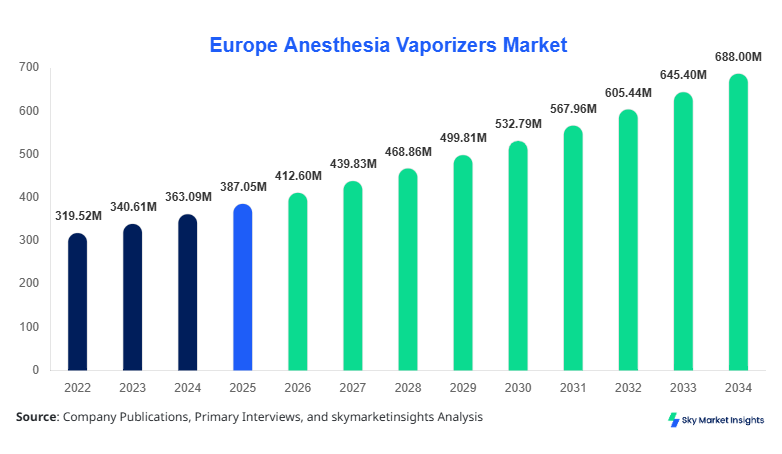
Europe Anesthesia Vaporizers market size is projected at USD 412.6 million in 2026 and is expected to hit USD 689.4 million by 2034 with a CAGR of 6.6%.
The increasing volume of surgical procedures across Europe, rising investments in operating room modernization, and the growing installation of advanced anesthesia workstations are accelerating revenue generation across the Europe Anesthesia Vaporizers market. More than 28.4 million surgical interventions were performed across major European healthcare systems in 2025, while over 61% of tertiary hospitals upgraded anesthesia delivery systems integrated with precision vaporizers. Market participants are emphasizing digital calibration systems, low-flow anesthesia technology, and agent-specific vaporizer integration to improve anesthetic precision and patient safety. The Europe Anesthesia Vaporizers market continues to witness extensive segmentation by product type, application environment, and healthcare infrastructure intensity, supported by a competitive landscape consisting of multinational manufacturers and regional medical device suppliers.
The anesthesia vaporizers industry comprises specialized medical devices designed to convert liquid anesthetic agents into controlled vapor concentrations for delivery during surgical and critical care procedures. Europe accounted for approximately 27.8% of global anesthesia equipment production in 2025, with Germany, the United Kingdom, and France contributing nearly 68% of regional manufacturing output. Adoption penetration across public and private hospitals exceeded 74% for electronically calibrated vaporizers, while integrated anesthesia workstations represented nearly 58% of total installations. Sevoflurane-compatible vaporizers accounted for 46% of deployed systems, followed by isoflurane-compatible devices at 31% and desflurane systems at 18%. Consumer demand analytics indicate that hospitals performing more than 9,000 annual surgeries increased vaporizer procurement budgets by 14.2% during 2024–2025. Performance metrics including vapor concentration stability of ±0.2%, thermal compensation efficiency above 96%, and fresh gas flow precision below 250 mL/min are becoming standard procurement benchmarks. Hospitals represented nearly 63% of overall application demand, ambulatory surgical centers contributed 24%, and specialty clinics captured 13% of installations. The Europe Anesthesia Vaporizers market continues to expand alongside rising perioperative care requirements and advanced surgical infrastructure deployment.
Explore more data points, trends and opportunities Download Free Sample Report
Anesthesia Vaporizers Market Trends
Expansion of Digitally Integrated Vaporizer Platforms
The integration of anesthesia vaporizers with digital anesthesia workstations has emerged as a major technological transformation across Europe. During 2025, more than 68,000 digitally enabled vaporizers were installed across regional hospitals, representing a 19.3% increase compared with 2023 installations. Advanced vaporizer systems equipped with touchscreen calibration, automated anesthetic recognition, and low-flow optimization technology accounted for nearly 57% of new procurement contracts. In high-volume hospitals, electronically controlled vaporizer systems reduced anesthetic wastage by approximately 16% while improving dosage accuracy by nearly 21%. The United Kingdom and Germany collectively represented more than 49% of regional smart vaporizer deployment. Manufacturers are increasingly incorporating AI-assisted monitoring systems capable of predicting refill cycles and gas flow anomalies with operational accuracy above 93%. The increasing adoption of digitally integrated anesthesia systems continues to reshape procurement strategies and operational efficiency across the Anesthesia Vaporizers market.
Growing Adoption of Low-Flow Anesthesia Technology
Low-flow anesthesia administration has become a critical operational priority among European healthcare institutions due to sustainability objectives and anesthetic gas cost optimization. In 2025, nearly 44% of newly procured anesthesia vaporizers supported fresh gas flow rates below 500 mL/min compared with 29% in 2022. France and Italy reported adoption increases exceeding 13% annually for low-flow compatible vaporizers across tertiary surgical centers. Hospitals implementing low-flow anesthesia technology reduced volatile anesthetic agent consumption by nearly 22%, while operating room carbon emissions declined by approximately 17%. Demand for desflurane-reducing systems also accelerated following environmental regulations affecting greenhouse gas-intensive anesthetic agents. More than 36% of procurement contracts in Europe included sustainability-based performance specifications during 2025. Manufacturers are investing in thermal compensation enhancements, digital leak prevention systems, and automated gas concentration control mechanisms to support sustainability-focused procurement patterns in the Anesthesia Vaporizers market.
Increasing Demand from Ambulatory Surgical Centers
Ambulatory surgical centers across Europe are increasingly investing in compact anesthesia delivery systems integrated with portable vaporizers. The number of outpatient surgeries surpassed 12.6 million procedures in 2025, generating significant demand for lightweight and mobile anesthesia systems. Compact vaporizer installations within ambulatory surgical centers increased by 18.8% between 2023 and 2025, while portable anesthesia platforms represented nearly 26% of total new installations. Spain and the United Kingdom recorded outpatient surgical growth rates above 11%, stimulating procurement demand for quick-calibration vaporizer systems with reduced maintenance cycles. Facilities operating under same-day discharge models emphasized equipment with anesthetic delivery stabilization below 30 seconds and concentration accuracy above 98%. Manufacturers are introducing modular anesthesia platforms compatible with multiple anesthetic agents to support flexible surgical environments. Rising outpatient surgical volumes continue to stimulate long-term expansion opportunities within the Anesthesia Vaporizers market.
Europe Anesthesia Vaporizers Drivers
Rising Surgical Volumes and Expansion of Operating Room Infrastructure
The increasing number of surgical procedures across Europe remains a primary driver for anesthesia vaporizer installations. In 2025, total surgical procedures across Europe exceeded 28 million, reflecting a 12.7% increase compared with 2022. Orthopedic surgeries accounted for 21% of total operations, cardiovascular procedures represented 14%, neurological interventions contributed 8%, and oncology-related surgeries represented 11%. More than 4,600 operating rooms across Europe underwent modernization projects between 2023 and 2025, with approximately 63% incorporating advanced anesthesia workstations integrated with precision vaporizers. Germany, France, and the United Kingdom collectively represented nearly 58% of new operating room installations during this period. Hospital expenditure on anesthesia delivery infrastructure rose by approximately 15.2% annually due to increasing perioperative care standards and patient monitoring requirements. Vaporizer systems supporting low-flow anesthesia and automated calibration represented 61% of procurement demand within tertiary care hospitals. Growing surgical intensity, aging populations, and increasing chronic disease incidence continue to strengthen long-term procurement activity across the Europe Anesthesia Vaporizers market growth.
Europe Anesthesia Vaporizers Restraints
High Equipment Costs and Maintenance Complexity
The relatively high acquisition and maintenance cost of advanced anesthesia vaporizers remains a significant restraint across smaller hospitals and specialty clinics. Digitally integrated anesthesia vaporizers equipped with automated calibration and electronic flow control systems can cost between USD 12,000 and USD 38,000 per unit depending on configuration and anesthetic compatibility. Annual maintenance expenses account for nearly 9% to 14% of total ownership costs, while periodic calibration and certification procedures increase operational expenditure for healthcare facilities. Approximately 31% of mid-sized hospitals across Eastern and Southern Europe delayed equipment replacement cycles beyond recommended operational timelines due to capital expenditure limitations. In addition, maintenance downtime for electronically controlled vaporizers averaged 3.8 days annually compared with 1.7 days for conventional systems. Import dependency for specialized components exceeded 46% within several regional healthcare markets, contributing to procurement delays and spare part price volatility. Budget constraints within publicly funded healthcare systems continue to slow modernization initiatives and limit rapid replacement rates within the Europe Anesthesia Vaporizers market growth.
Europe Anesthesia Vaporizers Opportunities
Integration of Smart Monitoring and AI-Enabled Anesthesia Platforms
The integration of artificial intelligence and predictive monitoring technology into anesthesia delivery systems presents substantial growth opportunities for vaporizer manufacturers. In 2025, approximately 27% of newly launched anesthesia platforms across Europe included AI-supported vapor monitoring systems capable of detecting gas delivery fluctuations with accuracy above 94%. Hospitals adopting predictive maintenance systems reduced equipment failure rates by nearly 18% and lowered anesthetic wastage by approximately 12%. More than 39% of procurement tenders issued by university hospitals specified digital integration compatibility with electronic health record systems and operating room analytics software. Cloud-enabled anesthesia management systems supporting centralized monitoring across multiple operating rooms witnessed installation growth above 21% annually between 2023 and 2025. Manufacturers investing in remote calibration technology, automated agent recognition systems, and machine learning-based dosage optimization are expected to strengthen their competitive positioning. The increasing digital transformation of perioperative care infrastructure creates long-term expansion potential within the Europe Anesthesia Vaporizers market demand.
Europe Anesthesia Vaporizers Challenge
Regulatory Compliance and Environmental Sustainability Pressures
Manufacturers operating in the European anesthesia vaporizer sector face significant regulatory and sustainability-related challenges. More than 41% of European healthcare procurement contracts in 2025 incorporated environmental performance requirements related to volatile anesthetic emissions and greenhouse gas reduction targets. Desflurane-related environmental restrictions increased operational compliance costs for manufacturers by approximately 11.4% during 2024–2025. Regulatory certification timelines for advanced electronically controlled vaporizers averaged 14 to 18 months, delaying commercialization and product launches. Additionally, compliance with EU Medical Device Regulation standards increased documentation and validation expenditures by nearly 16%. Healthcare providers are increasingly requesting systems capable of supporting low-emission anesthetic agents and ultra-low-flow delivery below 300 mL/min. Manufacturers unable to meet sustainability benchmarks risk procurement exclusion across public hospital networks. Balancing environmental expectations, operational efficiency, and evolving regulatory frameworks remains a major challenge affecting long-term competitiveness within the Europe Anesthesia Vaporizers market.
Report Scope
| Report Metric | Details |
|---|---|
| Market Size in 2025 | USD 387.05 Million |
| Market Size in 2026 | USD 412.6 Million |
| Market Size in 2034 | USD 689.4 Million |
| CAGR | 6.6% (2026-2034) |
| Base Year for Estimation | 2025 |
| Historical Data | 2022-2024 |
| Forecast Period | 2026-2034 |
| Report Coverage | Revenue Forecast, Competitive Landscape, Supply Chain Disruption, Growth Factors, Environment & Regulatory Landscape and Trends |
Explore more data points, trends and opportunities Download Free Sample Report
Anesthesia Vaporizers Market Segmentation
The Europe anesthesia vaporizers industry is segmented by product type and end user, with hospitals dominating nearly 63% of overall installations in 2025. Variable bypass vaporizers represented approximately 52% of regional product demand due to compatibility with multiple anesthetic agents and broad deployment across tertiary hospitals. Ambulatory surgical centers contributed 24% of application demand, supported by rising outpatient procedure volumes and compact anesthesia workstation installations.
By Type
Variable bypass vaporizers dominated the European market with nearly 52% share in 2025 owing to their compatibility with sevoflurane and isoflurane delivery systems. More than 126,000 units were operational across European hospitals, with Germany, France, and the United Kingdom accounting for nearly 67% of deployments. These vaporizers maintain concentration accuracy within ±0.2% and support fresh gas flow ranges between 0.2 L/min and 15 L/min. Approximately 71% of tertiary care hospitals preferred variable bypass systems due to thermal compensation reliability and simplified maintenance requirements. Installation growth within cardiovascular and orthopedic operating rooms exceeded 13% annually between 2023 and 2025.
Measured flow vaporizers accounted for approximately 28% of total installations and were widely utilized in specialized anesthesia environments requiring high precision agent delivery. Nearly 48,000 measured flow units were deployed across Europe during 2025. These systems supported anesthetic concentration control accuracy above 98% while reducing volatile anesthetic wastage by approximately 15%. University hospitals and high-acuity surgical centers represented nearly 61% of demand for measured flow systems. France and Italy recorded strong procurement activity due to increasing adoption of advanced anesthesia monitoring platforms integrated with precision-controlled gas delivery mechanisms.
Injection vaporizers represented nearly 20% of regional demand and witnessed strong adoption across digitally integrated operating room environments. More than 31,000 injection vaporizer units were active across Europe in 2025, with annual installation expansion above 11%. These systems enabled rapid anesthetic delivery stabilization within 25 seconds while supporting automated calibration functionality. Approximately 46% of newly constructed surgical centers installed injection vaporizer systems due to compatibility with electronic anesthesia management software and low-flow operation. Spain and the United Kingdom showed increasing procurement momentum for portable injection vaporizer platforms integrated with compact anesthesia workstations.
By Application
Hospitals represented the largest application segment with nearly 63% of total Europe anesthesia vaporizer demand in 2025. More than 212,000 vaporizer systems were operational across public and private hospitals throughout the region. General surgery departments contributed approximately 34% of hospital-based vaporizer utilization, while orthopedic procedures accounted for 19%, cardiovascular surgeries represented 16%, and oncology interventions contributed 9%. Large tertiary hospitals increasingly preferred digitally integrated vaporizers equipped with automated concentration monitoring and AI-supported predictive maintenance systems. More than 58% of hospital procurement budgets allocated toward anesthesia equipment modernization focused on integrated vaporizer platforms with low-flow capability and electronic calibration systems.
Ambulatory surgical centers accounted for approximately 24% of total installations and demonstrated rapid expansion due to increasing outpatient surgical volumes. Over 74,000 vaporizer systems were installed across ambulatory care centers during 2025. Facilities performing same-day discharge surgeries emphasized portable systems with rapid warm-up times below 45 seconds and vapor concentration stabilization above 97%. Outpatient orthopedic, ophthalmic, and minimally invasive procedures represented nearly 62% of anesthesia demand within ambulatory centers. Spain and the United Kingdom reported outpatient surgery growth rates exceeding 10%, supporting continued equipment procurement activity.
Specialty clinics represented nearly 13% of overall market demand, supported by dental anesthesia, cosmetic surgery, and pain management applications. Approximately 38,000 vaporizer units operated across specialty clinics in 2025. Compact and modular systems accounted for 44% of specialty clinic installations due to limited infrastructure space and mobile anesthesia requirements. Clinics emphasized energy-efficient vaporizers capable of reducing anesthetic consumption by more than 14% while maintaining stable concentration accuracy. Growing demand for office-based surgical procedures and minimally invasive interventions continues to stimulate procurement activity across specialty clinic environments.
Europe Anesthesia Vaporizers Market Segmentations
Product Type
- Variable Bypass Vaporizers
- Measured Flow Vaporizers
- Injection Vaporizers
End User
- Hospitals
- Ambulatory Surgical Centers
- Specialty Clinics
Europe Anesthesia Vaporizers Regional Outlook
United Kingdom
The United Kingdom accounted for approximately 18% of Europe anesthesia vaporizer revenue during 2025. More than 2.7 million inpatient surgeries and 3.8 million outpatient procedures were conducted across NHS and private healthcare systems. Nearly 61% of hospitals utilized digitally integrated anesthesia workstations equipped with electronically calibrated vaporizers. General surgery contributed 31% of total vaporizer utilization, while orthopedic procedures represented 22%. The country operated approximately 6,300 active operating rooms, with modernization investments increasing by 14% annually. Compact anesthesia platforms for ambulatory surgical centers experienced installation growth above 16% during 2024–2025.
Germany
Germany remained the largest regional contributor with nearly 29.6% market share. The country manufactured approximately 184,000 vaporizer units annually and exported more than 41% of total production output. Over 72% of tertiary hospitals deployed advanced vaporizer systems integrated with AI-assisted anesthesia monitoring platforms. Orthopedic and cardiovascular procedures collectively represented 40% of total anesthesia delivery demand. Germany also recorded one of the highest adoption rates for low-flow anesthesia systems at approximately 64%. Healthcare expenditure related to surgical infrastructure modernization exceeded USD 2.1 billion during 2025.
France
France represented approximately 15% of Europe anesthesia vaporizer revenue and maintained strong demand for precision-controlled anesthesia systems. More than 4.4 million surgical procedures were conducted in France during 2025, while public hospitals accounted for nearly 68% of vaporizer procurement expenditure. Low-flow anesthesia systems experienced adoption growth of approximately 13.7% annually. France also witnessed strong integration of digital operating room analytics platforms, with nearly 49% of university hospitals utilizing AI-assisted anesthesia monitoring systems. Measured flow vaporizers accounted for approximately 34% of installations due to demand from specialized surgical centers.
Spain
Spain accounted for approximately 10% of regional market demand and experienced rapid expansion in ambulatory surgery infrastructure. Outpatient surgical procedures exceeded 2.1 million during 2025, generating strong procurement demand for portable vaporizer systems. Compact anesthesia platforms represented nearly 38% of new installations across Spanish surgical centers. More than 46% of private hospitals upgraded anesthesia workstations during 2024–2025. Orthopedic and cosmetic surgery applications collectively contributed approximately 33% of anesthesia vaporizer utilization. Increasing investment in minimally invasive surgical capabilities continues to stimulate procurement activity.
Italy
Italy captured nearly 11% of Europe anesthesia vaporizer revenue during 2025. Public healthcare facilities represented approximately 71% of total installations, while university hospitals accounted for 29% of procurement spending on advanced anesthesia systems. More than 52% of operating room modernization projects included digitally integrated vaporizers supporting low-flow anesthetic delivery. Italy also witnessed increasing demand for environmentally sustainable anesthesia systems capable of reducing volatile anesthetic emissions by approximately 18%. General surgery and oncology procedures collectively contributed nearly 43% of anesthesia delivery utilization.
Russia
Russia accounted for approximately 8% of Europe anesthesia vaporizer demand. More than 1.8 million surgeries requiring general anesthesia were conducted during 2025 across regional healthcare systems. Domestic manufacturing represented approximately 37% of total vaporizer supply, while imports accounted for 63%. Government investments in hospital modernization increased by approximately 9.4% annually between 2023 and 2025. Urban hospitals demonstrated stronger adoption of electronically controlled vaporizers compared with rural facilities. General surgery represented 36% of utilization, followed by trauma procedures at 19%.
Top players in Europe Anesthesia Vaporizers
- Drägerwerk AG
- GE HealthCare
- Mindray Medical International
- Penlon Limited
- Becton Dickinson and Company
- Smiths Medical
- Spacelabs Healthcare
- Beijing Aeonmed
- Infinium Medical
- Heyer Medical AG
- Medec International
- Siare Engineering International Group
- Oricare Inc.
- Supera Anesthesia Innovations
- DRE Medical Equipment
Drägerwerk AG
-
Drägerwerk AG accounted for approximately 18% of Europe anesthesia vaporizer revenue in 2025.
-
The company operates manufacturing facilities across Germany and maintains distribution coverage in more than 70 countries.
-
Nearly 64% of its anesthesia systems sold in Europe included integrated digital vaporizer technology with automated calibration capabilities.
-
The company invested approximately 11% of annual medical division expenditure toward AI-assisted anesthesia delivery and sustainability-focused low-flow systems.
-
Drägerwerk maintained strong positioning across university hospitals and high-volume tertiary surgical centers due to high reliability standards and advanced monitoring integration.
GE HealthCare
-
GE HealthCare represented nearly 14% of regional anesthesia vaporizer installations during 2025.
-
The company emphasized digitally integrated anesthesia workstations equipped with predictive maintenance analytics and electronic gas concentration monitoring systems.
-
More than 58% of its European anesthesia installations were deployed across hospitals performing above 7,000 annual surgeries.
-
GE HealthCare expanded partnerships with ambulatory surgical centers and specialty hospitals to strengthen compact anesthesia platform adoption.
-
The company invested significantly in low-emission anesthesia technologies and cloud-connected operating room management platforms to enhance competitive positioning.
Investment Analysis
Investment activity within the European anesthesia vaporizer industry increased substantially between 2023 and 2025 due to operating room modernization and digital healthcare transformation initiatives. Approximately 42% of total medical device infrastructure investments across perioperative care were directed toward anesthesia delivery systems and monitoring technologies. Germany represented nearly 31% of total regional investment allocation, followed by the United Kingdom at 19% and France at 15%. Public healthcare modernization programs contributed approximately 58% of investment activity, while private hospital groups represented 27% of spending. Venture-backed investment into AI-integrated anesthesia systems increased by nearly 18.6% annually.
Mergers, acquisitions, and collaborative agreements continued to strengthen technological innovation across the sector. More than 24 strategic partnerships involving anesthesia technology providers were announced across Europe during 2024–2025. Approximately 36% of collaborative agreements focused on digital operating room integration, while 22% emphasized low-emission anesthetic delivery systems. Manufacturers invested heavily in software-based anesthesia monitoring platforms and remote diagnostic capabilities to reduce maintenance downtime. Joint ventures between medical device companies and hospital networks also increased by approximately 14%, supporting customized anesthesia workflow optimization and sustainability-focused operating room modernization.
New Product Developments
Manufacturers across Europe accelerated product innovation focused on digital monitoring, low-flow anesthesia compatibility, and sustainability improvements. Nearly 34% of newly launched vaporizer systems during 2025 incorporated automated anesthetic recognition and cloud-connected calibration technology. Advanced vaporizers reduced anesthetic wastage by approximately 17% while improving dosage stability by nearly 22% compared with previous-generation systems. More than 41% of new products introduced supported ultra-low-flow operation below 300 mL/min.
Portable and modular anesthesia vaporizer platforms also experienced strong innovation momentum. Compact systems introduced for ambulatory surgical centers reduced equipment footprint by approximately 26% while improving thermal stabilization efficiency by 19%. Manufacturers focused on touchscreen-enabled calibration interfaces, predictive refill monitoring, and integrated environmental impact tracking systems to strengthen adoption across sustainability-driven healthcare institutions.
Recent Developments in Europe Anesthesia Vaporizers
- 2025: Drägerwerk AG expanded production capacity in Germany by approximately 14% to meet rising demand for digitally integrated anesthesia vaporizers. The expansion added more than 22,000 annual unit manufacturing capacity and improved delivery timelines across Europe. The company also introduced enhanced low-flow calibration systems capable of reducing anesthetic consumption by nearly 16%.
- 2025: GE HealthCare launched a next-generation AI-assisted anesthesia monitoring platform integrated with electronically controlled vaporizers. Early deployments across 140 European hospitals improved anesthetic concentration accuracy by approximately 21% and reduced maintenance-related downtime by 12%. The rollout supported growing smart operating room infrastructure demand.
Research Methodology
The Europe anesthesia vaporizers market assessment was developed using a comprehensive multi-stage research methodology combining primary and secondary data analysis. The research process included detailed evaluation of medical device manufacturing statistics, hospital procurement records, surgical procedure volumes, healthcare expenditure trends, and anesthesia equipment deployment rates across major European countries. Primary research involved interviews with hospital procurement managers, anesthesia equipment distributors, operating room specialists, and medical device executives to validate pricing structures, installation trends, technology adoption, and regulatory developments. Secondary research incorporated analysis of healthcare databases, annual company reports, surgical statistics publications, medical journals, trade association data, and government healthcare infrastructure records. Market size estimation was conducted using bottom-up and top-down analytical approaches integrating operating room installations, anesthesia workstation deployments, surgical procedure growth patterns, and average equipment pricing. Forecast modeling included macroeconomic indicators, healthcare modernization expenditure, demographic trends, outpatient surgery expansion, and digital operating room adoption rates to generate long-term industry projections across Europe through 2034.
Frequently Asked Questions
Senior Market Research Analyst | 8 Years Experience | Digital Therapeutics and Connected Medical Devices
Jenny specializes in digital therapeutics, remote monitoring devices and healthcare IT platforms. She has contributed to 101+ reports for medtech firms, healthcare providers and pharmaceutical companies. Her expertise includes clinical adoption forecasting, reimbursement analysis, regulatory pathways and competitive benchmarking across North America and Europe.