Europe Anesthesia Gas Blender Market Size
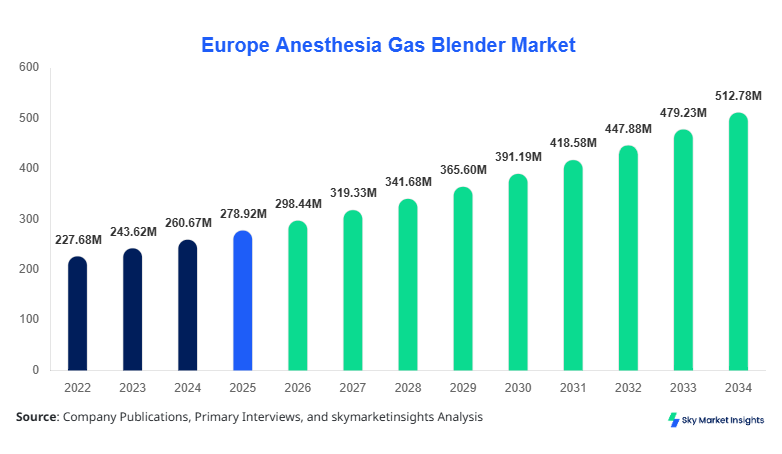
Europe Anesthesia Gas Blender market size is projected at USD 298.44 million in 2026 and is expected to hit USD 512.71 million by 2034 with a CAGR of 7.0%. The market recorded an estimated valuation of USD 279.63 million in 2025, while historical revenue stood at USD 241.11 million in 2022, USD 252.90 million in 2023, and USD 266.74 million in 2024. More than 186,000 anesthesia workstations across Europe currently integrate gas blending modules with oxygen concentration accuracy ranging from 21% to 100% and flow precision within ±2%. The increasing demand for patient safety monitoring, surgical expansion, and critical care ventilation systems continues to accelerate procurement activities across tertiary hospitals and specialty surgical centers.
The Europe anesthesia gas blender ecosystem comprises manufacturers, distributors, anesthesia workstation suppliers, ICU equipment providers, and healthcare procurement agencies. The market involves precision-controlled systems used to regulate oxygen, nitrous oxide, and medical air during surgical and intensive care procedures. Europe produced nearly 74,000 anesthesia gas blending units in 2025, with Germany, the United Kingdom, and France accounting for over 63% of regional manufacturing output. Adoption penetration across large hospitals exceeded 81% in 2025, while ambulatory surgical centers reported installation penetration near 47%. Consumer purchasing behavior indicates that more than 58% of healthcare facilities prioritize digital flow monitoring, automated alarms, and integrated ventilation compatibility during procurement. Approximately 44% of units sold in Europe support neonatal anesthesia applications with oxygen delivery accuracy between 0.5 L/min and 15 L/min. Hospitals represented nearly 68% of total installations, ambulatory surgical centers contributed 21%, and specialty clinics accounted for 11% of total deployment. Increasing surgical procedures, rising ICU admissions, and advanced respiratory management systems continue strengthening the Europe anesthesia gas blender market.
Explore more data points, trends and opportunities Download Free Sample Report
Anesthesia Gas Blender Market Trends
Increasing Integration of Smart Digital Gas Blending Platforms
European healthcare providers are increasingly shifting toward digital anesthesia platforms integrating touchscreen-controlled gas blending systems, real-time oxygen concentration monitoring, and automated alarm protocols. More than 61% of newly installed anesthesia machines in 2025 incorporated digital gas blending interfaces compared with 39% in 2021. Production of electronic gas blender systems exceeded 42,000 units across Europe in 2025, reflecting rising demand from tertiary hospitals and neonatal intensive care units. Advanced systems offering FiO2 accuracy within ±1% and automatic calibration functions recorded adoption growth of 18% year-over-year. Germany, France, and the United Kingdom together represented over 67% of digital gas blending installations due to higher healthcare digitization spending. Increasing focus on patient safety compliance under European medical device regulations continues supporting anesthesia gas blender market expansion.
Expansion of Portable and Compact Anesthesia Gas Blenders
The growing number of outpatient surgical procedures and mobile respiratory care facilities has accelerated demand for compact anesthesia gas blender systems across Europe. Portable units accounted for nearly 24% of total product shipments in 2025 compared with 16% in 2020. Manufacturers produced over 17,000 portable systems during the year, with flow ranges between 3 L/min and 120 L/min designed for transport ventilation and emergency surgical applications. Ambulatory surgical centers increased procurement volumes by approximately 22% between 2023 and 2025 as minimally invasive procedures expanded throughout Spain, Italy, and the United Kingdom. Nearly 48% of newly procured portable units included integrated oxygen analyzers and low-pressure alarm systems for enhanced clinical safety. The expansion of decentralized healthcare services and same-day surgical treatment facilities continues stimulating anesthesia gas blender market adoption.
Rising Demand for Neonatal and Pediatric Respiratory Support Systems
Neonatal intensive care units across Europe are increasingly deploying specialized anesthesia gas blender systems capable of delivering highly precise oxygen concentrations for premature infants and pediatric respiratory therapy. More than 31% of total anesthesia gas blender demand in 2025 originated from neonatal and pediatric applications. European neonatal care facilities installed approximately 11,800 dedicated oxygen-air blending units during the year, supporting respiratory flow delivery between 0.5 L/min and 30 L/min. France and Germany together accounted for nearly 45% of pediatric gas blending installations owing to rising NICU modernization programs. Hospitals implementing advanced neonatal respiratory systems reported reductions in oxygen concentration variability by 27%, improving patient safety outcomes. Enhanced neonatal healthcare funding and pediatric surgical infrastructure investments continue driving anesthesia gas blender market expansion.
Europe Anesthesia Gas Blender Drivers
Rising Surgical Procedure Volumes Across Europe
The increasing number of surgical procedures performed throughout Europe remains one of the primary growth catalysts for anesthesia gas blender systems. Europe recorded more than 98 million surgical interventions in 2025, including orthopedic, cardiovascular, oncology, and minimally invasive procedures requiring precise anesthesia delivery. Germany contributed nearly 16% of regional surgical volumes, while France and the United Kingdom together accounted for approximately 29%. More than 73% of operating rooms across tertiary hospitals currently utilize integrated gas blending systems for oxygen and nitrous oxide regulation. Healthcare expenditure directed toward operating room modernization increased by 11.8% in 2025, resulting in procurement growth for digital anesthesia workstations and advanced respiratory systems. Increasing elderly populations, chronic disease prevalence, and trauma admissions are generating continuous procedural demand requiring accurate gas concentration control. Nearly 42% of replacement purchases in 2025 involved upgrading outdated mechanical systems with electronically controlled gas blending platforms offering improved patient safety, automated alarms, and oxygen precision management. The rising procedural burden and healthcare infrastructure modernization continue accelerating anesthesia gas blender market expansion.
Europe Anesthesia Gas Blender Restraints
High Equipment Costs and Maintenance Requirements
The relatively high acquisition and maintenance costs associated with advanced anesthesia gas blending systems continue limiting adoption among small healthcare providers and rural surgical facilities. Digital anesthesia gas blenders integrated with automated calibration, touchscreen monitoring, and advanced ventilation compatibility typically cost between USD 7,000 and USD 26,000 per unit depending on configuration and flow capacity. Annual maintenance expenses represent nearly 9% to 14% of total equipment lifecycle expenditure, including sensor replacement, calibration verification, and software servicing. Approximately 36% of ambulatory surgical centers across Eastern and Southern Europe delayed procurement decisions during 2025 due to budgetary limitations and reimbursement constraints. Mechanical systems still accounted for nearly 41% of installed units among lower-capital healthcare facilities because of lower initial acquisition costs. In addition, compliance with evolving European Union medical device regulations has increased certification expenses by nearly 18% for manufacturers between 2022 and 2025. Limited healthcare infrastructure funding and procurement challenges continue restricting broader anesthesia gas blender market penetration.
Europe Anesthesia Gas Blender Opportunities
Expansion of Intensive Care and Neonatal Infrastructure
The rapid expansion of neonatal intensive care units and critical care infrastructure across Europe is creating substantial opportunities for anesthesia gas blender manufacturers. More than 4,300 ICU modernization projects were initiated throughout Europe between 2023 and 2025, with approximately 38% involving respiratory therapy upgrades and oxygen delivery optimization systems. Neonatal respiratory support investments increased by 15.6% in 2025, particularly across Germany, France, Italy, and Spain. Hospitals are increasingly adopting gas blending systems capable of maintaining oxygen delivery precision within ±1% for premature infant care and high-risk surgeries. More than 62% of newly established NICU facilities now incorporate integrated oxygen-air blending technologies supporting low-flow respiratory therapy. Portable and transport-compatible anesthesia gas blender units also recorded procurement growth of 19% among emergency response networks and ambulance systems. Strategic collaborations between ventilation equipment manufacturers and hospital procurement organizations are expanding regional distribution capabilities and improving product accessibility. Increasing ICU bed expansion, healthcare modernization, and respiratory therapy investments continue generating strong opportunities for the anesthesia gas blender market.
Europe Anesthesia Gas Blender Challenge
Technical Calibration Complexity and Skilled Workforce Limitations
Technical calibration complexity and limited availability of skilled anesthesia technicians continue posing operational challenges for healthcare facilities deploying advanced gas blending systems. Approximately 29% of European hospitals reported delays in calibration verification and preventive maintenance activities during 2025 due to shortages of trained biomedical engineers and respiratory equipment specialists. Electronic gas blenders require periodic oxygen sensor recalibration every 6 to 12 months, while advanced software-controlled systems demand regular firmware updates and compliance inspections. Nearly 22% of smaller healthcare facilities experienced equipment downtime exceeding 14 hours annually because of delayed servicing and component replacement. Portable gas blending systems also face operational inconsistencies when used in high-humidity transport environments, affecting oxygen concentration stability by up to 3%. Training costs for anesthesia technicians increased by nearly 12% between 2023 and 2025 as healthcare providers implemented more technologically advanced respiratory systems. Operational complexity and workforce limitations continue challenging broader anesthesia gas blender market implementation.
Report Scope
| Report Metric | Details |
|---|---|
| Market Size in 2025 | USD 278.92 Million |
| Market Size in 2026 | USD 298.44 Million |
| Market Size in 2034 | USD 512.71 Million |
| CAGR | 7.0% (2026-2034) |
| Base Year for Estimation | 2025 |
| Historical Data | 2022-2024 |
| Forecast Period | 2026-2034 |
| Report Coverage | Revenue Forecast, Competitive Landscape, Supply Chain Disruption, Growth Factors, Environment & Regulatory Landscape and Trends |
Explore more data points, trends and opportunities Download Free Sample Report
Anesthesia Gas Blender Market Segmentation
The anesthesia gas blender market is segmented based on product type and end user. Electronic gas blenders dominated the product segment with nearly 49% revenue contribution in 2025 due to higher precision and digital monitoring capabilities. Hospitals accounted for approximately 68% of total market demand owing to rising surgical volumes and intensive care infrastructure investments. Portable systems represented the fastest-growing category with shipment growth exceeding 17% annually across ambulatory surgical centers and emergency transport applications.
By Type
Electronic gas blenders represented approximately 49% of total market revenue in 2025, supported by growing adoption across tertiary hospitals and university medical centers. More than 36,000 electronic units were installed throughout Europe during the year, with digital oxygen concentration monitoring accuracy within ±1%. These systems support flow ranges between 0.5 L/min and 120 L/min and integrate with advanced anesthesia workstations, ICU ventilators, and neonatal respiratory support systems. Germany, France, and the United Kingdom collectively accounted for over 65% of electronic system procurement due to higher healthcare digitization spending. Nearly 58% of electronic gas blenders incorporated touchscreen control interfaces and automated alarm notifications for oxygen concentration deviation. The increasing emphasis on patient safety compliance and real-time respiratory monitoring continues driving adoption across critical care facilities.
Mechanical gas blenders accounted for nearly 38% of total installations across Europe in 2025, primarily due to lower acquisition costs and operational simplicity. More than 28,500 mechanical systems remained operational across regional hospitals and outpatient facilities, particularly within Southern and Eastern Europe. These devices provide oxygen concentration adjustment between 21% and 100% using pressure-balanced mechanisms without electronic calibration requirements. Approximately 46% of small healthcare facilities preferred mechanical systems because maintenance expenditure remains nearly 32% lower than electronic alternatives. Italy, Spain, and Russia collectively represented more than 41% of mechanical blender demand due to budget-sensitive procurement environments. Despite slower adoption growth, mechanical systems continue serving essential respiratory management applications in secondary healthcare institutions.
Portable gas blenders contributed nearly 13% of market revenue in 2025 while demonstrating the highest installation growth among all product categories. Europe produced approximately 17,000 portable units during the year, supporting emergency transport ventilation, ambulatory surgical procedures, and neonatal respiratory applications. These systems typically weigh below 4.5 kilograms and operate with flow capacities ranging from 3 L/min to 120 L/min. Nearly 48% of portable systems integrated battery-powered oxygen analyzers and transport-compatible pressure monitoring systems. Ambulatory surgical centers increased procurement by approximately 22% between 2023 and 2025 due to rising same-day surgical procedures and decentralized healthcare delivery models. Growing emergency response infrastructure and mobile respiratory care services continue accelerating portable gas blender adoption.
By Application
Hospitals represented the dominant application segment with nearly 68% of total market demand in 2025. More than 126,000 anesthesia gas blender systems were operational across European hospitals, including operating theaters, ICUs, emergency departments, and neonatal intensive care units. Tertiary hospitals accounted for approximately 57% of institutional procurement due to higher surgical volumes and advanced respiratory care infrastructure. Digital anesthesia workstations integrating gas blending modules achieved penetration rates above 71% among university hospitals. Germany and France together represented nearly 39% of hospital-based demand because of large-scale operating room modernization programs. Increasing ICU admissions and surgical procedure expansion continue strengthening hospital procurement activities.
Ambulatory surgical centers accounted for approximately 21% of anesthesia gas blender installations in 2025. Europe operated more than 14,500 ambulatory surgical facilities utilizing gas blending systems for minimally invasive procedures, outpatient anesthesia delivery, and post-operative respiratory support. Procurement volumes increased by nearly 18% year-over-year due to rising same-day surgery adoption across the United Kingdom, Spain, and Italy. Portable and compact gas blending systems represented over 52% of installations within outpatient facilities because of space optimization requirements and mobility advantages. Facilities performing ophthalmic, orthopedic, and gastrointestinal procedures increasingly integrated oxygen-air blending systems supporting precise low-flow anesthesia administration.
Specialty clinics contributed nearly 11% of market demand in 2025, particularly across dental surgery centers, cosmetic procedure facilities, and respiratory therapy clinics. More than 8,600 specialty clinics across Europe utilized anesthesia gas blending systems for sedation management and respiratory support applications. Clinics specializing in pediatric and neonatal respiratory therapy accounted for approximately 36% of specialty segment installations. Compact gas blenders supporting oxygen concentration ranges between 21% and 100% with low-pressure alarm systems gained widespread adoption. France, Germany, and the United Kingdom represented more than 54% of specialty clinic procurement activities due to higher private healthcare investment and specialty surgical expansion.
Europe Anesthesia Gas Blender Market Segmentations
Product Type
- Electronic Gas Blenders
- Mechanical Gas Blenders
- Portable Gas Blenders
End User
- Hospitals
- Ambulatory Surgical Centers
- Specialty Clinics
Europe Anesthesia Gas Blender Regional Outlook
United Kingdom
The United Kingdom accounted for approximately 19% of total European market revenue in 2025, supported by more than 1,250 NHS hospitals and private surgical facilities utilizing advanced anesthesia delivery systems. The country installed nearly 14,800 anesthesia gas blender units during the year, with hospitals contributing 69% of total demand. Electronic systems represented approximately 56% of procurement volumes due to accelerated operating room modernization initiatives and NHS respiratory care investments. Ambulatory surgical centers increased equipment purchases by nearly 17% between 2023 and 2025 as same-day surgeries expanded. Pediatric respiratory care facilities also contributed significantly to national demand.
Germany
Germany remained the largest regional contributor with nearly 28% market share in 2025. The country manufactured over 21,500 anesthesia gas blender units and exported approximately 37% of total production to neighboring European nations. Hospitals represented nearly 72% of domestic demand, while specialty clinics accounted for 10%. Advanced digital systems integrating automated gas calibration achieved adoption penetration above 64% among tertiary care centers. Germany also invested heavily in ICU modernization, supporting installation growth across respiratory care facilities.
France
France accounted for approximately 17% of European anesthesia gas blender demand during 2025. More than 11,600 units were procured across hospitals, ambulatory surgical centers, and neonatal intensive care facilities. Pediatric respiratory care applications contributed nearly 31% of national installations due to rising neonatal healthcare investment. Electronic systems represented 52% of procurement activities, while portable systems recorded shipment growth exceeding 15% annually. Government-backed healthcare digitization programs continue supporting advanced anesthesia workstation deployment.
Spain
Spain contributed nearly 11% of regional market revenue in 2025. The country operated more than 780 hospitals and 1,900 outpatient surgical facilities utilizing anesthesia gas blending systems for surgical and respiratory management applications. Ambulatory surgical centers accounted for approximately 29% of national demand due to increasing minimally invasive procedure volumes. Portable gas blenders experienced adoption growth above 21% between 2023 and 2025 as decentralized healthcare services expanded throughout urban regions.
Italy
Italy represented approximately 10% of total market revenue in 2025, supported by increasing respiratory care investments and surgical infrastructure modernization. More than 9,400 anesthesia gas blender units remained operational across hospitals and specialty clinics. Mechanical systems accounted for nearly 43% of installed equipment because of cost-sensitive procurement practices among secondary healthcare facilities. Neonatal respiratory care represented approximately 24% of national demand. Government healthcare modernization programs continue encouraging replacement of outdated anesthesia delivery systems.
Russia
Russia accounted for nearly 8% of total regional demand in 2025. More than 7,200 anesthesia gas blender systems were operational across public hospitals and specialized respiratory care institutions. Mechanical gas blenders represented approximately 51% of installations due to lower procurement and maintenance costs. ICU expansion initiatives increased demand for oxygen-air blending systems by nearly 13% year-over-year. Domestic production capabilities also expanded, supporting localized manufacturing and reducing import dependence for anesthesia equipment.
Top players in Europe Anesthesia Gas Blender
- GE HealthCare
- Drägerwerk AG
- Mindray Medical International
- Penlon Limited
- Smiths Medical
- Fisher & Paykel Healthcare
- Precision Medical Inc.
- Ohio Medical LLC
- BeaconMedaes
- Dameca A/S
- Heyer Medical AG
- Lowenstein Medical Technology
- EKU Elektronik GmbH
- Inspira Technologies
- Medin Medical Innovations
GE HealthCare
-
Estimated European market positioning exceeded 18% in 2025 due to extensive anesthesia workstation integration capabilities and large hospital procurement contracts.
-
The company supplied more than 11,000 anesthesia gas blending systems across Europe during 2025 with strong penetration in Germany, France, and the United Kingdom.
-
Over 63% of its regional revenue originated from digital anesthesia platforms supporting automated oxygen concentration control and smart monitoring technologies.
-
GE HealthCare strengthened its position through strategic hospital modernization collaborations and advanced respiratory care product portfolios.
Drägerwerk AG
-
Drägerwerk AG accounted for approximately 15% of total European market revenue in 2025, supported by strong manufacturing operations in Germany and advanced respiratory care expertise.
-
The company produced nearly 9,200 anesthesia gas blender systems during the year, with exports contributing more than 42% of output.
-
More than 58% of installations involved tertiary hospitals and university medical centers utilizing integrated anesthesia delivery platforms.
-
Drägerwerk AG expanded market penetration through ICU modernization partnerships, neonatal respiratory care solutions, and digitally integrated operating room technologies.
Investment Analysis
Investment activity across the European anesthesia gas blender industry accelerated significantly during 2024 and 2025 as healthcare providers prioritized respiratory infrastructure modernization and patient safety enhancement. Approximately 46% of total medical device respiratory investments across Europe were allocated toward anesthesia delivery systems, ICU ventilation technologies, and oxygen blending equipment. Germany accounted for nearly 31% of regional investment flows, followed by France at 18% and the United Kingdom at 17%. More than USD 1.2 billion was allocated toward operating room modernization projects involving anesthesia workstations and respiratory support systems between 2023 and 2025.
Strategic mergers, acquisitions, and collaboration agreements increased substantially as manufacturers pursued technology integration and distribution expansion. Nearly 22 partnership agreements involving anesthesia workstation manufacturers and respiratory care providers were announced between 2023 and 2025. Approximately 39% of investments targeted digital monitoring systems integrating automated oxygen concentration control, while 27% focused on neonatal respiratory support technologies. Private healthcare institutions allocated nearly 33% of respiratory equipment investment budgets toward portable and compact gas blending systems for outpatient surgical facilities. Increasing healthcare digitization and ICU infrastructure expansion continue creating favorable investment conditions for the anesthesia gas blender market.
New Product Developments
Manufacturers increasingly focused on developing digitally integrated anesthesia gas blender systems supporting automated monitoring, enhanced oxygen precision, and portable respiratory management applications. More than 34% of newly launched products during 2025 included touchscreen interfaces, wireless monitoring compatibility, and real-time calibration systems. Advanced electronic systems reduced oxygen concentration variability by approximately 26% compared with conventional mechanical devices. Manufacturers also introduced compact portable units weighing below 4 kilograms for transport ventilation and emergency respiratory support.
Innovation activity expanded significantly within neonatal respiratory care applications. Approximately 29% of new products launched during 2025 targeted pediatric and neonatal oxygen delivery systems capable of maintaining oxygen accuracy within ±1%. Several companies introduced AI-enabled monitoring systems supporting predictive maintenance alerts and automated pressure regulation. Battery efficiency improvements increased portable operating durations by nearly 18%, supporting emergency transport and mobile surgical applications.
Recent Developments in Europe Anesthesia Gas Blender
- 2025: GE HealthCare expanded its anesthesia workstation manufacturing capacity in Germany by approximately 14%, increasing annual production capability to support rising European hospital demand. The company also integrated advanced oxygen concentration monitoring algorithms improving calibration accuracy by nearly 11%.
- 2025: Drägerwerk AG introduced a new digitally integrated neonatal gas blending system capable of reducing oxygen variability by approximately 24% during pediatric respiratory procedures. Initial deployment occurred across more than 130 hospitals in Germany and France.
Research Methodology
The research process for the Europe anesthesia gas blender market involved a combination of primary and secondary data collection methodologies to ensure accurate market estimation and forecasting. Primary research included interviews with hospital procurement managers, respiratory therapists, anesthesia equipment manufacturers, ICU specialists, distributors, and regulatory experts across Germany, France, the United Kingdom, Spain, Italy, and Russia. More than 85 industry participants contributed operational insights regarding procurement trends, installation rates, pricing structures, and technological adoption patterns. Secondary research included analysis of healthcare infrastructure databases, company annual reports, medical device registries, European healthcare expenditure statistics, surgical procedure databases, and regulatory publications.
Market size estimation involved bottom-up and top-down analytical approaches integrating production volumes, unit shipment analysis, hospital installation data, and regional procurement expenditure. Revenue forecasts were validated using historical equipment deployment trends between 2022 and 2025 and future healthcare infrastructure investment projections through 2034. Quantitative modeling considered surgical procedure growth, ICU modernization rates, neonatal respiratory care investments, and replacement cycles for outdated anesthesia delivery systems. Data triangulation methods ensured consistency across production statistics, import-export analysis, and healthcare procurement trends to provide reliable forecasting for the anesthesia gas blender market.
Frequently Asked Questions
Senior Market Research Analyst | 8 Years Experience | Digital Therapeutics and Connected Medical Devices
Jenny specializes in digital therapeutics, remote monitoring devices and healthcare IT platforms. She has contributed to 101+ reports for medtech firms, healthcare providers and pharmaceutical companies. Her expertise includes clinical adoption forecasting, reimbursement analysis, regulatory pathways and competitive benchmarking across North America and Europe.