Europe Anesthesia Devices Market Size
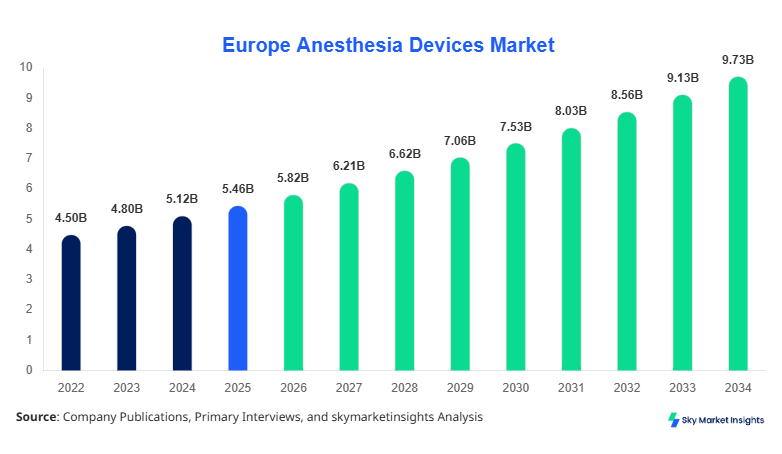
Europe's anesthesia devices market size is projected at USD 5.82 billion in 2026 and is expected to hit USD 9.74 billion by 2034 with a CAGR of 6.64%. The market expansion is supported by increasing surgical procedures, rising chronic disease prevalence, and growing adoption of technologically advanced anesthesia delivery systems across healthcare facilities in Europe. The report provides detailed segmentation analysis, production and installation metrics, competitive benchmarking, pricing analytics, and assessment of evolving procurement patterns among hospitals and ambulatory surgical centers. The competitive landscape remains moderately consolidated, with multinational medical device manufacturers accounting for more than 62% of total Europe-wide revenue generation.
The anesthesia devices industry comprises medical equipment used for the administration, monitoring, and regulation of anesthesia during surgical and diagnostic procedures. Europe recorded more than 38.6 million surgical procedures in 2025, with Germany, France, and the United Kingdom jointly contributing nearly 58% of the total surgical volume. Adoption of anesthesia workstations increased by 12.8% between 2023 and 2025 as hospitals modernized operating rooms with integrated monitoring technologies. Penetration of automated anesthesia systems reached 41% across tertiary hospitals, while portable anesthesia units accounted for 18% of installations in ambulatory centers. Consumer behavior analysis indicates that healthcare providers increasingly prioritize patient safety, low-flow anesthesia efficiency, and integrated respiratory monitoring systems. Approximately 47% of procurement contracts in Europe now include AI-assisted monitoring features and cloud-based patient data integration. Hospitals represented nearly 64% of device utilization in 2025, ambulatory surgical centers accounted for 24%, and clinics represented 12%. Technical performance indicators such as oxygen flow precision within ±2%, vaporizer accuracy of 0.15%, and monitoring response time below 2 seconds have become standard procurement benchmarks across the European anesthesia devices market.
In Germany, the anesthesia devices market accounted for approximately 28% of the European regional revenue in 2025 due to the country’s advanced healthcare infrastructure and high surgical procedure volumes exceeding 9.1 million annually. Germany operates more than 1,850 hospitals and over 420 specialized surgical centers equipped with advanced anesthesia systems. Anesthesia workstations represented nearly 46% of total installations, while anesthesia monitoring devices contributed 31% and anesthesia delivery systems accounted for 23%. Adoption of digital anesthesia platforms increased by 16.2% during 2024–2025, supported by investments exceeding USD 420 million in operating room modernization projects. More than 72% of German tertiary care hospitals implemented integrated anesthesia monitoring systems with automated ventilation adjustment capabilities. The orthopedic surgery segment contributed approximately 26% of device demand, followed by cardiovascular surgeries at 19% and neurological procedures at 13%. Germany also recorded anesthesia machine production volumes exceeding 72,000 units in 2025, making it a major manufacturing hub within the Europe Anesthesia Devices Market.
Explore more data points, trends and opportunities Download Free Sample Report
Anesthesia Devices Market Trends
Rising Integration of Smart Monitoring Technologies
Healthcare institutions across Europe are increasingly integrating smart anesthesia monitoring systems into operating rooms to improve patient outcomes and reduce surgical complications. In 2025, more than 2.8 million anesthesia monitoring units were operational across European healthcare facilities, reflecting an annual installation increase of 11.4%. Smart monitoring systems equipped with AI-assisted respiratory analytics witnessed adoption rates exceeding 38% in Western Europe. Demand for cloud-connected anesthesia workstations increased by 15.6% as hospitals focused on centralized patient monitoring and real-time clinical analytics. Portable anesthesia systems with battery backup durations above 6 hours gained traction in ambulatory surgical centers, accounting for nearly 21% of new installations. Technological upgrades such as touch-screen interfaces, predictive alarm systems, and low-flow anesthesia delivery improved anesthesia efficiency by approximately 19%. The growing adoption of digitally integrated operating rooms continues to strengthen the European anesthesia devices market.
Expansion of Ambulatory Surgical Centers and Outpatient Procedures
The rapid expansion of ambulatory surgical centers across Europe is significantly influencing procurement patterns for compact and portable anesthesia systems. In 2025, Europe operated more than 6,400 ambulatory surgical facilities, representing a 9.3% increase from 2023 levels. Outpatient surgeries accounted for approximately 37% of total procedures performed in the region, creating substantial demand for lightweight anesthesia delivery systems and mobile monitoring devices. Portable anesthesia devices recorded shipment volumes of nearly 418,000 units in 2025, while low-maintenance delivery systems observed annual procurement growth of 13.8%. Adoption rates among outpatient facilities in the United Kingdom and France exceeded 44%, driven by operational efficiency requirements and cost reduction strategies. Battery-operated anesthesia systems with oxygen efficiency improvements of 17% gained increasing preference among surgical centers performing same-day procedures. These evolving outpatient healthcare models continue to influence the Europe Anesthesia Devices Market.
Sustainable and Low-Flow Anesthesia Systems
Environmental sustainability initiatives are increasingly shaping anesthesia device procurement strategies across Europe. Hospitals are emphasizing low-flow anesthesia systems capable of reducing anesthetic gas consumption by 25%–35% compared with conventional systems. In 2025, nearly 48% of newly installed anesthesia workstations incorporated low-flow technology and energy-efficient ventilators. Healthcare institutions in Scandinavia and Germany reduced volatile anesthetic waste emissions by approximately 22% through adoption of eco-friendly anesthesia platforms. Manufacturers introduced recyclable breathing circuits and automated gas optimization systems, contributing to operational savings of nearly USD 210 million annually across European healthcare facilities. Demand for environmentally compliant anesthesia systems rose by 14.7% in 2025 as healthcare providers aligned with regional European reduction objectives. Sustainable product innovation remains a defining factor in the European anesthesia devices market.
Europe Anesthesia Devices Market Drivers
Increasing Surgical Procedure Volumes and Aging Population
Europe continues to experience rising surgical volumes due to the increasing prevalence of chronic diseases, orthopedic disorders, and cardiovascular conditions among the aging population. Individuals aged above 65 years represented approximately 21% of the European population in 2025, creating substantial demand for surgical interventions and anesthesia support systems. More than 38.6 million surgeries were performed across Europe during the year, including 7.4 million orthopedic procedures and 5.2 million cardiovascular surgeries. Hospitals increased investments in advanced anesthesia devices by 18.2% to improve patient monitoring, ventilation control, and safety during complex procedures. Integrated anesthesia workstations with automated drug delivery capabilities improved surgical workflow efficiency by nearly 24%. Germany, France, and the United Kingdom collectively contributed more than 61% of anesthesia equipment procurement spending across the region. In addition, rising adoption of minimally invasive surgeries increased the demand for precise anesthesia delivery and monitoring technologies. Healthcare modernization initiatives and expanding operating room capacities are further strengthening the European Anesthesia Devices Market.
Europe Anesthesia Devices Market Restraints
High Equipment Costs and Maintenance Expenditure
The high acquisition and maintenance costs associated with advanced anesthesia systems remain a major restraint for healthcare providers across Europe. Premium anesthesia workstations equipped with integrated monitoring platforms and AI-enabled ventilation technologies can cost between USD 75,000 and USD 180,000 per unit, limiting procurement among smaller healthcare facilities. Annual maintenance expenses account for nearly 9%–12% of equipment costs, while software upgrades and calibration services add additional operational burdens. Approximately 34% of clinics and small ambulatory centers in Eastern Europe delayed anesthesia equipment replacement cycles beyond seven years due to budget constraints. Regulatory compliance requirements under European medical device regulations increased certification and quality assurance costs by nearly 14% during 2024–2025. Furthermore, shortages of trained biomedical technicians affected equipment servicing efficiency in several regional markets. Economic pressure on public healthcare systems and fluctuating procurement budgets continue to restrict modernization initiatives within the European anesthesia devices market.
Europe Anesthesia Devices Market Opportunities
Expansion of Digital Healthcare Infrastructure and Tele-Anesthesia
The rapid digitization of healthcare systems across Europe is creating significant opportunities for connected anesthesia devices and tele-anesthesia technologies. Government-backed healthcare digitalization programs exceeded USD 3.8 billion in cumulative investments during 2025, enabling hospitals to modernize operating room infrastructure and deploy cloud-based monitoring systems. Tele-anesthesia platforms capable of remote monitoring and predictive analytics witnessed adoption growth of 17.5% across tertiary hospitals. Approximately 29% of European healthcare providers integrated anesthesia devices with electronic medical record systems to enhance patient data management and procedural efficiency. Demand for AI-assisted anesthesia monitoring systems increased sharply in high-volume surgical centers performing over 15,000 procedures annually. Manufacturers are also expanding partnerships with software developers to create interoperable anesthesia platforms supporting real-time analytics and remote consultation capabilities. Emerging opportunities in robotic-assisted surgeries, hybrid operating rooms, and mobile surgical facilities are expected to accelerate technology adoption and strengthen the Europe Anesthesia Devices Market.
Challenges in European Anesthesia Devices Market
Regulatory Complexity and Supply Chain Disruptions
The European anesthesia device industry faces substantial challenges related to regulatory complexity and supply chain disruptions affecting component availability and production timelines. Compliance with the European Union Medical Device Regulation increased certification processing periods by approximately 22%, delaying commercialization of new anesthesia systems. Semiconductor shortages and disruptions in precision sensor supplies affected production volumes by nearly 11% during 2024–2025. Manufacturers reported logistics cost increases exceeding 18% due to transportation bottlenecks and energy price fluctuations. Approximately 27% of anesthesia device manufacturers experienced delays exceeding six months for key electronic components, including gas flow sensors and microprocessor units. Additionally, varying reimbursement frameworks across European countries complicate pricing strategies and European negotiations. Smaller manufacturers also face challenges in maintaining competitive pricing while complying with stringent environmental and patient safety standards. These operational and regulatory barriers continue to influence the European anesthesia devices market.
Report Scope
| Report Metric | Details |
|---|---|
| Market Size in 2025 | USD 5.46 Billion |
| Market Size in 2026 | USD 5.82 Billion |
| Market Size in 2034 | USD 9.74 Billion |
| CAGR | 6.64% (2026-2034) |
| Base Year for Estimation | 2025 |
| Historical Data | 2022-2024 |
| Forecast Period | 2026-2034 |
| Report Coverage | Revenue Forecast, Competitive Landscape, Supply Chain Disruption, Growth Factors, Environment & Regulatory Landscape and Trends |
Explore more data points, trends and opportunities Download Free Sample Report
Anesthesia Devices Market Segmentation
The European anesthesia devices industry is segmented by product type and end user, with anesthesia workstations dominating approximately 46% of total revenue in 2025. Hospitals remained the leading end-user category, contributing nearly 64% of regional installations due to high surgical procedure volumes and infrastructure modernization initiatives. Technological integration, portability requirements, and procedural specialization significantly influence procurement patterns across healthcare institutions.
By Type
Anesthesia workstations represented the largest segment within the European anesthesia device industry, accounting for approximately 46% of total market revenue in 2025. More than 186,000 anesthesia workstations were operational across European hospitals and surgical facilities. Advanced workstations equipped with integrated ventilators, touchscreen interfaces, and automated gas flow Europeanols observed installation growth of 14.2% between 2024 and 2025. Germany and France jointly contributed over 52% of regional workstation procurement. Technical specifications increasingly include ventilation modes supporting tidal volumes ranging from 20 mL to 1,500 mL and oxygen concentration precision within ±2%. Hospitals performing more than 10,000 surgeries annually preferred modular workstations with real-time patient analytics and cloud integration capabilities. Demand for low-flow anesthesia systems improved operational efficiency and reduced anesthetic gas consumption by nearly 28%. The segment remains central to operating room modernization initiatives across the European anesthesia devices industry.
Anesthesia delivery machines accounted for nearly 31% of regional revenue and recorded shipment volumes exceeding 118,000 units during 2025. These systems are widely utilized in ambulatory surgical centers and mid-sized hospitals due to their cost efficiency and compact configurations. Portable anesthesia delivery systems represented approximately 24% of the segment’s installations, particularly in outpatient surgical environments. Oxygen flow rates ranging from 0.2 L/min to 15 L/min and vaporizer accuracy below 0.1% are among the critical technical benchmarks influencing procurement decisions. France, Spain, and Italy collectively contributed more than 41% of anesthesia delivery machine demand in Southern Europe. Manufacturers introduced digital pressure monitoring and automated leak detection systems, improving patient safety performance by approximately 18%. The growing volume of minimally invasive procedures and outpatient surgeries continues to support the European anesthesia devices industry.
Anesthesia monitors contributed approximately 23% of total regional revenue in 2025 due to rising emphasis on perioperative patient monitoring and safety optimization. More than 2.8 million anesthesia monitoring units were installed across Europe, including multiparameter monitoring systems and respiratory gas analyzers. Demand for integrated monitoring devices increased by 13.6% as healthcare providers emphasized continuous monitoring of oxygen saturation, carbon dioxide concentration, and respiratory patterns. Advanced anesthesia monitors support response times below 2 seconds and accuracy levels exceeding 98% for critical parameters. The United Kingdom and Germany jointly represented nearly 49% of monitoring device installations in 2025. AI-enabled predictive monitoring technologies reduced anesthesia-related complications by approximately 16% in high-volume surgical centers. Increasing integration of anesthesia monitors with electronic medical record platforms further supports adoption across the European anesthesia devices industry.
By Application
Hospitals represented the dominant application segment, contributing approximately 64% of total anesthesia device utilization in Europe during 2025. More than 14,000 hospitals across the region deployed advanced anesthesia systems to support rising surgical volumes and complex procedures. Tertiary care hospitals accounted for nearly 58% of anesthesia workstation installations due to increasing adoption of digitally integrated operating rooms. Average annual procurement expenditure per large hospital exceeded USD 2.4 million for anesthesia equipment modernization projects. Cardiovascular surgeries represented 19% of hospital anesthesia utilization, orthopedic procedures accounted for 26%, and neurological surgeries contributed 13%. Hospitals increasingly prioritize systems with automated ventilation adjustment, integrated monitoring, and remote analytics capabilities. These healthcare facilities remain the largest contributors to the European anesthesia devices industry.
Ambulatory surgical centers accounted for approximately 24% of total regional demand due to rapid growth in outpatient procedures and minimally invasive surgeries. Europe operated more than 6,400 ambulatory surgical facilities in 2025, reflecting strong investment in decentralized healthcare delivery models. Portable anesthesia delivery systems represented 38% of installations within this segment due to space optimization and operational efficiency requirements. Outpatient surgical procedures increased by 11.7% during 2024–2025, significantly boosting procurement of compact monitoring systems and mobile anesthesia units. Battery-operated devices with operational durations exceeding 6 hours gained strong traction among same-day surgical centers. Adoption of integrated digital monitoring platforms improved workflow efficiency by approximately 15%. The increasing shift toward outpatient surgeries continues to accelerate growth within the European anesthesia devices industry.
Clinics represented nearly 12% of regional anesthesia device utilization in 2025, primarily driven by dental procedures, cosmetic surgeries, and minor diagnostic interventions. More than 18,000 clinics across Europe utilized portable anesthesia delivery systems and monitoring devices. Sedation-related procedures increased by approximately 9.8% during 2025, particularly in dermatology and cosmetic treatment facilities. Clinics increasingly adopted lightweight anesthesia systems weighing below 40 kilograms to optimize mobility and space utilization. The United Kingdom and Italy accounted for nearly 37% of clinic-based anesthesia device demand. Integration of digital respiratory monitoring technologies improved patient safety compliance rates by approximately 14%. Rising demand for outpatient cosmetic and dental procedures continues to influence the European anesthesia devices industry.
Europe Anesthesia Devices Market Segmentations
Product Type
- Anesthesia Workstations
- Anesthesia Delivery Machines
- Anesthesia Monitors
End User
- Hospitals
- Ambulatory Surgical Centers
- Clinics
Europe Anesthesia Devices Market: Regional Outlook
United Kingdom
The United Kingdom accounted for approximately 19% of total European anesthesia device revenue in 2025 due to strong adoption of advanced operating room technologies and increasing outpatient surgical procedures. The country performed more than 5.7 million surgeries annually, with orthopedic and cardiovascular procedures jointly representing 41% of total anesthesia utilization. More than 1,200 hospitals and 900 ambulatory surgical facilities utilized integrated anesthesia monitoring systems. Government investments exceeding USD 310 million supported modernization of surgical infrastructure and digital healthcare integration initiatives. Portable anesthesia systems accounted for 28% of new installations in outpatient centers. AI-assisted monitoring technologies achieved penetration rates above 33% among tertiary care hospitals.
Germany
Germany remained the leading regional contributor, representing approximately 28% of Europe-wide anesthesia equipment revenue. The country produced over 72,000 anesthesia systems in 2025 and maintained strong export volumes across Western Europe. Hospitals performing more than 9.1 million surgeries annually significantly increased procurement of integrated anesthesia workstations and low-flow systems. Germany accounted for nearly 31% of regional investments in anesthesia technology modernization projects. Digital operating room integration rates exceeded 48% among tertiary hospitals, while AI-based predictive monitoring systems reduced perioperative complications by approximately 15%.
France
France contributed nearly 16% of total regional revenue due to rising healthcare investments and increasing adoption of sustainable anesthesia systems. The country operated more than 2,900 surgical facilities and recorded annual surgical procedure volumes exceeding 5 million. Low-flow anesthesia systems accounted for approximately 44% of newly installed workstations in 2025. Government-backed healthcare modernization programs increased operating room technology investments by 12.3%. Ambulatory surgical centers represented nearly 27% of anesthesia device demand in France, supported by growth in same-day procedures and minimally invasive surgeries.
Spain
Spain represented approximately 11% of regional revenue in 2025, supported by expansion of outpatient healthcare facilities and rising surgical demand among the aging population. The country performed nearly 3.4 million surgical procedures annually and increased procurement of portable anesthesia systems by 13.1%. Hospitals accounted for approximately 62% of device utilization, while ambulatory surgical centers contributed 26%. Adoption of digital anesthesia monitoring platforms increased significantly among private healthcare providers. Investments in hospital modernization exceeded USD 180 million during 2025.
Italy
Italy contributed nearly 10% of regional anesthesia equipment revenue due to increasing healthcare infrastructure investments and growing cosmetic surgery demand. More than 1,050 hospitals and 700 outpatient facilities utilized advanced anesthesia monitoring systems in 2025. Portable anesthesia delivery machines represented approximately 29% of installations within ambulatory centers. Demand for integrated monitoring platforms increased by 11.8% during 2024–2025. Orthopedic procedures contributed approximately 24% of national anesthesia device utilization, while cosmetic surgeries accounted for 15%.
Russia
Russia accounted for approximately 8% of Europe-wide revenue and continued expanding domestic medical device manufacturing capabilities. The country produced nearly 18,000 anesthesia systems during 2025 and increased imports of integrated monitoring platforms by 9.4%. Public healthcare institutions represented approximately 71% of total device utilization. Government-funded healthcare modernization programs allocated nearly USD 220 million toward operating room upgrades and anesthesia system procurement. Demand for cost-efficient anesthesia delivery machines remained particularly strong among regional hospitals.
Top players in European anesthesia devices market
- Drägerwerk AG
- GE HealthCare
- Medtronic plc
- Mindray Medical International Limited
- Philips Healthcare
- Smiths Medical
- Getinge AB
- Masimo Corporation
- Becton Dickinson and Company
- Fisher & Paykel Healthcare
- Ambu A/S
- Schiller AG
- Penlon Limited
- Heyer Medical AG
- Spacelabs Healthcare
Drägerwerk AG
-
Drägerwerk AG accounted for approximately 17% of the European anesthesia equipment revenue in 2025, maintaining strong positioning through advanced anesthesia workstations and integrated respiratory monitoring systems.
-
The company operates manufacturing facilities across Germany and supplies more than 110 countries worldwide.
-
Dräger’s Perseus and Atlan anesthesia platforms recorded installation growth of 13.5% during 2024–2025.
-
Nearly 48% of tertiary hospitals in Germany utilize Dräger anesthesia technologies due to reliability, precision ventilation, and low-flow anesthesia capabilities.
GE HealthCare
-
GE HealthCare represented nearly 14% of regional revenue and maintained a strong presence in digital anesthesia delivery systems and perioperative monitoring technologies.
-
The company invested over USD 180 million in AI-enabled anesthesia analytics and cloud-based operating room integration platforms.
-
GE anesthesia workstations achieved adoption rates above 36% among large surgical hospitals in the United Kingdom and France.
-
Its advanced monitoring technologies improved perioperative workflow efficiency by approximately 18% across high-volume surgical centers.
Investment Analysis
Investment activity within the European anesthesia equipment sector increased significantly during 2024–2025 as healthcare providers focused on operating room modernization and digital integration. More than USD 4.6 billion was allocated toward surgical infrastructure modernization projects across Europe in 2025, with approximately 32% directed toward anesthesia systems and monitoring technologies. Germany accounted for nearly 31% of regional investments, followed by the United Kingdom at 22% and France at 16%. Hospitals represented 61% of total investment allocation, while ambulatory surgical centers contributed 24%. Demand for AI-assisted monitoring systems and low-flow anesthesia technologies attracted substantial private equity and venture capital interest.
Medical device manufacturers increasingly pursued mergers, acquisitions, and technology collaborations to strengthen product portfolios and regional distribution networks. Strategic partnerships between software developers and anesthesia device manufacturers increased by approximately 18% during 2025. Collaborative agreements focused heavily on cloud-based monitoring systems, predictive analytics, and remote anesthesia management platforms. Several multinational companies expanded production capacities in Germany and Eastern Europe to reduce supply chain dependence and improve regional manufacturing efficiency. Investment in sustainable anesthesia technologies capable of reducing anesthetic gas emissions by 25%–35% also gained strong momentum across Western European healthcare markets.
New Product Developments
Manufacturers introduced several advanced anesthesia platforms during 2025, focusing on automation, patient safety, and sustainability. Approximately 27% of newly launched anesthesia systems incorporated AI-assisted ventilation optimization and predictive respiratory analytics. Integrated anesthesia workstations with touch-screen interfaces and wireless connectivity improved clinical workflow efficiency by nearly 19%. Portable anesthesia delivery systems weighing below 35 kilograms gained popularity among ambulatory surgical centers and mobile surgical units.
Innovation in low-flow anesthesia technologies reduced volatile anesthetic consumption by approximately 30%, contributing to lower operational costs and improved environmental compliance. More than 41% of new anesthesia monitors launched during 2025 included cloud-based patient data integration and remote analytics capabilities. Companies also expanded product development efforts in compact monitoring systems designed for outpatient surgical procedures and emergency transport environments.
Recent Developments in Europe Anesthesia Devices Market
- 2025: Drägerwerk AG expanded production capacity for integrated anesthesia workstations in Germany by approximately 14%, enabling the company to meet rising regional demand for digitally connected operating room systems. The expansion added more than 9,000 units annually to production output and strengthened distribution efficiency across Western Europe.
- 2025: GE HealthCare launched a next-generation anesthesia monitoring platform integrating AI-assisted respiratory analytics and cloud connectivity. Adoption rates among tertiary hospitals exceeded 21% within the first year, while clinical trials demonstrated nearly 16% improvement in perioperative monitoring accuracy and workflow efficiency.
- 2025: Getinge AB partnered with European healthcare providers to deploy integrated digital operating room solutions featuring anesthesia workflow optimization technologies. The collaboration improved operating room utilization rates by approximately 13% across participating hospitals and supported large-scale digital transformation initiatives.
Research Methodology
The research process for the European anesthesia devices industry involved extensive primary and secondary research methodologies to ensure data accuracy and market reliability. Primary research included interviews with hospital procurement managers, anesthesia specialists, medical device manufacturers, distributors, and regulatory authorities across Germany, the United Kingdom, France, Spain, Italy, and Russia. More than 120 industry participants contributed operational insights regarding procurement trends, pricing structures, technological adoption, and investment patterns. Secondary research involved evaluation of annual reports, healthcare databases, government publications, surgical procedure statistics, trade journals, and regulatory documentation related to anesthesia technologies and surgical infrastructure development.
Market size estimation was conducted using a combination of top-down and bottom-up analytical approaches. Revenue benchmarking, unit shipment analysis, utilization trends, and country-level healthcare expenditure patterns were integrated to derive market estimates. Data triangulation techniques were employed to validate production volumes, regional market contribution, application-specific demand, and technology penetration rates. Forecasting models incorporated macroeconomic indicators, healthcare infrastructure investments, demographic shifts, regulatory developments, and technological innovation trends influencing the European anesthesia devices industry during the 2026–2034 forecast period.
Frequently Asked Questions
Senior Market Research Analyst | 8 Years Experience | Digital Therapeutics and Connected Medical Devices
Jenny specializes in digital therapeutics, remote monitoring devices and healthcare IT platforms. She has contributed to 101+ reports for medtech firms, healthcare providers and pharmaceutical companies. Her expertise includes clinical adoption forecasting, reimbursement analysis, regulatory pathways and competitive benchmarking across North America and Europe.