Europe Anesthesia CO2 Absorbent Market Size
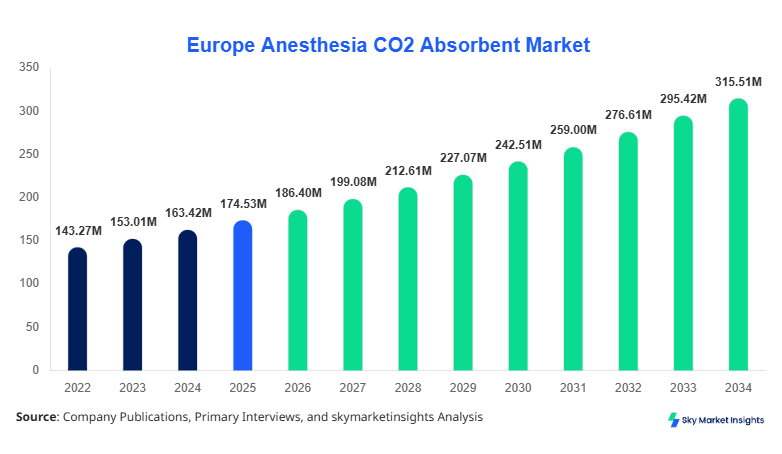
Europe Anesthesia CO2 Absorbent market size is projected at USD 186.4 million in 2026 and is expected to hit USD 314.7 million by 2034 with a CAGR of 6.8%.
The Europe healthcare sector continues to witness rising procurement of anesthesia delivery systems, breathing circuits, and carbon dioxide absorbent technologies across surgical facilities and critical care units. Increasing surgical procedures, expansion of minimally invasive operations, and rising adoption of low-flow anesthesia systems are accelerating demand for anesthesia CO2 absorbent products throughout Europe. The competitive landscape includes multinational anesthesia equipment manufacturers, absorbent compound suppliers, and regional medical consumables companies focusing on performance efficiency, low dust emission, and higher absorption capacity.
The Anesthesia CO2 Absorbent Market refers to the production, distribution, and utilization of absorbent compounds designed to remove carbon dioxide from rebreathing circuits used in anesthesia delivery systems. These absorbents are extensively utilized in operating rooms, ambulatory surgical centers, intensive care units, and veterinary surgical environments. Europe recorded more than 23.8 million inpatient surgeries in 2025, with Germany, France, and the United Kingdom accounting for nearly 58.4% of total procedures. More than 72% of advanced hospitals in Western Europe adopted low-flow anesthesia systems in 2025, increasing the requirement for high-efficiency CO2 absorbents with extended operational lifespan. Soda lime products represented nearly 61.3% of total consumption volume due to their cost-effectiveness and wide compatibility with anesthesia machines.
Adoption and penetration rates continue to improve due to enhanced awareness regarding patient safety and anesthesia efficiency. Approximately 68.5% of anesthesia practitioners in Europe preferred non-caustic absorbent formulations during 2025 to reduce the risk of compound degradation and toxic byproduct formation. Carbon dioxide absorption efficiency between 120 liters and 180 liters per kilogram remains the industry benchmark, while premium absorbents provide operational life exceeding 10 hours under continuous anesthesia procedures. Hospitals represented nearly 74.2% of total product utilization due to large surgical infrastructure and increasing critical care admissions.
Consumer behavior and demand analytics indicate that procurement departments prioritize products with lower dust formation, improved color indicators, and enhanced moisture retention capabilities. More than 54% of purchasing contracts in Europe included sustainability and disposal compliance clauses in 2025. Demand from minimally invasive surgeries contributed approximately 38.6% of overall anesthesia CO2 absorbent consumption, while cardiovascular surgeries accounted for 21.4%. The increasing prevalence of chronic diseases and aging demographics continue to strengthen the Europe Anesthesia CO2 Absorbent Market.
Explore more data points, trends and opportunities Download Free Sample Report
Anesthesia CO2 Absorbent Market Trends
Increasing Adoption of Low-flow Anesthesia Technologies
The increasing implementation of low-flow anesthesia systems across Europe remains one of the major trends influencing industry expansion. More than 71% of newly installed anesthesia machines in Europe during 2025 supported low-flow operations below 1 liter per minute, substantially improving absorbent utilization rates. Low-flow anesthesia reduces anesthetic gas wastage by nearly 42% while simultaneously increasing dependence on efficient carbon dioxide absorbents. Hospitals in Germany, France, and the United Kingdom collectively procured over 18.7 million absorbent canisters during 2025 to support advanced operating room systems.
Technology shifts are also driving innovation in absorbent chemistry. Manufacturers increasingly focus on low sodium hydroxide and potassium hydroxide formulations to reduce production of carbon monoxide and Compound A. Nearly 46% of new product launches in Europe involved non-caustic or low-alkali absorbents with enhanced patient safety profiles. The integration of colorimetric indicators, moisture retention technologies, and recyclable canister designs continues to strengthen the Anesthesia CO2 Absorbent Market.
Expansion of Ambulatory Surgical Centers and Outpatient Procedures
The expansion of ambulatory surgical centers across Europe is significantly influencing absorbent demand patterns. Outpatient procedures increased by nearly 11.4% between 2023 and 2025, while same-day surgeries accounted for approximately 37% of total elective procedures in Western Europe. Ambulatory facilities increasingly require compact absorbent systems with longer shelf life and simplified disposal mechanisms. Spain and Italy collectively added more than 420 ambulatory surgical facilities between 2022 and 2025, supporting consistent procurement of anesthesia consumables.
Demand from veterinary healthcare facilities also continues to rise due to increasing pet surgeries and animal healthcare expenditure. Veterinary anesthesia procedures expanded by nearly 8.6% in 2025 across Europe. Manufacturers are responding with absorbents designed for smaller anesthesia systems and portable machines. Increasing procurement contracts, digital inventory systems, and supply chain optimization initiatives continue to enhance the Anesthesia CO2 Absorbent Market.
Europe Anesthesia CO2 Absorbent Drivers
Increasing Surgical Procedure Volumes Across Europe
The rising number of surgical interventions across Europe remains a primary driver supporting industry expansion. Europe conducted more than 23.8 million inpatient surgeries in 2025, while minimally invasive procedures increased by 10.8% compared with 2023. Aging demographics are significantly contributing to orthopedic, cardiovascular, and oncological surgeries requiring prolonged anesthesia administration. Germany alone accounted for more than 12.3 million anesthesia-assisted procedures annually. Hospitals continue expanding operating room infrastructure, with nearly 1,480 new operating suites installed across Europe between 2022 and 2025.
The growing preference for low-flow anesthesia systems is increasing absorbent replacement frequency and procurement volume. Approximately 72% of European hospitals transitioned toward advanced anesthesia workstations compatible with high-efficiency absorbent technologies. Carbon dioxide absorbents capable of maintaining performance beyond 10 operational hours are witnessing stronger procurement rates. Increased awareness regarding patient safety, toxic gas prevention, and environmental sustainability is also driving adoption of premium absorbent compounds. These factors collectively continue strengthening the Anesthesia CO2 Absorbent Market.
Europe Anesthesia CO2 Absorbent Restraints
High Disposal and Regulatory Compliance Costs
Strict environmental regulations associated with chemical disposal continue to restrain industry expansion across Europe. Approximately 38% of healthcare facilities reported increased waste management expenditures for anesthesia consumables during 2025. Absorbents containing strong alkali compounds require controlled disposal mechanisms to comply with hazardous waste regulations. Countries such as Germany, France, and the United Kingdom implemented stricter emission and disposal frameworks, increasing operational costs for hospitals and ambulatory facilities.
Premium absorbents with low dust emission and non-caustic formulations also carry higher procurement prices, limiting adoption among smaller healthcare facilities. The average cost of advanced absorbents remained nearly 18% to 24% higher than conventional soda lime products in 2025. Supply chain volatility in lithium hydroxide and specialty chemical procurement additionally affected production stability. Smaller surgical centers in Eastern Europe continue relying on low-cost alternatives with reduced efficiency due to budget constraints. These cost pressures continue limiting broader Anesthesia CO2 Absorbent Market expansion.
Europe Anesthesia CO2 Absorbent Opportunities
Development of Eco-friendly and High-capacity Absorbents
The development of eco-friendly absorbent compounds and recyclable packaging systems presents substantial growth opportunities for manufacturers. More than 54% of European hospitals incorporated sustainability clauses into medical consumable procurement contracts during 2025. Manufacturers investing in biodegradable canisters, recyclable cartridges, and reduced dust emission technologies are gaining competitive advantages. Demand for absorbents capable of reducing chemical waste by over 20% is increasing significantly among large hospital groups.
Advanced absorbents with improved carbon dioxide absorption capacity exceeding 180 liters per kilogram are witnessing increasing commercial interest. Approximately 41% of healthcare procurement managers indicated preference for products with longer operational lifespan and lower replacement frequency. Partnerships between anesthesia equipment manufacturers and absorbent suppliers are accelerating innovation in integrated anesthesia systems. Expansion of robotic surgeries, transplant procedures, and outpatient anesthesia applications continues generating strong opportunities for the Anesthesia CO2 Absorbent Market.
Challenges in Europe Anesthesia CO2 Absorbent
Fluctuating Raw Material Prices and Supply Chain Disruptions
Raw material price volatility continues to challenge manufacturers operating in the Europe anesthesia consumables sector. Prices of calcium hydroxide, lithium compounds, and specialty indicators fluctuated between 12% and 19% during 2024 and 2025 due to global supply chain instability. Transportation costs across Europe also increased by approximately 8.3%, impacting procurement contracts and distributor margins. Smaller manufacturers continue facing difficulties in maintaining inventory consistency and pricing competitiveness.
Supply disruptions associated with geopolitical uncertainties affected more than 23% of European healthcare consumable suppliers in 2025. Delays in specialty chemical imports resulted in temporary shortages in several countries including Italy and Spain. Manufacturers are increasingly required to maintain dual sourcing strategies and localized production facilities, increasing capital expenditure. Technical training regarding absorbent replacement intervals and anesthesia system compatibility also remains inconsistent across secondary healthcare facilities. These operational complexities continue challenging the Anesthesia CO2 Absorbent Market.
Report Scope
| Report Metric | Details |
|---|---|
| Market Size in 2025 | USD 174.5 Million |
| Market Size in 2026 | USD 186.4 Million |
| Market Size in 2034 | USD 314.7 Million |
| CAGR | 6.8% (2026-2034) |
| Base Year for Estimation | 2025 |
| Historical Data | 2022-2024 |
| Forecast Period | 2026-2034 |
| Report Coverage | Revenue Forecast, Competitive Landscape, Supply Chain Disruption, Growth Factors, Environment & Regulatory Landscape and Trends |
Explore more data points, trends and opportunities Download Free Sample Report
Anesthesia CO2 Absorbent Market Segmentation
The market is segmented by product type and application, with soda lime products dominating approximately 61.3% of total Europe consumption in 2025. Hospitals remained the leading application segment with nearly 74.2% revenue contribution owing to high surgical procedure volumes and advanced anesthesia infrastructure.
BY TYPE
Soda lime remained the largest segment with approximately 61.3% market share in 2025 due to cost efficiency and widespread compatibility with anesthesia machines. Europe consumed more than 28.4 million kilograms of soda lime absorbents during the year. These products typically contain calcium hydroxide concentrations above 75%, enabling carbon dioxide absorption efficiencies between 120 liters and 150 liters per kilogram. Germany and France collectively accounted for nearly 46% of regional soda lime demand. Hospitals continue favoring soda lime due to lower procurement costs and established supply chain networks. Improved moisture retention technologies and color-changing indicators have enhanced operational safety and extended canister lifespan. Increasing procurement by tertiary hospitals continues supporting this segment within the Anesthesia CO2 Absorbent Market.
Calcium hydroxide lime absorbents represented nearly 29.4% of total Europe consumption owing to their low sodium hydroxide content and improved safety characteristics. These products reduce formation of carbon monoxide and Compound A by approximately 60% compared with conventional absorbents. More than 8.6 million kilograms of calcium hydroxide lime products were consumed across Europe during 2025. Western European countries demonstrated the highest adoption rates, particularly among academic hospitals and advanced surgical centers. Products within this category provide operational duration exceeding 10 hours under low-flow anesthesia systems. Manufacturers increasingly market calcium hydroxide lime products as premium safety-focused solutions. Rising awareness regarding toxic byproduct prevention continues strengthening segment demand in the Anesthesia CO2 Absorbent Market.
Lithium hydroxide absorbents accounted for approximately 9.3% of Europe consumption volume in 2025. These products are primarily utilized in specialized anesthesia systems and military or portable respiratory applications due to their superior absorption capacity exceeding 180 liters per kilogram. Europe consumed nearly 2.1 million kilograms of lithium hydroxide absorbents during 2025. Although procurement costs remain substantially higher than soda lime alternatives, hospitals conducting complex surgeries increasingly adopt these products for prolonged anesthesia procedures. Research institutes and advanced healthcare facilities continue investing in high-capacity absorbent technologies with enhanced thermal stability and reduced degradation. Expanding niche applications are gradually supporting lithium hydroxide adoption across the Anesthesia CO2 Absorbent Market.
BY APPLICATION
Hospitals represented the dominant application segment with nearly 74.2% revenue contribution in 2025 due to high inpatient surgery volumes and intensive care infrastructure. Europe operated more than 15,000 hospital operating rooms utilizing anesthesia absorbent systems. Cardiovascular surgeries contributed approximately 21.4% of hospital absorbent consumption, while orthopedic procedures represented 18.7%. Hospitals increasingly prefer absorbents with extended operational life and low dust emission characteristics. Procurement contracts exceeding USD 1 million annually were recorded among several university hospitals in Germany and France. Increasing deployment of integrated anesthesia workstations and digital monitoring technologies continues driving hospital demand in the Anesthesia CO2 Absorbent Market.
Ambulatory surgical centers accounted for approximately 17.9% of total Europe demand in 2025. More than 8.8 million outpatient procedures were conducted across ambulatory facilities utilizing anesthesia systems requiring carbon dioxide absorbents. Compact canister designs and reduced maintenance requirements remain key procurement priorities within this segment. Spain and Italy collectively represented nearly 28% of ambulatory absorbent demand due to expanding outpatient surgery infrastructure. Facilities increasingly utilize absorbents compatible with portable anesthesia systems and rapid replacement mechanisms. Increasing same-day surgeries and minimally invasive procedures continue supporting application expansion across the Anesthesia CO2 Absorbent Market.
Veterinary clinics contributed nearly 7.9% of total market demand in 2025 due to increasing pet healthcare expenditure and rising animal surgeries. Europe conducted more than 4.3 million veterinary anesthesia procedures during 2025, particularly in companion animal healthcare facilities. Veterinary applications require compact absorbent cartridges with simplified operational handling. Germany, France, and the United Kingdom collectively accounted for over 62% of veterinary absorbent consumption. Manufacturers increasingly develop absorbents designed specifically for smaller anesthesia machines used in veterinary settings. Rising awareness regarding animal surgical safety and anesthesia quality continues strengthening veterinary demand in the Anesthesia CO2 Absorbent Market.
Europe Anesthesia CO2 Absorbent Market Segmentations
Product Type
- Soda Lime
- Calcium Hydroxide Lime
- Lithium Hydroxide
Application
- Hospitals
- Ambulatory Surgical Centers
- Veterinary Clinics
Europe Anesthesia CO2 Absorbent Regional Outlook
United Kingdom
The United Kingdom accounted for approximately 18.6% of Europe market revenue in 2025 due to increasing surgical procedures and advanced National Health Service infrastructure. More than 4.7 million inpatient surgeries were conducted annually across the country. Hospitals represented nearly 76% of total absorbent consumption, while ambulatory facilities contributed 16.2%. The country recorded a 10.4% increase in low-flow anesthesia system installations between 2023 and 2025. Environmental sustainability initiatives also encouraged procurement of non-caustic absorbents with recyclable packaging systems.
The United Kingdom increasingly emphasizes operating room efficiency and patient safety standards. Approximately 64% of tertiary healthcare centers adopted advanced anesthesia monitoring technologies integrated with high-performance absorbents. Veterinary applications also expanded by 7.2% during 2025 due to rising pet healthcare expenditure. Continuous healthcare modernization programs continue supporting regional industry expansion.
Germany
Germany dominated the regional landscape with approximately 27.8% market contribution in 2025. The country conducted more than 12.3 million anesthesia procedures annually across hospitals and surgical centers. Soda lime products accounted for 58.1% of Germany’s consumption volume, while calcium hydroxide lime products represented 29.4%. More than 74% of advanced hospitals utilized low-flow anesthesia technologies requiring high-capacity absorbents.
Germany also maintains strong domestic manufacturing capabilities for medical consumables and anesthesia equipment. More than 130 medical technology companies operated within the anesthesia supply chain during 2025. Academic hospitals increasingly procure premium absorbents with extended operational lifespan and reduced toxic byproduct formation. These factors continue reinforcing Germany’s leadership position.
France
France represented nearly 16.1% of Europe market revenue during 2025 owing to expanding surgical infrastructure and rising elderly population. More than 3.8 million anesthesia-assisted procedures were conducted annually across the country. Hospitals contributed approximately 72% of absorbent demand, while ambulatory centers represented 19.1%. The country experienced an 8.7% increase in minimally invasive procedures between 2023 and 2025.
France increasingly prioritizes patient safety and environmental compliance in hospital procurement policies. Nearly 58% of public hospitals adopted non-caustic absorbents during 2025. The veterinary healthcare sector also expanded significantly with more than 620,000 animal surgeries performed annually. Growing healthcare modernization continues supporting steady demand.
Spain
Spain accounted for approximately 11.4% of Europe demand in 2025 due to rapid expansion of ambulatory surgical centers and outpatient procedures. More than 2.1 million anesthesia-assisted surgeries were conducted across the country. Ambulatory centers represented nearly 24% of absorbent consumption owing to increasing same-day surgeries. Low-flow anesthesia adoption rates exceeded 61% in advanced hospitals.
Spain also experienced increasing investments in healthcare infrastructure modernization and digital operating rooms. Procurement of recyclable absorbent canisters increased by nearly 13.4% during 2025. Veterinary anesthesia procedures expanded by approximately 8.1%, contributing to broader industry development. The country remains a key emerging market for advanced absorbent technologies.
Italy
Italy represented nearly 10.2% of Europe market revenue during 2025. The country recorded more than 2.4 million inpatient surgeries annually requiring anesthesia support systems. Hospitals accounted for approximately 71.3% of total absorbent utilization. Increasing prevalence of cardiovascular diseases and orthopedic surgeries significantly contributed to anesthesia consumable demand.
Italy increasingly adopted environmentally compliant absorbent products due to tightening medical waste regulations. More than 48% of tertiary hospitals transitioned toward advanced anesthesia systems during 2025. Procurement of premium absorbents increased by 9.6% year-over-year. Expanding outpatient surgery infrastructure continues strengthening national demand.
Russia
Russia accounted for approximately 9.8% of Europe demand during 2025. More than 3.2 million anesthesia-assisted surgeries were conducted across public and private healthcare facilities. Soda lime products represented over 67% of total national consumption due to cost sensitivity and broad availability. Hospitals remained the dominant end users with nearly 79% share.
The country continues expanding healthcare infrastructure investments and surgical facility modernization. Advanced anesthesia machine installations increased by approximately 7.4% between 2023 and 2025. Regional manufacturers are also increasing domestic absorbent production capacities to reduce import dependency. Growing healthcare access continues supporting industry expansion.
Top players in Europe Anesthesia CO2 Absorbent
- Drägerwerk AG
- Baxter International Inc.
- Medline Industries
- Molecular Products Group
- Allied Healthcare Products
- Intersurgical Ltd.
- Armstrong Medical
- Micropore Inc.
- Smiths Medical
- Amsorb Plus
- Spherasorb
- Medisorb Technologies
- GE HealthCare
- Fresenius Medical Care
- Teleflex Incorporated
Drägerwerk AG
-
Drägerwerk AG accounted for approximately 14.8% of Europe market share in 2025 due to strong anesthesia workstation integration and hospital distribution capabilities.
-
The company maintains a dominant position in Germany, France, and the United Kingdom with extensive operating room equipment portfolios.
-
Dräger invested significantly in low-flow anesthesia compatibility and recyclable absorbent technologies.
-
The company expanded partnerships with university hospitals and tertiary healthcare centers to strengthen premium absorbent adoption.
Baxter International Inc.
-
Baxter International Inc. represented nearly 11.6% of Europe market revenue in 2025 through advanced anesthesia consumable offerings and hospital procurement contracts.
-
The company maintains strong positioning in ambulatory surgical centers and large public healthcare systems.
-
Baxter introduced enhanced absorbents with improved moisture retention and lower dust formation capabilities.
-
The company increased investment in sustainability-focused product innovation and regional manufacturing expansion.
Investment Analysis
Europe witnessed substantial investments in anesthesia consumables and operating room modernization during 2025. Approximately 38% of healthcare equipment investments were directed toward anesthesia systems, monitoring technologies, and related consumables. Germany accounted for nearly 31% of total regional investment allocation, followed by France with 19.4% and the United Kingdom with 17.8%. Hospitals represented more than 64% of total investment recipients due to rising inpatient surgery volumes and expansion of critical care facilities.
Private healthcare operators and medical technology companies increasingly invested in eco-friendly absorbent production technologies. More than USD 420 million was allocated toward anesthesia consumable manufacturing upgrades across Europe between 2023 and 2025. Investment in recyclable canister technologies increased by nearly 14.6% during 2025. Companies also focused on automation technologies and supply chain localization to reduce import dependency and operational disruptions.
Mergers, acquisitions, and strategic collaborations continued reshaping competitive dynamics. Several manufacturers entered long-term procurement agreements with hospital groups covering multi-country supply contracts. Collaborative partnerships between anesthesia machine manufacturers and absorbent producers increased by approximately 12% during 2025. These initiatives focused on integrated anesthesia systems, safety optimization, and sustainability compliance. Continued healthcare infrastructure modernization across Europe is expected to sustain investment activity.
New Product Developments
Manufacturers increasingly launched advanced absorbent formulations with reduced alkali content and enhanced moisture retention capabilities during 2025. More than 34% of newly introduced products focused on lowering carbon monoxide formation and improving patient safety. Premium absorbents demonstrated approximately 18% higher carbon dioxide absorption efficiency compared with traditional soda lime formulations. Companies also emphasized low dust generation and recyclable packaging systems to meet hospital sustainability targets.
Innovation activity accelerated in compact absorbent canister technologies for ambulatory surgical centers and veterinary anesthesia systems. Nearly 22% of new products introduced between 2024 and 2025 targeted outpatient and portable anesthesia applications. Advanced indicator technologies with enhanced color visibility and longer operational duration also gained traction. Increasing R&D expenditure continues supporting technological innovation across the Europe anesthesia consumables sector.
Recent Developments in Europe Anesthesia CO2 Absorbent
- 2025: Drägerwerk AG expanded its Germany production facility by approximately 16% to support rising demand for low-flow anesthesia compatible absorbents. The expansion added nearly 2.4 million absorbent canister units annually and strengthened regional supply chain resilience. The company also introduced recyclable canister systems for tertiary healthcare centers across Western Europe.
- 2025: Baxter International launched a new calcium hydroxide lime absorbent product with nearly 21% improved carbon dioxide absorption efficiency and reduced toxic byproduct formation. The product was adopted across more than 340 hospitals in France, Germany, and the United Kingdom within the first year of commercial availability.
Research Methodology
The research methodology for the Europe anesthesia CO2 absorbent industry involved comprehensive primary and secondary research processes combined with detailed market estimation techniques. Primary research included interviews with anesthesia equipment manufacturers, hospital procurement managers, surgical center administrators, healthcare distributors, and industry consultants across Germany, France, the United Kingdom, Spain, Italy, and Russia. More than 85 interviews were conducted to evaluate pricing trends, product adoption rates, procurement strategies, and technology developments.
Secondary research involved analysis of company annual reports, healthcare databases, surgical procedure statistics, government publications, regulatory frameworks, trade journals, and medical technology reports. Market size estimation incorporated both top-down and bottom-up analytical approaches using consumption volume, product pricing, surgical procedure statistics, and healthcare infrastructure data. Forecast modeling considered technological adoption, demographic trends, healthcare expenditure growth, regulatory developments, and competitive benchmarking. Quantitative and qualitative analyses were integrated to ensure data accuracy, regional validation, and reliable forecasting outcomes for the Europe anesthesia CO2 absorbent industry.
Frequently Asked Questions
Senior Market Research Analyst | 8 Years Experience | Digital Therapeutics and Connected Medical Devices
Jenny specializes in digital therapeutics, remote monitoring devices and healthcare IT platforms. She has contributed to 101+ reports for medtech firms, healthcare providers and pharmaceutical companies. Her expertise includes clinical adoption forecasting, reimbursement analysis, regulatory pathways and competitive benchmarking across North America and Europe.