Europe Anemia And Vitamin Test Market Size
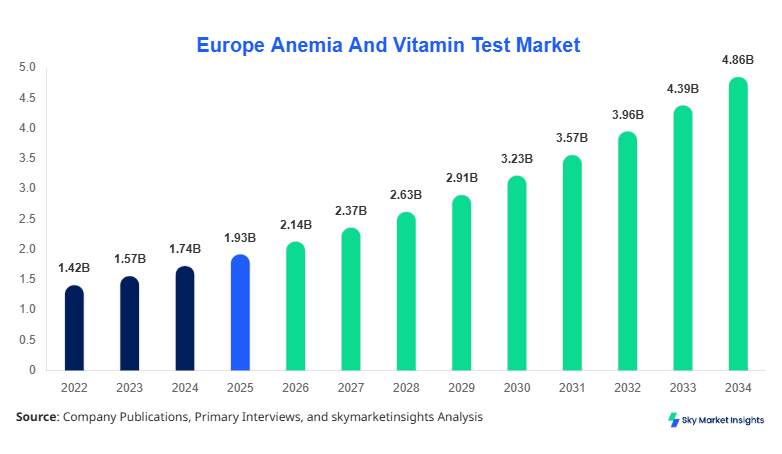
The European anemia and vitamin test market size is projected at USD 2.14 billion in 2026 and is expected to hit USD 4.87 billion by 2034 with a CAGR of 10.8%. The increasing prevalence of iron deficiency anemia, vitamin B12 deficiency, and chronic disease-related anemia across Europe is accelerating demand for diagnostic screening systems and laboratory testing solutions. The market is witnessing substantial expansion due to rising healthcare expenditure, improved laboratory infrastructure, and increased adoption of automated hematology analyzers across hospitals and diagnostic laboratories. Competitive benchmarking, technological innovation, and extensive segmentation by test type, end-user, and country are shaping the evolving industry landscape across the European anemia and vitamin test market.
The European anemia and vitamin test market refers to diagnostic products and laboratory solutions used for detecting anemia, vitamin deficiencies, and related hematological disorders. The market includes complete blood count testing, ferritin testing, transferrin saturation testing, folate analysis, and vitamin B12 screening conducted through centralized laboratories, hospitals, and point-of-care systems. Europe produced more than 198 million anemia and vitamin diagnostic test kits in 2025, with Germany, France, and the United Kingdom accounting for nearly 61% of regional production. Hospital-based laboratories contributed approximately 46% of total testing volumes, while independent diagnostic laboratories represented 39% of procedures conducted across Europe.
Adoption and penetration of anemia and vitamin testing systems continue to rise due to preventive healthcare awareness and aging demographics. Nearly 32% of women between 18 and 45 years in Europe underwent iron deficiency screening in 2025, while geriatric population screening increased by 18% compared with 2023. Automated hematology systems achieved penetration rates above 67% in tertiary hospitals, and digital diagnostic integration reached 54% adoption among laboratory networks. Consumer behavior indicates growing preference for preventive diagnostic screening, with at-home vitamin deficiency test demand increasing by 26% during 2025. Hospitals remain the leading application segment with 48% share, followed by diagnostic laboratories at 37% and home care settings at 15%. High-frequency blood analyzers capable of processing over 120 samples per hour are becoming standard in metropolitan laboratory facilities, reinforcing the European anemia and vitamin test market expansion.
In France, the anemia and vitamin test market recorded strong expansion due to increasing healthcare diagnostics spending and higher awareness regarding nutritional deficiencies. France accounted for nearly 19% of the European anemia and vitamin test market revenue in 2025, supported by more than 2,700 diagnostic laboratories and over 1,450 hospital facilities conducting hematology testing. Approximately 44 million anemia-related diagnostic procedures were conducted in France during 2025, with ferritin testing accounting for 31% of all procedures. Vitamin B12 testing represented nearly 18% of total diagnostic volume, while complete blood count testing dominated with 41% share.
Technology adoption rates in France remain among the highest in Europe, with automated analyzers deployed across 72% of tertiary healthcare institutions and AI-assisted laboratory reporting integrated into 38% of diagnostic chains. Public healthcare reimbursement programs increased preventive screening volumes by 22% between 2023 and 2025. Point-of-care diagnostic solutions achieved 16% penetration across home healthcare settings, while digital pathology connectivity expanded by 28% year-over-year. Rising geriatric population, increasing pregnancy-related anemia monitoring, and expanding wellness testing are supporting Europe's anemia and vitamin test market demand.
Explore more data points, trends and opportunities Download Free Sample Report
Anemia And Vitamin Test Market Trends
Rising Adoption of Automated Hematology Diagnostics
The European anemia and vitamin test market is witnessing rapid adoption of automated hematology diagnostics and high-throughput analyzers. In 2025, more than 64% of large-scale laboratories across Europe integrated fully automated blood analysis systems capable of processing between 100 and 150 samples per hour. Diagnostic facilities invested over USD 610 million in AI-enabled laboratory technologies and digital reporting systems. Automation reduced sample processing time by 36% and improved testing accuracy rates above 95%. Demand for integrated ferritin and vitamin B12 analyzers increased by 24% during 2025 due to the rising incidence of nutritional disorders and chronic anemia conditions. Countries such as Germany and France collectively installed over 8,000 advanced hematology systems in hospital laboratories, supporting Europe's anemia and vitamin test market growth.
Expansion of Preventive and Home-Based Testing
Preventive healthcare and wellness diagnostics are significantly transforming the European anemia and vitamin test market. Home-based anemia and vitamin testing kits exceeded 21 million unit shipments across Europe during 2025, reflecting 27% annual growth. Approximately 43% of urban consumers preferred preventive nutritional deficiency screening at least once annually. Digital healthcare platforms integrated remote diagnostic consultation services with home test kits, increasing consumer engagement by 31%. Subscription-based health monitoring services expanded across the United Kingdom, France, and Germany. Anemia and vitamin test consumers utilized periodic micronutrient screening packages. Vitamin D and vitamin B12 combined testing represented over 34% of preventive screening procedures. Growing consumer awareness and healthcare digitization continue to strengthen Europe's anemia and vitamin test market demand.
Integration of AI and Data Analytics in Laboratory Testing
Artificial intelligence and predictive analytics are reshaping operational efficiency within the European anemia and vitamin test market. More than 29% of advanced laboratories deployed machine learning-based diagnostic interpretation tools in 2025. AI-assisted screening improved abnormality detection rates by 22% while reducing diagnostic turnaround times by 17%. Healthcare providers increasingly integrated cloud-based laboratory management systems, resulting in 33% operational efficiency improvement. France, Germany, and the United Kingdom collectively accounted for nearly 71% of AI-based laboratory software adoption across Europe. Diagnostic companies invested over USD 420 million into anemia and vitamin assessment and vitamin deficiency analytics platforms during 2025, accelerating Europe's anemia and vitamin test market trend development.
Europe Anemia And Vitamin Test Market Drivers
Increasing Prevalence of Nutritional Deficiencies and Chronic Disorders
The rising prevalence of nutritional deficiencies, chronic diseases, and aging populations is a major factor driving the European anemia and vitamin test market. More than 110 million individuals across Europe were estimated to suffer from iron deficiency or vitamin-related disorders in 2025, with women and elderly populations representing over 62% of diagnosed cases. Approximately 24% of pregnant women across Europe required anemia-related screening during prenatal care programs. Chronic kidney disease-associated anemia cases increased by 16% between 2022 and 2025, significantly expanding diagnostic demand. Government healthcare initiatives supported preventive screening campaigns, increasing annual testing volumes by 21% in public healthcare systems. Diagnostic laboratories expanded testing capacities by 18%, while hospital hematology departments recorded a 26% increase in patient inflow for nutritional deficiency evaluation. Rising awareness regarding early diagnosis and preventive healthcare screening continues to strengthen Europe's anemia and vitamin test market growth.
Europe Anemia And Vitamin Test Market Restraints
High Cost of Advanced Diagnostic Systems and Limited Rural Accessibility
The high cost associated with advanced hematology analyzers and laboratory automation infrastructure remains a major restraint for the European anemia and vitamin test market. Fully automated blood diagnostic systems range between USD 45,000 and USD 280,000 depending on throughput capacity and AI integration features. Small-scale laboratories across Eastern Europe face financial limitations, resulting in lower technology penetration rates below 38%. Rural healthcare facilities continue to experience limited access to sophisticated diagnostic equipment, affecting nearly 27 million individuals across underserved areas. Maintenance and calibration costs for automated analyzers increased by 14% during 2025 due to inflationary pressures and supply chain disruptions. Furthermore, reimbursement variability among regional healthcare systems impacts testing affordability and patient accessibility. Limited laboratory infrastructure in remote regions and a shortage of trained diagnostic professionals continue to restrict the European anemia and vitamin test market's demand.
Europe Anemia And Vitamin Test Market Opportunities
Growing Demand for Personalized Preventive Healthcare Diagnostics
The increasing focus on personalized healthcare and preventive wellness screening presents substantial opportunities for the European anemia and vitamin test market. Preventive healthcare expenditure across Europe exceeded USD 310 billion in 2025, with nutritional diagnostics accounting for nearly 8% of preventive screening budgets. More than 48% of millennials and urban healthcare consumers expressed interest in personalized vitamin and nutrient monitoring services. Home healthcare diagnostics grew by 29%, creating strong demand for portable blood testing kits and digital laboratory integration platforms. Corporate wellness programs increased anemia and vitamin screening adoption by 24% among employees in France, Germany, and the United Kingdom. Investment in telemedicine-linked diagnostics rose by 32%, enabling improved accessibility for remote patient monitoring. Partnerships between healthcare providers and diagnostic manufacturers accelerated innovation in rapid testing systems capable of delivering results within 15 minutes. These developments continue to create long-term European anemia and vitamin test market opportunities.
Challenges in Europe: Anemia And Vitamin Test Market
Regulatory Compliance and Data Integration Complexities
Regulatory compliance challenges and interoperability limitations remain critical concerns within the European anemia and vitamin test market. European healthcare regulations require stringent quality validation procedures, increasing compliance costs by nearly 18% for diagnostic manufacturers. More than 41% of small and medium-sized laboratories reported difficulties integrating AI-enabled software with legacy laboratory information systems. Cross-border data standardization challenges impacted approximately 23% of multinational diagnostic operations across Europe. Cybersecurity risks associated with cloud-based laboratory platforms increased by 14% during 2025, compelling diagnostic companies to allocate higher budgets toward data protection measures. Delays in product approvals extended commercialization timelines by an average of 8 to 12 months for innovative anemia testing systems. A shortage of skilled laboratory personnel further intensified operational bottlenecks, with vacancy rates exceeding 11% across several European countries. These factors continue to challenge Europe's anemia and vitamin test market growth.
Report Scope
| Report Metric | Details |
|---|---|
| Market Size in 2025 | USD 1.93 Billion |
| Market Size in 2026 | USD 2.14 Billion |
| Market Size in 2034 | USD 4.87 Billion |
| CAGR | 10.8% (2026-2034) |
| Base Year for Estimation | 2025 |
| Historical Data | 2022-2024 |
| Forecast Period | 2026-2034 |
| Report Coverage | Revenue Forecast, Competitive Landscape, Supply Chain Disruption, Growth Factors, Environment & Regulatory Landscape and Trends |
Explore more data points, trends and opportunities Download Free Sample Report
Anemia And Vitamin Test Market Segmentation
The European anemia and vitamin test market segmentation is categorized by test type and end-user application. Complete blood count testing remained the dominant test category, with nearly a 41% share in 2025 due to high procedural frequency and broad clinical usage. Hospitals represented the leading end-user segment with approximately 48% market contribution, followed by diagnostic laboratories at 37%. Home care settings demonstrated the fastest adoption rate, increasing by 26% during 2025 because of growing preventive healthcare awareness and digital health integration.
BY TYPE
Complete Blood Count tests accounted for the largest segment within the European anemia and vitamin test market, with approximately 41% revenue contribution during 2025. More than 380 million CBC procedures were performed across Europe due to widespread application in routine health assessment, anemia diagnosis, and chronic disease monitoring. Automated CBC analyzers operating at processing speeds above 120 samples per hour became standard across tertiary healthcare institutions. Hospitals contributed nearly 52% of CBC testing demand, while diagnostic laboratories accounted for 39%. Increased prevalence of iron deficiency anemia among women and elderly populations significantly expanded procedural volumes. Germany, France, and the United Kingdom together represented nearly 63% of total CBC testing activity. AI-assisted hematology analysis improved diagnostic accuracy above 95%, reinforcing the European anemia and vitamin test market penetration.
Ferritin tests represented approximately 31% of Europe's anemia and vitamin test market revenue during 2025. Ferritin testing demand increased substantially due to the rising prevalence of iron deficiency and chronic inflammation-related anemia. Nearly 146 million ferritin tests were conducted across Europe, with women accounting for 58% of procedures. Advanced immunoassay analyzers capable of processing 90 samples per hour enhanced operational efficiency in centralized laboratories. France and Germany collectively contributed more than 44% of ferritin testing demand. Healthcare providers increasingly integrated ferritin evaluation into preventive wellness programs, increasing annual screening rates by 19%. Ferritin testing adoption within corporate health monitoring programs expanded by 17%, further supporting European anemia and vitamin test market demand.
Vitamin B12 tests accounted for nearly 18% of total European anemia and vitamin test market revenue in 2025. Approximately 92 million vitamin B12 diagnostic procedures were performed due to increasing awareness regarding neurological disorders and nutritional deficiencies. Elderly populations above 60 years represented nearly 49% of vitamin B12 screening demand. Automated chemiluminescence analyzers improved testing sensitivity by 21% compared with conventional systems. Hospitals contributed 46% of total vitamin B12 testing procedures, while independent laboratories accounted for 38%. Vegan dietary adoption and preventive healthcare trends increased annual demand growth by 14%. The United Kingdom and France together represented over 37% of vitamin B12 testing volumes, accelerating Europe's anemia and vitamin test market growth.
BY APPLICATION
Hospitals dominated the European anemia and vitamin test market with approximately a 48% share in 2025 due to high patient inflow and advanced laboratory infrastructure. More than 510 million anemia-related diagnostic procedures were conducted in hospital settings during the year. Tertiary hospitals increasingly deployed AI-integrated hematology analyzers capable of generating results within 10 minutes for emergency care applications. Government-funded healthcare systems expanded anemia screening programs for pregnant women, elderly populations, and chronic disease patients. France and Germany collectively represented 42% of hospital-based testing demand. Hospitals allocated nearly 16% of diagnostic budgets toward automated blood analysis systems and laboratory software integration. Rising inpatient admissions and preventive screening initiatives continue to strengthen Europe's anemia and vitamin test market penetration across hospital applications.
Diagnostic laboratories accounted for approximately 37% of the European anemia and vitamin test market in 2025. More than 4,800 specialized diagnostic laboratories operated across Europe, collectively processing over 430 million anemia and vitamin deficiency tests annually. Centralized laboratories invested heavily in high-throughput analyzers capable of processing between 100 and 150 samples per hour. Laboratory outsourcing by hospitals increased by 18%, driving procedural expansion within independent testing facilities. Digital pathology integration and AI-based result interpretation systems improved operational productivity by 28%. Germany, the United Kingdom, and France contributed over 61% of diagnostic laboratory revenues across Europe. Preventive healthcare programs and corporate wellness testing further accelerated the European anemia and vitamin test market demand.
Home care settings emerged as the fastest-growing application segment within the European anemia and vitamin test market, accounting for approximately 15% share during 2025. Shipments of home-based anemia and vitamin deficiency testing kits exceeded 21 million units across Europe. Remote healthcare platforms integrated mobile applications with diagnostic kits, enabling real-time result tracking and physician consultations. Urban consumer adoption rates increased by 26%, while subscription-based preventive health monitoring services expanded by 18%. Point-of-care analyzers delivering results within 15 minutes gained significant traction among elderly and chronic disease patients. The United Kingdom and France represented nearly 39% of home-based testing demand. Continuous innovation in portable diagnostic technologies continues supporting the European anemia and vitamin test market growth.
Europe Anemia And Vitamin Test Market Segmentations
Test Type
- Complete Blood Count Tests
- Ferritin Tests
- Vitamin B12 Tests
End User
- Hospitals
- Diagnostic Laboratories
- Home Care Settings
Europe Anemia And Vitamin Test Market Regional Outlook
United Kingdom
The United Kingdom accounted for approximately 17% of the European anemia and vitamin test market during 2025. More than 138 million anemia and vitamin-related diagnostic procedures were conducted annually across NHS hospitals and private diagnostic facilities. Preventive healthcare screening programs increased testing adoption by 23%, particularly among women and elderly populations. Home-based diagnostic kits recorded shipment volumes exceeding 4.2 million units. Diagnostic laboratories invested over USD 180 million into automation technologies and AI-integrated hematology systems. Hospitals represented nearly 49% of total testing demand, while diagnostic laboratories accounted for 36%. Growing telehealth integration and corporate wellness screening continue to strengthen regional market penetration.
Germany
Germany remained the largest contributor to the European anemia and vitamin test market with approximately 24% regional share in 2025. More than 620 million blood diagnostic tests were processed annually across hospitals and centralized laboratories. Germany housed over 1,200 advanced diagnostic facilities equipped with automated analyzers capable of processing above 140 samples per hour. Ferritin testing represented 32% of total procedures, while complete blood count testing contributed 43%. Healthcare digitization investment exceeded USD 460 million during 2025, enhancing laboratory automation and AI-based analytics. The aging population and rising prevalence of chronic kidney disease-related anemia continue to accelerate market expansion.
France
France represented nearly 19% of the European anemia and vitamin test market during 2025. More than 44 million anemia-related diagnostic procedures were conducted annually, supported by strong public healthcare infrastructure and laboratory reimbursement systems. Automated hematology analyzer adoption exceeded 72% across tertiary hospitals. Preventive wellness testing among urban populations increased by 21%, while vitamin deficiency screening programs expanded across prenatal and geriatric care facilities. Home care diagnostic kit shipments surpassed 3.5 million units. France also emerged as a major center for AI-integrated laboratory innovation, contributing significantly to the Europe Anemia and Vitamin Test market development.
Spain
Spain accounted for approximately 11% of the European anemia and vitamin test market in 2025. Public healthcare initiatives increased anemia screening coverage by 18% among women and elderly populations. More than 92 million blood diagnostic tests were conducted annually across public hospitals and private laboratories. Ferritin and vitamin B12 testing collectively represented 39% of total procedures. Spain invested nearly USD 120 million into diagnostic laboratory modernization and automation technologies during the Europe Home. Healthcare diagnostics experienced 24% annual growth due to rising preventive healthcare awareness and telemedicine integration.
Italy
Italy contributed around 13% of the European anemia and vitamin test market during 2025. More than 108 million anemia and vitamin deficiency diagnostic procedures were processed annually. Hospitals accounted for 51% of testing demand due to rising chronic disease prevalence and increasing geriatric patient admissions. Laboratory automation adoption exceeded 61% among metropolitan diagnostic centers. Vitamin B12 deficiency testing increased by 17% year-over-year due to growing awareness regarding neurological disorders and nutritional deficiencies. Preventive healthcare initiatives and digital diagnostic integration continue to support regional market expansion.
Russia
Russia represented approximately 9% of the European anemia and vitamin test market during 2025. More than 86 million anemia and vitamin-related diagnostic procedures were conducted annually. Government healthcare infrastructure programs expanded laboratory testing capacities by 14%, while urban diagnostic centers adopted automated hematology systems at a rate of 48%. Ferritin testing represented 28% of total procedures, driven by the increasing prevalence of iron deficiency anemia among women and children. Home-based testing adoption remained relatively low at 9% but demonstrated annual growth above 18%. Rising healthcare investment and laboratory modernization continue supporting market demand.
Top players in Europe: anemia and vitamin tests market
- Abbott Laboratories
- Siemens Healthineers
- Roche Diagnostics
- Danaher Corporation
- Sysmex Corporation
- Bio-Rad Laboratories
- Thermo Fisher Scientific
- Mindray Medical International
- Horiba Ltd.
- Becton Dickinson and Company
- QuidelOrtho Corporation
- DiaSorin S.p.A.
- Trinity Biotech
- EKF Diagnostics
- Randox Laboratories
Abbott Laboratories
-
Abbott Laboratories accounted for nearly a 14% share of the European anemia and vitamin test market during 2025 through its extensive hematology analyzer portfolio and diagnostic reagent systems.
-
The company operates across more than 32 European countries and processes over 170 million diagnostic procedures annually through integrated laboratory partnerships.
-
Abbott invested approximately USD 240 million into AI-based diagnostic analytics and automated laboratory systems between 2023 and 2025.
-
Its Alinity diagnostic platform improved testing throughput by 28% and reduced reporting turnaround times by 19%, strengthening market positioning.
Roche Diagnostics
-
Roche Diagnostics represented approximately 12% of the European anemia and vitamin test market in 2025 due to strong immunoassay and vitamin deficiency testing capabilities.
-
The company maintained partnerships with over 1,500 healthcare institutions across Europe and supplied more than 62 million ferritin and vitamin B12 testing kits annually.
-
Roche expanded digital pathology and cloud-based laboratory integration solutions, improving diagnostic efficiency by 24%.
-
Investments in AI-assisted blood analysis platforms and preventive healthcare diagnostics enhanced its competitive position across hospitals and diagnostic laboratories.
Investment Analysis
Investment activity within the European anemia and vitamin test market accelerated significantly during 2025 due to rising demand for preventive healthcare diagnostics and laboratory automation. More than USD 3.2 billion was allocated toward hematology diagnostics, laboratory modernization, and AI-enabled healthcare technologies across Europe. Approximately 42% of investment focused on automated analyzers and digital laboratory systems, while 27% targeted home-based diagnostic technologies. France, Germany, and the United Kingdom collectively accounted for nearly 68% of total regional healthcare diagnostic investments. Venture capital funding for digital health and point-of-care testing companies increased by 31% compared with 2024.
Mergers, acquisitions, and strategic collaborations played a significant role in reshaping the European anemia and vitamin test market landscape. Diagnostic manufacturers pursued partnerships with AI software developers and telemedicine providers to strengthen remote healthcare capabilities. More than 48 collaboration agreements were announced across Europe during 2025 involving laboratory automation, cloud integration, and personalized diagnostic solutions. Healthcare providers allocated nearly 18% of technology budgets toward interoperability and laboratory information systems. Cross-border partnerships between French and German diagnostic companies expanded production capacities by 14%, while acquisitions targeting rapid diagnostic testing technologies increased by 22%.
Public-private healthcare collaborations further accelerated regional expansion. Governments across Europe invested over USD 920 million into preventive healthcare screening infrastructure, including laboratory modernization and rural diagnostic accessibility programs. Corporate wellness testing programs increased investment in nutritional screening by 19%, while pharmaceutical partnerships expanded anemia-related diagnostic research activities by 17%. Continuous investment inflows are expected to strengthen Europe's anemia and vitamin test market penetration across hospitals, laboratories, and home health care applications.
New Product Developments
Manufacturers operating within the European anemia and vitamin test market introduced multiple innovative diagnostic solutions during 2025. Nearly 23% of newly launched products incorporated AI-enabled analytics and cloud-based reporting systems. Portable hematology analyzers improved testing efficiency by 31% while reducing processing times below 10 minutes. Diagnostic kit manufacturers enhanced ferritin and vitamin B12 assay sensitivity by 18% through chemiluminescence technology integration. Home-based test kits featuring smartphone connectivity accounted for approximately 14% of new product introductions across Europe.
Advanced laboratory systems integrating multiplex vitamin and anemia testing capabilities gained substantial adoption among hospitals and centralized laboratories. More than 36% of newly commercialized analyzers offered combined ferritin, vitamin B12, folate, and CBC testing through single-platform systems. Companies also focused on sustainability, reducing reagent consumption by 12% and improving analyzer energy efficiency by 16%. These innovations continue strengthening Europe's anemia and vitamin test market's competitiveness.
Recent Developments in Europe: Anemia And Vitamin Test Market
- In 2025, Roche Diagnostics expanded its European hematology analyzer production capacity by 18%, enabling annual output exceeding 4.8 million testing units. The company integrated AI-based diagnostic interpretation systems across 420 hospital laboratories, improving processing efficiency by 24% and strengthening preventive healthcare diagnostics across France and Germany.
- In 2025, Siemens Healthineers invested approximately USD 190 million into laboratory automation technologies across Europe. The initiative improved digital pathology integration rates by 27% and expanded cloud-based diagnostic reporting across over 600 healthcare facilities in Germany, Italy, and Spain.
- In 2025, Danaher Corporation entered collaborative agreements with telemedicine providers and diagnostic laboratories across the United Kingdom and France. These partnerships increased home-based diagnostic kit adoption by 19% and improved remote patient monitoring capabilities for anemia and nutritional deficiency testing.
Research Methodology
The research methodology for the European anemia and vitamin test market combines extensive primary and secondary research techniques to ensure accurate industry evaluation and forecasting. The research process involved collection of historical data from 2022 to 2024 and comprehensive assessment of 2025 market performance indicators across hospitals, laboratories, and home healthcare settings. Primary research included interviews with over 120 industry participants, including diagnostic manufacturers, laboratory directors, healthcare professionals, distributors, and regulatory experts. Secondary research incorporated analysis of healthcare databases, government statistics, annual reports, diagnostic journals, and trade associations across Europe.
Market size estimation was conducted using top-down and bottom-up analytical models integrating procedural volumes, diagnostic equipment shipments, healthcare expenditure patterns, and regional penetration rates. Country-level analysis evaluated production capacity, testing volumes, healthcare infrastructure, reimbursement systems, and technological adoption trends across the United Kingdom, Germany, France, Spain, Italy, and Russia. Data triangulation and validation techniques ensured high accuracy of market projections. Competitive benchmarking assessed market positioning, product portfolios, investment activities, and innovation trends among major companies operating within the European anemia and vitamin test market.
Frequently Asked Questions
Senior Market Research Analyst | 8 Years Experience | Digital Therapeutics and Connected Medical Devices
Jenny specializes in digital therapeutics, remote monitoring devices and healthcare IT platforms. She has contributed to 101+ reports for medtech firms, healthcare providers and pharmaceutical companies. Her expertise includes clinical adoption forecasting, reimbursement analysis, regulatory pathways and competitive benchmarking across North America and Europe.