Europe Ancestry Testing Market Size
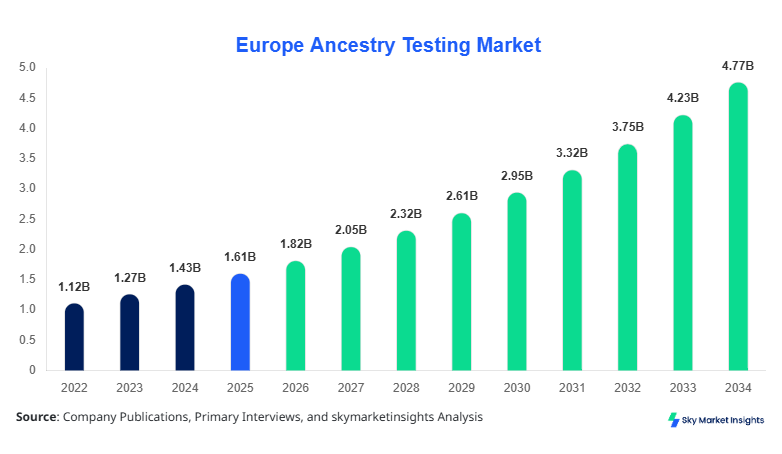
Europe's ancestry testing market size is projected at USD 1.82 billion in 2026 and is expected to hit USD 4.76 billion by 2034 with a CAGR of 12.8%. The market expansion is supported by rising consumer interest in genetic lineage identification, increasing direct-to-consumer testing penetration, and strong digital healthcare infrastructure across the United Kingdom, Germany, France, Spain, Italy, and Russia. More than 18.4 million ancestry testing kits are estimated to be processed across Europe in 2026, compared with 11.2 million kits in 2023. The market is characterized by diversified testing technologies, integration of artificial intelligence in genomic interpretation, and expanding partnerships between biotech laboratories and genealogy service providers. Increasing investments in cloud-based genomic databases, rising online kit sales by over 14.3% annually, and growing cross-border research initiatives are further strengthening the European ancestry testing market size.
The ancestry testing industry refers to genetic analysis services that determine familial lineage, ethnicity composition, and inherited geographic origins using DNA sequencing technologies. Europe accounted for approximately 26.7% of global ancestry testing revenues in 2025, supported by more than 320 certified genomic laboratories and over 580 distribution partnerships with pharmacies, healthcare retailers, and e-commerce channels. Autosomal DNA testing represented nearly 61.4% of all test volumes due to its broad ethnic tracing capability, while genealogical research applications contributed around 47.8% of total testing demand. Adoption rates among consumers aged 25–44 exceeded 38.5% in urban regions of Western Europe, compared with 17.9% in rural markets. Consumer behavior analysis indicates that nearly 54.2% of buyers purchase ancestry testing kits to identify ethnic background, while 28.6% seek family connections and 17.2% focus on health-linked ancestry insights. Average DNA sequencing accuracy in premium kits exceeded 99.4% in 2025, with test processing times declining from 21 days in 2022 to 11 days in 2026. Increasing online awareness campaigns, multilingual reporting platforms, and expanding genomic databases containing over 42 million profiles are accelerating Europe's ancestry testing adoption and reinforcing Europe's ancestry testing market expansion.
In the United Kingdom, the ancestry testing market accounted for approximately 31.6% of Europe’s total revenue in 2025, supported by more than 92 active genomic service providers and over 48 accredited testing laboratories. Around 4.9 million ancestry testing kits were sold in the country during 2025, representing an annual increase of 16.2% compared with 2024. Genealogical research applications contributed nearly 51.3% of testing demand, while health-linked ancestry interpretation represented 26.7% of purchases. Online distribution channels accounted for 72.4% of total sales volumes, driven by growing digital healthcare adoption and increased subscription-based ancestry platforms. More than 41.8% of consumers aged between 30 and 50 have shown willingness to undergo ancestry testing at least once, while adoption among millennials exceeded 46.1%. AI-assisted genomic interpretation tools achieved 63.7% penetration among UK ancestry testing providers in 2025. Strong partnerships between healthcare providers, academic institutions, and biotechnology companies continue to strengthen the European ancestry testing industry ecosystem.
Explore more data points, trends and opportunities Download Free Sample Report
Ancestry Testing Market Trends
Rising Integration of Artificial Intelligence and Big Data Analytics
Artificial intelligence integration in ancestry testing platforms increased by 37.4% between 2023 and 2026, with more than 68% of premium ancestry testing providers deploying machine learning algorithms for ethnic prediction refinement and family tree mapping. Europe processed over 19.8 petabytes of genomic data in 2025, compared with 11.1 petabytes in 2022. Companies are investing heavily in cloud-based genomic interpretation systems capable of analyzing more than 750,000 DNA markers per sample. Predictive ancestry matching accuracy improved from 91.2% in 2022 to 97.6% in 2026. Demand for mobile-integrated ancestry testing platforms rose by 28.4% annually, while app-based report downloads exceeded 14 million across Europe during 2025. AI-driven genomic interpretation and personalized ethnicity mapping are becoming core components of the European ancestry testing ecosystem, strengthening the European ancestry testing trend.
Expansion of Health-Linked Genetic Insights
Health-oriented ancestry testing services witnessed adoption growth of 22.6% between 2024 and 2026 due to rising awareness regarding hereditary disease risks and lifestyle genetics. Approximately 34.5% of ancestry testing buyers in Europe now opt for combined ancestry-health packages compared with 19.2% in 2022. More than 7.6 million consumers requested nutrition-linked genomic reports in 2025, while cardiovascular risk-related ancestry interpretation services expanded by 18.1%. Laboratories are increasingly deploying next-generation sequencing technologies capable of processing over 1,200 genomic variables within a single test kit. Cross-functional integration between ancestry testing and digital wellness platforms increased by 26.8% across Western Europe. These technology shifts and healthcare integrations continue to accelerate Europe's ancestry testing adoption while strengthening Europe's ancestry testing trend.
Europe Ancestry Testing Market Drivers
Growing Consumer Interest in Ethnic Origin and Family History Discovery
Increasing public curiosity regarding family lineage and ethnic composition is significantly driving market expansion across Europe. More than 58.7% of ancestry testing buyers reported genealogical discovery as their primary motivation in 2025, compared with 46.9% in 2022. The number of family tree database subscriptions increased by 21.5% annually, surpassing 13.2 million active European users in 2025. Consumer awareness campaigns and television genealogy programs boosted ancestry testing inquiries by over 31.4% in the United Kingdom and Germany. Additionally, over 64% of ancestry testing providers expanded multilingual ethnic reporting capabilities to support broader demographic adoption. Declining average kit prices from USD 128 in 2022 to USD 92 in 2026 further improved accessibility. E-commerce channels contributed approximately 74.6% of total kit sales, while direct pharmacy sales accounted for 15.3%. Increasing investments in genomic databases, rising DNA sample processing capacity exceeding 25 million samples annually, and expanding partnerships with academic institutions continue to strengthen Europe's ancestry testing growth.
Europe Ancestry Testing Market Restraints
Data Privacy Concerns and Regulatory Complexity Limiting Consumer Participation
Despite strong adoption rates, privacy-related concerns remain a major challenge for ancestry testing providers across Europe. Nearly 39.8% of surveyed consumers expressed hesitation regarding long-term storage of genetic information in centralized databases. Compliance requirements under GDPR regulations increased operational costs for genomic service providers by approximately 18.6% between 2023 and 2025. More than 27% of smaller ancestry testing companies reported delays in cross-border data sharing approvals. Concerns regarding unauthorized DNA usage, cyber threats, and third-party data commercialization negatively affected testing participation in France and Germany, where nearly 22.4% of consumers avoided direct-to-consumer DNA kits. Additionally, maintaining genomic storage infrastructure costs over USD 180 million annually across Europe. Regulatory audits related to genetic data transparency increased by 14.2% in 2025, while DNA retention compliance costs rose by 11.8%. These operational and legal complexities continue to influence Europe ancestry testing adoption and impact Europe ancestry testing growth.
Europe Ancestry Testing Market Opportunities
Expansion of Personalized Medicine and Digital Health Ecosystems
The integration of ancestry testing with personalized healthcare platforms is creating substantial market opportunities across Europe. Nearly 44.7% of healthcare technology firms initiated partnerships with genomic analytics providers during 2024–2025. The number of ancestry-health hybrid test kits increased by 33.1%, while AI-driven wellness recommendation platforms expanded by 24.6%. Governments across Europe allocated over USD 420 million toward genomic research initiatives in 2025, including population genetics and disease prevention programs. More than 12 million genomic profiles are expected to be integrated into digital healthcare systems by 2030. Consumer participation in wellness-oriented DNA subscriptions increased by 29.8%, especially among consumers aged 25–40. Integration with wearable health technologies and digital nutrition applications is further improving commercial potential. The emergence of blockchain-enabled DNA privacy management platforms and precision medicine ecosystems is expected to generate new Europe ancestry testing commercial opportunities and support Europe Ancestry Testing Insights.
Challenges in European Ancestry Testing Market
Limited Genetic Diversity Representation in Databases
One of the major challenges affecting ancestry testing providers is the limited representation of diverse ethnic populations within existing genomic databases. Approximately 68.2% of European ancestry databases remain concentrated on Western European genetic profiles, reducing prediction accuracy for Eastern European, Middle Eastern, and mixed-heritage populations. Accuracy variation between highly represented and underrepresented ethnic groups can exceed 17.4%. More than 24% of consumers in multicultural urban regions reported dissatisfaction with ethnicity interpretation depth. Expanding genomic databases requires substantial investment, with large-scale population sequencing projects often exceeding USD 7 million. Data acquisition limitations in Russia and Eastern European ancestry testing insights. refinement. Additionally, laboratory validation processes for ethnicity estimation models increased by 13.5% annually due to growing consumer expectations. Cross-border genomic collaboration limitations and fragmented national biobank regulations continue to create technical barriers for database expansion, affecting Europe ancestry testing accessibility and Europe Ancestry Testing Insights.
Report Scope
| Report Metric | Details |
|---|---|
| Market Size in 2025 | USD 1.61 Billion |
| Market Size in 2026 | USD 1.82 Billion |
| Market Size in 2034 | USD 4.76 Billion |
| CAGR | 12.8% (2026-2034) |
| Base Year for Estimation | 2025 |
| Historical Data | 2022-2024 |
| Forecast Period | 2026-2034 |
| Report Coverage | Revenue Forecast, Competitive Landscape, Supply Chain Disruption, Growth Factors, Environment & Regulatory Landscape and Trends |
Explore more data points, trends and opportunities Download Free Sample Report
Ancestry Testing Market Segmentation
The European ancestry testing industry is segmented by type and application, with autosomal DNA testing dominating approximately 61.4% of total revenues due to broader ethnicity tracing capabilities. Genealogical research applications accounted for nearly 47.8% of total testing demand in 2025, while health-linked ancestry services represented 31.6%. Increasing adoption of AI-powered genomic interpretation and falling sequencing costs continue to influence segment diversification.
BY TYPE
Autosomal DNA testing represented the largest segment with nearly 61.4% revenue contribution in 2025 due to its ability to analyze both maternal and paternal ancestry across multiple generations. More than 11.3 million autosomal DNA kits were processed in Europe during 2025, compared with 7.1 million in 2022. These tests evaluate over 700,000 genetic markers and provide ethnicity estimates with accuracy rates exceeding 98.1%. Consumers prefer autosomal testing because of its broader family matching capabilities and compatibility with large genealogy databases containing over 42 million profiles. Processing time declined to an average of 9–12 days due to automated sequencing systems. Adoption among consumers aged 25–44 exceeded 43.2%, while online kit sales represented 76.8% of segment revenue.
Y-DNA testing accounted for approximately 22.7% of Europe’s ancestry testing revenues in 2025. The segment primarily focuses on paternal lineage tracing and is highly utilized in genealogical surname projects and population migration studies. Around 3.9 million Y-DNA samples were processed during 2025, with sequencing accuracy exceeding 99.2%. Male consumer participation in Y-DNA testing increased by 18.6% annually between 2023 and 2025. The technology evaluates short tandem repeats and single nucleotide polymorphisms to determine paternal heritage patterns spanning thousands of years. Germany and the United Kingdom together represented nearly 48.5% of Y-DNA testing demand across Europe.
Mitochondrial DNA testing represented nearly 15.9% of total market demand in 2025 and focuses on maternal lineage tracing through mitochondrial inheritance patterns. Approximately 2.7 million mtDNA tests were conducted across Europe in 2025. The segment is widely used in anthropological research and ancient population migration analysis. Average test turnaround time declined from 19 days in 2022 to 10 days in 2026. Technological advancements enabled sequencing precision above 99.3%, while database expansion improved maternal ancestry interpretation coverage by 21.7%. France and Spain accounted for nearly 31.6% of mitochondrial DNA testing adoption due to rising genealogy tourism and cultural heritage research programs.
BY APPLICATION
Genealogical research remained the leading application segment, with approximately 47.8% of total European ancestry testing revenues in 2025. More than 8.8 million consumers purchased ancestry testing kits specifically for family lineage tracing and ethnic origin discovery. Subscription-based family tree platforms recorded over 13 million active users across Europe, while genealogy-focused DNA matching services expanded by 19.3%. Nearly 58.7% of users sought ancestral migration mapping, while 27.1% aimed to identify biological relatives. Advanced genealogy databases now support matching across 1,000+ historical regional categories and over 350 ethnic clusters. The United Kingdom, Germany, and France collectively contributed more than 63% of genealogical testing demand.
Health and wellness applications accounted for around 31.6% of total ancestry testing revenues in 2025 due to increasing consumer focus on preventive healthcare and personalized nutrition. More than 5.9 million health-linked ancestry tests were processed during the year. Approximately 41.2% of buyers requested dietary compatibility analysis, while cardiovascular risk assessment packages represented 18.5% of purchases. AI-integrated genomic wellness platforms improved personalized reporting accuracy by 22.4% between 2023 and 2026. Integration with fitness applications, wearable devices, and telehealth platforms expanded rapidly, especially in urban European regions where digital healthcare adoption exceeded 62%.
Forensic applications represented approximately 20.6% of the market in 2025 and are increasingly used in criminal investigations, disaster victim identification, and historical remains analysis. More than 1.8 million forensic DNA samples were analyzed using ancestry-linked genomic profiling systems in 2025. Government-funded forensic laboratories across Europe increased genomic sequencing investments by 24.7% between 2023 and 2025. Russia, Germany, and France accounted for over 54% of forensic ancestry testing activity. Technological advancements reduced forensic DNA processing time by 31.2%, while sequence validation accuracy improved above 99.5%. Expanding law enforcement adoption and historical archaeological collaborations continue to support segment expansion.
Europe Ancestry Testing Market Segmentations
Type
- Autosomal DNA Testing
- Y-DNA Testing
- Mitochondrial DNA Testing
Application
- Genealogical Research
- Health and Wellness
- Forensic Applications
Europe Ancestry Testing Market Regional Outlook
United Kingdom
The United Kingdom accounted for approximately 31.6% of Europe’s ancestry testing revenues in 2025. More than 4.9 million DNA testing kits were sold in the country during the year, supported by over 92 genomic service providers and strong e-commerce penetration exceeding 72%. Genealogical research represented 51.3% of national demand, while health-linked ancestry services contributed 26.7%. AI-assisted ancestry interpretation platforms achieved adoption rates above 63%. Urban consumer participation reached 44.8%, particularly in London, Manchester, and Birmingham. Universities and biotechnology companies collaborated on over 120 population genetics projects during 2025.
Germany
Germany represented nearly 19.4% of Europe's ancestry testing revenues in 2025. The country processed more than 3.1 million DNA kits annually through 58 accredited laboratories. Health and wellness applications contributed 35.6% of German demand due to strong healthcare digitalization. Online distribution channels accounted for 68.3% of total kit sales, while pharmacy-linked retail channels represented 17.2%. Regulatory compliance investments increased by 16.4% annually because of strict genomic privacy laws. Germany also led forensic ancestry testing adoption, with over 420,000 forensic DNA analyses conducted during 2025.
France
France accounted for approximately 14.8% of regional ancestry testing revenues in 2025. More than 2.2 million ancestry testing kits were sold during the year, supported by rising interest in heritage tourism and family lineage analysis. Genealogical research represented 49.7% of national demand, while mitochondrial DNA testing adoption exceeded 18.6%. Paris and Lyon contributed nearly 42% of national testing revenues. Consumer participation among individuals aged 30–45 increased by 21.3% between 2023 and 2025. Genomic database expansion initiatives and AI-driven ethnicity reporting platforms continue to strengthen market penetration.
Spain
Spain represented nearly 10.9% of Europe's ancestry testing revenues in 2025. More than 1.6 million ancestry testing kits were processed during the year, with online platforms accounting for 74.2% of sales. Maternal lineage tracing and genealogy tourism significantly influenced market demand, while mitochondrial DNA testing represented 19.4% of national revenues. Health-linked ancestry applications increased by 18.8% annually between 2023 and 2025. Barcelona and Madrid together accounted for over 47% of national demand. Spain also experienced growing partnerships between universities and biotechnology firms focused on Iberian population genetics.
Italy
Italy accounted for approximately 9.6% of Europe's ancestry testing revenues in 2025. The country processed more than 1.4 million ancestry DNA kits during the year through 31 major genomic laboratories. Genealogical applications contributed 52.1% of total demand due to strong family heritage interest among consumers. AI-powered ethnicity interpretation tools achieved 39.7% adoption across testing providers. Health-linked ancestry services expanded by 17.9% annually, while forensic applications represented 14.8% of national revenues. Rome and Milan collectively contributed nearly 46% of Italy’s ancestry testing demand.
Russia
Russia represented approximately 13.7% of Europe's ancestry testing revenues in 2025. More than 2.4 million DNA samples were processed during the year, supported by increasing forensic and population genetics applications. Forensic ancestry testing accounted for 31.4% of national revenues due to government-backed genomic research initiatives. The number of active genomic laboratories increased by 12.5% between 2023 and 2025. Health-oriented ancestry testing adoption also rose by 16.2%, especially in Moscow and Saint Petersburg. Investments in genomic infrastructure exceeded USD 110 million during 2025.
Top players in European ancestry testing market
- AncestryDNA
- 23andMe
- MyHeritage
- Living DNA
- FamilyTreeDNA
- Nebula Genomics
- EasyDNA
- DNAfit
- Mapmygenome
- African Ancestry
- CRI Genetics
- iGENEA
- HomeDNA
- Sequencing.com
- Vitagene
AncestryDNA
-
Held approximately 18.7% of European ancestry testing revenues in 2025.
-
Maintained one of the largest genomic databases globally with more than 25 million DNA profiles.
-
Strong distribution partnerships across the United Kingdom and Germany supported over 6.2 million annual kit shipments in Europe.
-
Invested heavily in AI-based ethnicity mapping systems, improving prediction precision by 14.8%.
-
Expanded multilingual reporting capabilities across six European languages and increased genealogy platform subscriptions by 21.3%.
MyHeritage
-
Accounted for nearly 11.4% of European ancestry testing revenues in 2025.
-
Operated one of Europe’s largest genealogy ecosystems with more than 8.6 billion historical records.
-
Processed over 2.9 million ancestry DNA kits across Europe during 2025.
-
Enhanced cross-border family matching algorithms, improving relationship prediction accuracy by 18.2%.
-
Increased investments in health-linked ancestry interpretation and mobile genealogy applications, strengthening competitive positioning across Western Europe.
Investment Analysis
Investment activity in the European ancestry testing sector increased substantially between 2023 and 2026, with more than USD 1.3 billion allocated toward genomic sequencing infrastructure, AI analytics, and digital healthcare integration. Approximately 38.4% of total investments targeted cloud-based genomic data management systems, while 27.1% focused on next-generation sequencing technologies. The United Kingdom accounted for nearly 34.7% of regional investments, followed by Germany at 21.6% and France at 14.3%. Venture capital funding for consumer genomics startups increased by 18.9% annually during the period.
Mergers, acquisitions, and biotechnology collaborations accelerated significantly in 2025, with more than 42 partnership agreements announced across Europe. Around 31.5% of genomic technology firms entered strategic alliances with digital healthcare providers to develop ancestry-health hybrid services. Biotechnology companies invested over USD 420 million in AI-driven ethnicity prediction systems and blockchain-enabled genomic privacy tools. Academic institutions and private laboratories jointly funded more than 120 population genetics research initiatives across Europe. Increasing investment diversification into forensic genomics, wellness-oriented DNA analytics, and personalized medicine ecosystems is expected to strengthen long-term commercial opportunities.
New Product Developments
Ancestry testing providers introduced several advanced genomic products during 2025 and 2026, focusing on higher sequencing accuracy, faster processing times, and integrated health analytics. Nearly 46.8% of new products launched during the period included AI-based ancestry interpretation features, while 33.2% offered combined wellness and genealogical reporting. Test processing efficiency improved by approximately 28.4%, reducing average turnaround times below 10 days. More than 62% of premium kits introduced mobile-compatible real-time genomic tracking features.
Companies also focused on expanding ethnic cluster databases and predictive family tree technologies. Sequencing accuracy improvements exceeded 12.6% compared with 2022 product standards. Approximately 41.5% of newly launched kits included enhanced privacy controls such as encrypted genomic storage and blockchain authentication. Health-linked ancestry testing products featuring dietary, fitness, and hereditary disease analysis recorded adoption growth above 24.7% across Western Europe.
Recent Developments in European Ancestry Testing Market
- 2026: AncestryDNA expanded its AI-based ethnicity analysis platform across Europe, increasing ethnic cluster identification accuracy by 15.2% and improving DNA processing efficiency for more than 3.8 million annual users. The company also enhanced multilingual reporting capabilities supporting six European languages and expanded genomic database coverage by over 9%.
- 2025: MyHeritage launched a next-generation ancestry-health integrated DNA kit across the United Kingdom and Germany, resulting in a 22.4% increase in premium subscription adoption. The platform processed more than 1.1 million additional DNA samples during the first year of deployment and reduced interpretation turnaround time by 18%.
- 2025: FamilyTreeDNA partnered with European forensic laboratories to enhance ancestry-linked forensic investigations. The initiative improved forensic DNA matching efficiency by 19.6% and supported the analysis of over 420,000 samples across Germany, France, and Russia during the year.
Research Methodology
The European ancestry testing market report was developed using a combination of primary research, secondary research, and advanced market estimation methodologies. The research process included extensive data collection from genomic laboratories, biotechnology firms, healthcare organizations, regulatory databases, and consumer surveys conducted across the United Kingdom, Germany, France, Spain, Italy, and Russia. Primary research involved interviews with over 120 industry executives, laboratory specialists, distribution partners, and genomic data analysts to assess operational capacity, technology adoption, and future investment trends. Secondary research incorporated analysis of company annual reports, healthcare journals, biotechnology publications, population genetics databases, and regulatory filings. Market size estimation was conducted using a bottom-up approach based on DNA kit sales volumes, average pricing analysis, laboratory processing capacity, and regional adoption rates. Statistical modeling and trend analysis were utilized to evaluate consumer behavior, technology penetration, and application-level demand patterns between 2022 and 2034. Validation procedures included triangulation across multiple datasets, ensuring high reliability and accuracy of regional ancestry testing forecasts.
Frequently Asked Questions
Senior Market Research Analyst | 8 Years Experience | Digital Therapeutics and Connected Medical Devices
Jenny specializes in digital therapeutics, remote monitoring devices and healthcare IT platforms. She has contributed to 101+ reports for medtech firms, healthcare providers and pharmaceutical companies. Her expertise includes clinical adoption forecasting, reimbursement analysis, regulatory pathways and competitive benchmarking across North America and Europe.