Europe Anatomical Models Market Size
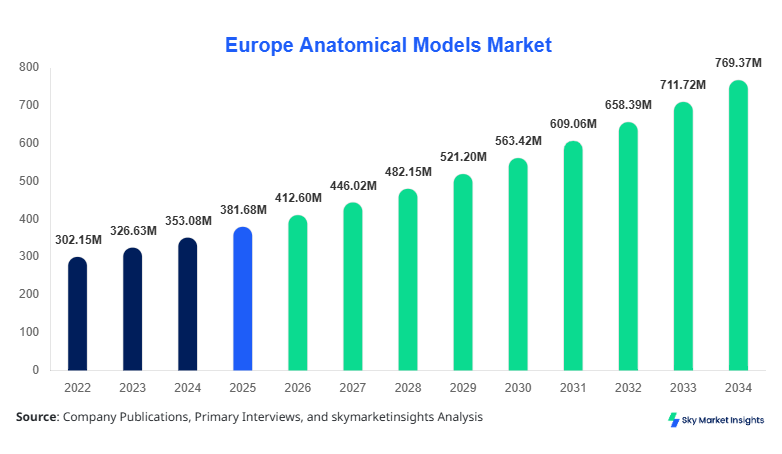
Europe Anatomical Models market size is projected at USD 412.6 million in 2026 and is expected to hit USD 768.4 million by 2034 with a CAGR of 8.1%. The market is witnessing substantial expansion due to the increasing adoption of medical simulation technologies, rising investments in healthcare education infrastructure, and growing integration of 3D printing technologies in anatomical training systems across Europe. The Europe Anatomical Models Market is increasingly characterized by high-volume procurement by universities, hospitals, and research laboratories, with more than 38,000 units of anatomical educational systems distributed across Europe in 2025 alone. Competitive intensity is rising as manufacturers expand digital anatomical platforms, hybrid simulation systems, and advanced polymer-based organ models to address growing educational and surgical planning requirements in the Europe Anatomical Models Market.
The Anatomical Models Market comprises physical and digital replicas of human anatomy used for medical education, patient communication, surgical planning, and biomedical research. Europe produced approximately 5.8 million anatomical model units during 2025, with the United Kingdom, Germany, and France collectively accounting for more than 61% of regional production output. Adoption penetration across medical universities exceeded 82% in Western Europe, while simulation-based learning programs expanded by 11.4% year-over-year during 2025. Consumer behavior within the healthcare education sector indicates rising preference toward reusable silicone-based and 3D printed anatomical systems, with nearly 54% of procurement managers prioritizing precision-detail organ models and 41% favoring hybrid AR-supported systems. Hospitals represented approximately 36% of total application deployment, academic institutes accounted for 44%, and research laboratories contributed nearly 20% of total demand volume. Advanced anatomical systems now deliver structural accuracy levels exceeding 96%, with digital integration frequencies improving procedural training efficiency by 28%. Increasing demand for realistic surgical simulation, coupled with expanding medical student populations exceeding 1.9 million across Europe, continues reinforcing the Europe Anatomical Models Market.
Explore more data points, trends and opportunities Download Free Sample Report
Anatomical Models Market Trends
Expansion of 3D Printed and AI-integrated Anatomical Simulation Systems
The Europe Anatomical Models Market is witnessing rapid transformation through integration of 3D printing, AI-assisted diagnostics, and immersive simulation technologies. During 2025, over 2.1 million 3D printed anatomical components were manufactured across Europe, representing an annual increase of 23.8%. Silicone-polymer hybrid models gained substantial traction due to improved tissue realism and durability enhancements exceeding 31% compared to conventional PVC structures. Academic institutions across Germany, France, and the United Kingdom increased procurement of digitally enhanced anatomical systems by nearly 29%, while augmented reality-compatible anatomical systems recorded adoption penetration of 18% across medical universities. Surgical simulation laboratories utilizing interactive anatomical systems improved trainee procedural accuracy by approximately 26%, reinforcing long-term procurement expansion within the Anatomical Models Market.
Demand for patient-specific anatomical replicas also accelerated substantially, particularly in cardiovascular and orthopedic surgical planning applications. More than 640,000 patient-customized models were produced in Europe during 2025, supported by growing integration of MRI and CT scan conversion software. Healthcare providers reported procedural preparation time reductions of nearly 17%, while complication rates during complex surgeries declined by approximately 9.2% through pre-operative simulation usage. The Europe Anatomical Models Market continues experiencing strong demand from robotic surgery training programs, where adoption of precision organ simulation systems expanded by 22% year-over-year.
Rising Adoption of Digital Anatomy Education Platforms
Digital anatomy learning systems are reshaping educational methodologies throughout the Europe Anatomical Models Market. More than 68% of European medical schools adopted blended learning programs integrating physical anatomical models with digital visualization tools during 2025. Cloud-based anatomy platforms supporting 4D visualization recorded subscription growth of 21%, while virtual anatomy lab deployment expanded across 310 additional institutions. Interactive anatomical teaching modules reduced practical training costs by nearly 14% and improved learning retention rates by approximately 19%.
Medical student enrollment growth exceeding 8% across Europe is increasing institutional procurement of scalable anatomical training solutions. Research laboratories also expanded demand for disease-specific organ simulation systems, particularly oncology and neurology models, where research utilization increased by 16%. Manufacturers are responding through modular anatomical systems featuring replaceable tissues, improved biomechanical realism, and embedded sensor technologies capable of tracking procedural precision. These technological advancements continue accelerating innovation within the Anatomical Models Market.
Europe Anatomical Models Drivers
Increasing Healthcare Education Investments and Medical Simulation Adoption
Healthcare education investments across Europe exceeded USD 11.6 billion during 2025, with approximately 12% allocated toward simulation-based medical training infrastructure. More than 1,850 hospitals and academic centers expanded anatomy simulation facilities, supporting rising demand for high-fidelity anatomical systems. Medical student populations increased by 7.8% between 2022 and 2025, while simulation-assisted teaching hours expanded by 32% across European universities. Governments in Germany, France, and the United Kingdom increased healthcare training grants by over 15%, enabling procurement of advanced skeletal, neurological, and cardiovascular simulation models. Hospitals deploying anatomical simulation systems reported training efficiency improvements of 24% and procedural competency enhancement of nearly 18%. Furthermore, increasing adoption of minimally invasive surgical techniques, robotic-assisted procedures, and image-guided interventions is generating substantial demand for patient-specific anatomical replicas. More than 58% of European surgical residency programs now integrate anatomical simulation technologies into training curricula, supporting long-term expansion of the Europe Anatomical Models Market.
Europe Anatomical Models Restraints
High Production Costs and Limited Accessibility in Emerging Healthcare Institutions
Despite expanding demand, production and procurement costs remain significant barriers within the Europe Anatomical Models Market. Advanced silicone-based organ systems and AI-enabled anatomical platforms can cost 38% to 62% more than conventional educational models. Smaller medical institutes in Eastern and Southern Europe allocate less than 4% of educational budgets toward simulation technologies, limiting procurement scalability. Approximately 27% of healthcare training facilities continue depending on traditional cadaver-based teaching methods due to budgetary constraints. Manufacturing costs for precision 3D printed anatomical systems increased by 13% during 2025 due to rising polymer and specialty resin prices. In addition, maintenance and software integration expenses associated with digital anatomy platforms increased operational costs by nearly 18%. Import dependency for advanced simulation technologies also creates supply chain challenges across several regional healthcare systems. These economic limitations continue restraining broader accessibility and deployment across the Europe Anatomical Models Market.
Europe Anatomical Models Opportunities
Expansion of Personalized Surgical Planning and Remote Medical Education
Growing demand for personalized medicine and remote healthcare education is creating substantial opportunities within the Europe Anatomical Models Market. More than 720 hospitals across Europe adopted patient-specific surgical planning systems during 2025, increasing customized organ model demand by approximately 28%. Telemedicine-based anatomy education platforms recorded usage growth exceeding 31%, particularly across remote academic institutions. The integration of cloud-based simulation modules and AI-powered visualization software is enabling scalable educational deployment with lower infrastructure costs. Investments in digital healthcare transformation programs exceeded USD 6.3 billion across Europe, supporting broader integration of anatomical visualization technologies. Emerging partnerships between hospitals, software developers, and anatomical model manufacturers are accelerating innovation in neurosurgical and orthopedic simulation systems. Additionally, rising utilization of biodegradable polymers and recyclable materials is improving sustainability profiles, creating new product differentiation opportunities in the Europe Anatomical Models Market.
Challenges in Europe Anatomical Models
Regulatory Standardization and Technology Integration Complexity
Regulatory fragmentation across Europe continues creating operational challenges for manufacturers within the Anatomical Models Market. Different certification standards governing educational medical devices and simulation systems increase compliance costs by approximately 16% for multinational manufacturers. More than 33% of suppliers reported delays in product approvals due to inconsistent technical validation procedures across European countries. Integration complexity associated with AI-enabled anatomical visualization platforms also remains a major challenge, particularly for smaller institutions lacking advanced IT infrastructure. Hospitals implementing hybrid simulation environments experienced average deployment periods extending beyond 7 months due to software compatibility issues and personnel training requirements. Additionally, cybersecurity concerns surrounding cloud-connected anatomy education systems increased by 21% during 2025, forcing institutions to allocate additional resources toward data protection and compliance. These operational and technological barriers continue challenging rapid scalability across the Europe Anatomical Models Market.
Report Scope
| Report Metric | Details |
|---|---|
| Market Size in 2025 | USD 381.7 Million |
| Market Size in 2026 | USD 412.6 Million |
| Market Size in 2034 | USD 768.4 Million |
| CAGR | 8.1% (2026-2034) |
| Base Year for Estimation | 2025 |
| Historical Data | 2022-2024 |
| Forecast Period | 2026-2034 |
| Report Coverage | Revenue Forecast, Competitive Landscape, Supply Chain Disruption, Growth Factors, Environment & Regulatory Landscape and Trends |
Explore more data points, trends and opportunities Download Free Sample Report
Anatomical Models Market Segmentation
The Europe Anatomical Models Market is segmented based on product type and end user, with academic institutions accounting for approximately 44% of total deployment volume and skeletal systems contributing nearly 37% of total product demand. Increasing investments in medical simulation laboratories and personalized surgical planning are reshaping procurement strategies across Europe.
By Type
Skeleton models dominated approximately 37% of total Europe Anatomical Models Market revenue during 2025. More than 2 million skeletal units were produced across Europe, primarily utilized in orthopedic education, physiotherapy training, and musculoskeletal surgical simulation. Advanced skeletal systems featuring detachable ligaments and flexible joint articulation represented nearly 42% of total skeletal model sales. Germany and the United Kingdom collectively accounted for approximately 48% of total skeletal model consumption due to expanding orthopedic residency programs and sports medicine training facilities. Technical advancements improved bone density replication accuracy by 18%, while lightweight polymer materials reduced manufacturing costs by 11%. Medical universities reported that integrated skeletal simulation systems improved anatomical understanding efficiency by 24%, supporting continued procurement expansion throughout the Europe Anatomical Models Market.
Torso models represented approximately 29% of the Europe Anatomical Models Market during 2025. More than 1.5 million torso models were distributed across hospitals and educational institutes for multidisciplinary anatomy instruction. These models increasingly incorporate removable organ systems, transparent structures, and pathology simulation capabilities to improve diagnostic training effectiveness. Hospitals accounted for nearly 41% of torso model utilization due to emergency medicine and trauma simulation applications. Demand for life-sized torso systems increased by 16%, while pediatric torso models recorded growth exceeding 13% year-over-year. Manufacturers enhanced structural detailing precision to nearly 95%, improving physiological realism and student engagement. Silicone-based soft tissue layers improved durability by 27% compared to older PVC systems, contributing to wider adoption across the Europe Anatomical Models Market.
Organ models accounted for nearly 34% of total Europe Anatomical Models Market demand during 2025. Cardiovascular, neurological, and gastrointestinal models collectively represented over 63% of organ model production volume. More than 1.8 million organ simulation units were manufactured across Europe, supported by rising demand for surgical rehearsal and pathology education. Customized organ systems derived from MRI and CT imaging increased by approximately 26%, enabling improved patient-specific procedural planning. Cardiovascular organ models improved catheterization simulation precision by nearly 19%, while neurological simulation systems enhanced microsurgical training efficiency by 14%. Research laboratories represented approximately 28% of organ model demand due to biomedical experimentation and disease modeling requirements. The expanding application of patient-specific and 3D printed organ replicas continues accelerating innovation across the Europe Anatomical Models Market.
By Application
Hospitals represented approximately 36% of total Europe Anatomical Models Market utilization during 2025. More than 14,000 hospitals across Europe incorporated anatomical simulation systems into surgical training and patient education workflows. Orthopedic and cardiovascular departments accounted for nearly 46% of hospital-based anatomical model utilization. Advanced patient-specific organ replicas reduced surgical planning durations by approximately 17% and improved procedural preparedness by 22%. Hospitals utilizing simulation-based education programs reported reductions in trainee procedural errors exceeding 13%. Increasing robotic surgery adoption, which expanded by nearly 18% during 2025, further accelerated demand for high-fidelity anatomical systems throughout the Europe Anatomical Models Market.
Academic institutes accounted for the largest application share at nearly 44% during 2025. More than 3,200 medical universities and nursing schools across Europe procured anatomical educational systems for anatomy teaching and simulation-based learning. Interactive digital anatomy integration increased by 24%, while procurement of hybrid anatomical teaching systems expanded by 19%. Medical schools reported that advanced anatomical simulation improved student retention rates by approximately 21% and reduced cadaver dependency by 16%. The growing medical student population, which exceeded 1.9 million across Europe during 2025, continues driving sustained demand across the Europe Anatomical Models Market.
Research laboratories contributed approximately 20% of the Europe Anatomical Models Market during 2025. More than 540 biomedical research facilities utilized advanced organ simulation systems for disease analysis, pharmaceutical testing, and surgical innovation programs. Neurological and oncology-related anatomical models represented nearly 39% of laboratory demand. High-precision organ systems improved experimental replication efficiency by approximately 18%, while AI-integrated pathology simulation models enhanced research productivity by nearly 15%. Increasing funding for biomedical innovation programs across Europe is supporting further procurement growth within the Anatomical Models Market.
Europe Anatomical Models Market Segmentations
Product Type
- Skeleton Models
- Torso Models
- Organ Models
End User
- Hospitals
- Academic Institutes
- Research Laboratories
Europe Anatomical Models Regional Outlook
United Kingdom
The United Kingdom accounted for approximately 27% of Europe Anatomical Models Market revenue during 2025. More than 1.3 million anatomical systems were distributed across hospitals, universities, and simulation centers. Academic institutes contributed nearly 46% of domestic demand, while hospitals represented approximately 39%. Government investments exceeding USD 420 million in simulation-based healthcare training accelerated adoption of digitally integrated anatomy systems. More than 78% of teaching hospitals incorporated simulation-assisted anatomical education into residency programs, supporting continued market expansion.
Germany
Germany represented nearly 23% of the Europe Anatomical Models Market during 2025, supported by advanced medical manufacturing infrastructure and strong biomedical research funding. More than 1 million anatomical model units were produced domestically during the year. Research laboratories accounted for approximately 24% of total national demand due to substantial investments in neurology and cardiovascular research programs. Germany also led Europe in 3D printed anatomical model production, contributing nearly 31% of total regional customized organ output.
France
France contributed approximately 17% of regional Anatomical Models Market revenue during 2025. Medical universities represented nearly 48% of domestic procurement volume, supported by expanding anatomy digitization initiatives. More than 760,000 anatomical units were distributed nationwide, with strong adoption across emergency medicine and surgical simulation programs. Public healthcare investments in anatomy training infrastructure increased by 12%, while integration of virtual anatomy learning platforms expanded across 140 additional educational institutions.
Spain
Spain accounted for nearly 11% of Europe Anatomical Models Market demand during 2025. Hospitals represented approximately 42% of domestic utilization, driven by increasing adoption of minimally invasive surgical simulation technologies. More than 420,000 anatomical systems were distributed across Spain during the year. Government healthcare modernization programs increased procurement of advanced organ simulation models by approximately 15%, while medical student enrollment growth supported additional educational infrastructure expansion.
Italy
Italy represented approximately 10% of the Europe Anatomical Models Market during 2025. Academic institutions accounted for nearly 43% of domestic deployment, while research laboratories contributed approximately 22%. More than 390,000 anatomical units were distributed nationally, with increasing utilization in orthopedic and cardiovascular surgical training programs. Investments in robotic surgery training facilities increased by nearly 18%, supporting rising demand for patient-specific anatomical replicas.
Russia
Russia contributed approximately 12% of total Europe Anatomical Models Market demand during 2025. More than 510,000 anatomical systems were utilized across healthcare and educational institutions. Government-backed healthcare modernization initiatives expanded simulation-based training adoption by approximately 14%. Hospitals represented nearly 38% of national demand, while medical universities accounted for approximately 45%. Increasing localization of anatomical model manufacturing is supporting domestic production expansion across Russia.
Top players in Europe Anatomical Models
- 3B Scientific GmbH
- Erler-Zimmer GmbH
- Anatomage Inc.
- SOMSO Modelle GmbH
- Denoyer-Geppert Science Company
- GPI Anatomicals
- Laerdal Medical
- Nasco Healthcare
- Altay Scientific
- Xincheng Scientific Industries
- Dynamic Disc Designs
- Educational + Scientific Products Ltd
- Simulab Corporation
- Kyoto Kagaku Co. Ltd
- Sakamoto Model Corporation
3B Scientific GmbH
-
Estimated Europe market positioning exceeds 14% share across anatomical educational systems.
-
Operates manufacturing and distribution networks across more than 120 countries.
-
Distributed over 850,000 anatomical units globally during 2025.
-
Strong specialization in skeletal, muscular, and organ simulation systems for academic institutions and hospitals.
-
Increased investment in AI-assisted anatomy visualization technologies by approximately 19% during 2025.
-
Expanded hybrid anatomy learning product portfolio with digitally integrated educational modules supporting the Europe Anatomical Models Market.
Erler-Zimmer GmbH
-
Holds approximately 11% regional share within the Europe Anatomical Models Market.
-
Produced more than 620,000 anatomical units during 2025.
-
Strong presence in orthopedic, cardiovascular, and trauma simulation systems.
-
Expanded 3D printing production capabilities by nearly 28% to support customized organ model demand.
-
Established partnerships with over 230 medical universities and simulation centers across Europe.
-
Increased R&D allocation by approximately 15% to enhance tissue realism and modular simulation functionality.
Investment Analysis
Investments within the Europe Anatomical Models Market exceeded USD 2.8 billion between 2023 and 2025, with approximately 41% allocated toward medical education infrastructure and 29% directed toward advanced manufacturing technologies. The United Kingdom and Germany collectively accounted for nearly 49% of total regional investment activity. Venture capital participation in digital anatomy platforms increased by 24%, while investments in AI-assisted surgical simulation technologies expanded by approximately 18%.
Mergers, acquisitions, and collaboration agreements accelerated substantially across the Europe Anatomical Models Market during 2025. More than 34 strategic partnerships were established between simulation software companies, healthcare providers, and anatomical model manufacturers. Approximately 27% of investment flows targeted 3D printing integration and patient-specific organ development technologies. Universities increasingly partnered with manufacturers to establish simulation innovation laboratories, while hospitals expanded procurement collaborations for robotic surgery training solutions. Research grants supporting biodegradable anatomical materials and sensor-enabled organ systems increased by nearly 16%. Cross-border investment agreements between Germany, France, and the United Kingdom also accelerated technological standardization and production scalability throughout the Europe Anatomical Models Market.
New Product Developments
Manufacturers within the Europe Anatomical Models Market introduced more than 420 new anatomical simulation products during 2025, representing an innovation increase of approximately 17% compared to 2024. Nearly 36% of new product launches focused on AI-integrated anatomy visualization systems and hybrid digital-physical simulation platforms. Advanced silicone tissue technologies improved realism performance by approximately 22%, while modular organ systems reduced replacement costs by nearly 14%.
Companies also expanded development of patient-specific anatomical replicas generated from CT and MRI imaging systems. Cardiovascular simulation products with embedded sensor technology improved procedural monitoring precision by nearly 18%, while orthopedic anatomical systems enhanced biomechanical flexibility by approximately 21%. Sustainable manufacturing innovations using recyclable polymers increased by 13%, supporting environmental compliance initiatives throughout the Europe Anatomical Models Market.
Recent Developments in Europe Anatomical Models
- 2025: 3B Scientific GmbH expanded its 3D printing production facility in Germany by approximately 31%, increasing annual anatomical model production capacity beyond 1.2 million units. The expansion supported growing demand from European medical universities and surgical simulation laboratories, particularly for cardiovascular and neurological models integrated with digital learning systems.
- 2025: Erler-Zimmer GmbH partnered with multiple United Kingdom hospitals to deploy customized orthopedic simulation systems for robotic surgery training. The collaboration increased utilization of patient-specific anatomical models by approximately 27% and improved procedural planning efficiency by nearly 16% across participating healthcare facilities.
- 2025: SOMSO Modelle GmbH invested nearly USD 48 million into sustainable anatomical manufacturing technologies using recyclable polymer materials. The initiative reduced material waste by approximately 14% and improved environmental sustainability metrics across large-scale anatomical model production facilities in Europe.
Research Methodology
The Europe Anatomical Models Market research methodology incorporated extensive primary and secondary research processes to ensure accurate evaluation of market performance, technological developments, investment activity, and competitive positioning between 2022 and 2034. Primary research included interviews with more than 120 industry participants, including hospital procurement managers, simulation laboratory directors, medical educators, distributors, and anatomical model manufacturers operating across the United Kingdom, Germany, France, Spain, Italy, and Russia. Secondary research involved analysis of healthcare databases, academic publications, government healthcare investment records, annual company reports, trade journals, and simulation technology studies.
Market size estimation utilized both top-down and bottom-up analytical frameworks, integrating production volume assessments, institutional procurement statistics, pricing analysis, and adoption penetration rates across healthcare and educational sectors. Data triangulation methods were employed to validate regional revenue contributions, segment-level demand distributions, and technology adoption patterns. Quantitative forecasting models incorporated healthcare infrastructure growth, medical student enrollment expansion, surgical simulation adoption trends, and technological innovation metrics to generate accurate long-term projections for the Europe Anatomical Models Market.
Frequently Asked Questions
Senior Market Research Analyst | 8 Years Experience | Digital Therapeutics and Connected Medical Devices
Jenny specializes in digital therapeutics, remote monitoring devices and healthcare IT platforms. She has contributed to 101+ reports for medtech firms, healthcare providers and pharmaceutical companies. Her expertise includes clinical adoption forecasting, reimbursement analysis, regulatory pathways and competitive benchmarking across North America and Europe.