Europe Anastomosis Devices Market Size
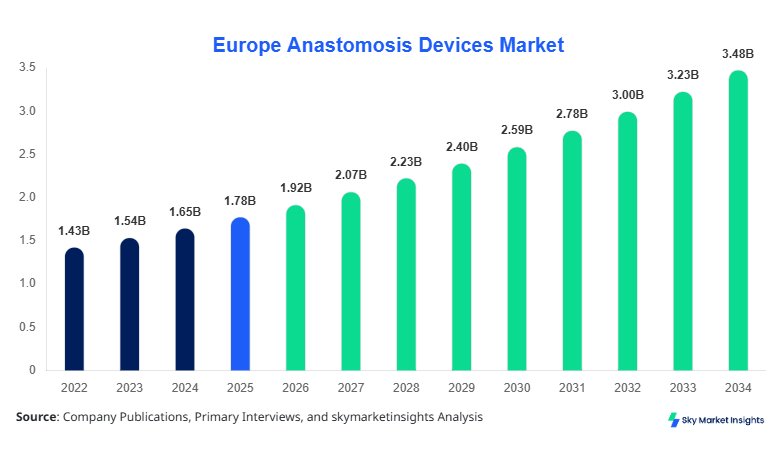
Europe Anastomosis Devices market size is projected at USD 1.92 billion in 2026 and is expected to hit USD 3.48 billion by 2034 with a CAGR of 7.72%. The market expansion is being supported by increasing minimally invasive surgeries, growing prevalence of cardiovascular and gastrointestinal disorders, and higher adoption of automated surgical systems across Europe. More than 7.4 million surgical procedures involving anastomosis technologies are estimated to be performed annually across the region, while hospitals account for nearly 68% of total procurement volume in 2026. The competitive landscape is characterized by multinational medical device manufacturers, regional distributors, and technology-driven surgical innovation companies focusing on robotic-assisted surgical integration and enhanced tissue healing technologies.
The anastomosis devices industry refers to medical technologies used for connecting blood vessels, intestines, and other tubular structures during surgical procedures. These devices include staplers, sutures, clips, sealants, and powered closure systems utilized in gastrointestinal, cardiovascular, pulmonary, and urological surgeries. Europe produced approximately 19.6 million surgical consumable units related to anastomosis procedures in 2025, with Germany, France, and the United Kingdom collectively contributing over 61% of regional production capacity. Penetration of minimally invasive surgical devices exceeded 54% across tertiary care hospitals in 2025, while robotic-assisted surgeries involving anastomosis devices increased by 18.3% year-over-year. Consumer demand is strongly linked to rising chronic disease prevalence, increasing geriatric population, and preference for reduced post-operative recovery times. Gastrointestinal surgeries represented nearly 39% of total device utilization, followed by cardiovascular procedures at 31% and orthopedic applications at 14%. Surgical staplers contributed approximately 46% of overall revenue generation due to higher precision and lower complication rates compared with manual suturing methods. Technical performance metrics show powered stapling devices reducing leak rates by nearly 23% and operative duration by 17% in laparoscopic procedures. Hospitals remain the largest end-use sector with 71% adoption penetration, while ambulatory surgical centers accounted for 16% of total demand in 2025. The Europe Anastomosis Devices market continues to witness increasing clinical adoption and procedural expansion across multiple specialties.
Explore more data points, trends and opportunities Download Free Sample Report
Anastomosis Devices Market Trends
The Europe healthcare sector is increasingly transitioning toward robotic-assisted and minimally invasive surgeries, significantly influencing anastomosis device utilization patterns. In 2025, more than 3.2 million laparoscopic surgeries across Europe incorporated powered anastomosis systems, reflecting a 19% increase compared with 2023 volumes. Hospitals are rapidly replacing conventional suturing techniques with automated stapling technologies due to their ability to reduce surgical leakage rates by nearly 24% and decrease operation time by 16%–20%. Smart stapling systems integrated with pressure sensing and tissue compression monitoring technologies represented approximately 14% of premium surgical equipment purchases during 2025. Furthermore, disposable stapler demand increased by 27% due to infection control priorities and enhanced procedural safety protocols. Cardiovascular surgical centers across Germany, France, and the United Kingdom collectively accounted for nearly 58% of advanced powered stapler installations. The Europe Anastomosis Devices market is witnessing substantial technology-driven transformation.
Another major trend involves rising outpatient and ambulatory surgical center adoption of compact and portable anastomosis devices. Ambulatory surgical centers conducted approximately 1.4 million minimally invasive procedures requiring tissue closure technologies during 2025, with gastrointestinal surgeries contributing 46% of total outpatient applications. Battery-powered surgical staplers demonstrated penetration exceeding 38% within ambulatory settings because of portability, ergonomic handling, and reduced maintenance requirements. Simultaneously, biodegradable surgical sealants and absorbable sutures gained strong demand momentum, with Europe recording more than 112 million absorbable suture units sold in 2025. Demand for precision-driven closure systems in oncology surgeries increased by 17.6%, particularly across colorectal and gastric cancer procedures. Surgeons are also increasingly favoring reloadable stapling cartridges capable of reducing device wastage by nearly 21%. The Europe Anastomosis Devices market continues to evolve through clinical innovation and procedural modernization.
Digital integration and artificial intelligence-supported surgical planning tools are becoming increasingly common within Europe’s advanced surgical ecosystem. More than 29% of robotic-assisted surgeries in 2025 utilized AI-supported visualization systems integrated with powered stapling technologies. France and Germany together invested over USD 420 million in smart surgical infrastructure modernization programs between 2024 and 2025. Hospitals adopting AI-guided tissue assessment systems reported nearly 14% lower post-operative complication rates during gastrointestinal surgeries. In addition, manufacturers are emphasizing eco-friendly disposable systems and recyclable packaging, reducing medical plastic waste generation by approximately 11%. Increasing preference for high-performance titanium staples capable of sustaining tissue integrity for more than 12 weeks has also influenced procurement strategies. The Europe Anastomosis Devices market is experiencing strong modernization supported by digital transformation and sustainability-focused innovations.
Europe Anastomosis Devices Drivers
Rising Incidence of Cardiovascular and Gastrointestinal Disorders Accelerating Surgical Procedure Volumes
The increasing burden of chronic diseases across Europe remains a primary driver for anastomosis device adoption. More than 11.3 million cardiovascular surgeries and gastrointestinal interventions were performed collectively across Europe during 2025, reflecting a 9.4% increase compared with 2022 levels. Colorectal cancer incidence exceeded 520,000 diagnosed cases annually, while coronary artery disease prevalence affected nearly 49 million adults across the region. Surgical staplers and powered closure systems are increasingly preferred because they reduce tissue trauma by nearly 18% and minimize leakage complications by approximately 22%. Hospitals accounted for 71% of device procurement, while specialized cardiac surgery centers contributed another 18% of purchasing demand. Germany, France, and the United Kingdom collectively represented nearly 63% of total surgical device consumption across Europe. Government healthcare expenditure across the region surpassed USD 2.4 trillion in 2025, supporting investments in advanced surgical infrastructure and minimally invasive technologies. Furthermore, the aging population is driving procedural expansion, with individuals aged above 65 years expected to represent over 28% of Europe’s population by 2034. This demographic shift significantly increases demand for cardiovascular bypass surgeries, gastrointestinal resections, and tissue repair procedures. The Europe Anastomosis Devices market continues to expand due to increasing disease prevalence and surgical intervention rates.
Europe Anastomosis Devices Restraints
High Cost of Advanced Surgical Stapling Systems and Reimbursement Challenges
The high acquisition cost of technologically advanced anastomosis systems remains a major restraint affecting broader adoption across smaller healthcare facilities. Powered surgical staplers cost between USD 420 and USD 1,300 per unit depending on configuration and cartridge compatibility, while robotic-assisted closure systems may exceed USD 4,000 per procedure setup. Approximately 38% of medium-sized hospitals in Eastern and Southern Europe continue relying on conventional sutures because of budgetary limitations and reimbursement restrictions. Maintenance expenses for automated surgical platforms increased by 14% between 2023 and 2025 due to rising component and sterilization costs. Furthermore, inconsistent reimbursement frameworks across Europe negatively impact adoption rates within outpatient centers and secondary care hospitals. Russia, Spain, and Italy collectively reported nearly 19% lower penetration of premium stapling systems compared with Germany and France. Training requirements for robotic-assisted stapling technologies also contribute to adoption barriers, as surgeons typically require 30–45 supervised procedures for competency certification. Post-operative complications associated with improper stapler handling resulted in approximately 2.8% of revision surgeries during 2025. These economic and operational limitations continue to challenge expansion opportunities within the Europe Anastomosis Devices market.
Europe Anastomosis Devices Opportunities
Expansion of Robotic-Assisted Surgery and Ambulatory Surgical Infrastructure
The growing adoption of robotic-assisted surgery across Europe is creating substantial opportunities for manufacturers of advanced anastomosis technologies. More than 4,200 robotic surgical systems were operational across European hospitals during 2025, representing an increase of 23% compared with 2022 levels. Robotic-assisted gastrointestinal procedures utilizing powered staplers expanded by nearly 27% year-over-year due to improved precision and reduced recovery durations. Ambulatory surgical centers across Europe are projected to perform over 2.2 million minimally invasive procedures annually by 2030, generating strong procurement demand for compact closure systems and disposable stapling cartridges. Approximately 44% of healthcare investments in Western Europe are now directed toward minimally invasive surgery modernization and robotic integration programs. Manufacturers introducing AI-integrated tissue sensing technologies observed nearly 16% higher adoption rates among tertiary hospitals. Strategic partnerships between medical device companies and healthcare providers increased by 19% during 2024–2025, facilitating wider deployment of technologically advanced surgical systems. Furthermore, increasing demand for bioabsorbable sealants and antimicrobial-coated sutures presents attractive revenue opportunities across infection-sensitive procedures. The Europe Anastomosis Devices market is positioned for significant expansion through robotic-assisted surgical adoption and ambulatory healthcare growth.
Europe Anastomosis Devices Challenge
Shortage of Skilled Surgeons and Risk of Surgical Complications
A major challenge affecting the Europe anastomosis device industry is the shortage of highly trained surgeons capable of handling advanced powered closure systems and robotic-assisted procedures. Europe currently faces a deficit of more than 120,000 specialized surgical professionals, particularly across cardiovascular and minimally invasive surgical disciplines. Approximately 26% of hospitals reported procedural delays in 2025 due to workforce shortages and insufficient operating room staff availability. Complication risks associated with improper device usage continue to impact clinical confidence, with anastomotic leakage rates ranging between 3% and 11% depending on procedural complexity. Surgical training programs for robotic-assisted stapling technologies often require investments exceeding USD 180,000 per institution annually. Furthermore, variations in surgical guidelines across regional healthcare systems create operational inefficiencies and procurement challenges for device manufacturers. Smaller healthcare facilities in Russia, Spain, and rural Italy demonstrated adoption rates nearly 34% lower than urban tertiary hospitals due to limited access to advanced training infrastructure. Regulatory compliance requirements under Europe’s Medical Device Regulation framework also increased product approval timelines by approximately 18 months for several manufacturers. These operational, workforce, and regulatory limitations continue to challenge the Europe Anastomosis Devices market.
Report Scope
| Report Metric | Details |
|---|---|
| Market Size in 2025 | USD 1.78 Billion |
| Market Size in 2026 | USD 1.92 Billion |
| Market Size in 2034 | USD 3.48 Billion |
| CAGR | 7.72% (2026-2034) |
| Base Year for Estimation | 2025 |
| Historical Data | 2022-2024 |
| Forecast Period | 2026-2034 |
| Report Coverage | Revenue Forecast, Competitive Landscape, Supply Chain Disruption, Growth Factors, Environment & Regulatory Landscape and Trends |
Explore more data points, trends and opportunities Download Free Sample Report
Anastomosis Devices Market Segmentation
The Europe anastomosis devices industry is segmented by product type and application, with surgical staplers dominating nearly 46% of total revenue contribution in 2025 due to precision, reduced surgery duration, and lower complication risks. Gastrointestinal surgery remained the leading application segment with approximately 39% consumption share, followed by cardiovascular surgeries at 31%. Technological advancements in minimally invasive and robotic-assisted surgical systems continue reshaping demand patterns across Europe.
By Type
Surgical staplers represented the dominant product category, accounting for nearly 46% of Europe’s total device consumption in 2025. More than 8.7 million stapling units were utilized annually across gastrointestinal, thoracic, and cardiovascular procedures. Powered staplers demonstrated leak reduction efficiency of approximately 23% compared with traditional manual suturing techniques. Germany and France collectively accounted for 52% of advanced stapler installations across Europe. Reloadable stapling cartridges gained popularity because they reduced surgical waste by nearly 21% and improved operating room efficiency by 14%. Titanium-based staples capable of maintaining tissue integrity for more than 12 weeks represented approximately 61% of premium product demand. Battery-powered laparoscopic staplers witnessed adoption growth exceeding 19% year-over-year because of portability and improved ergonomics. The segment remains central to surgical modernization across Europe.
Surgical sutures accounted for approximately 34% of overall market revenue and remain widely used in both conventional and minimally invasive surgeries. Europe consumed nearly 118 million suture units in 2025, with absorbable sutures representing around 63% of total utilization. Antimicrobial-coated sutures demonstrated infection reduction benefits ranging between 13% and 17% during gastrointestinal procedures. Cardiovascular surgeries contributed nearly 28% of total suture demand, while orthopedic surgeries represented 19%. Advanced braided sutures with enhanced tensile strength exceeding 90 Newtons gained significant traction in tertiary hospitals and trauma centers. France and Italy together represented nearly 31% of Europe’s absorbable suture procurement. The increasing preference for biodegradable and infection-resistant materials continues to support segment expansion across Europe.
Surgical sealants contributed approximately 20% of regional revenue generation and are increasingly utilized in leakage prevention and tissue reinforcement procedures. Europe consumed more than 24 million surgical sealant units in 2025 across cardiovascular, pulmonary, and gastrointestinal surgeries. Fibrin-based sealants represented 42% of total sealant demand due to superior hemostatic performance and reduced inflammatory response. Hospitals utilizing advanced hydrogel sealants reported postoperative complication reductions of nearly 15%. Germany and the United Kingdom together accounted for approximately 48% of premium sealant product adoption. Bioabsorbable sealants with degradation periods ranging between 4 and 8 weeks experienced significant procedural preference in laparoscopic surgeries. The segment is benefiting from increasing focus on precision surgery and faster patient recovery.
By Application
Cardiovascular surgery represented nearly 31% of overall device utilization across Europe in 2025 due to increasing incidence of coronary artery disease and vascular disorders. More than 3.5 million cardiovascular interventions requiring anastomosis technologies were conducted annually across the region. Powered staplers and antimicrobial sutures demonstrated leakage reduction benefits of approximately 18% during bypass surgeries. Germany and the United Kingdom together accounted for nearly 44% of cardiovascular device demand across Europe. Advanced tissue sealants capable of maintaining vascular integrity for over 10 weeks gained increasing clinical preference. Robotic-assisted cardiac surgeries utilizing precision closure systems expanded by 22% year-over-year. Hospitals continue investing heavily in cardiovascular surgical modernization, driving procedural demand across Europe.
Gastrointestinal surgery remained the largest application category, accounting for approximately 39% of Europe’s total anastomosis device consumption. More than 4.6 million colorectal, gastric, and bariatric procedures requiring tissue closure technologies were performed in 2025. Surgical staplers represented nearly 52% of gastrointestinal procedure usage due to reduced operating time and improved leak prevention. Colorectal cancer surgeries contributed around 34% of gastrointestinal device demand, while bariatric surgeries represented 18%. France, Germany, and Italy collectively accounted for 58% of regional gastrointestinal procedure volumes. Powered laparoscopic staplers capable of reducing operative duration by nearly 19% gained significant adoption momentum among tertiary hospitals. Increasing obesity prevalence and gastrointestinal disease incidence continue supporting procedural growth across Europe.
Orthopedic surgery accounted for approximately 14% of total device utilization, supported by rising trauma cases and increasing joint replacement procedures. Europe conducted nearly 1.8 million orthopedic surgeries requiring tissue closure devices during 2025. Antimicrobial sutures represented around 46% of orthopedic procedure utilization because of infection prevention advantages. Germany and Spain together accounted for nearly 37% of orthopedic surgical demand within Europe. Advanced closure systems capable of reducing wound healing duration by 11%–14% gained strong preference among sports medicine and trauma centers. Minimally invasive orthopedic surgeries involving robotic-assisted technologies increased by approximately 17% between 2023 and 2025. The segment continues to expand alongside rising geriatric orthopedic care requirements.
Europe Anastomosis Devices Market Segmentations
Product Type
- Surgical Staplers
- Surgical Sutures
- Surgical Sealants
Application
- Cardiovascular Surgery
- Gastrointestinal Surgery
- Orthopedic Surgery
Europe Anastomosis Devices Regional Outlook
United Kingdom
The United Kingdom accounted for approximately 18% of Europe’s total anastomosis device revenue in 2025 due to increasing minimally invasive surgeries and strong NHS procurement programs. More than 1.3 million gastrointestinal and cardiovascular procedures involving anastomosis technologies were conducted annually across the country. Surgical staplers represented nearly 47% of product utilization, while absorbable sutures contributed 33% of hospital procurement demand. The United Kingdom operated over 420 specialized surgical facilities utilizing robotic-assisted systems in 2025. Cardiovascular surgeries accounted for approximately 29% of total application demand, while gastrointestinal procedures represented 41%. Investments exceeding USD 180 million in robotic surgery modernization programs significantly accelerated adoption of advanced closure systems.
Germany
Germany maintained the largest regional contribution with approximately 28% share of Europe’s total market revenue in 2025. The country produced over 5.6 million surgical closure device units annually and exported nearly 38% of production volume to neighboring European countries. More than 63% of tertiary hospitals adopted powered surgical staplers integrated with digital tissue monitoring systems. Gastrointestinal surgeries contributed 41% of demand, while cardiovascular procedures represented 29%. Germany’s healthcare expenditure exceeded USD 560 billion in 2025, supporting rapid deployment of advanced surgical technologies and robotic-assisted operating infrastructure.
France
France represented nearly 16% of regional device consumption due to increasing colorectal cancer surgeries and growing bariatric procedure volumes. More than 970,000 surgical interventions requiring tissue closure technologies were conducted annually across France. Absorbable sutures accounted for approximately 39% of total product demand, while sealants contributed 18%. The country recorded over 14% growth in robotic-assisted surgeries between 2023 and 2025. Public and private hospitals collectively invested over USD 120 million in advanced laparoscopic surgery equipment. France remains a major hub for minimally invasive gastrointestinal procedures across Europe.
Spain
Spain accounted for approximately 11% of Europe’s total anastomosis device consumption in 2025. More than 620,000 gastrointestinal and cardiovascular surgeries were performed annually across Spanish hospitals. Surgical staplers represented nearly 44% of total utilization due to increasing laparoscopic procedure preference. Spain experienced approximately 16% growth in ambulatory surgical center adoption of compact stapling systems during 2024–2025. Orthopedic applications represented around 15% of device demand, while gastrointestinal surgeries contributed 38%. Public healthcare modernization programs continue supporting procedural growth across Spain.
Italy
Italy contributed nearly 12% of regional market revenue supported by rising geriatric surgical demand and expanding hospital infrastructure modernization. More than 780,000 surgeries involving tissue closure systems were performed in Italy during 2025. Absorbable sutures represented approximately 36% of procurement demand, while powered staplers accounted for 42%. Gastrointestinal surgeries contributed 40% of total application share due to increasing colorectal disease incidence. Italy invested approximately USD 95 million in robotic-assisted surgery upgrades between 2024 and 2025, supporting greater adoption of precision closure technologies.
Russia
Russia accounted for approximately 9% of Europe’s total device consumption despite lower penetration of advanced robotic-assisted systems compared with Western Europe. More than 540,000 cardiovascular and gastrointestinal surgeries requiring anastomosis technologies were conducted annually in 2025. Conventional sutures continued representing around 48% of product utilization due to cost sensitivity and reimbursement constraints. However, powered stapler adoption increased by nearly 13% during 2024–2025. Government healthcare expansion initiatives targeting surgical infrastructure modernization are expected to improve adoption rates over the coming years.
Top players in Europe Anastomosis Devices
- Johnson & Johnson MedTech
- Medtronic plc
- Becton Dickinson and Company
- Intuitive Surgical Inc.
- B. Braun SE
- Smith & Nephew plc
- Stryker Corporation
- CONMED Corporation
- Olympus Corporation
- Zimmer Biomet Holdings
- Boston Scientific Corporation
- Teleflex Incorporated
- Frankenman International Ltd.
- Meril Life Sciences Pvt. Ltd.
- Reach Surgical Inc.
Johnson & Johnson MedTech
-
Estimated Europe regional share: 22%
-
Strong leadership in powered surgical staplers and laparoscopic closure systems
-
Extensive hospital partnerships across Germany, France, and the United Kingdom
-
Advanced robotic-assisted surgery integration capabilities
Johnson & Johnson MedTech maintained dominant positioning across Europe due to its extensive portfolio of powered stapling systems and minimally invasive surgical technologies. The company supplied more than 3.1 million surgical stapling units across Europe during 2025 and maintained strong partnerships with over 2,400 hospitals. Its premium Ethicon stapling systems demonstrated approximately 20% lower leakage rates compared with conventional closure techniques. The company continues investing heavily in AI-integrated surgical visualization technologies and robotic-assisted operating systems to strengthen competitive positioning.
Medtronic plc
-
Estimated Europe regional share: 18%
-
Strong presence in cardiovascular and gastrointestinal surgery devices
-
Expanding robotic-assisted surgery portfolio
-
High penetration across tertiary healthcare institutions
Medtronic plc remains a major competitor within Europe due to its broad portfolio of surgical staplers, sutures, and tissue sealants. The company generated strong demand across cardiovascular procedures, accounting for nearly 29% of hospital procurement in specialized cardiac centers. Medtronic’s powered staplers reduced surgical operating duration by approximately 17% during laparoscopic procedures. The company expanded production capacity by nearly 14% during 2024–2025 to meet rising European demand. Its strong clinical support programs and surgeon training initiatives continue reinforcing adoption across major European healthcare systems.
Investment Analysis
Investment activity across Europe’s anastomosis device industry accelerated substantially during 2024–2026, driven by robotic-assisted surgery expansion and healthcare modernization programs. More than USD 2.1 billion was allocated toward minimally invasive surgery infrastructure projects across Europe during 2025. Approximately 44% of total healthcare technology investment was directed toward robotic surgery systems, while 29% supported advanced stapling and closure technologies. Germany represented nearly 31% of regional investment allocation, followed by France at 18% and the United Kingdom at 17%. Venture capital funding for AI-integrated surgical technologies increased by approximately 26% compared with 2023 levels.
Mergers, acquisitions, and strategic collaborations remained highly active across the industry. More than 34 partnership agreements involving robotic surgery, tissue engineering, and closure technologies were announced during 2024–2025. Major medical device companies expanded manufacturing facilities across Germany and Ireland to improve supply chain resilience and meet rising procedural demand. Approximately 22% of total investment focused on biodegradable sealants and absorbable suture innovations aimed at reducing postoperative complications. Hospitals and research institutes across Europe collectively invested over USD 640 million in surgeon training and robotic-assisted surgical certification programs.
Private equity firms also increased participation in specialized surgical technology startups focusing on AI-supported tissue monitoring and smart stapling systems. Western Europe accounted for nearly 72% of total investment inflows due to higher healthcare expenditure and faster regulatory approvals. Strategic collaborations between healthcare providers and medical device manufacturers contributed to approximately 16% faster deployment of next-generation laparoscopic closure systems across tertiary hospitals. Increasing investments in outpatient surgical infrastructure are expected to create long-term procurement opportunities throughout the Europe anastomosis device industry.
New Product Developments
Manufacturers across Europe increasingly focused on developing AI-enabled stapling systems, biodegradable sealants, and advanced antimicrobial sutures during 2024–2026. More than 18% of newly launched surgical closure products incorporated smart tissue sensing capabilities capable of adjusting compression pressure automatically during procedures. Powered laparoscopic staplers introduced in 2025 demonstrated approximately 21% improvement in tissue sealing consistency and reduced staple-line leakage by nearly 19%. Battery-powered handheld devices accounted for around 27% of all new product launches targeting ambulatory surgical centers.
Innovation activity also intensified in bioabsorbable technologies and infection-resistant materials. Advanced antimicrobial sutures reduced postoperative infection risks by approximately 15% during gastrointestinal surgeries. Several manufacturers launched recyclable disposable stapling cartridges that reduced plastic medical waste generation by nearly 11%. Robotic-assisted surgical systems integrated with real-time tissue analytics expanded significantly across Germany and France, improving procedural precision and reducing operating duration by approximately 14%. These product innovations continue strengthening technological competitiveness within Europe’s surgical ecosystem.
Recent Developments in Europe Anastomosis Devices
- 2025: Johnson & Johnson expanded production capacity for powered surgical staplers in Germany by approximately 18%, increasing annual manufacturing output to over 2.4 million units. The expansion supported rising laparoscopic surgery demand across Europe and reduced regional supply shortages by nearly 11%.
- 2025: Medtronic introduced AI-integrated tissue sensing stapling systems across major European hospitals, improving tissue compression precision by approximately 17% and reducing leakage-related complications during gastrointestinal surgeries by nearly 14%.
Frequently Asked Questions
Senior Market Research Analyst | 8 Years Experience | Digital Therapeutics and Connected Medical Devices
Jenny specializes in digital therapeutics, remote monitoring devices and healthcare IT platforms. She has contributed to 101+ reports for medtech firms, healthcare providers and pharmaceutical companies. Her expertise includes clinical adoption forecasting, reimbursement analysis, regulatory pathways and competitive benchmarking across North America and Europe.