Europe Ammonium Phosphatide Market Size
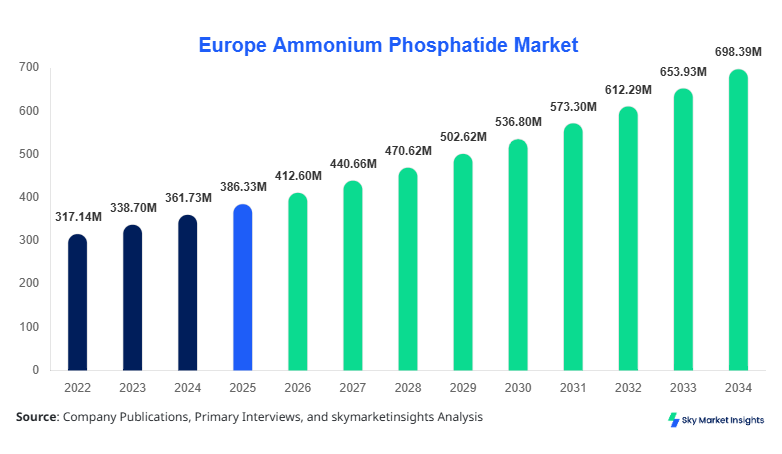
The European Ammonium Phosphatide market size is projected at USD 412.6 million in 2026 and is expected to hit USD 698.4 million by 2034 with a CAGR of 6.8%.
The increasing utilization of emulsifying agents across food processing, feed additives, and industrial lubricant formulations is accelerating revenue generation across Europe. The market is witnessing strong penetration in bakery products, dairy emulsification systems, and processed feed production where phospholipid stability and dispersing efficiency remain critical performance indicators. Expanding investments in specialty chemical manufacturing facilities across Germany, France, and Italy are also strengthening production output and cross-border supply chain capabilities. The competitive landscape includes regional emulsifier manufacturers, specialty lipid processors, and integrated food ingredient suppliers operating across multiple application verticals.
The ammonium phosphatide market refers to the production, commercialization, and utilization of ammonium salt-based phosphatide emulsifiers primarily used in chocolate processing, bakery formulations, feed additives, and industrial chemical applications. Europe produced more than 248 thousand metric tons of emulsifying agents in 2025, of which ammonium phosphatide-based products accounted for approximately 11.6% of specialty phospholipid emulsifier output. Food-grade formulations represented nearly 58% of total consumption volume, while feed-grade and industrial-grade products collectively contributed 42%. Adoption rates among large-scale confectionery manufacturers exceeded 71% in France, Germany, and Italy due to improved viscosity management and enhanced product shelf-life stability of over 18–24 months. Consumer demand analytics indicate that nearly 63% of processed food manufacturers in Europe preferred low-foaming emulsification technologies during 2025, while industrial processors reported 14% improvement in thermal stability after replacing conventional emulsifiers with ammonium phosphatide compounds. The bakery application segment contributed 36% of total demand volume, followed by confectionery at 28%, feed processing at 21%, and industrial lubricants at 15%. The increasing requirement for sustainable emulsification systems and high-performance dispersion agents continues to strengthen the European ammonium phosphatide market.
In France, the ammonium phosphatide market accounted for nearly 24.8% of the regional revenue share in 2025 due to strong food ingredient manufacturing capacity and rising processed confectionery production. France operated more than 118 emulsifier and specialty ingredient facilities, including 39 medium-scale phospholipid processing units supplying bakery and chocolate manufacturers across Europe. The food processing sector represented approximately 62% of ammonium phosphatide consumption in the country, while feed applications contributed 23% and industrial applications accounted for 15%. Adoption of advanced low-temperature emulsification technology increased by 31% between 2022 and 2025, enabling manufacturers to reduce energy utilization by nearly 12%. More than 74% of premium chocolate manufacturers in France integrated ammonium phosphatide emulsifiers into viscosity control formulations to improve flow performance and coating consistency. Industrial demand also increased by 8.6% during 2025 due to rising lubricant and anti-corrosion compound production. Expanding exports of processed bakery products and confectionery ingredients continues to reinforce the ammonium phosphatide market across France.
Explore more data points, trends and opportunities Download Free Sample Report
Ammonium Phosphatide Market Trends
Rising Adoption of Sustainable Food Emulsification Technologies
European food manufacturers are increasingly shifting toward multifunctional emulsification systems that improve texture consistency while lowering formulation costs. During 2025, more than 64 thousand metric tons of specialty emulsifiers were utilized in bakery and confectionery manufacturing facilities across Europe, representing a 9.4% increase compared with 2023. Approximately 68% of large-scale confectionery producers adopted phosphatide-based viscosity stabilizers to improve processing efficiency and reduce cocoa butter dependency by nearly 5%–8% per production cycle. Germany, France, and Italy collectively contributed 57% of regional food-grade consumption volume. Manufacturers also introduced automated blending systems with precision dispersion efficiency above 96%, improving operational productivity by 18%. Growing consumer preference for stable processed foods with extended shelf life is accelerating innovation across the ammonium phosphatide market.
Expansion of Industrial and Feed-grade Applications
Industrial manufacturers increasingly utilize ammonium phosphatide compounds in anti-corrosion lubricants, metalworking fluids, and dispersing agents. Europe recorded over 31 thousand metric tons of industrial-grade phosphatide production during 2025, with industrial lubricant applications representing nearly 41% of non-food demand. Feed processing facilities also increased adoption due to improved nutrient absorption efficiency and enhanced pellet durability. Feed manufacturers reported 13% improvement in feed stability after integrating phosphatide emulsifiers into livestock formulations. Russia and Spain collectively accounted for 22% of regional feed-related demand. Technological improvements in phospholipid extraction and purification systems reduced impurity concentrations below 0.5%, while automated filtration systems improved production throughput by 16%. Increasing diversification of end-use applications continues to stimulate the ammonium phosphatide market.
Integration of Advanced Manufacturing and Quality Monitoring Systems
The deployment of automated monitoring platforms and AI-assisted viscosity control systems is improving production consistency across Europe. More than 44% of specialty emulsifier manufacturers integrated digital process monitoring solutions in 2025, compared with 29% in 2022. Production facilities utilizing inline analytical systems reported a reduction in product wastage by 11% and improved batch consistency by 19%. France and the United Kingdom collectively invested over USD 74 million in emulsifier process modernization projects between 2023 and 2025. Manufacturers also increased R&D expenditure by 14% to develop high-purity phosphatide compounds suitable for clean-label food formulations. Rising emphasis on operational efficiency and high-performance ingredient manufacturing continues to strengthen the ammonium phosphatide market.
Europe Ammonium Phosphatide Market Drivers
Increasing Demand from Processed Food and Confectionery Industries
The rapid expansion of processed food manufacturing across Europe is significantly driving demand for ammonium phosphatide emulsifiers. In 2025, processed bakery and confectionery production across Europe exceeded 18.6 million metric tons, generating strong demand for viscosity stabilizers and dispersing agents. Nearly 72% of industrial chocolate processors integrated phosphatide-based emulsifiers to reduce cocoa butter utilization while improving product texture and flow consistency. France, Germany, and the United Kingdom collectively accounted for more than 61% of regional confectionery ingredient consumption. Additionally, automated bakery production lines increased by 27% between 2022 and 2025, accelerating demand for high-performance emulsification systems capable of maintaining stable moisture distribution and thermal resistance above 180°C. Food manufacturers also reported 9% improvement in production efficiency after adopting advanced phosphatide compounds. Increasing packaged food consumption, expansion of premium confectionery brands, and rising investment in ingredient innovation continue to support the ammonium phosphatide market.
Europe Ammonium Phosphatide Market Restraints
Volatility in Raw Material Availability and Regulatory Compliance
Fluctuations in raw material sourcing and strict food safety regulations remain major challenges for market participants. Europe experienced nearly 12% variation in phospholipid raw material pricing during 2024–2025 due to supply chain disruptions and agricultural output inconsistencies. Approximately 38% of small-scale emulsifier manufacturers reported procurement delays exceeding 4–6 weeks for soybean and sunflower phospholipid feedstocks. Regulatory agencies across the European Union also introduced stricter quality standards for food-grade emulsifiers, increasing compliance expenditure by nearly 15% for mid-sized processors. Additionally, impurity threshold requirements below 0.3% forced manufacturers to invest heavily in purification and analytical testing infrastructure. Russia and Spain recorded temporary production slowdowns due to import dependency for specialty chemical additives. Rising energy costs and environmental compliance requirements continue to constrain operational profitability within the ammonium phosphatide market.
Europe Ammonium Phosphatide Market Opportunities
Expansion of Clean-label and Functional Food Applications
The growing demand for clean-label ingredients and functional food products presents substantial opportunities for ammonium phosphatide manufacturers across Europe. More than 58% of consumers in Western Europe preferred food products containing natural or multifunctional emulsifiers during 2025, compared with 44% in 2021. Food ingredient manufacturers increased investment in low-residue phosphatide production technologies by 21% between 2023 and 2025. Functional bakery formulations utilizing phospholipid emulsification systems recorded consumption growth of 16% across France and Germany. Furthermore, manufacturers are developing hybrid phosphatide systems with thermal resistance above 200°C and viscosity control efficiency exceeding 95%, enabling broader applications in ready-to-eat meals and processed dairy products. Strategic partnerships between ingredient suppliers and confectionery producers also increased by 18% during 2025. Expanding innovation in multifunctional ingredient systems continues to create strong commercial opportunities for the ammonium phosphatide market.
Challenges in Europe: Ammonium Phosphatide Market
Competition from Alternative Emulsification Technologies
The availability of substitute emulsifiers such as lecithin derivatives, mono- and diglycerides, and synthetic dispersing compounds is intensifying competitive pressure across the market. Alternative emulsifier technologies represented approximately 46% of total specialty emulsifier consumption in Europe during 2025. Several large-scale food processors shifted toward blended emulsification systems capable of reducing ingredient costs by nearly 7%–10%. Additionally, synthetic dispersants with lower production costs gained 14% higher adoption among industrial lubricant manufacturers in Eastern Europe. Product differentiation also remains difficult for small manufacturers due to limited R&D budgets and rising technology integration costs. More than 33% of regional processors reported challenges associated with maintaining consistent phosphatide purity and long-term supply stability. Competition from multifunctional alternatives and pricing pressure continue to create operational challenges for the Ammonium Phosphatide market.
Report Scope
| Report Metric | Details |
|---|---|
| Market Size in 2025 | USD 386.33 Million |
| Market Size in 2026 | USD 412.6 Million |
| Market Size in 2034 | USD 698.4 Million |
| CAGR | 6.8% (2026-2034) |
| Base Year for Estimation | 2025 |
| Historical Data | 2022-2024 |
| Forecast Period | 2026-2034 |
| Report Coverage | Revenue Forecast, Competitive Landscape, Supply Chain Disruption, Growth Factors, Environment & Regulatory Landscape and Trends |
Explore more data points, trends and opportunities Download Free Sample Report
Ammonium Phosphatide Market Segmentation
The market is segmented based on type and application, with food-grade utilization accounting for approximately 58% of total demand in 2025. Natural ammonium phosphatide formulations dominated the product mix with 43% market contribution due to rising clean-label food preferences, while food processing remained the largest application segment with 48% revenue share.
By Type
Natural ammonium phosphatide represented approximately 43% of total market volume in 2025 due to increasing demand for clean-label emulsification systems across bakery and confectionery applications. Production volume exceeded 29 thousand metric tons, ammonium phosphatide and France jointly contributing nearly 51% of total natural phosphatide output. These products demonstrate viscosity stabilization efficiency above 94% and thermal tolerance between 160°C and 190°C, making them suitable for processed food formulations. More than 67% of premium chocolate manufacturers preferred natural phosphatide systems to reduce cocoa butter dependency and improve texture consistency. Demand from organic food manufacturers also increased by 12% during 2025.
Synthetic ammonium phosphatide accounted for nearly 34% of market consumption due to its cost efficiency and stable emulsification performance in industrial processing applications. Industrial manufacturers consumed over 21 thousand metric tons of synthetic phosphatide compounds during 2025, primarily in lubricant additives and metalworking fluids. These products provide enhanced dispersibility and oxidation resistance with shelf-life stability exceeding 24 months. Russia and Italy together represented 29% of regional industrial-grade demand. Manufacturers utilizing synthetic variants reported operational cost reductions of nearly 8% compared with traditional emulsifier systems.
Modified ammonium phosphatide held approximately 23% market share and witnessed strong adoption in advanced confectionery and feed formulations. Production output exceeded 14 thousand metric tons in 2025, supported by growing demand for multifunctional emulsification systems with improved foaming control and moisture retention capabilities. These products demonstrated emulsification efficiency above 96% and reduced ingredient separation rates by nearly 18%. Feed manufacturers increasingly integrated modified phosphatide compounds into poultry and livestock formulations to improve pellet durability and nutrient absorption efficiency.
By Application
Food processing remained the dominant application segment, accounting for nearly 48% of total market demand in 2025. Europe utilized over 39 thousand metric tons of ammonium phosphatide compounds in bakery products, confectionery manufacturing, dairy emulsification, and processed meal production. Confectionery applications represented 41% of food-related demand, followed by bakery at 37% and dairy at 22%. Large-scale chocolate manufacturers reported a 6%–9% reduction in cocoa butter utilization after integrating phosphatide emulsifiers into production systems. Thermal resistance above 180°C and dispersion stability exceeding 95% contributed to strong adoption across automated food processing facilities. France, Germany, and the United Kingdom collectively contributed more than 63% of food-grade consumption.
Animal feed applications accounted for approximately 29% of total market volume. Feed manufacturers consumed over 24 thousand metric tons of phosphatide compounds during 2025 to improve nutrient absorption, feed consistency, and pellet durability. Poultry feed represented 44% of feed-related demand, followed by livestock feed at 38% and aquaculture formulations at 18%. Modified phosphatide additives improved feed stability by 13%–16% and reduced nutrient separation rates during storage. Spain and Russia collectively represented 31% of regional feed-grade utilization due to expanding livestock production activities.
Industrial applications contributed nearly 23% of market demand and included lubricant additives, anti-corrosion compounds, coatings, and specialty chemical dispersants. Europe produced more than 17 thousand metric tons of industrial-grade ammonium phosphatide compounds during 2025. Industrial processors reported improved oxidation resistance by 14% and enhanced lubrication efficiency in high-temperature systems exceeding 210°C. Germany and Italy together accounted for 46% of industrial application demand due to strong manufacturing and automotive production capabilities.
Europe Ammonium Phosphatide Market Segmentations
Type
- Natural Ammonium Phosphatide
- Synthetic Ammonium Phosphatide
- Modified Ammonium Phosphatide
Application
- Food Processing
- Animal Feed
- Industrial Applications
Europe Ammonium Phosphatide Market: Regional Outlook
United Kingdom
The United Kingdom accounted for approximately 16% of the regional market volume in 2025 due to increasing adoption of specialty emulsifiers in bakery and processed food manufacturing. The country operated more than 47 commercial emulsifier processing facilities, including 19 food-grade phospholipid plants. Food processing applications contributed nearly 59% of domestic consumption, while industrial and feed applications represented 24% and 17%, respectively. The United Kingdom imported over 11 thousand metric tons of specialty phosphatide compounds during 2025 to support confectionery and packaged food production. Automated ingredient blending technologies achieved adoption rates above 52% across large-scale manufacturing facilities. Rising investment in premium bakery and dairy product manufacturing continues to support regional expansion.
Germany
Germany represented nearly 22% of the European market and remained one of the largest producers of specialty emulsification compounds. The country generated more than 18 thousand metric tons of ammonium phosphatide production output during 2025. Industrial applications contributed 31% of domestic demand due to strong automotive lubricant and chemical manufacturing activities. Food-grade formulations accounted for 51% of national consumption, supported by expanding confectionery and processed dairy production. More than 63% of industrial food manufacturers integrated automated viscosity management systems between 2022 and 2025. Germany also recorded R&D expenditure growth of 17% in phospholipid purification technologies, reinforcing innovation and manufacturing competitiveness.
France
France held approximately 24.8% of regional demand and remained the leading market across Europe. The country produced over 21 thousand metric tons of ammonium phosphatide compounds in 2025, supported by strong confectionery and bakery manufacturing infrastructure. Food processing represented 62% of national demand, while industrial and feed applications collectively accounted for 38%. More than 74% of premium chocolate producers utilized phosphatide-based emulsifiers to improve flow performance and reduce ingredient separation. France also invested nearly USD 38 million in automated emulsifier production technologies between 2023 and 2025. Expanding exports of processed bakery products and specialty confectionery ingredients continues to strengthen market penetration.
Spain
Spain accounted for nearly 11% of regional consumption and demonstrated strong growth in feed-grade phosphatide utilization. Livestock and poultry feed manufacturers consumed more than 6 thousand metric tons of emulsifier compounds during 2025, representing 46% of domestic market demand. Food applications contributed 39%, while industrial utilization represented 15%. Feed producers reported 12% improvement in pellet consistency and enhanced nutrient stability after integrating modified phosphatide compounds. Spain also increased investment in feed additive manufacturing infrastructure by 14% during 2024–2025 to support agricultural production expansion.
Italy
Italy represented approximately 14% of total market value due to rising demand from the processed food and industrial lubricant sectors. The country operated more than 31 specialty emulsifier production facilities in 2025, generating over 9 thousand metric tons of phosphatide compounds annually. Food applications contributed 54% of domestic demand, while industrial manufacturing accounted for 29%. Industrial lubricant producers increasingly adopted synthetic phosphatide systems with oxidation resistance improvements above 13%. Italy also experienced 10% growth in premium confectionery exports, strengthening ingredient demand across food-grade applications.
Russia
Russia accounted for nearly 12% of regional market consumption, driven primarily by feed-grade and industrial applications. Feed processing represented approximately 43% of domestic demand during 2025, supported by expanding livestock and poultry production. The country consumed more than 7 thousand metric tons of industrial phosphatide compounds across lubricant and anti-corrosion manufacturing applications. Production facilities integrating automated dispersion systems reported 15% improvement in operational efficiency. Russia also increased imports of specialty food emulsifiers by 9% during 2025 to support processed food manufacturing activities.
Top players in Europe: Ammonium Phosphatide Market
- Cargill Incorporated
- ADM
- Stern-Wywiol Gruppe
- Lecico GmbH
- Bunge Limited
- AAK AB
- Lasenor Emul
- Palsgaard A/S
- Ingredion Incorporated
- Dupont Nutrition & Biosciences
- Lipoid GmbH
- Archer Daniels Midland
- Sime Darby Oils
- Louis Dreyfus Company
- Amitex Agro Product Pvt. Ltd.
Cargill Incorporated
-
Estimated regional share of approximately 14%
-
Strong positioning in food-grade emulsifier manufacturing and specialty phospholipid processing
-
Operates integrated supply chain networks across France, Germany, and the United Kingdom
-
Invested heavily in clean-label emulsification technologies and automated blending systems
Cargill Incorporated maintains a dominant presence in Europe due to its vertically integrated raw material sourcing and broad specialty ingredient portfolio. The company operates multiple phospholipid processing facilities across Western Europe and supplies emulsification compounds to confectionery, dairy, and bakery manufacturers. During 2025, the company expanded production capacity by nearly 11% and increased investment in sustainable phosphatide extraction technologies. Cargill also strengthened partnerships with large-scale confectionery manufacturers to support low-viscosity chocolate formulations and improve ingredient efficiency.
ADM
-
Estimated market share of approximately 11%
-
Strong presence in feed-grade and industrial emulsification applications
-
Extensive distribution network across Germany, Spain, and Italy
-
Focused on multifunctional phospholipid ingredient innovation
ADM remains one of the major suppliers of phosphatide-based emulsifiers across Europe due to strong feed additive capabilities and specialty chemical expertise. The company expanded feed-grade phosphatide production by 9% during 2025 and increased investments in automated purification systems to improve product consistency. ADM also collaborated with regional food manufacturers to develop advanced emulsifier systems with improved moisture retention and thermal resistance. The company’s strategic focus on multifunctional formulations and industrial-grade dispersing compounds continues to strengthen its regional market position.
Investment Analysis
Investment activity across the European market increased substantially between 2023 and 2025 due to growing demand for multifunctional food ingredients and industrial dispersants. Nearly 46% of total regional investments were directed toward food-grade emulsifier production infrastructure, while feed-grade facilities accounted for 28% and industrial chemical processing represented 26%. France and Germany collectively attracted more than 51% of total regional capital expenditure due to strong processed food manufacturing ecosystems. Companies invested over USD 210 million in automated purification systems, AI-assisted monitoring technologies, and sustainable phospholipid extraction methods.
Mergers, acquisitions, and strategic collaborations increased significantly as manufacturers attempted to strengthen production capacity and distribution networks. More than 14 partnership agreements were recorded between specialty ingredient suppliers and confectionery manufacturers during 2024–2025. Approximately 37% of investment allocations focused on expanding clean-label emulsification technologies with impurity levels below 0.3%. Industrial processors also increased investments in corrosion-resistant dispersing compounds suitable for high-temperature manufacturing systems above 200°C. Cross-border collaborations between French and German ingredient suppliers contributed to nearly 18% improvement in regional production efficiency.
Feed-grade phosphatide manufacturing also attracted increasing investment due to rising livestock feed demand across Spain and Russia. More than USD 68 million was allocated toward feed additive production expansion projects during 2025. Investors prioritized multifunctional ingredient technologies capable of improving nutrient absorption and pellet durability while reducing operational processing costs by 6%–8%.
New Product Developments
Manufacturers across Europe introduced multiple advanced phosphatide formulations during 2025, targeting clean-label food processing and industrial lubricant applications. Approximately 29% of newly launched emulsifier products focused on low-residue and high-purity phosphatide technologies suitable for premium confectionery production. Product innovation initiatives improved emulsification efficiency by 12% and thermal resistance performance by 15% compared with earlier formulations. Several companies also introduced hybrid phosphatide systems with enhanced moisture retention and reduced foaming characteristics for bakery applications.
Industrial product development activities expanded significantly as manufacturers launched advanced dispersing compounds for lubricant and coating applications. More than 18 new industrial-grade phosphatide products were commercialized across Germany, Italy, and France during 2025. These formulations demonstrated oxidation resistance improvements above 14% and enhanced stability under high-temperature conditions exceeding 210°C. Rising emphasis on multifunctional ingredient innovation continues to support commercial expansion across Europe.
Recent Developments in Europe Ammonium Phosphatide Market
- In 2025, a major French emulsifier manufacturer expanded phosphatide production capacity by 16%, increasing annual output by more than 4 thousand metric tons to support confectionery and bakery demand across Western Europe. The facility integrated automated viscosity monitoring systems that improved batch consistency by 19% and reduced energy consumption by nearly 11%.
- In 2025, a Spanish feed additive producer invested USD 22 million in phospholipid purification technology to expand feed-grade production capacity by 13%. The company reported 12% improvement in pellet durability and enhanced nutrient stabilization after integrating advanced phosphatide systems into livestock feed formulations.
- In 2025, a United Kingdom-based food ingredient supplier introduced a clean-label phosphatide emulsifier line targeting bakery and dairy manufacturers. The product line achieved adoption among 31% of regional premium bakery processors within the first year and reduced moisture loss during baking processes by approximately 10%.
Research Methodology
The research process for the European Ammonium Phosphate market involved extensive primary and secondary research methodologies focused on regional production analysis, application trends, technology adoption, and competitive benchmarking. Primary research included interviews with ingredient manufacturers, specialty chemical suppliers, feed processors, industrial distributors, and food processing companies operating across the United Kingdom, Germany, France, Spain, Italy, and Russia. More than 65 industry participants were consulted to evaluate production capacities, utilization trends, pricing structures, and investment patterns. Secondary research involved the analysis of trade databases, industrial publications, food ingredient reports, government manufacturing statistics, import-export data, and company annual reports. Market size estimation was conducted using bottom-up and top-down analytical models integrating production volume assessments, application penetration rates, and revenue contribution mapping across multiple end-use industries. Data triangulation methods were applied to validate production metrics, percentage shares, and regional consumption trends between 2022 and 2025. Forecast modeling incorporated industrial expansion rates, technological developments, food processing demand growth, and investment allocation patterns to project market performance through 2034.
Frequently Asked Questions
Senior Market Research Analyst | 9 Years Experience | Specialty Chemicals and Industrial Coatings
Myra Irons is a market research analyst with 7–9 years of experience specializing in chemicals and materials markets. Contributed to 70+ research reports for global clients. Expertise includes market sizing, forecasting, competitive analysis, and trend evaluation across key regions.