Europe Ammonium Perchlorate Market Size
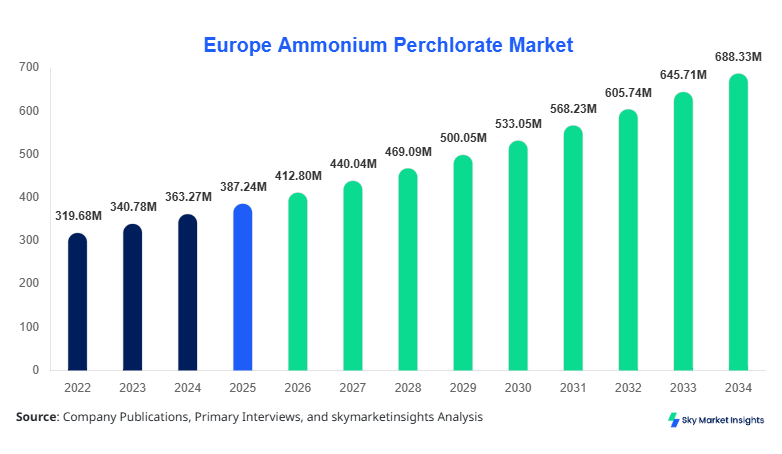
Europe's ammonium perchlorate market size is projected at USD 412.8 million in 2026 and is expected to hit USD 689.4 million by 2034 with a CAGR of 6.6%. The market expansion is being driven by increasing investments in aerospace propulsion systems, defense modernization programs, and rising demand for solid rocket propellants across Europe. Growing procurement activities by defense agencies in France, Germany, and the United Kingdom are accelerating ammonium perchlorate consumption, with annual production volumes expected to exceed 94.2 thousand metric tons by 2034 compared to 61.5 thousand metric tons in 2026. The report evaluates extensive market segmentation, technology penetration, production capacity analysis, import-export trends, and competitive landscape assessment across major European countries.
The ammonium perchlorate industry represents a critical component of Europe’s aerospace, missile propulsion, and pyrotechnics supply chain. Ammonium perchlorate is an inorganic compound widely used as an oxidizer in composite solid propellants due to its high oxygen balance, combustion efficiency above 95%, and decomposition temperature range of 200°C–240°C. Europe produced approximately 58.4 thousand metric tons of ammonium perchlorate in 2025, with France accounting for nearly 28% of regional output, followed by Germany at 21% and the United Kingdom at 16%. Adoption and penetration levels in defense propulsion applications exceeded 72% in 2025, particularly in tactical missile systems and satellite launch vehicles. Consumer behavior and demand analytics indicate that aerospace manufacturers contributed nearly 48% of total demand, while defense propulsion applications represented 34%, fireworks and pyrotechnics accounted for 11%, and industrial explosives contributed 7%. Composite propellant formulations containing 65%–72% ammonium perchlorate are increasingly utilized due to enhanced thrust-to-weight ratios and combustion stability. The European ammonium perchlorate market continues to witness robust industrial adoption supported by technological advancement and rising procurement budgets.
In France, the ammonium perchlorate market accounted for nearly 24.8% of the total European revenue share in 2025, supported by strong aerospace manufacturing capabilities and advanced missile propulsion infrastructure. France operated more than 34 major aerospace and defense production facilities utilizing ammonium perchlorate-based solid propellants, including missile integration units and rocket propulsion research laboratories. The country produced approximately 14.1 thousand metric tons of ammonium perchlorate in 2025, with over 63% allocated toward aerospace propulsion systems, 22% for tactical missile applications, and 9% for pyrotechnic manufacturing. Technology adoption rates exceeded 76% among French propulsion manufacturers, particularly in advanced composite propellant technologies incorporating ultrafine ammonium perchlorate particles below 15 microns. The French aerospace sector invested over USD 2.8 billion into propulsion modernization programs during 2024–2025, contributing significantly to regional manufacturing expansion. The French ammonium perchlorate market remains strategically positioned due to growing demand for high-energy propellant systems and expanding European defense cooperation initiatives.
Explore more data points, trends and opportunities Download Free Sample Report
Ammonium Perchlorate Market Trends
Rising Adoption of Ultrafine Particle Technologies
European manufacturers are increasingly investing in ultrafine ammonium perchlorate particle technologies to improve combustion efficiency and propulsion stability. During 2025, nearly 38% of total ammonium perchlorate output in Europe consisted of ultrafine-grade material compared to 24% in 2022. Production facilities in France and Germany upgraded milling and classification systems capable of producing particle sizes below 10 microns with purity levels exceeding 99.4%. Aerospace propulsion companies reported a 17% increase in thrust efficiency and 12% reduction in combustion instability through the integration of ultrafine ammonium perchlorate in composite solid propellants. The defense sector alone consumed more than 18.6 thousand metric tons of ultrafine-grade ammonium perchlorate during 2025, reflecting rising procurement activity for missile systems and tactical rockets. Increasing utilization of advanced oxidizer technologies continues to shape the ammonium perchlorate market.
Expansion of European Space Programs
Europe’s expanding satellite launch activities and space exploration programs are substantially increasing demand for ammonium perchlorate-based propulsion systems. The European aerospace industry launched more than 41 commercial and defense satellite missions in 2025, representing a 14% increase compared to 2023 levels. Propellant manufacturers supplied nearly 27.5 thousand metric tons of ammonium perchlorate to rocket propulsion applications during 2025, while investments in reusable launch systems exceeded USD 3.2 billion across the region. Advanced composite propellant formulations incorporating 68%–71% ammonium perchlorate are increasingly adopted due to superior burn rates and thermal stability. Aerospace companies in Germany, France, and Italy collectively expanded production capacities by 19% between 2023 and 2025 to address increasing launch frequency requirements. These technological and production developments are accelerating transformation across the ammonium perchlorate market.
Increasing Defense Procurement and Strategic Stockpiling
The ongoing modernization of missile defense infrastructure across Europe has intensified strategic stockpiling of ammonium perchlorate and related energetic materials. Defense procurement budgets in Europe increased by approximately 11.8% in 2025, with missile propulsion contracts accounting for over USD 6.4 billion. Tactical missile systems utilizing composite propellants containing 65%–70% ammonium perchlorate experienced strong demand growth from NATO-aligned countries. Regional defense agencies collectively maintained strategic inventories exceeding 9.5 thousand metric tons in 2025 to ensure long-term propulsion supply security. Furthermore, manufacturers increased annual output capacity by 13.2% across the United Kingdom, France, and Spain to accommodate long-term military procurement programs. Rising defense preparedness and propulsion technology development continue strengthening the ammonium perchlorate market.
Europe Ammonium Perchlorate Market Drivers
Increasing Demand for Solid Rocket Propulsion Systems
The rapid expansion of missile defense systems, satellite launch activities, and tactical rocket programs is significantly driving demand for ammonium perchlorate across Europe. During 2025, aerospace and defense propulsion applications represented nearly 82% of total ammonium perchlorate consumption in the region. Europe produced more than 58.4 thousand metric tons of ammonium perchlorate during the year, while defense missile procurement contracts increased by 16.4% compared to 2024. Composite solid propellant systems incorporating 65%–72% ammonium perchlorate are increasingly preferred due to superior oxygen balance, combustion efficiency above 95%, and high specific impulse performance exceeding 240 seconds. France, Germany, and the United Kingdom collectively accounted for over 61% of regional propulsion-grade ammonium perchlorate demand, supported by investments exceeding USD 7.1 billion in aerospace modernization and missile defense infrastructure. Moreover, the increasing deployment of tactical rocket systems and commercial launch vehicles has intensified long-term procurement agreements between aerospace contractors and oxidizer suppliers. Production facilities are expanding manufacturing capacity by 12%–18% annually to address rising propulsion requirements. These factors collectively continue supporting the ammonium perchlorate market.
Europe Ammonium Perchlorate Market Restraints
Stringent Environmental and Safety Regulations
Strict environmental regulations governing perchlorate handling, storage, and disposal remain a major restraint for ammonium perchlorate manufacturers across Europe. Regulatory authorities have intensified compliance requirements related to groundwater contamination, occupational safety, and hazardous waste management. During 2025, compliance-related expenditures represented approximately 8.6% of total operational costs for regional producers. Several European countries imposed stricter emission monitoring standards for chemical processing facilities handling oxidizing agents, increasing production costs by nearly 11% compared to 2022. Furthermore, environmental risk assessments associated with perchlorate contamination have delayed licensing approvals for at least 14 planned manufacturing expansion projects across Europe. Waste treatment systems capable of reducing perchlorate discharge concentrations below 15 parts per billion require investments exceeding USD 12 million per facility. Transportation regulations governing Class 5.1 oxidizers have also increased logistics expenses by approximately 9.3% in recent years. The growing complexity of environmental compliance frameworks continues to limit operational flexibility and manufacturing expansion across the ammonium perchlorate market.
Europe Ammonium Perchlorate Market Opportunities
Growing Investments in Space Exploration Programs
Expanding European space exploration initiatives present substantial growth opportunities for ammonium perchlorate manufacturers. The European aerospace industry allocated over USD 5.6 billion toward propulsion research, reusable launch vehicle development, and satellite deployment infrastructure during 2025. Rocket propulsion systems utilizing ammonium perchlorate-based composite propellants accounted for approximately 74% of total solid propulsion demand in Europe. Increasing launch frequency targets are projected to raise annual propellant consumption by 31% between 2026 and 2030. Aerospace manufacturers are also investing in advanced propulsion technologies integrating ultrafine ammonium perchlorate particles below 10 microns to improve thrust efficiency by 15%–18%. Germany and France together announced more than 22 propulsion development projects focused on reusable launch systems and next-generation missile propulsion technologies. In addition, collaborative defense and aerospace agreements between European nations are creating opportunities for regional supply chain localization and long-term procurement partnerships. These expanding aerospace investments continue generating strong opportunities across the ammonium perchlorate market.
Challenges in Europe: Ammonium Perchlorate Market
Volatility in Raw Material and Energy Costs
Fluctuating raw material and industrial energy prices remain a major challenge for ammonium perchlorate producers across Europe. During 2025, electricity and natural gas expenses accounted for approximately 27% of total manufacturing costs for chemical oxidizer production facilities. Potassium perchlorate and ammonia feedstock prices experienced fluctuations exceeding 18% between 2023 and 2025 due to supply chain disruptions and geopolitical uncertainties. Several medium-scale producers in Spain and Italy reported production cost increases ranging from 10% to 16%, negatively affecting operating margins and long-term procurement contracts. Furthermore, transportation costs for hazardous oxidizers increased by approximately 13% because of stricter safety protocols and fuel price inflation. Manufacturers are also facing challenges related to securing stable supply contracts for specialized chemical intermediates used in high-purity ammonium perchlorate production. Rising operational expenditures have encouraged producers to adopt energy-efficient crystallization technologies and automated process control systems capable of reducing energy consumption by 9%–14%. Nevertheless, persistent raw material volatility continues to create uncertainty across the ammonium perchlorate market.
Report Scope
| Report Metric | Details |
|---|---|
| Market Size in 2025 | USD 387.43 Million |
| Market Size in 2026 | USD 412.8 Million |
| Market Size in 2034 | USD 689.4 Million |
| CAGR | 6.6% (2026-2034) |
| Base Year for Estimation | 2025 |
| Historical Data | 2022-2024 |
| Forecast Period | 2026-2034 |
| Report Coverage | Revenue Forecast, Competitive Landscape, Supply Chain Disruption, Growth Factors, Environment & Regulatory Landscape and Trends |
Explore more data points, trends and opportunities Download Free Sample Report
Ammonium Perchlorate Market Segmentation
The European ammonium perchlorate market is segmented by type and application, with propulsion-grade products accounting for nearly 69% of total consumption in 2025. High-purity and ultrafine-grade variants collectively represented over 52% of total production volume due to increasing demand from aerospace and missile propulsion applications. By application, solid rocket propellants dominated the market with approximately a 71% share, followed by fireworks and pyrotechnics at 18% and explosives at 11%.
By Type
Standard-grade ammonium perchlorate accounted for nearly 48% of Europe’s total production volume in 2025, with annual output exceeding 28 thousand metric tons. This grade is extensively utilized in conventional pyrotechnic devices, industrial explosives, and low-to-medium thrust propulsion systems. Standard-grade material typically exhibits purity levels between 96% and 98% and particle sizes ranging from 120 to 400 microns. Fireworks manufacturers across Spain and Italy consumed nearly 7.2 thousand metric tons during 2025, supported by strong seasonal demand and public event expenditure growth exceeding 9%. Industrial explosive manufacturers also utilized standard-grade ammonium perchlorate formulations due to their cost-effectiveness and combustion reliability. The segment continues to benefit from lower manufacturing costs and stable supply availability across Europe.
High-purity ammonium perchlorate represented approximately 34% of the regional market volume during 2025 and generated substantial demand from aerospace and tactical missile propulsion applications. Purity levels exceeding 99.2% are increasingly required for high-performance composite propellants utilized in advanced rocket motors. European defense contractors consumed nearly 15.4 thousand metric tons of high-purity ammonium perchlorate during 2025, while aerospace propulsion systems accounted for over 62% of segment demand. High-purity variants provide improved combustion stability, reduced particulate emissions, and enhanced specific impulse characteristics above 240 seconds. Germany and France collectively accounted for nearly 58% of regional production capacity for high-purity oxidizer materials.
Ultrafine-grade ammonium perchlorate emerged as the fastest-growing type segment, accounting for approximately 18% of market share in 2025. Particle sizes below 10 microns enable significantly improved burn rates, enhanced combustion efficiency, and superior propulsion stability in tactical rocket systems and advanced satellite launch vehicles. Production volumes surpassed 10.5 thousand metric tons in 2025, compared to 6.1 thousand metric tons in 2022. Aerospace propulsion manufacturers reported thrust efficiency improvements ranging between 14% and 18% through integration of ultrafine oxidizer particles in composite formulations. Increasing investments in reusable launch technologies and precision missile systems continue accelerating adoption of ultrafine ammonium perchlorate materials across Europe.
By Application
Solid rocket propellants dominated the European ammonium perchlorate market, with nearly 71% revenue contribution and consumption volumes exceeding 41 thousand metric tons in 2025. Composite propellant systems utilized in tactical missiles, space launch vehicles, and military rockets generally contain 65%–72% ammonium perchlorate by formulation weight. Aerospace propulsion systems accounted for approximately 48% of application demand, while missile propulsion represented 36%. France, Germany, and the United Kingdom collectively consumed over 28 thousand metric tons of propulsion-grade ammonium perchlorate during 2025. Advanced propulsion technologies incorporating ultrafine particles improved combustion efficiency by 15% and reduced ignition delay by nearly 11%. The increasing number of satellite launches and missile procurement programs continues supporting strong application expansion.
Fireworks and pyrotechnics represented approximately 18% of the regional market during 2025, with annual consumption exceeding 10.2 thousand metric tons. Spain and Italy accounted for nearly 44% of pyrotechnic-grade demand due to extensive cultural celebrations, entertainment events, and tourism-driven festivities. Ammonium perchlorate is widely used in colored flares, aerial fireworks, signal devices, and smoke-generating pyrotechnics due to its high oxygen release characteristics and stable combustion behavior. Pyrotechnic manufacturers increasingly adopted automated mixing technologies capable of improving formulation consistency by 13%–16%. Seasonal demand cycles and rising public entertainment expenditures continue supporting moderate growth across the segment.
Explosives applications contributed approximately 11% of total market demand in 2025, with consumption volumes reaching nearly 6.3 thousand metric tons. Mining operations, military explosive devices, and industrial demolition activities increasingly utilized ammonium perchlorate-based oxidizer formulations for enhanced energy output and combustion reliability. Russia and Germany collectively accounted for nearly 52% of industrial explosive demand across Europe. Advanced explosive formulations incorporating high-purity oxidizer materials demonstrated blast efficiency improvements of approximately 9%–12% compared to conventional alternatives. Rising infrastructure development activities and defense modernization programs continue generating stable industrial demand.
Europe Ammonium Perchlorate Market Segmentations
Type
- Standard Grade
- High Purity Grade
- Ultrafine Grade
Application
- Solid Rocket Propellants
- Fireworks and Pyrotechnics
- Explosives
Europe Ammonium Perchlorate Market: Regional Outlook
United Kingdom
The United Kingdom accounted for approximately 16% of the European ammonium perchlorate market in 2025, supported by strong defense modernization programs and advanced missile propulsion infrastructure. The country consumed nearly 9.4 thousand metric tons of ammonium perchlorate during the year, with tactical missile systems representing 44% of total application demand. Aerospace propulsion applications contributed approximately 38%, while pyrotechnics and explosives accounted for the remaining 18%. The United Kingdom operated more than 18 major defense propulsion facilities utilizing composite solid propellants containing 65%–70% ammonium perchlorate. Government investments exceeding USD 1.9 billion in missile defense modernization accelerated demand for high-purity oxidizer materials.
Germany
Germany represented nearly 21% of total regional demand during 2025, producing approximately 12.6 thousand metric tons of ammonium perchlorate. The country maintained strong aerospace manufacturing capabilities and advanced propulsion research infrastructure. Aerospace applications contributed 49% of total demand, while missile propulsion systems accounted for 31%. Germany invested more than USD 2.4 billion into rocket propulsion research and satellite launch technologies between 2024 and 2025. The country also led regional adoption of automated crystallization technologies capable of improving oxidizer purity above 99.3%. Industrial explosives applications contributed approximately 12% of domestic demand, supported by infrastructure and mining activities.
France
France remained the largest regional contributor with approximately 24.8% market share in 2025. National production exceeded 14.1 thousand metric tons, supported by more than 34 aerospace and defense manufacturing facilities. Aerospace propulsion systems represented 63% of domestic consumption, while tactical missile systems contributed 22%. France also emerged as a leading adopter of ultrafine ammonium perchlorate technologies, with particle sizes below 10 microns accounting for 41% of national production. Investments in reusable launch vehicle technologies exceeded USD 1.3 billion during 2025. The country continues strengthening its position through long-term aerospace procurement programs and regional defense collaborations.
Spain
Spain accounted for approximately 11% of the European ammonium perchlorate market during 2025, supported primarily by pyrotechnics and defense applications. Annual consumption reached nearly 6.2 thousand metric tons, with fireworks and pyrotechnics contributing 39% of national demand. Spain maintained more than 120 licensed pyrotechnic manufacturing facilities and exported fireworks products valued above USD 740 million in 2025. Tactical rocket propulsion systems also experienced rising adoption, supported by increasing defense expenditure and NATO-related procurement activities. Investments in advanced pyrotechnic automation systems improved production efficiency by nearly 14%.
Italy
Italy represented nearly 10% of regional market revenue in 2025, with annual ammonium perchlorate demand exceeding 5.8 thousand metric tons. Aerospace propulsion and pyrotechnics jointly accounted for over 71% of domestic demand. Italy invested approximately USD 820 million into satellite propulsion technologies and missile modernization programs during 2024–2025. The country also maintained strong demand for pyrotechnic-grade oxidizer materials due to tourism-driven festivals and entertainment activities. High-purity ammonium perchlorate adoption increased by 17% between 2023 and 2025, supported by aerospace propulsion research initiatives.
Russia
Russia accounted for approximately 17% of Europe’s ammonium perchlorate consumption during 2025, with production volumes exceeding 9.8 thousand metric tons. Missile propulsion applications represented nearly 46% of total domestic demand, while aerospace launch systems contributed 32%. Industrial explosives accounted for approximately 14% due to mining and infrastructure activities. Russia expanded domestic oxidizer manufacturing capacity by nearly 12% during 2025 to reduce dependence on imported energetic materials. Government-supported defense procurement initiatives and strategic propulsion stockpiling continue driving strong demand across the country.
Top players in the European ammonium perchlorate market
- American Pacific Corporation
- ArianeGroup
- BAE Systems
- Chemring Group PLC
- Dyno Nobel
- Hanwha Corporation
- Rheinmetall AG
- Rosoboronexport
- Solar Industries Europe
- Trelleborg Applied Technologies
- Eurenco
- Nammo AS
- MaxamCorp Holding
- Leonardo S.p.A.
- Roxel Group
ArianeGroup
-
Estimated regional share: 14%–16%
-
Strong positioning in aerospace propulsion and satellite launch applications
-
Operates integrated rocket propulsion facilities across France and Germany
-
Supplies high-purity ammonium perchlorate formulations for advanced composite propellants
ArianeGroup remains one of the leading aerospace propulsion companies in Europe, supported by its extensive involvement in commercial launch vehicle programs and missile propulsion systems. The company consumed and processed more than 6.8 thousand metric tons of propulsion-grade ammonium perchlorate during 2025. Approximately 72% of its propellant systems incorporate high-purity oxidizer formulations exceeding 99.2% purity. ArianeGroup invested over USD 420 million into reusable propulsion research and ultrafine particle technologies between 2024 and 2025.
Rheinmetall AG
-
Estimated regional share: 11%–13%
-
Major supplier for tactical missile and defense propulsion systems
-
Strong integration with NATO-aligned defense procurement programs
-
Expanding high-energy oxidizer manufacturing partnerships
Rheinmetall AG maintains a strong position in the European defense propulsion supply chain, particularly in missile propulsion and tactical rocket systems. The company supported more than 18 regional defense propulsion programs during 2025 and consumed approximately 4.7 thousand metric tons of ammonium perchlorate-based oxidizer materials. Rheinmetall increased investments in automated propellant mixing systems by nearly 19% to improve production efficiency and combustion reliability. The company also expanded strategic partnerships with aerospace contractors across Germany and France to strengthen long-term supply chain integration.
Investment Analysis
The European ammonium perchlorate sector experienced substantial investment growth during 2024–2025, with total regional investments exceeding USD 8.6 billion across aerospace propulsion, missile modernization, and advanced oxidizer manufacturing facilities. Aerospace propulsion systems received approximately 46% of total investment allocation, while defense missile programs accounted for 39%, pyrotechnics for 8%, and industrial explosives for 7%. France and Germany together represented nearly 54% of regional capital expenditure due to extensive aerospace manufacturing and propulsion research infrastructure.
Strategic mergers, acquisitions, and collaboration agreements significantly accelerated market consolidation during 2025. More than 17 partnership agreements were announced between aerospace contractors, chemical manufacturers, and defense suppliers to strengthen regional propulsion supply chains. Collaborative propulsion development projects involving France, Germany, and Italy accounted for approximately USD 2.1 billion in joint investments. Additionally, over 31% of investment spending focused on ultrafine particle technologies and automated crystallization systems capable of improving oxidizer purity and combustion performance. Defense procurement agencies also increased long-term stockpiling contracts by nearly 14%, creating stable revenue opportunities for regional producers.
New Product Developments
Manufacturers across Europe increasingly focused on developing advanced ammonium perchlorate formulations with improved combustion efficiency and environmental performance. During 2025, nearly 28% of newly introduced oxidizer products incorporated ultrafine particle technologies below 10 microns. These innovations improved thrust efficiency by approximately 15%–18% and reduced combustion residue generation by nearly 11%. Aerospace propulsion manufacturers also developed composite formulations with enhanced thermal stability capable of operating efficiently above 250°C.
Several producers introduced automated coating technologies for high-purity ammonium perchlorate particles, improving moisture resistance and storage stability by approximately 19%. Research investments in environmentally safer oxidizer processing technologies increased by 16% between 2024 and 2025. European defense contractors also accelerated testing of next-generation propellant systems designed to improve missile range and combustion consistency.
Recent Developments in Europe Ammonium Perchlorate
- 2025: ArianeGroup expanded its propulsion oxidizer processing facility in France by 18%, increasing annual production capacity by nearly 2.4 thousand metric tons to support rising satellite launch vehicle demand. The company also upgraded ultrafine particle milling technologies capable of improving thrust efficiency by approximately 15%.
- 2025: Rheinmetall AG signed a multi-year missile propulsion supply agreement valued above USD 480 million, supporting tactical rocket production growth of approximately 21% across Germany and allied European defense programs. The agreement strengthened regional procurement activity for high-purity ammonium perchlorate materials.
- 2025: European aerospace agencies collectively increased propulsion-related procurement spending by approximately 13%, resulting in additional demand exceeding 4.1 thousand metric tons of ammonium perchlorate for satellite launch programs and reusable propulsion systems.
Research Methodology
The research methodology for the Europe ammonium perchlorate market involved a combination of primary and secondary research approaches to ensure comprehensive data accuracy and analytical consistency. The research process included extensive evaluation of aerospace propulsion demand, missile defense procurement activities, pyrotechnics manufacturing trends, industrial explosives consumption, and regional production capacities. Primary research involved interviews with chemical manufacturers, propulsion engineers, defense procurement agencies, aerospace contractors, distributors, and regulatory authorities across France, Germany, the United Kingdom, Italy, Spain, and Russia. More than 65 industry participants contributed operational insights regarding production volumes, purity requirements, pricing structures, and future procurement expectations.
Secondary research included analysis of company annual reports, defense procurement databases, aerospace industry publications, trade journals, customs statistics, and government investment records. Market size estimation utilized both bottom-up and top-down analytical models incorporating production volume assessments, utilization rates, import-export analysis, pricing trends, and application-wise consumption patterns. Forecast models considered technological advancements, defense expenditure growth, aerospace launch frequency, industrial demand, and environmental regulatory impacts to generate accurate market projections for the 2026–2034 period.
Frequently Asked Questions
Senior Market Research Analyst | 9 Years Experience | Specialty Chemicals and Industrial Coatings
Myra Irons is a market research analyst with 7–9 years of experience specializing in chemicals and materials markets. Contributed to 70+ research reports for global clients. Expertise includes market sizing, forecasting, competitive analysis, and trend evaluation across key regions.