Europe's Ammonia Remover Market Size
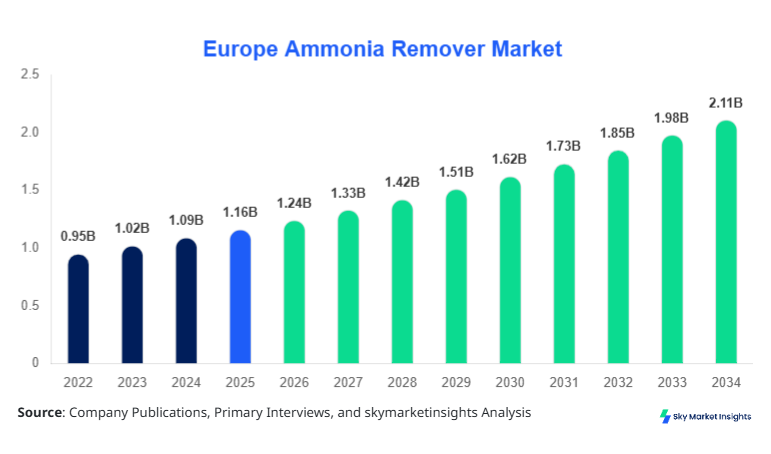
Europe's ammonia remover market size is projected at USD 1.24 billion in 2026 and is expected to hit USD 2.11 billion by 2034 with a CAGR of 6.9%. The market expansion is supported by rising industrial sanitation requirements, wastewater purification demand, and stricter European environmental regulations concerning ammonia emissions across manufacturing and municipal sectors. Increasing investment in industrial cleaning chemicals, growth in household hygiene consumption, and expansion of water treatment infrastructure across Germany, France, and the United Kingdom are reshaping competitive intensity and product innovation strategies. The report evaluates production capacities, import-export dynamics, pricing structures, distribution channels, end-user penetration, and competitive benchmarking across the European ammonia remover market.
The ammonia remover industry refers to chemical formulations designed to neutralize, absorb, or eliminate ammonia compounds from industrial equipment, water systems, household surfaces, and air purification systems. In Europe, annual ammonia remover production exceeded 412 kilotons in 2025, with Germany accounting for nearly 29% of regional output volume, followed by France at 17% and the United Kingdom at 15%. Industrial cleaning applications represented approximately 46% of total demand, while household cleaning accounted for 31% and water treatment applications contributed 23% of regional consumption. Adoption rates among municipal wastewater treatment facilities increased from 54% in 2022 to nearly 68% in 2025 due to tightening nitrogen discharge standards across the European Union. Consumer purchasing behavior also shifted significantly, as over 61% of surveyed commercial cleaning operators preferred low-toxicity and biodegradable ammonia remover formulations during 2025. Household penetration across urban Europe reached 37%, particularly in Germany, Italy, and Spain where demand for odor-neutralizing cleaning products expanded by more than 8.4% year-over-year. Performance efficiency metrics improved substantially, with advanced liquid ammonia removers demonstrating ammonia neutralization rates above 92% within 15 minutes of application. Industrial formulations with pH stabilization technologies witnessed nearly 24% adoption growth in manufacturing facilities, reinforcing Europe Ammonia Remover market expansion.
In Germany, the ammonia remover market accounted for approximately 31% of total European revenue generation during 2025, supported by the presence of more than 220 chemical processing facilities and over 145 wastewater treatment equipment manufacturers. Germany processed nearly 128 kilotons of ammonia remover products annually, with industrial cleaning applications contributing 48% of domestic consumption, water treatment applications accounting for 29%, and household cleaning in Spain sending 23%. Adoption of automated ammonia Spain,alization systems across German manufacturing plants surpassed 58% in 2025 compared to 41% in 2022. More than 72% of large-scale municipal wastewater treatment facilities integrated advanced ammonia-removal technologies capable of reducing ammonia concentration below 1.5 mg/L. Germany also recorded strong penetration in eco-certified ammonia remover products, with biodegradable formulations representing nearly 44% of retail shelf presence. Demand from automotive component manufacturing and pharmaceutical production sectors collectively contributed more than USD 210 million in annual product utilization. Rising environmental compliance spending and investments in sustainable industrial sanitation continue supporting Europe Ammonia Remov's ammonia removal.
Explore more data points, trends and opportunities Download Free Sample Report
Ammonia Remover Market Trends
Rising Adoption of Bio-based Neutralization Technologies
The European cleaning chemicals sector is increasingly transitioning toward bio-based ammonia neutralization technologies as industries seek sustainable compliance solutions. During 2025, bio-based ammonia remover production volumes exceeded 96 kilotons across Europe, representing nearly 23% of overall product manufacturing. Adoption among industrial facilities increased from 18% in 2022 to approximately 34% in 2025 due to lower toxicity and reduced wastewater contamination levels. Germany, France, and Italy collectively contributed more than 61% of bio-based product consumption across the region. Manufacturers are investing heavily in enzyme-based and microbial neutralization compounds capable of achieving 88% to 94% ammonia reduction efficiency while lowering chemical residue generation by nearly 37%. The household cleaning sector also recorded significant transformation, as more than 42% of new product launches in 2025 incorporated biodegradable ingredients and phosphate-free formulations. Retail brands' ammonia-verified cleaning products rose by 11.8% annually across supermarkets and e-commerce channels. Industrial buyers are increasingly selecting low-VOC ammonia remover solutions to comply with European emission standards, reinforcing Europe's ammonia remover market expansion.
Integration of Smart Monitoring and Automated Dosing Systems
Technology integration within ammonia management infrastructure has become a significant operational trend across Europe. Automated dosing systems integrated with IoT-enabled ammonia sensors expanded by approximately 26% during 2025, particularly across wastewater treatment and industrial sanitation applications. More than 38% of medium-to-large water treatment facilities across Europe deployed real-time ammonia monitoring technologies capable of maintaining ammonia concentrations below regulatory thresholds of 2 mg/L. Germany alone installed over 4,500 automated dosing units during 2025. Industrial cleaning operators reported up to a 21% reduction in chemical wastage through AI-assisted dosing optimization systems. Manufacturers are also introducing high-concentration liquid ammonia removers with extended reaction efficiency, reducing operational downtime by nearly 17%. Smart packaging technologies with refillable cartridges and usage tracking features experienced 14% annual adoption growth in household cleaning chemicals' ammonia remover, increasing use of digitally managed chemical treatment infrastructure is strengthening operational productivity and Europe's ammonia remover market expansion.
Growth in Wastewater Treatment Applications
Municipal wastewater treatment applications are emerging as a high-growth segment within the European ammonia removal industry. Wastewater facilities across Europe treated more than 54 billion cubic meters of municipal water during 2025, creating substantial demand for ammonia neutralization chemicals and catalytic treatment systems. Approximately 46% of ammonia remover consumption in the water treatment segment originated from Germany, France, and the United Kingdom. Investments exceeding USD 2.8 billion were allocated toward wastewater modernization projects between 2023 and 2025, with nitrogen reduction infrastructure representing nearly 33% of total project expenditure. Advanced catalytic ammonia removers capable of removing up to 96% of dissolved ammonia compounds are witnessing rapid deployment across municipal plants. The aquaculture and food processing sectors are also increasing ammonia remover consumption due to stricter contamination. Nearly 58% of industrial wastewater operators upgraded ammonia treatment capacity during the last three years, accelerating Europe's ammonia remover market expansion.
Europe's Ammonia Remover Market Drivers
Stringent Environmental Regulations and Industrial Emission Controls
The implementation of stringent environmental regulations across Europe is significantly accelerating ammonia remover adoption across industrial and municipal sectors. European nitrogen emission directives introduced between 2023 and 2025 increased mandatory ammonia treatment compliance rates by nearly 27% among chemical manufacturing facilities and wastewater plants. More than 73% of industrial wastewater operators in Germany and France invested in upgraded ammonia neutralization systems during 2025 to comply with stricter discharge standards. Industrial ammonia emissions across Europe exceeded 3.1 million metric tons annually, prompting regulators to impose tighter concentration thresholds below 2 mg/L in wastewater streams. Water treatment facilities allocated approximately USD 1.4 billion toward ammonia reduction infrastructure upgrades in 2025 alone. Adoption rates for advanced catalytic ammonia removers increased by 19% annually across municipal treatment plants. Manufacturing sectors, including pharmaceuticals, food processing, and automotive coatings, collectively accounted for more than 41% of industrial ammonia remover consumption. Rising regulatory enforcement and environmental sustainability initiatives continue accelerating Europe's ammonia remover market expansion.
Europe Ammonia Remover Market Restraints
Volatility in Raw Material Prices and Supply Chain Instability
Fluctuations in raw material costs and disruptions in chemical supply chains are creating operational challenges for ammonia remover manufacturers across Europe. Prices of surfactants, neutralizing agents, and specialty catalysts increased by approximately 18% between 2023 and 2025 due to energy inflation and geopolitical instability. Import dependency on specialty chemical intermediates from Asia exceeded 36% across the European market, increasing procurement risks for regional manufacturers. Transportation costs for industrial cleaning chemicals rose by nearly 14% in 2025, negatively affecting profit margins among medium-scale suppliers. Smacoatings manufacturers faced production cost increases of 11% to 16%, limiting competitive pricing flexibility. Supply shortages of biodegradable additives and enzyme-based compounds also delayed nearly 22% of planned product launches during 2025. Industrial customers increasingly demand low-cost formulations, creating pricing pressure despite rising compliance costs. These operational and procurement constraints continue limiting Europe's ammonia remover market expansion.
Europe's Ammonia Remover Market Opportunities
Expansion of Sustainable and Biodegradable Product Portfolios
Growing consumer preference for environmentally safe cleaning products is generating substantial opportunities for biodegradable ammonia remover formulations across Europe. Eco-certified products accounted for approximately 39% of new product launches in 2025, compared to 24% in 2022. Household demand for biodegradable cleaning chemicals increased by 13.2% annually across Germany, Italy, and Spain. More than 64% of surveyed commercial cleaning contractors indicated willingness to pay premium prices for low-toxicity ammonia removers capable of reducing hazardous residue generation. Investments in green chemistry manufacturing infrastructure exceeded USD 760 million across Europe during 2025. Industrial buyers are also prioritizing formulations with reduced VOC emissions and recyclable packaging systems. The hospitality and healthcare sectors collectively increased sustainable cleaning chemical procurement by nearly 21% year-over-year. Expansion of green industrial certification programs and sustainable procurement policies is expected to create strong long-term opportunities for Europe Ammonia Remover market expansion.
Challenges in Europe's Ammonia Remover Market
Technical Compatibility Issues Across Industrial Applications
Compatibility limitations between ammonia remover formulations and specialized industrial equipment remain a major operational challenge across Europe. Approximately 18% of industrial users reported corrosion-related concerns when utilizing high-concentration ammonia neutralization chemicals in stainless steel and aluminum processing systems. Manufacturing facilities operating at temperatures above 85°C often require customized formulations capable of maintaining neutralization efficiency without degrading equipment surfaces. Product standardization also remains limited, as nearly 29% of industrial cleaning operators utilize proprietary ammonia treatment processes incompatible with conventional formulations. Water treatment facilities frequently encounter dosing calibration inconsistencies, the Euammonia removermoveria reduction inefficiencies of 8% to 12%. Technical training shortages among facility operators additionally contributed to nearly 16% operational inefficiency across medium-scale wastewater treatment plants in 2025. These technical integration and performance reliability issues continue to create operational complexities for the European ammonia remover market expansion.
Report Scope
| Report Metric | Details |
|---|---|
| Market Size in 2025 | USD 1.16 Billion |
| Market Size in 2026 | USD 1.24 Billion |
| Market Size in 2034 | USD 2.11 Billion |
| CAGR | 6.9% (2026-2034) |
| Base Year for Estimation | 2025 |
| Historical Data | 2022-2024 |
| Forecast Period | 2026-2034 |
| Report Coverage | Revenue Forecast, Competitive Landscape, Supply Chain Disruption, Growth Factors, Environment & Regulatory Landscape and Trends |
Explore more data points, trends and opportunities Download Free Sample Report
Ammonia Remover Market Segmentation
The European ammonia remover industry is segmented based on type and application, with liquid formulations dominating approximately 49% of total market consumption in 2025 due to faster neutralization efficiency and ease of industrial deployment. Industrial cleaning remained the leading application segment with nearly 46% regional consumption share, followed by household cleaning at 31% and water treatment at 23%. Growing demand for biodegradable formulations and automated dosing compatibility continues reshaping segmentation dynamics across the Europe Ammonia Remover market.
By Type
Liquid ammonia removers represented nearly 49% of total European demand during 2025, supported by rapid reaction capability and widespread industrial adoption. Production volumes exceeded 201 kilotons annually across Europe, with Germany accounting for 32% of total liquid formulation manufacturing. European ammonia removers achieve ammonia neutralization rates above 92% withEuropean ammonia removerd are widely utilized in wastewater facilities, industrial cleaning systems, and heavy-duty sanitation applications. More than 58% of wastewater treatment plants in Europe integrated liquid dosing systems due to operational efficiency advantages and automated compatibility. Low-foam liquid variants also witnessed 17% annual demand growth across pharmaceutical and food processing industries. Household liquid ammonia removers gained strong retail penetration, particularly in the United Kingdom and France, where online sales increased by 14.3% in 2025.
Powder ammonia removers accounted for approximately 31% of total regional consumption due to longer shelf life and lower transportation costs. European production volumes surpassed 127 kilotons in 2025, with industrial cleaning facilities contributing nearly 61% of product demand. Powder formulations are extensively used in large-scale wastewater treatment systems and agricultural sanitation due to high concentration stability and reduced packaging requirements. These products typically deliver ammonia absorption capacities ranging from 0.8 to 1.2 kilograms per kilogram of active compound. Industrial operators reported nearly a 12% reduction in storage costs when utilizing powder formulations compared to liquid alternatives. Germany and Italy collectively represented more than 44% of powder ammonia remover utilization.
Gel ammonia removers represented nearly 20% of regional demand and are primarily utilized in household cleaning and specialty industrial applications. Gel-based formulations provide controlled surface adherence and prolonged neutralization activity lasting between 30 and 60 minutes. Production volumes exceeded 84 kilotons across Europe during 2025, with retail household applications contributing approximately 57% of total gel consumption. These products demonstrated nearly 89% ammonia removal efficiency on ceramic and metallic surfaces while reducing chemical runoff by approximately 26%. Spain and France emerged as key growth markets for gel ammonia removers due to rising premium cleaning product consumption. Increasing innovation in fragrance-enhanced and biodegradable gel products continues supporting Europe's ammonia remover market expansion.
By Application
Industrial cleaning remained the dominant application segment, with approximately 46% regional consumption share in 2025. Industrial facilities across Europe consumed over 189 kilotons of ammonia remover formulations annually for equipment sanitation, surface treatment, and emission control applications. Manufacturing sectors including automotive, pharmaceuticals, chemicals, and food processing collectively accounted for nearly 71% of industrial demand. Advanced ammonia removers with corrosion-resistant properties achieved adoption rates above 53% across large-scale processing facilities. Germany alone accounted for more than USD 185 million in industrial cleaning product utilization during 2025. Increasing automation in industrial sanitation systems and stricter workplace emission standards continue accelerating segment expansion.
Household cleaning applications represented nearly 31% of regional ammonia remover consumption, driven by rising hygiene awareness and demand for odor-neutralizing products. Household consumption exceeded 128 kilotons in 2025, with liquid and gel formulations collectively accounting for 76% of retail product sales. Approximately 43% of urban households across Germany, France, and the United Kingdom utilized ammonia remover-based kitchen and bathroom cleaning products during 2025. Retail supermarkets contributed nearly 52% of total household sales volume, while e-commerce channels accounted for 28%. Product innovations focused on biodegradable ingredients, low-toxicity compounds, and fragrance enhancement improved consumer retention rates by approximately 18%.
Water treatment applications accounted for approximately 23% of regional demand due to increasing investments in wastewater purification infrastructure. Municipal and industrial treatment facilities consumed more than 95 kilotons of ammonia remover chemicals in 2025. Adoption rates for advanced catalytic and biological ammonia neutralization systems increased from 29% in 2022 to nearly 44% in 2025. Germany, France, and the United Kingdom collectively represented approximately 62% of regional water treatment demand. Industrial wastewater operators reported ammonia reduction efficiency levels above 95% through integrated chemical treatment systems. Rising investment in nitrogen discharge reduction and sustainable water management continues supporting Europe Ammonia Remover market expansion.
Europe Ammonia Remover Market Segmentations
Type
- Liquid Ammonia Removers
- Powder Ammonia Removers
- Gel Ammonia Removers
Application
- Industrial Cleaning
- Household Cleaning
- Water Treatment
Europe Ammonia Remover Market Regional Outlook
United Kingdom
The United Kingdom accounted for approximately 16% of European ammonia-remover consumption during 2025, supported by strong demand from industrial sanitation and household cleaning sectors. Annual product utilization exceeded 66 kilotons, with industrial cleaning applications representing 42% of domestic demand. Wastewater treatment modernization projects valued above USD 420 million accelerated deployment of advanced ammonia neutralization technologies across municipal facilities. More than 49% of commercial cleaning operators adopted Biodegradable's ammonia remover formulations in 2025. Household demand for premium odor-neutralizing products increased by 9.1% annually due to expanding hygiene awareness and urban residential consumption.
Germany
Germany remained the leading regional market, with approximately 31% revenue contribution and annual production exceeding 128 kilotons. More than 220 chemical processing facilities and 145 wastewater equipment manufacturers actively participated in domestic supply chains. Industrial cleaning applications accounted for 48% of total demand, while water treatment represented 29%. Germany also led adoption of automated dosing systems, with nearly 58% penetration across industrial facilities. Strong environmental compliance enforcement and sustainability investment continue supporting industrial consumption growth across the country.
France
France represented nearly 17% of regional consumption and recorded annual ammonia remover demand exceeding 71 kilotons during 2025. Industrial cleaning contributed approximately 44% of domestic demand, while household cleaning accounted for 34%. More than 38% of retail cleaning products introduced in France during 2025 incorporated biodegradable ammonia-neutralizing compounds. Municipal wastewater modernization projects increased ammonia treatment chemical procurement by nearly 16% year-over-year. France also witnessed strong adoption in food processing facilities and hospitality sanitation applications.
Spain
Spain accounted for approximately 11% of regional demand, with annual consumption exceeding 46 kilotons in 2025. Household cleaning represented nearly 39% of total market utilization due to growing consumer preference for odor-neutralizing and eco-friendly cleaning products. Industrial sanitation applications in food processing and tourism infrastructure generated significant demand growth. More than 27% of ammonia remover product launches in Spain during 2025 featured plant-based ingredients and recyclable packaging systems. Wastewater infrastructure investment increased by approximately 14% annually.
Italy
Italy contributed approximately 13% of regional ammonia remover demand, supported by manufacturing, hospitality, and wastewater treatment applications. Domestic consumption exceeded 53 kilotons during 2025, with industrial cleaning accounting for nearly 45% of total utilization. Italy recorded strong adoption of powder ammonia removers due to lower transportation costs and high-concentration efficiency. Municipal water authorities increased ammonia treatment infrastructure spending by approximately 18% between 2023 and 2025. Eco-certified cleaning products represented more than 36% of retail sales.
Russia
Russia represented approximately 12% of European ammonia remover consumption, with industrial applications accounting for more than 57% of domestic demand. Annual utilization exceeded 49 kilotons during 2025, driven by petrochemical processing, industrial sanitation, and water treatment infrastructure. Large-scale manufacturing facilities increasingly adopted high-concentration liquid ammonia removers capable of reducing ammonia emissions by over 90%. Domestic chemical production expansion improved regional supply availability despite ongoing import restrictions. Industrial wastewater modernization initiatives supported steady demand across municipal sectors.
Top players in Europe: Ammonia-remover market
- BASF SE
- Evonik Industries AG
- Ecolab Inc.
- Solenis LLC
- Kemira Oyj
- Clariant AG
- Veolia Water Technologies
- Suez SA
- Diversey Holdings Ltd.
- Dow Chemical Company
- Brenntag SE
- Croda International Plc
- Huntsman Corporation
- AquaChem Industries
- LANXESS AG
BASF SE
-
BASF SE accounted for approximately 14% of European ammonia remover revenue generation during 2025.
-
The company operates multiple production facilities across Germany and France with combined annual output exceeding 52 kilotons.
-
BASF focuses heavily on biodegradable industrial ammonia remover formulations with ammonia neutralization efficiency above 94%.
-
Nearly 38% of BASF’s ammonia remover revenue originated from wastewater treatment applications.
-
The company invested over USD 110 million in green chemistry and low-emission production technologies during 2025, strengthening competitive positioning across industrial cleaning and municipal treatment segments.
Ecolab Inc.
-
Ecolab Inc. held nearly 11% regional market share in 2025 through extensive industrial sanitation and water treatment operations.
-
The company supplies ammonia remover systems to more than 6,000 industrial facilities across Europe.
-
Ecolab’s smart dosing and automated ammonia monitoring technologies reduced chemical wastage by approximately 21% for industrial users.
-
Water treatment applications represented nearly 47% of company revenue generation within Europe.
-
Strategic collaborations with wastewater operators and industrial manufacturers strengthened Ecolab’s positioning across Germany, France, and the United Kingdom.
Investment Analysis
Investment activity across the European ammonia remover industry increased significantly between 2023 and 2025 due to environmental compliance requirements and wastewater treatment modernization. More than USD 3.4 billion was allocated toward industrial sanitation and ammonia neutralization infrastructure projects during the period. Approximately 41% of investment funding targeted wastewater treatment applications, while industrial cleaning infrastructure accounted for 37% and household product innovation represented 22%. Germany attracted nearly 34% of total regional investment due to advanced chemical manufacturing capabilities and strict environmental regulations.
Private equity participation and strategic mergers accelerated across specialty cleaning chemical manufacturers during 2025. More than 18 acquisition agreements were finalized across Europe, with transaction values exceeding USD 940 million collectively. Chemical companies increasingly pursued acquisitions focused on biodegradable formulations and automated dosing technologies. France and the United Kingdom collectively accounted for approximately 29% of strategic investment activity due to expanding sustainable cleaning product demand. Municipal wastewater authorities also entered long-term technology partnerships with chemical suppliers to improve ammonia reduction efficiency and reduce nitrogen discharge levels. Industrial automation firms collaborated with ammonia remover manufacturers to integrate sensor-based dosing technologies, improving operational efficiency by nearly 19%.
New Product Developments
Manufacturers across Europe introduced advanced ammonia remover formulations with improved biodegradability, faster neutralization efficiency, and reduced VOC emissions during 2025. Approximately 44% of newly launched products incorporated enzyme-based or plant-derived active compounds. Performance testing demonstrated ammonia reduction efficiency improvements ranging from 12% to 18% compared to conventional formulations. Nearly 36% of new household products introduced refillable packaging systems designed to reduce plastic waste generation.
Industrial product innovation also accelerated significantly, with manufacturers introducing high-concentration liquid formulations capable of maintaining above 95% ammonia neutralization efficiency under high-temperature operating conditions. Smart dosing compatibility and IoT integration features expanded across nearly 28% of industrial product launches during 2025. Advanced gel formulations with prolonged surface adhesion capability improved cleaning cycle efficiency by approximately 16%, supporting Europe's ammonia remover market expansion.
Recent Developments in Europe's Ammonia Remover Market
- In 2025, BASF SE expanded biodegradable ammonia remover production capacity in Germany by approximately 18%, increasing annual output beyond 52 kilotons. The expansion focused on low-VOC industrial cleaning formulations targeting wastewater treatment facilities and pharmaceutical manufacturing applications. BASF also introduced advanced catalytic neutralization compounds capable of reducing ammonia concentrations below 1.2 mg/L while lowering chemical residue generation by 22%.
- In 2025, Kemira Oyj invested nearly USD 85 million toward the expansion of wastewater treatment chemical production facilities in Northern Europe. The project increased ammonia remover manufacturing capacity by approximately 16% and strengthened supply availability for municipal treatment plants. Kemira also launched biodegradable powder ammonia removers capable of reducing storage requirements by 12% compared to liquid alternatives.
- In 2025, Veolia Water Technologies collaborated with multiple municipal authorities across Europe to modernize wastewater treatment infrastructure incorporating advanced ammonia neutralization systems. The initiative improved ammonia removal efficiency above 95% across participating treatment facilities and increased operational automation penetration by approximately 24%. Investments associated with the program exceeded USD 140 million during the implementation phase.
Research Methodology
The European ammonia remover industry analysis was developed through a combination of primary research, secondary research, and advanced market estimation methodologies. The research process included evaluation of production volumes, pricing trends, regulatory frameworks, import-export statistics, technological developments, and end-user demand patterns across Germany, France, the United Kingdom, Spain, Italy, and Russia. Primary research involved interviews with chemical manufacturers, wastewater treatment operators, industrial cleaning contractors, distributors, and environmental regulatory agencies. More than 85 industry participants contributed operational insights regarding product performance, consumption trends, investment priorities, and future expansion strategies.
Secondary research included analysis of company annual reports, government environmental databases, industrial association publications, chemical trade statistics, sustainability reports, and regulatory filings. Market size estimation was conducted using bottom-up and top-down modeling approaches integrating production capacity analysis, application penetration rates, pricing benchmarks, and regional demand distribution. Data triangulation methods were utilized to validate consumption trends and competitive positioning across industrial cleaning, household cleaning, and water treatment applications. Forecast calculations for 2026–2034 incorporated macroeconomic indicators, environmental regulation developments, wastewater infrastructure investment, and evolving consumer demand for sustainable cleaning solutions.
Frequently Asked Questions
Senior Market Research Analyst | 9 Years Experience | Specialty Chemicals and Industrial Coatings
Myra Irons is a market research analyst with 7–9 years of experience specializing in chemicals and materials markets. Contributed to 70+ research reports for global clients. Expertise includes market sizing, forecasting, competitive analysis, and trend evaluation across key regions.