Europe Amino Resin Market Size
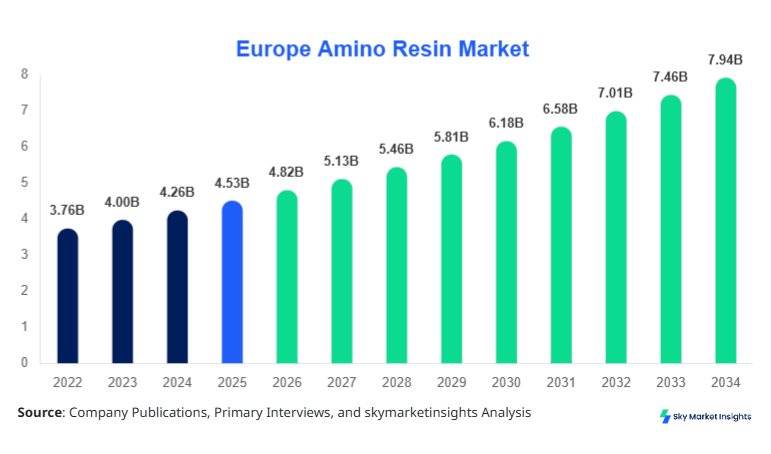
Europe Amino Resin market size is projected at USD 4.82 billion in 2026 and is expected to hit USD 7.94 billion by 2034 with a CAGR of 6.43%.
The market expansion is being supported by rising construction activities, increasing engineered wood consumption, and higher demand for industrial coatings across Europe. Strong growth in furniture manufacturing, automotive coatings, and laminates has increased the need for advanced amino resin formulations with enhanced durability and thermal resistance. Market participants are focusing on capacity additions, technological upgrades, and sustainability initiatives to strengthen competitive positioning. The report provides detailed segmentation analysis, production statistics, application insights, import-export trends, and competitive landscape assessment across major European countries.
The amino resin industry comprises thermosetting resins manufactured through the reaction of amino compounds such as urea and melamine with formaldehyde. These resins are widely utilized in particleboards, MDF panels, plywood adhesives, automotive coatings, decorative laminates, textile finishing agents, and molding compounds. Europe produced more than 3.9 million metric tons of amino resins in 2025, with Germany, France, and Italy accounting for nearly 58% of total regional production. Urea formaldehyde represented approximately 52% of overall production volume due to its extensive use in engineered wood panels and furniture applications. Melamine formaldehyde accounted for nearly 31% of total consumption owing to its superior heat resistance and surface hardness characteristics.
Adoption levels of low-emission amino resin technologies increased by 37% between 2022 and 2025 as environmental regulations across Europe became stricter. Nearly 64% of wood panel manufacturers in Europe adopted formaldehyde-reduced resin systems to comply with E1 and E0 emission standards. Consumer demand analytics indicate that residential renovation projects contributed nearly 41% of decorative laminate demand during 2025, while commercial construction contributed 28%. Furniture manufacturing applications represented approximately 46% of total amino resin consumption, followed by coatings at 22%, adhesives at 18%, and textiles at 8%. Thermal stability ranges between 120°C and 180°C for advanced melamine formaldehyde products, while moisture resistance performance improved by 21% in newly developed resin grades. Increasing penetration in sustainable construction materials and industrial coatings continues to support Europe Amino Resin Market expansion.
Explore more data points, trends and opportunities Download Free Sample Report
Amino Resin Market Trends
Rising Adoption of Low-Emission and Sustainable Resin Technologies
European manufacturers are increasingly transitioning toward low-formaldehyde and bio-based amino resin technologies due to environmental regulations and sustainability targets. More than 68% of new production facilities commissioned between 2023 and 2025 integrated emission-reduction systems and renewable feedstock technologies. Production volume of low-emission amino resins surpassed 1.4 million metric tons in 2025, compared to 0.9 million metric tons in 2022. Germany and France collectively accounted for nearly 46% of regional low-emission resin output. Wood panel manufacturers reported a 32% increase in demand for E0-compliant resin systems due to stricter indoor air quality standards across residential construction projects. Manufacturers are also investing in formaldehyde scavenger technologies capable of reducing emissions by up to 45% during panel curing operations. Sustainable innovation and eco-friendly manufacturing processes are significantly influencing the Amino Resin Market.
Expansion of Decorative Laminates and Engineered Wood Applications
The engineered wood sector has emerged as one of the fastest-growing application areas for amino resins in Europe. Decorative laminates production exceeded 5.8 billion square meters in 2025, with amino resin-based coatings and binders accounting for approximately 71% of total laminate manufacturing materials. Demand from modular furniture manufacturers increased by 13% during 2025 due to urbanization and rising residential renovation activities. Nearly 58% of particleboard and MDF producers adopted advanced melamine formaldehyde formulations offering higher moisture resistance and scratch durability. Construction sector investments across Europe reached USD 1.7 trillion in 2025, generating higher consumption of amino resin-based adhesives and coatings. Advanced amino resin systems offering curing speeds 19% faster than traditional formulations are improving manufacturing efficiency across furniture production lines. These developments continue to reinforce Amino Resin Market expansion.
Increasing Use in Automotive and Industrial Coatings
Automotive coatings and industrial surface protection applications are witnessing substantial adoption of amino resin technologies. Europe manufactured more than 15.2 million vehicles in 2025, with amino resin crosslinkers used in approximately 63% of OEM automotive coating systems. Industrial coatings utilizing melamine formaldehyde resins demonstrated improved abrasion resistance by 27% and UV stability by 18% compared to conventional alternatives. Demand for high-performance coatings increased significantly in Germany, Italy, and Spain due to infrastructure modernization and machinery manufacturing activities. Powder coating manufacturers expanded amino resin consumption by nearly 12% during 2025 as industries increasingly preferred durable and corrosion-resistant coating systems. Growth in industrial manufacturing and premium coating applications continues to accelerate Amino Resin Market adoption.
Europe Amino Resin Drivers
Rising Engineered Wood and Furniture Production Across Europe
The expansion of engineered wood manufacturing and furniture production is a primary factor supporting market development across Europe. The European furniture industry generated more than USD 132 billion in revenue during 2025, while engineered wood panel production exceeded 67 million cubic meters. Amino resins are extensively utilized as binders in particleboards, MDF panels, plywood, and decorative laminates due to their high bonding strength and low production cost. Urea formaldehyde adhesives accounted for nearly 74% of wood panel binder consumption in Europe. Residential renovation spending increased by 9.2% during 2025, contributing significantly to decorative laminate and modular furniture demand. Germany, France, and Italy collectively represented approximately 61% of regional furniture manufacturing output. Advanced amino resin systems offering curing temperatures below 120°C improved energy efficiency by nearly 14% for panel manufacturers. Expansion in eco-friendly housing construction and rising investments in interior décor continue to strengthen Europe Amino Resin Market adoption.
Europe Amino Resin Restraints
Volatility in Raw Material Prices and Environmental Regulations
Fluctuations in methanol, formaldehyde, and melamine prices remain a major challenge for amino resin manufacturers across Europe. Melamine prices increased by nearly 18% during 2025 due to higher natural gas costs and supply disruptions affecting chemical feedstock production. Formaldehyde emission regulations imposed by European authorities also increased compliance costs for manufacturers by approximately 12% annually. Nearly 39% of small-scale resin manufacturers reported operational pressure due to rising environmental certification expenses and process modernization requirements. Restrictions on volatile organic compound emissions reduced the utilization of traditional formaldehyde-rich resin formulations, impacting profitability margins. Additionally, raw material import dependency from Asia and Eastern Europe exposed manufacturers to currency volatility and transportation cost fluctuations exceeding 16% during 2024–2025. These regulatory and supply chain constraints continue to impact Europe Amino Resin Market profitability.
Europe Amino Resin Opportunities
Growth in Bio-based and High-Performance Resin Technologies
The increasing focus on sustainable construction materials and advanced industrial coatings is creating strong opportunities for bio-based amino resin technologies. Investments in green chemistry research across Europe exceeded USD 620 million in 2025, with nearly 24% allocated to low-emission and renewable resin development projects. Manufacturers are introducing lignin-modified and bio-methanol-derived amino resin formulations capable of reducing carbon emissions by up to 28%. Demand for premium industrial coatings with enhanced thermal stability and chemical resistance increased by 15% across automotive and aerospace sectors. Europe’s green building initiatives generated nearly 34% growth in sustainable wood panel demand during 2025. Advanced melamine formaldehyde products offering surface hardness improvements above 22% are gaining significant traction in decorative laminates and flooring applications. Increasing investments in sustainable innovation and specialty coatings present significant opportunities for Europe Amino Resin Market participants.
Challenges in Europe Amino Resin
Competition from Alternative Resin Technologies and Recycling Limitations
The market faces increasing competition from polyurethane, epoxy, and bio-polymer alternatives offering improved environmental performance and recyclability. Approximately 21% of European furniture manufacturers tested non-formaldehyde adhesive systems during 2025 to reduce environmental compliance risks. Recycling limitations associated with thermosetting amino resins remain a significant challenge, as only 14% of post-consumer amino resin-based wood products are currently recyclable through industrial processes. Disposal and waste management costs increased by nearly 11% between 2023 and 2025 due to stricter sustainability policies. In addition, manufacturers face technical challenges in balancing low formaldehyde emissions with adhesive strength and curing efficiency. Some low-emission formulations demonstrated 8% lower bonding strength compared to conventional systems during large-scale industrial applications. Rising pressure from sustainable packaging and eco-friendly material regulations continues to challenge Europe Amino Resin Market manufacturers.
Report Scope
| Report Metric | Details |
|---|---|
| Market Size in 2025 | USD 4.53 Billion |
| Market Size in 2026 | USD 4.82 Billion |
| Market Size in 2034 | USD 7.94 Billion |
| CAGR | 6.43% (2026-2034) |
| Base Year for Estimation | 2025 |
| Historical Data | 2022-2024 |
| Forecast Period | 2026-2034 |
| Report Coverage | Revenue Forecast, Competitive Landscape, Supply Chain Disruption, Growth Factors, Environment & Regulatory Landscape and Trends |
Explore more data points, trends and opportunities Download Free Sample Report
Amino Resin Market Segmentation
The market is segmented by type and application, with urea formaldehyde dominating nearly 52% of total consumption due to its cost-effectiveness and extensive use in wood panel manufacturing. By application, wood panels accounted for approximately 46% of overall amino resin demand, followed by coatings at 22% and adhesives at 18%.
BY TYPE
Urea formaldehyde represented the largest product category with nearly 52% regional consumption share in 2025. Production volumes exceeded 2 million metric tons across Europe, primarily utilized in particleboards, MDF panels, and plywood manufacturing. These resins provide strong bonding performance with curing temperatures between 90°C and 120°C, making them suitable for high-volume furniture production. Germany and France collectively accounted for approximately 48% of urea formaldehyde manufacturing capacity. The segment witnessed a 7.1% increase in demand due to expansion in residential furniture and modular housing applications. Improved low-emission formulations reduced formaldehyde release levels by nearly 35%, increasing regulatory compliance across Europe.
Melamine formaldehyde accounted for nearly 31% of market consumption owing to superior hardness, heat resistance, and chemical durability properties. Europe produced more than 1.2 million metric tons of melamine formaldehyde resins during 2025. Decorative laminates and industrial coatings represented over 58% of segment demand. Advanced melamine resins demonstrated thermal resistance above 180°C and moisture resistance improvements nearing 26% compared to conventional formulations. Automotive coating applications increased by 11% during 2025, particularly in Germany and Italy. The segment also benefited from rising demand for anti-scratch and anti-bacterial laminate surfaces in commercial construction projects.
Phenol formaldehyde represented approximately 17% of total market volume, supported by industrial adhesive and insulation applications. Production exceeded 650 thousand metric tons in 2025. These resins provide high thermal stability, fire resistance, and mechanical durability for industrial wood composites and insulation panels. Construction insulation applications accounted for nearly 36% of phenol formaldehyde consumption across Europe. Manufacturers improved curing efficiency by 14% using catalytic polymerization technologies. Demand from industrial equipment and aerospace composite sectors also expanded by approximately 9% during 2025.
BY APPLICATION
Wood panels represented the dominant application segment with nearly 46% market share in 2025. Europe manufactured approximately 67 million cubic meters of particleboards and MDF panels utilizing amino resin binders. Urea formaldehyde remained the preferred adhesive system for engineered wood products due to low production cost and strong mechanical bonding properties. Furniture manufacturing contributed over 61% of total wood panel demand. Demand for moisture-resistant and fire-retardant panels increased by 18% across residential and commercial construction projects. Manufacturers also introduced rapid-curing resin systems reducing production cycle times by nearly 16%. Germany, France, and Italy remained the largest consumers of amino resin-based wood panels.
Coatings accounted for nearly 22% of amino resin consumption, driven by automotive, industrial machinery, and decorative laminate applications. Europe produced more than 5.1 million tons of industrial coatings during 2025, with amino resin crosslinkers used in approximately 41% of high-performance coating systems. Melamine formaldehyde coatings demonstrated gloss retention improvements of 23% and chemical resistance enhancements above 19%. Automotive OEM coating demand increased by 8.7% during 2025 due to vehicle manufacturing recovery across Germany and Spain. Powder coating applications also expanded significantly because of lower VOC emissions and superior surface durability.
Adhesives represented approximately 18% of overall market demand. Amino resin-based adhesives are extensively used in plywood assembly, furniture bonding, decorative laminates, and industrial composite manufacturing. Europe consumed over 1.3 million metric tons of amino resin adhesives during 2025. Construction and furniture manufacturing jointly accounted for nearly 72% of adhesive demand. Advanced resin technologies improved bonding strength by approximately 12% while reducing curing times by 15%. Demand for environmentally compliant adhesive formulations increased significantly following adoption of E1 emission standards across Europe.
Europe Amino Resin Market Segmentations
By Type
- Urea Formaldehyde
- Melamine Formaldehyde
- Phenol Formaldehyde
By Application
- Wood Panels
- Coatings
- Adhesives
Europe Amino Resin Regional Outlook
United Kingdom
The United Kingdom accounted for nearly 12% of total European amino resin consumption during 2025. The country produced approximately 420 thousand metric tons of amino resins, with strong demand from furniture manufacturing, industrial coatings, and decorative laminate sectors. Construction renovation projects contributed over 34% of domestic amino resin consumption. The UK furniture industry generated nearly USD 18 billion in annual revenue, driving higher utilization of engineered wood adhesives. Nearly 57% of local manufacturers adopted low-emission amino resin technologies by 2025. Decorative laminate imports also increased by 11%, supporting domestic coating and adhesive demand.
Germany
Germany remained the largest regional market, contributing approximately 27% of European amino resin demand. Production volumes exceeded 1 million metric tons during 2025. The country’s advanced automotive and industrial manufacturing sectors significantly supported coatings consumption. Automotive coatings represented nearly 24% of German amino resin demand, while engineered wood products accounted for 39%. Germany also led sustainable resin innovation, with nearly 46% of regional bio-based amino resin research investments concentrated within the country. High automation levels improved manufacturing efficiency by approximately 18% between 2023 and 2025.
France
France represented around 21% of regional market consumption due to strong furniture production and construction activities. The country produced approximately 742 thousand metric tons of amino resins during 2025. Wood panel applications accounted for nearly 44% of domestic consumption, while industrial coatings contributed 19%. Decorative laminate manufacturing increased by 9.4% during 2025 owing to rising residential renovation demand. More than 61% of French manufacturers implemented low-VOC amino resin technologies. Export volumes to Southern Europe increased by approximately 14%, strengthening the country’s position within the regional supply chain.
Spain
Spain accounted for nearly 10% of European amino resin demand in 2025. Furniture exports and construction modernization projects significantly supported local market expansion. Spain produced approximately 360 thousand metric tons of amino resins, with decorative laminates and engineered wood panels representing nearly 49% of consumption. Tourism-driven commercial infrastructure development increased laminate and coating demand by approximately 12%. Automotive component manufacturing also contributed to industrial coating growth across Barcelona and Madrid manufacturing clusters.
Italy
Italy contributed approximately 15% of regional amino resin demand due to its premium furniture and luxury laminate manufacturing industries. Production volumes surpassed 530 thousand metric tons in 2025. Furniture and interior décor applications represented nearly 52% of domestic amino resin consumption. Italy’s decorative laminate exports increased by 13% during 2025, particularly toward Central Europe and the Middle East. Nearly 58% of local manufacturers invested in energy-efficient resin curing technologies, reducing operational energy consumption by 9%.
Russia
Russia represented nearly 9% of total European amino resin demand. The country produced approximately 310 thousand metric tons of amino resins during 2025. Wood processing industries accounted for nearly 61% of local consumption due to large-scale plywood and MDF manufacturing operations. Industrial coatings demand increased by approximately 7% during 2025 because of infrastructure and heavy equipment projects. Domestic producers also expanded export shipments toward Eastern Europe and Central Asia, contributing to regional supply diversification.
Top players in Europe Amino Resin
- BASF SE
- Hexion Inc.
- INEOS Group
- Prefere Resins Holding GmbH
- Georgia-Pacific Chemicals
- Allnex Belgium SA
- Mitsui Chemicals Inc.
- Mitsubishi Chemical Group
- Acron Group
- Arclin Inc.
- Dynea AS
- Metadynea Austria GmbH
- Sprea Misr
- Chemiplastica SPA
- Kronospan Holdings Ltd.
BASF SE
-
BASF SE accounted for approximately 14% of the European amino resin industry during 2025.
-
The company maintains strong positioning in industrial coatings, engineered wood adhesives, and decorative laminate applications.
-
BASF operates advanced chemical production facilities across Germany and France with annual amino resin capacity exceeding 420 thousand metric tons.
-
The company invested nearly USD 180 million between 2023 and 2025 in low-emission resin technologies and digital manufacturing systems.
-
BASF expanded bio-based resin product launches by 21% and improved energy efficiency in polymerization operations by approximately 13%.
Hexion Inc.
-
Hexion Inc. represented nearly 11% of regional market share in 2025.
-
The company has strong presence in engineered wood products and industrial adhesive applications.
-
Hexion produced more than 350 thousand metric tons of amino resin formulations across Europe during 2025.
-
The company expanded low-formaldehyde adhesive solutions with emission reductions exceeding 40% compared to traditional products.
-
Investments in advanced curing technologies improved manufacturing productivity by nearly 15% and strengthened the company’s competitive positioning across furniture and laminate industries.
Investment Analysis
Investment activity across the European amino resin sector increased substantially between 2023 and 2025 due to rising demand for sustainable construction materials and industrial coatings. Total capital investments exceeded USD 2.4 billion during 2025, with approximately 38% allocated toward low-emission resin technologies and sustainable manufacturing infrastructure. Germany attracted nearly 31% of total regional investments, followed by France at 24% and Italy at 14%. Capacity expansion projects contributed around 42% of overall capital expenditure, while digital process automation represented nearly 18%.
Mergers, acquisitions, and collaborative agreements accelerated across the industry as manufacturers pursued technological innovation and supply chain integration. More than 17 major collaboration agreements were recorded during 2024–2025 involving chemical manufacturers, wood panel producers, and automotive coating suppliers. Strategic investments in bio-based feedstock technologies increased by approximately 26% during 2025. Private equity participation within specialty resin manufacturing also expanded significantly, particularly in France and Germany. Companies increasingly focused on expanding low-VOC coating portfolios and formaldehyde-reduced adhesive technologies to address evolving sustainability regulations and customer requirements.
New Product Developments
Manufacturers across Europe introduced several advanced amino resin formulations during 2025 focused on sustainability, thermal resistance, and faster curing efficiency. Nearly 29% of newly launched products incorporated low-formaldehyde or bio-based feedstock technologies. Advanced melamine formaldehyde coatings improved abrasion resistance by approximately 24% and UV durability by 18% compared to previous-generation formulations. Rapid-curing resin systems reduced industrial production cycle times by nearly 16% across furniture manufacturing applications.
Research and development expenditure across the industry increased by approximately 13% during 2025, with strong focus on recyclable thermosetting systems and eco-friendly laminates. More than 41% of newly commercialized amino resin products targeted engineered wood and decorative laminate applications. Manufacturers also introduced hybrid resin technologies capable of reducing VOC emissions by nearly 37% while maintaining strong adhesive performance and mechanical durability.
Recent Developments in Europe Amino Resin
- 2025: BASF expanded its low-emission amino resin production facility in Germany, increasing annual production capacity by nearly 18% and reducing formaldehyde emissions by approximately 32%. The expansion supported rising engineered wood demand across Central Europe and strengthened sustainable adhesive supply chains.
- 2025: Hexion introduced a new melamine formaldehyde coating technology for automotive applications, improving scratch resistance by 21% and curing efficiency by 14%. The product launch targeted premium vehicle coating manufacturers across Germany, France, and Italy.
Research Methodology
The research methodology for the Europe amino resin industry involved a combination of primary and secondary research approaches to ensure accurate market estimation and comprehensive industry analysis. The research process included detailed evaluation of production capacities, trade statistics, pricing trends, raw material supply dynamics, and end-user demand patterns across Europe. Secondary research involved analysis of company annual reports, government databases, trade journals, industrial associations, chemical manufacturing statistics, and import-export records covering the 2022–2025 historical period.
Primary research included interviews with amino resin manufacturers, distributors, furniture producers, coating formulators, and industry consultants across Germany, France, Italy, Spain, and the United Kingdom. More than 85 industry participants contributed operational insights regarding production trends, technology adoption, sustainability initiatives, and investment strategies. Market size estimation utilized bottom-up and top-down analytical models supported by revenue benchmarking, production volume assessments, and consumption analysis across application sectors. Forecast modeling considered macroeconomic indicators, construction investments, automotive production trends, environmental regulations, and technological innovation rates to project industry performance through 2034.
Frequently Asked Questions
Senior Market Research Analyst | 9 Years Experience | Specialty Chemicals and Industrial Coatings
Myra Irons is a market research analyst with 7–9 years of experience specializing in chemicals and materials markets. Contributed to 70+ research reports for global clients. Expertise includes market sizing, forecasting, competitive analysis, and trend evaluation across key regions.