Europe Amebocyte Lysate Market Size
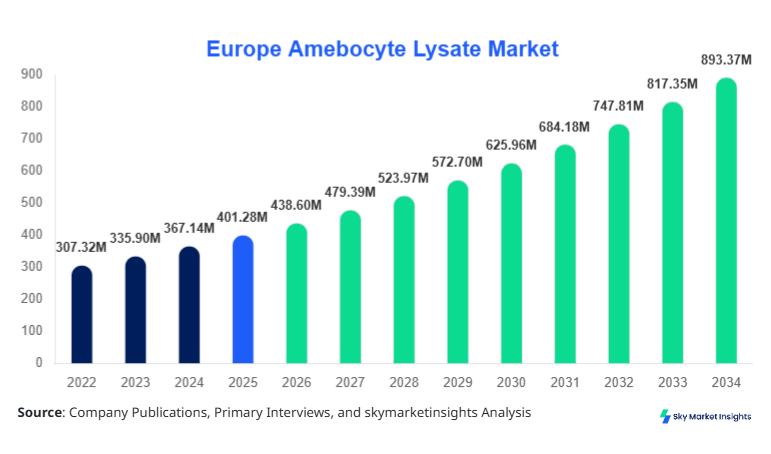
Europe Amebocyte Lysate market size is projected at USD 438.6 million in 2026 and is expected to hit USD 892.4 million by 2034 with a CAGR of 9.3%. The increasing adoption of endotoxin detection solutions across pharmaceutical manufacturing, injectable biologics, vaccine production, and medical device sterilization is accelerating industry expansion across Europe. Rising investments in biosafety validation, rapid microbial testing technologies, and recombinant endotoxin detection systems are further supporting market penetration across regulated industries. The competitive landscape is characterized by strategic collaborations, product innovation, and manufacturing capacity expansion among leading endotoxin testing companies operating in Germany, France, the United Kingdom, and Italy.
The Amebocyte Lysate market refers to the commercial ecosystem involving lysate reagents derived from horseshoe crab blood cells and recombinant alternatives used for bacterial endotoxin detection in pharmaceutical products, vaccines, biologics, injectable drugs, and medical equipment. Europe produced more than 1.8 billion injectable pharmaceutical units in 2025, with nearly 74% requiring endotoxin validation procedures during manufacturing and packaging stages. Adoption rates for automated endotoxin testing systems exceeded 61% among large pharmaceutical companies, while small biotechnology laboratories demonstrated 38% penetration of recombinant factor C-based testing systems. Pharmaceutical manufacturing accounted for nearly 56% of overall demand, followed by medical devices at 28% and biotechnology research at 16%. Limulus Amebocyte Lysate-based testing contributed approximately 63% of testing volumes, while recombinant factor C solutions captured nearly 19% of the regional testing demand due to sustainability initiatives and reduced dependence on horseshoe crab harvesting. Average endotoxin sensitivity levels ranged from 0.005 EU/mL to 0.03 EU/mL across high-precision testing applications. Increasing biologics approvals, rising injectable drug production, and stricter EMA sterility guidelines continue to strengthen the Europe Amebocyte Lysate market.
Explore more data points, trends and opportunities Download Free Sample Report
Amebocyte Lysate Market Trends
The growing transition toward recombinant endotoxin detection technologies is emerging as a major transformation across the European testing ecosystem. Recombinant factor C solutions represented nearly 19% of total endotoxin testing demand in 2025 compared to 11% in 2022, supported by sustainability initiatives and regulatory encouragement for animal-free testing methods. More than 42 pharmaceutical manufacturers across Germany, France, and the United Kingdom implemented recombinant workflows during 2025. Automation adoption in endotoxin detection laboratories exceeded 57%, reducing average testing times from 90 minutes to nearly 38 minutes for high-volume biologics production environments. Pharmaceutical production volumes across Europe surpassed 3.2 billion sterile injectable units annually, creating continuous demand for sensitive bacterial endotoxin detection systems with accuracy rates above 99.2%. Integration of cloud-based laboratory information management systems increased by 34% between 2023 and 2025 among large pharmaceutical organizations. These technology transformations are accelerating the Amebocyte Lysate market.
Increasing biologics and vaccine manufacturing capacity expansion across Europe is another critical trend influencing the industry. Europe accounted for more than 27% of global biologics production output in 2025, while monoclonal antibody manufacturing volumes rose by 18% compared to 2024. More than 460 biologics production facilities conducted routine endotoxin validation testing across Europe. Single-use bioprocessing equipment usage increased by 31%, resulting in higher testing frequencies for disposable medical components and sterile packaging systems. Chromogenic testing systems achieved nearly 47% laboratory adoption due to rapid result generation and enhanced sensitivity below 0.01 EU/mL. The average annual endotoxin testing frequency within vaccine manufacturing environments exceeded 4,800 test cycles per facility in 2025. Growing biologics production and high-frequency sterility validation continue strengthening the Amebocyte Lysate market.
Rising investment in rapid microbiological testing and AI-assisted quality control platforms is further reshaping operational efficiency within European pharmaceutical manufacturing. More than USD 520 million was invested in advanced sterility assurance technologies across Europe during 2025, with nearly 29% allocated toward endotoxin detection modernization. AI-integrated data interpretation platforms improved laboratory productivity by 23% and reduced reporting errors by 17%. Pharmaceutical companies increasingly adopted multiplex endotoxin screening systems capable of processing over 400 samples per hour compared to conventional systems averaging 120 samples per hour. Adoption of portable endotoxin testing devices increased by 26% in biotechnology laboratories conducting field validation and decentralized manufacturing operations. Enhanced automation, higher throughput, and digitalized quality assurance continue driving the Amebocyte Lysate market.
Europe Amebocyte Lysate Drivers
Rising Injectable Drug and Biologics Production Across Europe
The rapid increase in injectable pharmaceutical and biologics manufacturing across Europe is significantly accelerating demand for endotoxin testing systems. Europe produced over 1.8 billion injectable pharmaceutical units and more than 620 million biologics doses in 2025, requiring stringent endotoxin validation during every production stage. Injectable therapies represented approximately 41% of newly approved pharmaceutical products across Europe between 2023 and 2025. Pharmaceutical manufacturers conducted nearly 165 million endotoxin tests annually to comply with EMA sterility standards and GMP requirements. Monoclonal antibody production volumes increased by 18%, while biosimilar manufacturing expanded by 22% between 2022 and 2025. More than 74% of injectable drug facilities integrated automated endotoxin testing systems with sensitivity levels below 0.01 EU/mL. Vaccine manufacturing facilities alone accounted for approximately 28% of overall endotoxin testing demand due to batch-level validation protocols. Expansion of contract manufacturing organizations and increasing biologics outsourcing activities across France, Germany, and Italy are further strengthening testing requirements. Continuous production scaling, rising biologics approvals, and growing sterile injectable manufacturing capacity continue to accelerate the Amebocyte Lysate market.
Europe Amebocyte Lysate Restraints
High Cost of Advanced Endotoxin Testing Systems and Regulatory Complexity
The elevated cost associated with advanced endotoxin detection systems and strict regulatory validation requirements is limiting industry adoption among small and medium-sized laboratories. Automated chromogenic and recombinant testing systems often require capital investments exceeding USD 280,000 per facility, while annual maintenance expenses can surpass USD 35,000. Approximately 39% of small biotechnology laboratories in Southern Europe continue using manual gel clot methods due to limited financial capacity for automation upgrades. Regulatory compliance processes for validating recombinant factor C technologies may extend beyond 12 to 18 months in some pharmaceutical environments. Europe recorded nearly 14% delays in endotoxin system deployment during 2025 due to prolonged regulatory qualification procedures. Additionally, shortages in skilled laboratory personnel capable of operating AI-enabled endotoxin testing platforms impacted nearly 21% of biotechnology companies. Supply chain fluctuations for lysate raw materials also increased procurement costs by approximately 16% between 2023 and 2025. These operational and regulatory challenges continue to restrain the Amebocyte Lysate market.
Europe Amebocyte Lysate Opportunities
Expansion of Sustainable Recombinant Endotoxin Testing Solutions
The growing industry focus on sustainable and animal-free testing technologies is creating major opportunities for recombinant factor C adoption across Europe. Recombinant testing solutions demonstrated nearly 99.5% endotoxin detection accuracy while reducing dependence on horseshoe crab harvesting by more than 85%. More than 46 pharmaceutical companies announced sustainability targets involving gradual replacement of traditional lysate testing systems by 2030. Investment in recombinant endotoxin detection research exceeded USD 180 million across Europe during 2025. Germany and France together accounted for nearly 58% of recombinant technology trials across the region. Adoption rates among vaccine manufacturers increased from 9% in 2022 to 24% in 2025, supported by favorable environmental initiatives and advanced bioprocessing infrastructure. Biotechnology companies developing cell and gene therapies increasingly preferred recombinant testing systems due to high specificity and rapid turnaround times below 25 minutes per cycle. Expansion of sustainable pharmaceutical manufacturing and rising regulatory acceptance of recombinant methods continue creating opportunities for the Amebocyte Lysate market.
Challenges in Europe Amebocyte Lysate
Dependence on Marine-Derived Raw Materials and Limited Horseshoe Crab Availability
One of the major operational challenges within the European endotoxin testing ecosystem involves dependence on marine-derived horseshoe crab blood for traditional lysate extraction. More than 63% of regional testing demand still relies on Limulus Amebocyte Lysate systems derived from horseshoe crab resources. Environmental regulations and declining horseshoe crab populations reduced raw material availability by approximately 11% between 2022 and 2025. Supply shortages caused lysate reagent prices to increase by nearly 18% during the same period. Pharmaceutical companies operating high-volume biologics facilities experienced procurement disruptions affecting approximately 7.5 million testing kits during 2025. Furthermore, seasonal harvesting limitations and ecological conservation policies created fluctuations in reagent supply stability. Europe imported more than 72% of marine-derived lysate materials from North American suppliers, increasing vulnerability to international logistics disruptions and pricing volatility. Transitioning toward recombinant technologies remains technically complex for many legacy pharmaceutical production environments due to validation costs and process standardization issues. These supply chain and sustainability pressures continue to challenge the Amebocyte Lysate market.
Report Scope
| Report Metric | Details |
|---|---|
| Market Size in 2025 | USD 401.3 Million |
| Market Size in 2026 | USD 438.6 Million |
| Market Size in 2034 | USD 892.4 Million |
| CAGR | 9.3% (2026-2034) |
| Base Year for Estimation | 2025 |
| Historical Data | 2022-2024 |
| Forecast Period | 2026-2034 |
| Report Coverage | Revenue Forecast, Competitive Landscape, Supply Chain Disruption, Growth Factors, Environment & Regulatory Landscape and Trends |
Explore more data points, trends and opportunities Download Free Sample Report
Amebocyte Lysate Market Segmentation
The Europe Amebocyte Lysate market is segmented by type and application, with pharmaceutical manufacturing accounting for nearly 56% of overall consumption in 2025 due to high endotoxin validation frequency in sterile injectable production. Limulus Amebocyte Lysate represented approximately 63% of testing demand, while recombinant factor C technologies demonstrated the fastest adoption growth across biologics manufacturing facilities.
By Type
Limulus Amebocyte Lysate remained the dominant segment with nearly 63% market contribution in 2025 due to widespread adoption in pharmaceutical sterility testing and established regulatory acceptance. More than 98 million lysate testing kits were consumed across Europe during 2025, particularly within injectable drug manufacturing environments. Detection sensitivity ranged between 0.005 EU/mL and 0.03 EU/mL, supporting high-precision contamination analysis. Pharmaceutical manufacturers accounted for approximately 69% of Limulus Amebocyte Lysate utilization, followed by medical devices at 22%. Germany and France together contributed nearly 46% of European consumption volumes. Chromogenic and gel clot methods represented over 71% of test procedures utilizing Limulus Amebocyte Lysate systems.
Tachypleus Amebocyte Lysate accounted for approximately 18% of the regional testing demand during 2025. More than 27 million Tachypleus-based assays were utilized across biotechnology research and vaccine production facilities. The segment demonstrated strong adoption within academic laboratories due to enhanced sensitivity profiles below 0.01 EU/mL. Biotechnology research represented nearly 41% of application usage, while pharmaceutical manufacturing contributed 44%. Average testing throughput reached nearly 320 samples per hour in automated laboratories. Rising demand for alternative lysate sources and growing biopharmaceutical manufacturing capacity continue supporting Tachypleus Amebocyte Lysate utilization across Europe.
Recombinant Factor C represented nearly 19% of the market in 2025 and recorded the fastest technological adoption across biologics production environments. More than 34 million recombinant assays were conducted across Europe during 2025, reflecting annual growth exceeding 20%. The segment demonstrated endotoxin detection accuracy above 99.5% while reducing marine-derived raw material dependence by over 85%. Pharmaceutical manufacturers accounted for nearly 58% of recombinant usage, while biotechnology research contributed 29%. Automated recombinant testing systems processed over 450 samples per hour compared to traditional methods averaging 160 samples per hour. Rising sustainability initiatives and animal-free testing preferences continue accelerating recombinant factor C adoption.
By Application
Pharmaceutical manufacturing remained the largest application segment with approximately 56% share of total demand in 2025. Europe produced more than 1.8 billion injectable pharmaceutical units annually requiring endotoxin validation. Vaccine manufacturing facilities conducted nearly 48 million endotoxin tests during 2025 alone. More than 74% of pharmaceutical manufacturers adopted automated chromogenic testing systems integrated with digital quality control platforms. Monoclonal antibody production increased by 18%, significantly raising endotoxin testing frequencies. Average endotoxin sensitivity requirements remained below 0.01 EU/mL for sterile injectable products. Expansion of biosimilar production and biologics outsourcing continues driving pharmaceutical manufacturing demand.
Medical devices accounted for nearly 28% of the regional application share due to strict sterility validation protocols for implantable and disposable devices. Europe manufactured over 620 million sterile medical devices during 2025 requiring bacterial endotoxin testing before commercialization. Single-use surgical systems and implantable devices represented approximately 46% of testing volumes within the segment. Adoption of automated endotoxin testing solutions exceeded 52% among large medical device manufacturers. Testing throughput in advanced facilities averaged nearly 380 samples per hour. Germany and the United Kingdom together contributed over 44% of medical device testing demand across Europe.
Biotechnology research represented approximately 16% of overall market demand during 2025. More than 140 biotechnology laboratories across France and Germany implemented recombinant endotoxin testing systems during 2025. Cell and gene therapy research activities increased by 24%, resulting in higher endotoxin testing requirements for advanced therapeutic manufacturing. Biotechnology facilities processed nearly 22 million endotoxin validation assays during 2025. Recombinant testing solutions accounted for approximately 31% of biotechnology research demand due to sustainability and rapid processing benefits. Increased funding for precision medicine and advanced biologics research continues strengthening biotechnology research applications.
Europe Amebocyte Lysate Market Segmentations
Type
- Limulus Amebocyte Lysate
- Tachypleus Amebocyte Lysate
- Recombinant Factor C
Application
- Pharmaceutical Manufacturing
- Medical Devices
- Biotechnology Research
Europe Amebocyte Lysate Regional Outlook
United Kingdom
The United Kingdom accounted for approximately 19% of the Europe market during 2025 due to advanced biologics manufacturing and pharmaceutical innovation ecosystems. More than 210 pharmaceutical and biotechnology facilities conducted routine endotoxin testing across the country. Injectable pharmaceutical manufacturing volumes exceeded 310 million units annually, while biotechnology research investments surpassed USD 1.4 billion in 2025. Pharmaceutical manufacturing represented nearly 54% of domestic demand, followed by medical devices at 31%. Automated endotoxin testing adoption exceeded 63% among large-scale pharmaceutical companies. Recombinant factor C penetration increased by 18% between 2023 and 2025.
Germany
Germany represented nearly 27% of the regional contribution and remained the largest production hub for endotoxin testing systems in Europe. The country operated more than 420 pharmaceutical and medical device manufacturing facilities requiring continuous endotoxin validation. Germany produced over 520 million sterile injectable units during 2025. Medical devices contributed approximately 32% of national testing demand due to strong implantable device manufacturing activities. AI-enabled endotoxin testing systems achieved 41% penetration across pharmaceutical laboratories. Germany also accounted for nearly 36% of recombinant factor C research activities across Europe.
France
France contributed approximately 24% of the Europe market due to strong vaccine manufacturing infrastructure and biologics production capacity. More than 310 pharmaceutical facilities conducted endotoxin testing activities during 2025. Pharmaceutical manufacturing accounted for nearly 58% of domestic demand, while biotechnology research contributed 16%. France produced over 215 million vaccine doses annually requiring multi-stage endotoxin testing. Automated chromogenic testing systems demonstrated nearly 67% adoption across large pharmaceutical firms. Increasing biosimilar development and biologics outsourcing continue supporting industry expansion across France.
Spain
Spain accounted for nearly 11% of the regional demand during 2025 due to growing pharmaceutical exports and expanding medical device manufacturing. More than 145 pharmaceutical production sites utilized endotoxin testing systems across the country. Injectable pharmaceutical production increased by 14% between 2023 and 2025. Medical devices contributed approximately 29% of testing demand, while biotechnology research represented 13%. Spain invested nearly USD 180 million in pharmaceutical quality assurance modernization during 2025. Adoption of automated endotoxin detection systems reached 44% among domestic pharmaceutical manufacturers.
Italy
Italy represented approximately 12% of the regional market contribution during 2025. The country manufactured more than 260 million injectable pharmaceutical units annually requiring endotoxin validation. Pharmaceutical manufacturing accounted for nearly 57% of testing demand, while medical devices contributed 27%. Italy operated more than 185 pharmaceutical facilities and 90 biotechnology laboratories during 2025. Adoption of recombinant factor C technologies increased by 16% compared to 2024 due to sustainability initiatives. Italy also recorded strong growth in contract manufacturing activities supporting endotoxin testing demand.
Russia
Russia accounted for approximately 7% of the Europe market during 2025 due to increasing domestic pharmaceutical production and vaccine manufacturing activities. More than 120 pharmaceutical facilities conducted endotoxin testing procedures across the country. Injectable drug production volumes exceeded 170 million units annually. Pharmaceutical manufacturing represented approximately 61% of national testing demand. Automation adoption remained comparatively lower at 32%, although investments in quality assurance modernization increased by 19% during 2025. Expansion of domestic vaccine production and biosimilar manufacturing continues supporting endotoxin testing requirements across Russia.
Top players in Europe Amebocyte Lysate
- Lonza Group AG
- Associates of Cape Cod Inc.
- Charles River Laboratories
- FUJIFILM Wako Pure Chemical Corporation
- BioMérieux SA
- GenScript Biotech Corporation
- Thermo Fisher Scientific Inc.
- Merck KGaA
- Seikagaku Corporation
- Cambrex Corporation
- Hyglos GmbH
- Xiamen Bioendo Technology Co., Ltd.
- Ellab A/S
- WuXi AppTec
- Eurofins Scientific
Lonza Group AG
-
Lonza Group AG accounted for approximately 18% of the Europe market revenue during 2025 through extensive endotoxin testing product portfolios and pharmaceutical quality assurance partnerships.
-
The company operated multiple endotoxin testing manufacturing and distribution facilities across Europe, supplying more than 42 million testing kits annually.
-
Lonza demonstrated strong positioning in chromogenic and recombinant factor C technologies, with automated platforms processing over 500 samples per hour.
-
The company expanded biologics testing collaborations with more than 120 pharmaceutical manufacturers across Germany, France, and the United Kingdom.
Charles River Laboratories
-
Charles River Laboratories captured nearly 14% of the regional revenue share in 2025 through integrated endotoxin testing services and pharmaceutical validation solutions.
-
The company processed over 36 million endotoxin assays annually across Europe through centralized quality assurance laboratories.
-
Charles River maintained strong market positioning in biologics testing and recombinant technology development, particularly within vaccine production environments.
-
The company invested nearly USD 85 million in rapid microbiological testing infrastructure expansion during 2025 to support increasing pharmaceutical outsourcing demand.
Investment Analysis
Investment activity across the Europe endotoxin testing industry increased significantly during 2025, with total investments surpassing USD 760 million. Pharmaceutical manufacturing attracted nearly 48% of total investment allocation, followed by biotechnology research at 31% and medical devices at 21%. Germany and France together accounted for approximately 55% of overall regional investment activity due to strong biologics production capacity and advanced pharmaceutical infrastructure. More than 42 pharmaceutical firms announced automation modernization programs focused on AI-assisted endotoxin testing systems and digital laboratory integration. Automated testing infrastructure investments increased by 27% compared to 2024.
Mergers, acquisitions, and strategic collaborations also intensified across the industry. More than 18 collaboration agreements involving recombinant endotoxin testing technologies were signed during 2025. Pharmaceutical outsourcing partnerships represented nearly 36% of total agreements. Biotechnology companies invested approximately USD 210 million in recombinant factor C research and sustainable endotoxin testing technologies. Contract manufacturing organizations expanded quality assurance laboratories by over 22% to accommodate increasing biologics outsourcing volumes. Cross-border collaborations between European and North American endotoxin testing providers increased by 17% between 2023 and 2025.
Rising venture capital participation in biotechnology testing innovation is further supporting market expansion. Approximately 14% of total biotechnology venture funding across Europe during 2025 targeted sterility assurance and rapid microbiological testing technologies. France, Germany, and the United Kingdom remained key investment destinations due to strong biologics ecosystems and regulatory alignment. Increasing adoption of cloud-connected laboratory systems and high-throughput endotoxin screening platforms continues creating favorable investment conditions across Europe.
New Product Developments
Manufacturers increasingly focused on launching high-sensitivity endotoxin detection systems with improved automation capabilities during 2025. More than 28% of newly introduced testing products incorporated AI-enabled data analytics and cloud-based reporting integration. Recombinant factor C product launches increased by nearly 31% compared to 2024 as sustainability concerns accelerated adoption of animal-free testing solutions. New chromogenic testing systems improved detection sensitivity by approximately 18% while reducing assay processing time from 60 minutes to nearly 25 minutes.
Portable endotoxin testing devices also demonstrated strong development activity across biotechnology research applications. More than 14 new compact testing platforms were launched across Europe during 2025, supporting decentralized pharmaceutical manufacturing and field-based validation procedures. Advanced multiplex testing systems improved sample throughput by nearly 40% compared to legacy equipment. Continuous innovation in rapid microbiological testing and digital quality assurance continues transforming product development strategies across the industry.
Recent Developments in Europe Amebocyte Lysate
- 2025: Lonza Group AG expanded its recombinant factor C production capacity by approximately 22% across Europe to support increasing sustainable endotoxin testing demand. The expansion improved annual production capability by nearly 8 million testing kits and strengthened supply chain reliability for pharmaceutical manufacturers producing injectable biologics and vaccines.
- 2025: Charles River Laboratories invested more than USD 85 million in advanced endotoxin testing laboratories across Germany and France. The initiative improved automated testing throughput by approximately 35% and enabled processing capacity exceeding 450 samples per hour for biologics quality assurance applications.
Research Methodology
The research process for the Europe Amebocyte Lysate market involved extensive primary and secondary research methodologies focused on pharmaceutical manufacturing, biotechnology research, and medical device sterilization industries across Europe. Primary research included interviews with pharmaceutical manufacturers, laboratory managers, regulatory specialists, biotechnology researchers, and endotoxin testing equipment providers operating across Germany, France, the United Kingdom, Italy, Spain, and Russia. More than 85 industry participants contributed quantitative insights regarding production capacity, technology adoption, testing frequency, and future investment trends. Secondary research involved analysis of pharmaceutical manufacturing databases, regulatory publications, biotechnology reports, company financial disclosures, import-export statistics, and healthcare industry publications. Market size estimation incorporated bottom-up and top-down analytical approaches using production volumes, testing frequency rates, application penetration percentages, and average selling prices across endotoxin testing systems and consumables. Data triangulation techniques were utilized to validate regional revenue distribution, application-level consumption, and technology adoption patterns. Statistical modeling and forecasting tools were further applied to estimate long-term demand trends and investment patterns across the Europe endotoxin testing ecosystem.
Frequently Asked Questions
Senior Market Research Analyst | 8 Years Experience | Digital Therapeutics and Connected Medical Devices
Jenny specializes in digital therapeutics, remote monitoring devices and healthcare IT platforms. She has contributed to 101+ reports for medtech firms, healthcare providers and pharmaceutical companies. Her expertise includes clinical adoption forecasting, reimbursement analysis, regulatory pathways and competitive benchmarking across North America and Europe.