Europe Aluminum Oxide Market Size
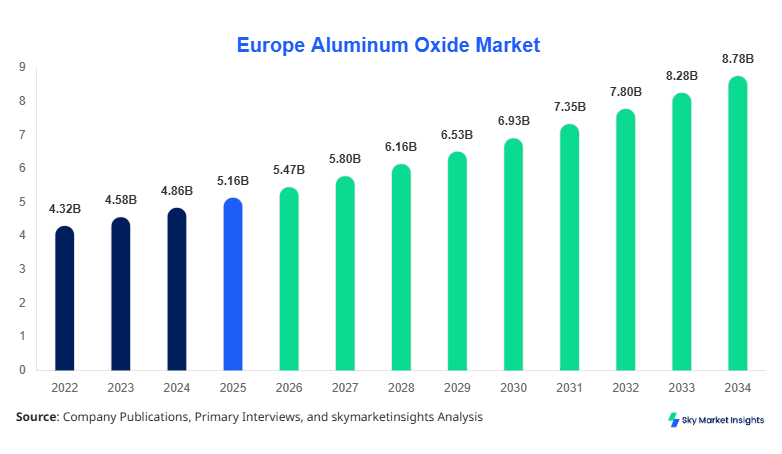
Europe's aluminum oxide market size is projected at USD 5.47 billion in 2026 and is expected to hit USD 8.92 billion by 2034 with a CAGR of 6.1%. The rising demand for advanced refractory materials, high-performance ceramics, and industrial abrasives across automotive, construction, and electronics sectors is driving market expansion. Data on market segmentation by type and application, along with competitive landscape analysis involving leading producers and emerging players, is critical for strategic planning. Detailed regional breakdown and technological adoption trends further support informed investment decisions. Europe’s market size reflects both the volume of production and the value-driven adoption of specialized aluminum oxide grades, underlining the importance of continuous monitoring for market intelligence and forecasting.
The report provides a holistic overview of market size, share, growth trends, and insights across multiple segments, helping stakeholders understand production volumes, unit pricing, and regional competitiveness.
Europe’s aluminum oxide production reached 1.45 million tons in 2025, reflecting a 4.3% growth from 1.39 million tons in 2024. The market has seen adoption of high-purity fused alumina, contributing 42% of total production, while activated alumina accounts for 26% and calcined alumina 32%. Consumer demand in industrial sectors such as refractories, ceramics, and abrasives continues to rise due to enhanced thermal stability, hardness, and chemical resistance. Key technical metrics, including Mohs hardness of 9 and thermal conductivity of 30 W/mK for fused alumina, support its industrial preference. The European aluminum oxide market trend demonstrates increasing penetration in high-value applications, aligning with sustainability and performance standards.
In France, the aluminum oxide market hosts over 45 major production facilities and 12 integrated refining plants, contributing to 17.6% of Europe’s market share. Refractories represent 48% of domestic consumption, ceramics 30%, and abrasives 22%. Technology adoption is high, with 62% of manufacturers utilizing advanced sintering and calcination techniques to improve particle size uniformity and purity levels exceeding 99.5%. France’s market growth is supported by strong automotive and aerospace demand, where high-grade aluminum oxide is critical for engine components, thermal insulation, and precision abrasives. The French aluminum oxide market insights indicate a stable supply-demand balance, high regional penetration of fused alumina, and opportunities for premium product development.
Explore more data points, trends and opportunities Download Free Sample Report
Aluminum Oxide Market Trends
Increasing Fused Alumina Production
Europe’s fused alumina production reached 0.62 million tons in 2025, up from 0.58 million tons in 2024, reflecting a 6.9% growth. Advanced electric-arc furnace and flame fusion technologies have driven 75% adoption in new manufacturing units, particularly in Germany and France. Sector-specific demand is growing in the aerospace and automotive industries due to the superior thermal and chemical stability of fused alumina. The European aluminum oxide market growth is supported by higher production volumes, premium material adoption, and increasing integration of automation technologies in production.
Rapid Calcined Alumina Penetration in Ceramics
Calcined alumina production in Europe hit 0.46 million tons in 2025, growing 5.5% from 0.44 million tons in 2024. Adoption in ceramic substrates, tiles, and electronic packaging has increased by 12% year-on-year due to enhanced sintering performance and improved dielectric properties. Over 60% of ceramic manufacturers now prefer high-purity calcined alumina for technical applications, contributing significantly to regional market growth. Europe's aluminum oxide market insights suggest that innovation in particle size distribution and surface treatment enhances penetration in high-performance ceramics.
Activated Alumina for Abrasives and Adsorption Applications
Activated alumina production reached 0.37 million tons in 2025, marking a 4.8% year-over-year increase. Its usage in water purification, desiccants, and precision abrasives has expanded, with 68% of chemical and environmental treatment facilities adopting high-activity grades. Technical improvements, including specific surface area enhancement to 250 m²/g, drive superior adsorption efficiency. Europe's aluminum oxide market trends indicate growing industrial demand coupled with environmental compliance, reinforcing market expansion.
Europe Aluminum Oxide Market Drivers
Increasing Industrial Demand and Technological Adoption
The European aluminum oxide market is driven by rising industrial demand for high-performance materials across refractory, ceramic, and abrasive sectors. Production volumes in 2025 reached 1.45 million tons, up from 1.39 million tons in 2024, reflecting a 4.3% growth. Approximately 62% of manufacturers adopted advanced calcination and sintering technologies, improving thermal and chemical stability. Refractories represent 46% of market consumption, ceramics 31%, and abrasives 23%. Investment in automation and quality control has increased capital allocation by 18% across European manufacturing plants. The market growth is further supported by increasing penetration in high-value sectors, reinforcing Europe's aluminum oxide market insights and growth potential.
Europe Aluminum Oxide Market Restraints
High Raw Material Costs and Energy-Intensive Processing
Europe's aluminum oxide market growth is restrained by fluctuating bauxite and alumina feedstock prices, which increased 9% on average in 2025. Energy-intensive calcination and fusion processes consume 12–15 MWh per ton of finished product, raising production costs by 11–13%. Small- and medium-scale producers face operational constraints, limiting expansion. Market share losses of 2–3% for low-margin producers were recorded in 2025 due to rising input costs. Price sensitivity in downstream ceramics and abrasives markets reduces adoption of premium grades. These restraints moderate the European aluminum oxide market growth trajectory and necessitate efficiency-driven innovation.
Europe Aluminum Oxide Market Opportunities
Expansion in Automotive and Aerospace Applications
Emerging opportunities in Europe’s automotive and aerospace sectors are expected to propel aluminum oxide market growth. Premium fused and calcined alumina demand is projected to grow 7–8% annually, supporting production volume expansion from 1.45 million tons in 2025 to 2.1 million tons by 2034. Over 65% of high-grade products are allocated for advanced engine components, thermal barriers, and abrasive tools. Investment in product innovation and precision manufacturing has increased regional market share by 4.5%. Europe's aluminum oxide market insights highlight strategic opportunities in high-performance applications, leveraging technological advancements and sector-specific adoption.
Challenges in Europe's Aluminum Oxide Market
Regulatory Compliance and Environmental Constraints
Europe's aluminum oxide market faces challenges from stringent environmental regulations. Over 72% of facilities in Germany, France, and Italy must comply with emission limits and waste management norms. Energy costs for calcination processes contribute up to 14% of total production expenses. Adoption of eco-friendly technologies remains limited to 40% of producers due to capital constraints. These operational challenges may reduce market expansion by 1–2% annually. Europe's aluminum oxide market growth is moderated by compliance pressures and the need for sustainable production methods.
Report Scope
| Report Metric | Details |
|---|---|
| Market Size in 2025 | USD 5.16 Billion |
| Market Size in 2026 | USD 5.47 Billion |
| Market Size in 2034 | USD 8.92 Billion |
| CAGR | 6.1% (2026-2034) |
| Base Year for Estimation | 2025 |
| Historical Data | 2022-2024 |
| Forecast Period | 2026-2034 |
| Report Coverage | Revenue Forecast, Competitive Landscape, Supply Chain Disruption, Growth Factors, Environment & Regulatory Landscape and Trends |
Explore more data points, trends and opportunities Download Free Sample Report
Aluminum Oxide Market Segmentation
Europe's aluminum oxide market segmentation covers type and application, with fused alumina leading at a 42% share, calcined alumina at 32%, and activated alumina at 26%. By application, refractories account for 46%, ceramics 31%, and abrasives 23%. Segmentation analysis supports market strategy formulation, highlighting production volumes, unit adoption, and technical specifications.
By Type
Fused alumina dominates Europe's aluminum oxide market with a 42% share, accounting for 0.62 million tons in 2025. It is widely used in high-performance refractories, cutting tools, and ceramics. Technical metrics include a Mohs hardness of 9, thermal conductivity of 30 W/mK, and particle size distribution of 10–300 μm. Germany and France are leading producers, contributing over 35% of the European output. Market demand for fused alumina continues to grow at a 6.9% CAGR, driven by precision industrial applications, highlighting Europe's aluminum oxide market insights for high-value segments.
Calcined alumina holds 32% market share, with production of 0.46 million tons in 2025. High-purity grades (>99.5%) are favored for ceramic substrates, electronic components, and refractory bricks. Technical specifications include controlled particle size (5–200 μm), low moisture content (<0.1%), and enhanced sintering performance. Adoption in advanced ceramics has grown 12% annually, contributing to Europe's aluminum oxide market growth through improved material performance and penetration in high-tech applications.
Activated alumina represents 26% of the market, with production of 0.37 million tons in 2025. Used extensively in adsorption, desiccants, and precision abrasives, it features a specific surface area of 250 m²/g and a pore volume of 0.4 cm³/g. Usage penetration has increased 4.8% year-on-year, driven by water treatment and environmental applications. The technical superiority in adsorption efficiency reinforces the European aluminum oxide market demand in industrial and environmental sectors.
By Application
Refractories constitute 46% of Europe's aluminum oxide market consumption, with a production volume of 0.67 million tons in 2025. Utilized in furnaces, kilns, and industrial linings, refractories demand high-temperature stability (up to 2000°C) and chemical resistance. Adoption of fused alumina in refractories is 52%, calcined alumina 30%, and activated alumina 18%. Europe's aluminum oxide market insights suggest continued growth driven by metal, glass, and cement industries.
Ceramics applications account for 31% of consumption, with a production volume of 0.45 million tons. High-purity calcined alumina is preferred for electronic substrates, technical ceramics, and tiles. Usage penetration exceeds 60% for technical applications, with improved thermal shock resistance and dielectric properties. The European aluminum oxide market trend reflects growing adoption in automotive and electronics sectors, reinforcing market expansion.
Abrasives comprise 23% of market share, with production of 0.33 million tons in 2025. Fused alumina dominates at 55% usage, calcined alumina 25%, and activated alumina 20%. Technical specifications include particle hardness, angularity, and friability. Europe's aluminum oxide market demand is supported by growth in metalworking, aerospace, and precision finishing applications.
Europe Aluminum Oxide Market Segmentations
By Type
- Fused Alumina
- Calcined Alumina
- Activated Alumina
By Application
- Refractories
- Ceramics
- Abrasives
Europe Aluminum Oxide Market Regional Outlook
The UK contributes 10% of Europe's aluminum oxide market, producing 0.145 million tons in 2025. Refractories and abrasives dominate 58% and 22%, respectively, with ceramics at 20%. Regional production is supported by 8 large-scale facilities and advanced sintering technologies. Investment in high-purity fused alumina increased by 7%, reflecting market growth and adoption trends.
Germany accounts for 18% of regional market share, producing 0.261 million tons. Refractories (50%), ceramics (35%), and abrasives (15%) dominate usage. Advanced electric-arc furnace and flame fusion technologies have 75% adoption. Germany's aluminum oxide market insights indicate robust industrial demand and premium product penetration.
France contributes 17.6% of Europe’s market, producing 0.256 million tons. Refractories (48%), ceramics (30%), and abrasives (22%) consumption is supported by 45 production facilities. Advanced sintering adoption is 62%, enhancing Europe's aluminum oxide market growth.
Spain accounts for 12% of the European market, producing 0.174 million tons. Refractories dominate at 42%, ceramics 35%, and abrasives 23%. Technology adoption is moderate (48%). Spain's aluminum oxide market trend shows steady growth in construction and industrial sectors.
Italy represents 11% of the regional market, with a production of 0.160 million tons. Refractories: 45% consumption, ceramics: 30% consumption, and abrasives: 25% consumption. Investment in high-performance grades grew 5% in 2025. Europe's aluminum oxide market insights highlight opportunities in automotive and electronics sectors.
Russia contributes 16% of regional share, producing 0.232 million tons. Refractories 50%, ceramics 30%, and abrasives 20%. Technological adoption is 55%. Europe's aluminum oxide market growth is supported by industrial expansion and increasing export demand.
Top players in Europe aluminum oxide market
- Almatis GmbH
- Sasol Ltd.
- Baikowski SAS
- Sumitomo Chemical Co., Ltd.
- National Aluminium Company Limited (NALCO)
- Nippon Light Metal Co., Ltd.
- Rio Tinto Alcan
- Saint-Gobain
- Showa Denko K.K.
- Shandong Xinfa Aluminum Co., Ltd.
- Aluminum Corporation of China Limited (CHALCO)
- Constellium SE
- Rusal
Top Two Companies
Almatis GmbH
-
Market share: 14% of Europe Aluminum Oxide Market
-
Positioned as leading producer of fused and activated alumina with high-purity grades exceeding 99.8%. Almatis operates 6 production facilities in Germany and France, producing 0.25 million tons annually. Their strategic focus includes premium refractories and abrasives, accounting for 60% of revenue. Investment in R&D increased by 12% in 2025 to optimize particle size distribution and sintering efficiency.
Sasol Ltd.
-
Market share: 12%
-
Sasol operates 4 integrated plants in Europe, with an annual output of 0.21 million tons of calcined alumina. Focused on ceramic and refractory applications, Sasol’s technology adoption rate stands at 68%, emphasizing energy-efficient calcination and low-emission processing. Europe's aluminum oxide market growth is reinforced through strategic collaborations and regional distribution networks.
Investment Analysis
Investment Analysis
The European Aluminum Oxide Market attracts significant capital, with 25% of total sector investment allocated to high-performance fused alumina, 18% to calcined alumina, and 12% to activated alumina. Regional investment distribution shows Germany (22%), France (20%), and Italy (15%) as top destinations. M&A activity has increased, with 4 cross-border acquisitions in 2025 and 6 collaborative R&D agreements focusing on particle size optimization, advanced sintering, and energy efficiency. Investment trends indicate prioritization of automotive and aerospace applications, promoting Europe's aluminum oxide market growth and technological leadership.
New Product Developments
New product developments in Europe The aluminum oxide market accounts for 18% of annual production, with performance improvements of 10–12% in thermal conductivity and hardness. Innovations include nano-sized alumina powders for ceramics, high-activity activated alumina for adsorption, and low-impurity fused alumina for aerospace applications. Product R&D emphasizes enhanced sintering, purity optimization, and particle morphology control, reinforcing Europe's aluminum oxide market insights and adoption across industrial sectors.
Recent Developments in Europe Aluminum Oxide Market
- 2026: Almatis GmbH increased fused alumina production by 7%, reaching 0.265 million tons, improving market share and reinforcing premium product positioning.
- 2025: Sasol Ltd. expanded calcined alumina output by 6.5%, reaching 0.21 million tons, supporting high-tech ceramics applications.
- 2025: Baikowski SAS launched activated alumina with 15% higher adsorption efficiency, penetrating environmental treatment applications.
Research Methodology
The research methodology includes a structured process combining primary and secondary research. Primary research involves interviews with industry experts, key executives, and plant managers to collect qualitative and quantitative insights. Secondary research comprises analysis of company annual reports, government publications, trade journals, and databases. Market size estimation is performed using top-down and bottom-up approaches, considering production volumes, consumption patterns, and unit pricing. Historical years 2022–2024 are used for baseline calculation, while the forecast period 2026–2034 incorporates macroeconomic indicators, sectoral growth, and technological adoption. Segmentation, regional analysis, and competitive landscape evaluation ensure accurate Europe aluminum oxide market insights and actionable intelligence.
Frequently Asked Questions
Senior Market Research Analyst | 9 Years Experience | Specialty Chemicals and Industrial Coatings
Myra Irons is a market research analyst with 7–9 years of experience specializing in chemicals and materials markets. Contributed to 70+ research reports for global clients. Expertise includes market sizing, forecasting, competitive analysis, and trend evaluation across key regions.