Europe Alternators Market Size
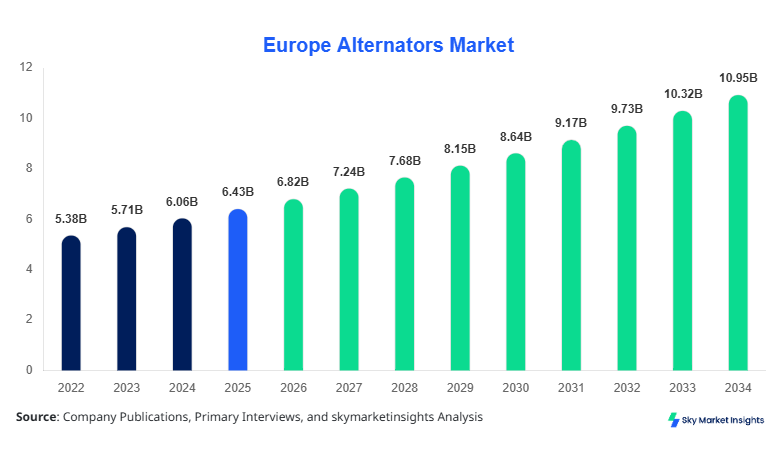
Europe Alternators market size is projected at USD 6.82 billion in 2026 and is expected to hit USD 10.97 billion by 2034 with a CAGR of 6.1%. The market expansion is being driven by rising vehicle electrification, increasing commercial vehicle production, and the modernization of industrial power systems across Europe. The report evaluates detailed production statistics, trade analysis, technology adoption patterns, segmentation insights, and competitive positioning of major manufacturers operating in the regional alternators ecosystem. The study further analyzes supply chain dynamics, OEM partnerships, aftermarket demand trends, and evolving efficiency standards influencing the Europe Alternators market.
The alternators market refers to the manufacturing, distribution, and integration of electromechanical generators that convert mechanical energy into electrical energy for automotive, industrial, marine, and power generation applications. Europe produced more than 16.4 million passenger and commercial vehicles in 2025, with Germany, France, and Spain accounting for nearly 58% of total regional output. Automotive applications represented approximately 72% of total alternator installations, while industrial machinery contributed 18% and marine systems accounted for 10% of regional consumption. Alternators operating between 12V and 48V systems dominated nearly 74% of installations due to increasing adoption in hybrid and mild-hybrid vehicles. Penetration of high-efficiency alternators exceeded 61% in commercial fleets owing to stricter emission regulations and fuel optimization targets. Consumer demand analytics indicated that replacement cycles averaged 5.8 years across passenger vehicles and 4.2 years across heavy commercial fleets. Demand for compact alternators with above 92% efficiency increased by 27% during 2025 due to rising electrification in vehicles and industrial equipment. Germany alone contributed more than 31% of regional production volume, while the United Kingdom and France collectively represented 29% of aftermarket demand. The Europe Alternators market continued to expand as OEMs increased investment in lightweight and digitally controlled charging systems.
Explore more data points, trends and opportunities Download Free Sample Report
Europe Alternators Market Trends
Rising Integration of Smart Charging Technologies
The integration of intelligent voltage regulation and smart charging technologies has become one of the most influential trends across the European alternators industry. During 2025, more than 46 million smart alternator units were deployed across passenger vehicles and commercial fleets in Europe, representing an adoption increase of nearly 24% compared with 2023 levels. Automotive OEMs increasingly adopted LIN-controlled alternators capable of dynamically adjusting charging output based on engine load and battery demand. Germany, France, and the United Kingdom collectively accounted for nearly 67% of smart alternator installations due to strong penetration of hybrid-electric platforms. High-efficiency alternators with energy recovery capabilities improved fuel economy by approximately 4%–7% in passenger vehicles and reduced CO₂ emissions by up to 9 g/km. The industrial sector also witnessed increased deployment of digitally monitored alternators with predictive maintenance functions, particularly in manufacturing plants operating above 500 kVA capacities. Investments in compact lightweight aluminum housing designs increased by 19% during 2025. The continuous shift toward intelligent energy management systems is significantly supporting the Europe Alternators market.
Increasing Demand for High-Output Alternators in Commercial Vehicles
Commercial transportation operators across Europe are increasingly demanding high-output alternators to support onboard electronics, refrigeration systems, telematics, and electrified auxiliary components. In 2025, over 8.6 million high-output alternator units above 200A capacity were supplied to heavy-duty commercial vehicles and buses throughout Europe. Adoption rates within logistics fleets exceeded 52% in Germany and 44% in France due to growing reliance on digital fleet management infrastructure. The rise in electric steering systems, advanced infotainment modules, ADAS technologies, and battery-intensive systems contributed to a 29% increase in alternator output requirements between 2022 and 2025. Commercial vehicle OEMs also reported that dual alternator systems improved operational reliability by nearly 18% in long-haul trucking applications. Industrial-grade alternators integrated into agricultural machinery and construction equipment expanded by 16% annually as automation levels increased across heavy machinery sectors. The transition toward electrified commercial mobility continues to accelerate production and technological innovation within the Europe Alternators market.
Europe Alternators Market Drivers
Rising Vehicle Electrification and Hybrid Vehicle Production
Vehicle electrification across Europe has become a major driver for alternator demand due to the growing adoption of hybrid and mild-hybrid systems. In 2025, hybrid-electric vehicle registrations in Europe exceeded 5.7 million units, representing nearly 34% of total passenger vehicle sales. Mild-hybrid platforms requiring advanced 48V alternator systems increased by 28% compared with 2024. Germany, France, and Italy collectively produced more than 3.2 million hybrid vehicles, driving substantial OEM procurement of intelligent alternators with enhanced energy recovery functionality. Alternators integrated with regenerative braking systems improved battery charging efficiency by approximately 21%, while lightweight designs reduced overall engine load by 7%. Automotive manufacturers allocated nearly 18% of powertrain electrification budgets toward energy management components, including advanced alternators. Commercial vehicle electrification also accelerated deployment of heavy-duty alternators above 250A ratings, particularly within logistics fleets and urban transport buses. The increasing integration of electronic control units, digital infotainment systems, and ADAS technologies further expanded onboard electrical loads, directly supporting alternator installations. Strong electrification initiatives and stringent European emission standards continue to stimulate the Europe Alternators market.
Europe Alternators Market Restraints
Volatility in Raw Material Prices and Supply Chain Disruptions
Fluctuating prices of copper, aluminum, semiconductors, and rare-earth materials remain a major restraint affecting alternator manufacturing economics across Europe. Copper prices increased by approximately 17% during 2025, while aluminum costs rose nearly 11%, significantly impacting production expenses for rotor windings and alternator housings. Semiconductor shortages also disrupted nearly 14% of smart alternator production schedules among European suppliers. Automotive component manufacturers reported logistics cost inflation exceeding 21% following geopolitical trade disruptions and energy price instability in Europe. More than 38% of small and medium-sized alternator suppliers experienced delays exceeding 8 weeks in sourcing electronic voltage regulators and diode assemblies. Rising labor costs in Germany and France additionally increased manufacturing overhead by nearly 9% between 2023 and 2025. These supply-side challenges forced several OEMs to renegotiate procurement contracts and reduce inventory volumes. High production volatility and margin pressure continue to constrain expansion opportunities across the Europe Alternators market.
Europe Alternators Market Opportunities
Expansion of Industrial Automation and Renewable Energy Infrastructure
The rapid expansion of industrial automation and renewable power infrastructure across Europe presents substantial opportunities for alternator manufacturers. In 2025, industrial automation investments exceeded USD 64 billion across Europe, with Germany contributing nearly 29% of total spending. Manufacturing facilities increasingly adopted industrial alternators ranging from 50 kVA to 500 kVA for backup power generation and automated production systems. Renewable energy installations, particularly wind and biogas plants, drove demand for specialized alternators with high thermal resistance and variable-speed capabilities. Europe added approximately 41 GW of renewable power capacity during 2025, supporting strong procurement of industrial-grade alternator systems. Smart factory adoption exceeded 36% among large-scale manufacturers, creating opportunities for digitally monitored alternator platforms with predictive maintenance functions. Marine transportation modernization programs across Italy and Spain also accelerated demand for corrosion-resistant marine alternators operating under harsh environmental conditions. The growing focus on industrial reliability, decentralized power generation, and energy efficiency is expected to create significant expansion potential for the Europe Alternators market.
Challenges in Europe Alternators Market
Increasing Competition from Battery Electric Vehicles
The rising penetration of battery electric vehicles presents a structural challenge for conventional automotive alternator manufacturers across Europe. Battery electric vehicles do not utilize traditional alternators, reducing long-term OEM demand within the automotive sector. In 2025, battery electric vehicles accounted for approximately 23% of total vehicle sales across Europe, compared with 17% in 2023. Norway, Germany, and the United Kingdom collectively registered over 2.9 million battery electric vehicles during the year. Several automotive manufacturers reduced procurement volumes for traditional alternator systems by nearly 12% as they expanded fully electric product portfolios. Suppliers focused primarily on internal combustion engine platforms experienced revenue declines ranging from 6% to 14% in certain product categories. Additionally, rising investment requirements for R&D and diversification into electrified energy management systems increased financial pressure on medium-sized manufacturers. Competition from integrated starter-generator technologies also intensified, particularly in premium vehicle segments where advanced electrification architectures are rapidly replacing conventional charging systems. These technological transitions continue to create operational and strategic challenges for the Europe Alternators market.
Report Scope
| Report Metric | Details |
|---|---|
| Market Size in 2025 | USD 6.43 Billion |
| Market Size in 2026 | USD 6.82 Billion |
| Market Size in 2034 | USD 10.97 Billion |
| CAGR | 6.1% (2026-2034) |
| Base Year for Estimation | 2025 |
| Historical Data | 2022-2024 |
| Forecast Period | 2026-2034 |
| Report Coverage | Revenue Forecast, Competitive Landscape, Supply Chain Disruption, Growth Factors, Environment & Regulatory Landscape and Trends |
Explore more data points, trends and opportunities Download Free Sample Report
Alternators Market Segmentation
The Europe alternators industry is segmented based on type and application. Automotive alternators accounted for approximately 72% of total revenue during 2025 due to strong passenger and commercial vehicle production across Germany, France, and Spain. Passenger vehicle applications represented nearly 61% of overall installations, followed by commercial vehicles with 27% and industrial machinery with 12%. Increasing electrification, smart charging systems, and industrial automation continue to influence segment-level demand distribution.
By Type
Automotive alternators dominated the regional industry with nearly 72% revenue contribution in 2025. More than 58 million automotive alternator units were produced across Europe during the year, supported by robust vehicle manufacturing activity. Alternators operating between 12V and 48V configurations accounted for nearly 81% of installations within passenger vehicles and mild-hybrid systems. Germany, France, and Spain collectively represented over 64% of regional automotive alternator output. High-efficiency alternators with integrated voltage regulators improved charging performance by approximately 19% compared with conventional systems. OEM adoption of lightweight aluminum housing designs rose by 23% to improve fuel efficiency and reduce emissions. Passenger vehicles required alternators ranging between 120A and 180A capacities, while commercial trucks increasingly utilized systems above 250A ratings. The transition toward advanced energy recovery and smart charging systems continues to strengthen automotive alternator production across Europ
Industrial alternators represented approximately 18% of regional demand during 2025 due to expanding automation and backup power infrastructure. Europe manufactured more than 7.8 million industrial alternator units for generators, manufacturing facilities, and renewable energy systems. Alternators operating between 50 kVA and 500 kVA capacities accounted for nearly 63% of industrial installations. Germany and Italy collectively contributed around 41% of industrial alternator production due to strong machinery and manufacturing sectors. Demand for digitally monitored alternators with predictive maintenance capabilities increased by 26% during 2025. Manufacturing plants adopting Industry 4.0 systems expanded utilization of high-efficiency alternators capable of maintaining above 94% operational efficiency under variable loads. Renewable energy projects also supported deployment of specialized alternators designed for wind turbines and biogas facilities. Industrial modernization programs continue to reinforce demand across the regional industrial alternator segmen
Marine alternators accounted for nearly 10% of total regional consumption during 2025, supported by increasing marine transportation and offshore applications. Italy, Spain, and the United Kingdom collectively generated approximately 58% of marine alternator demand across Europe. More than 2.4 million marine alternator units were supplied to cargo vessels, fishing fleets, and recreational marine equipment. Corrosion-resistant alternators operating between 24V and 48V systems dominated approximately 71% of installations. Advanced marine alternators improved onboard power efficiency by nearly 16% while supporting navigation systems, refrigeration units, and communication infrastructure. Offshore wind service vessels and maritime logistics fleets also accelerated adoption of high-output alternators above 300A capacities. Increased investment in marine electrification and emission reduction technologies continues to support expansion within the marine alternator segment.
By Application
Passenger vehicles represented approximately 61% of total alternator installations in Europe during 2025. More than 39 million alternator units were integrated into sedans, SUVs, hatchbacks, and hybrid passenger vehicles throughout the region. Germany alone contributed nearly 28% of passenger vehicle alternator demand due to high automotive production capacity. Alternators supporting start-stop systems and mild-hybrid architectures witnessed adoption growth exceeding 31% during 2025. Passenger vehicle OEMs increasingly deployed compact high-efficiency alternators capable of reducing engine load by approximately 5%–8%. Systems operating between 120A and 180A capacities dominated nearly 67% of installations. Consumer demand for connected infotainment systems, ADAS technologies, and onboard electronics significantly increased power requirements within modern passenger vehicles. Expanding hybrid vehicle registrations continue to accelerate demand for intelligent charging systems within the passenger vehicle segment.
Commercial vehicles accounted for nearly 27% of regional alternator demand during 2025. Europe produced approximately 3.9 million commercial vehicles, including trucks, buses, delivery vans, and heavy-duty logistics fleets. High-output alternators above 250A represented nearly 49% of commercial vehicle installations due to increasing onboard electrical loads. Logistics operators reported that advanced alternators improved fleet energy efficiency by approximately 14% while reducing battery maintenance frequency by 18%. Germany, France, and Russia collectively contributed nearly 57% of heavy-duty alternator consumption. Adoption of telematics systems, refrigeration units, and electric auxiliary components significantly expanded alternator performance requirements across commercial transportation fleets. Dual alternator systems witnessed a 17% rise in long-haul truck applications during 2025. Growth in e-commerce logistics and urban transportation modernization continues to strengthen commercial vehicle demand.
Industrial machinery applications represented around 12% of regional alternator installations during 2025. Manufacturing plants, agricultural equipment, construction machinery, and backup generator systems collectively consumed more than 6 million alternator units across Europe. Industrial alternators operating between 50 kVA and 300 kVA capacities dominated nearly 62% of installations. Germany and Italy together accounted for approximately 46% of industrial machinery alternator demand due to advanced manufacturing ecosystems. Automation-driven factories increasingly adopted digitally monitored alternators capable of reducing downtime by approximately 22%. Agricultural machinery equipped with GPS systems, hydraulic controls, and automated operating systems also required high-output charging solutions. Construction equipment manufacturers increased procurement of heavy-duty alternators by 19% during 2025 to support electrified hydraulic systems and advanced onboard diagnostics. Rising industrial automation investments continue to stimulate alternator integration across machinery applications.
Europe Alternators Market Segmentations
Type
- Automotive Alternators
- Industrial Alternators
- Marine Alternators
Application
- Passenger Vehicles
- Commercial Vehicles
- Industrial Machinery
Europe Alternators Regional Outlook
United Kingdom
The United Kingdom accounted for approximately 14% of regional alternator revenue during 2025. The country produced nearly 920,000 vehicles and imported more than 11 million aftermarket alternator units annually. Passenger vehicles represented around 59% of domestic alternator demand, while commercial transportation applications contributed 26%. Adoption of smart charging systems in hybrid vehicles exceeded 43% among UK automotive manufacturers. Industrial machinery and backup generator installations increased by 16% due to rising investments in manufacturing automation and decentralized energy systems. The UK aftermarket sector remained particularly strong, accounting for nearly 38% of total domestic alternator sales.
Germany
Germany remained the largest regional contributor with nearly 31% share of overall revenue during 2025. The country produced approximately 4.1 million passenger vehicles and maintained more than 70 dedicated alternator production facilities. Automotive applications represented 63% of total demand, followed by industrial systems at 24% and marine applications at 13%. Germany exported more than 18 million alternator units annually to neighboring European countries. Advanced manufacturing technologies and strong R&D spending accelerated adoption of digitally controlled alternators capable of exceeding 92% efficiency levels. The country also led Europe in hybrid vehicle production and smart charging system deployment.
France
France represented approximately 13% of regional alternator consumption during 2025. The country manufactured nearly 1.6 million vehicles and accounted for approximately 17% of Europe’s hybrid vehicle registrations. Passenger vehicles contributed 62% of domestic demand, while commercial transportation represented 23%. Industrial automation investments increased by nearly 21% during 2025, supporting industrial alternator deployment in manufacturing facilities and renewable energy systems. French OEMs increasingly adopted lightweight alternator platforms to comply with carbon reduction initiatives. High-output commercial vehicle alternators above 250A witnessed adoption growth of 18% during the year.
Spain
Spain contributed nearly 11% of regional revenue in 2025 due to its expanding automotive manufacturing ecosystem. The country produced approximately 2.3 million vehicles and exported over 80% of total automotive output. Passenger vehicle applications represented nearly 66% of alternator demand, while marine applications accounted for 12% due to strong maritime activity. Spain also expanded renewable energy infrastructure by nearly 14 GW during 2025, driving industrial alternator installations within wind and solar facilities. OEM demand for energy-efficient alternators increased by 24% due to growing hybrid vehicle production.
Italy
Italy accounted for approximately 9% of Europe’s alternator consumption during 2025. Marine transportation and industrial machinery represented nearly 37% of total domestic demand, reflecting Italy’s strong maritime and manufacturing sectors. The country manufactured more than 790,000 vehicles and increased industrial automation spending by approximately 19%. High-performance marine alternators operating within offshore environments witnessed adoption growth exceeding 21%. Italy also expanded construction and agricultural machinery production, stimulating procurement of heavy-duty alternator systems above 200A capacities.
Russia
Russia represented nearly 8% of regional demand during 2025, primarily supported by commercial transportation and industrial applications. Heavy commercial vehicles contributed approximately 41% of national alternator consumption due to extensive logistics and mining operations. Industrial generator systems operating within oil and gas facilities represented around 27% of total demand. Domestic production exceeded 4.8 million alternator units during 2025, while aftermarket sales increased by 13% amid aging vehicle fleets. High-output industrial alternators above 300 kVA capacities witnessed rising demand within infrastructure and energy projects.
Top players in Europe Alternators Market
- Bosch
- Valeo
- Denso Corporation
- Mitsubishi Electric
- Mahle GmbH
- Hitachi Astemo
- Prestolite Electric
- Cummins Inc.
- Lucas Electrical
- Mecc Alte
- Letrika
- NSK Ltd.
- Hella GmbH
- AS-PL Sp. z o.o.
- Linamar Corporation
Bosch
- Bosch accounted for approximately 18% of Europe’s alternator production during 2025.
- The company operated more than 25 manufacturing and R&D facilities across Germany, France, and Spain.
- Bosch expanded investment in 48V smart alternator systems by nearly 22% during 2025.
- The company strengthened its position within hybrid passenger vehicles and commercial transportation segments through high-efficiency charging technologies exceeding 93% operational efficiency.
- Bosch also increased aftermarket distribution coverage by approximately 17% across Eastern Europe and the United Kingdom.
Valeo
- Valeo represented nearly 14% of regional alternator revenue during 2025.
- The company supplied over 11 million alternator units annually to European automotive OEMs.
- Valeo accelerated deployment of integrated starter-generator technologies supporting mild-hybrid vehicle architectures.
- The company increased R&D spending by approximately 19% to develop lightweight and digitally controlled charging systems.
- Valeo also expanded partnerships with commercial vehicle manufacturers to provide high-output alternators above 250A capacities for electrified logistics fleets.
Investment Analysis
Investment activity within the European alternators sector increased substantially during 2025, with total industry investments surpassing USD 3.6 billion. Automotive electrification projects represented nearly 46% of total capital allocation, while industrial automation accounted for 29% and renewable energy infrastructure represented 17%. Germany attracted approximately 34% of total regional investment due to strong automotive manufacturing capacity and advanced industrial ecosystems. France and Spain collectively represented 27% of investments focused on hybrid vehicle production and energy-efficient charging systems. OEMs increasingly allocated funding toward smart alternator technologies integrated with predictive diagnostics and energy recovery systems. Investments in lightweight materials and semiconductor-based voltage regulation platforms increased by approximately 23% during 2025.
Mergers, acquisitions, and collaboration agreements also intensified across the alternators ecosystem. Automotive component manufacturers signed more than 42 strategic collaboration agreements during 2025 to strengthen electrification capabilities and improve supply chain resilience. Bosch expanded partnerships with battery management system providers, while Valeo collaborated with hybrid vehicle OEMs to develop integrated charging architectures. Industrial alternator manufacturers also increased acquisitions of digital monitoring technology firms to strengthen predictive maintenance capabilities. Cross-border investments between Germany, France, and Italy represented nearly 58% of total M&A activity across the sector. The growing shift toward electrified mobility and smart manufacturing continues to generate strong investment momentum across Europe.
New Product Developments
Manufacturers introduced multiple advanced alternator platforms during 2025 to improve efficiency, durability, and compatibility with electrified systems. Nearly 31% of newly launched alternator products incorporated smart voltage regulation technologies capable of reducing energy loss by approximately 18%. Lightweight aluminum housing designs improved thermal performance by nearly 14% while reducing overall system weight by 11%. Automotive OEMs increasingly adopted 48V alternators supporting mild-hybrid architectures and regenerative braking systems. More than 22 new high-output commercial vehicle alternator platforms above 300A capacity were launched across Europe during 2025.
Industrial alternator manufacturers also focused on digital innovation and operational reliability. Predictive maintenance-enabled alternators capable of real-time performance monitoring reduced unplanned downtime by approximately 24%. Marine alternator developers introduced corrosion-resistant designs with improved saltwater durability and 17% higher operational efficiency. Product innovation remains a critical competitive factor supporting technological advancement within the regional industry.
Recent Developments in Europe Alternators Market
- 2025: Bosch expanded its German manufacturing facility, increasing annual smart alternator production capacity by 18% and supporting deployment across more than 2 million hybrid vehicles annually in Europe. The expansion also improved energy-efficient alternator output above 250A capacities for commercial transportation fleets.
- 2025: Valeo launched a next-generation 48V alternator platform with approximately 15% higher charging efficiency and 12% lower system weight. The product targeted mild-hybrid passenger vehicles and strengthened Valeo’s partnerships with European automotive OEMs.
Research Methodology
The research methodology for the Europe alternators industry involved a combination of primary and secondary research techniques designed to provide accurate quantitative and qualitative market assessments. The research process included data collection from automotive OEMs, industrial equipment manufacturers, marine component suppliers, government trade databases, and regional industry associations. Primary research involved interviews with more than 85 executives, production managers, distributors, and technology specialists across Germany, France, Italy, and the United Kingdom. Secondary research sources included company annual reports, customs statistics, investor presentations, manufacturing databases, and industry journals. Market size estimation was conducted using both top-down and bottom-up analytical models to evaluate revenue contribution, production volume, regional consumption patterns, and technology penetration rates. Forecast modeling incorporated vehicle production trends, electrification adoption, industrial automation investments, and macroeconomic indicators influencing alternator demand across Europe. Data triangulation methods were utilized to validate market shares, application segmentation, pricing trends, and competitive positioning throughout the forecast period from 2026 to 2034.
Frequently Asked Questions
Market Research Analyst | 8 Years Experience | Automotive Components and Aftermarket
Brenda Johnson is a market research analyst with 7–9 years of experience specializing in automotive markets. Contributed to 70+ research reports for global clients. Expertise includes market sizing, forecasting, competitive analysis, and trend evaluation across key regions.