Europe ALS Simulator Market Size
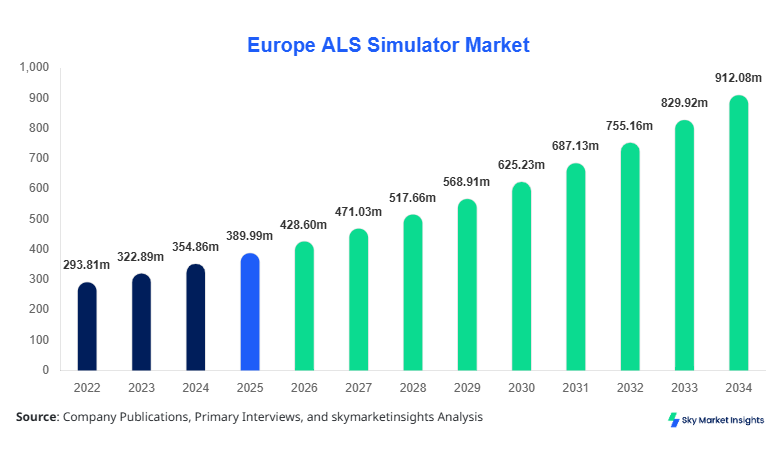
Europe ALS Simulator market size is projected at USD 428.6 million in 2026 and is expected to hit USD 912.4 million by 2034 with a CAGR of 9.9%.
The increasing adoption of advanced medical simulation technologies across Europe is driving strong revenue generation across healthcare education institutions, hospitals, and emergency response centers. Growing investments in healthcare training infrastructure, rising deployment of AI-integrated simulation systems, and expansion of critical care education programs are strengthening demand across the regional ecosystem. The competitive landscape remains moderately consolidated with over 45 regional and international manufacturers operating across the Europe ALS Simulator industry.
The ALS simulator market refers to advanced life support simulation systems utilized for emergency medical education, trauma response training, airway management practice, cardiac arrest simulation, and intensive care procedure training. These systems replicate real-life patient conditions through high-fidelity mannequins, software-based analytics, and immersive response scenarios. In 2025, Europe recorded production of approximately 148,000 ALS simulator units, with the United Kingdom and Germany contributing nearly 52% of total regional output. Adoption penetration across tertiary medical institutes exceeded 68%, while public emergency healthcare agencies represented 24% of overall procurement volume.
Consumer behavior within the Europe healthcare simulation ecosystem indicates rising preference for wireless monitoring capabilities, AI-enabled patient response algorithms, and cloud-based performance analytics. Nearly 61% of training centers prioritized integrated feedback systems, while 48% demanded multi-language simulation support across Europe. Hardware-based platforms accounted for 46% of total installations, software-based simulators represented 31%, and integrated simulation platforms held approximately 23% share in 2025. Application utilization remained dominated by medical training institutes with 49% contribution, followed by hospitals and clinics at 34%, and emergency response training facilities at 17%. Continuous investment in digital emergency medicine education continues reinforcing ALS Simulator market demand across Europe.
Explore more data points, trends and opportunities Download Free Sample Report
Europe ALS Simulator Market Trends
Expansion of AI-Integrated High-Fidelity Simulation Systems
Healthcare institutions across Europe are increasingly deploying AI-integrated ALS simulators capable of replicating advanced patient response mechanisms and dynamic physiological scenarios. In 2025, more than 58% of newly installed ALS simulators incorporated artificial intelligence-driven adaptive learning modules. Production of high-fidelity mannequins surpassed 64,000 units across Europe, reflecting a 19% increase compared with 2024 levels. Medical training institutes in Germany, France, and the United Kingdom significantly expanded procurement of advanced simulation platforms supporting automated ECG interpretation, airway obstruction feedback, and drug administration analytics. Demand for AI-enabled systems is particularly strong among tertiary healthcare institutions, strengthening ALS Simulator market trend development across Europe.
The transition toward cloud-connected simulation ecosystems is accelerating technology modernization throughout the region. Nearly 46% of hospitals adopted centralized cloud performance monitoring platforms during 2025, while 38% implemented remote instructor-led emergency simulation environments. Integrated simulation systems capable of multi-patient scenario replication gained substantial traction within military healthcare training programs and emergency response institutions. Europe recorded investment exceeding USD 118 million in cloud-enabled simulation infrastructure projects during 2025, reinforcing ALS Simulator market trend expansion.
Growing Demand for Portable and Wireless Emergency Simulation Devices
Portable ALS simulation systems are witnessing rapid commercialization due to increasing adoption in ambulance training services, field emergency response units, and remote medical education facilities. Europe produced approximately 51,000 portable ALS simulator devices during 2025, representing nearly 34% of total regional output. Wireless-enabled emergency simulators demonstrated 27% higher deployment rates compared with conventional wired systems. Spain and Italy reported strong procurement growth within public healthcare training agencies, while Russia expanded simulation-based military medical education programs by 22%.
Battery-operated systems supporting mobile deployment durations exceeding 12 hours are gaining strong acceptance across rural healthcare institutions. Portable software-based simulators achieved nearly 43% adoption among emergency response organizations across Europe in 2025. Advanced augmented reality integration and voice-guided emergency intervention systems also expanded by 31% year-over-year. Continuous modernization of emergency healthcare education remains a significant ALS Simulator market trend shaping future procurement strategies across Europe.
Europe ALS Simulator Market Drivers
Rising Healthcare Training Investments and Critical Care Education Expansion
The growing emphasis on advanced emergency care education across Europe is substantially driving adoption of ALS simulation systems. Public and private healthcare institutions collectively invested over USD 1.8 billion in healthcare simulation infrastructure between 2023 and 2025. Nearly 67% of tertiary hospitals increased annual budgets allocated to emergency response training, while over 54% of medical universities expanded high-fidelity simulation laboratories. Europe recorded more than 12.4 million emergency department admissions involving critical cardiac and respiratory incidents in 2025, intensifying the need for realistic training solutions. The United Kingdom alone introduced over 95 new advanced life support certification programs across regional healthcare institutions during the last three years. Demand for AI-supported simulation analytics increased by 39%, while adoption of immersive emergency training environments expanded by 33%. High procedural error reduction rates exceeding 28% among trained clinicians further support institutional investments in simulation-based education. These developments continue strengthening Europe ALS Simulator market growth across healthcare education and emergency medicine sectors.
Europe ALS Simulator Market Restraints
High Initial Deployment Costs and Maintenance Complexity
The high procurement and operational costs associated with advanced ALS simulation systems remain a major challenge for mid-sized healthcare institutions across Europe. High-fidelity integrated simulation platforms typically range between USD 85,000 and USD 420,000 per unit depending on functionality, software integration, and physiological realism. Nearly 42% of smaller medical colleges across Southern and Eastern Europe delayed procurement projects during 2025 due to limited budget allocation. Annual maintenance expenses account for approximately 11% to 16% of initial acquisition costs, while software licensing fees increased by nearly 18% between 2023 and 2025. Complex calibration requirements and specialized technician dependency also affect operational efficiency. Russia and Spain reported simulator downtime rates exceeding 9% due to technical maintenance delays. Additionally, replacement cycles for respiratory modules, cardiac feedback systems, and integrated sensors generally occur every 3–5 years, increasing ownership expenses. These cost-related limitations continue restraining Europe ALS Simulator market growth, particularly among smaller healthcare organizations and regional medical training institutes.
Europe ALS Simulator Market
Expansion of Digital Healthcare Education and Remote Simulation Training
Rapid digital transformation across Europe healthcare education systems presents substantial opportunities for ALS simulator manufacturers and software providers. More than 61% of medical universities across Europe implemented hybrid digital learning frameworks by 2025. Remote simulation platforms supporting real-time instructor monitoring and virtual emergency response assessment expanded by 37% during the same period. Government-funded digital healthcare education programs across Germany, France, and the United Kingdom exceeded USD 620 million in cumulative allocation between 2024 and 2025. Software-based ALS simulation platforms capable of supporting over 5,000 simultaneous trainees gained strong institutional adoption. Cloud-enabled performance analytics systems improved procedural competency tracking efficiency by approximately 32%. Emerging demand from military healthcare units, ambulance services, and private emergency care academies also creates untapped revenue streams. Europe recorded nearly 21% growth in procurement requests for multilingual training interfaces and virtual patient simulation modules. The continuous expansion of digital healthcare infrastructure is expected to generate long-term opportunities for ALS Simulator market demand across Europe.
Challenges in Europe ALS Simulator Market
Shortage of Skilled Simulation Instructors and Standardization Gaps
The limited availability of certified simulation educators and inconsistent training standards remain significant operational challenges across the Europe ALS Simulator industry. Approximately 36% of healthcare institutions reported shortages of qualified instructors capable of operating advanced high-fidelity ALS simulation systems in 2025. Variations in emergency response certification frameworks across Europe further complicate simulator integration and training consistency. Germany and Italy experienced instructor-to-trainee ratios exceeding 1:48 in several regional medical universities, reducing practical training effectiveness. Additionally, more than 29% of hospitals reported interoperability challenges between legacy hospital systems and newer simulation software platforms. Language localization requirements across multilingual European healthcare environments increase deployment complexity and software customization costs by nearly 14%. Delays in accreditation approvals for advanced simulation-based training programs additionally slow institutional adoption. Europe also recorded nearly 17% variance in emergency response training protocols among regional healthcare systems. These operational inefficiencies continue affecting Europe ALS Simulator market demand and technology deployment scalability.
Report Scope
| Report Metric | Details |
|---|---|
| Market Size in 2025 | USD 390.17 million |
| Market Size in 2026 | USD 428.6 million |
| Market Size in 2034 | USD 912.4 million |
| CAGR | 9.9% (2026-2034) |
| Base Year for Estimation | 2025 |
| Historical Data | 2022-2024 |
| Forecast Period | 2026-2034 |
| Report Coverage | Revenue Forecast, Competitive Landscape, Supply Chain Disruption, Growth Factors, Environment & Regulatory Landscape and Trends |
Explore more data points, trends and opportunities Download Free Sample Report
Europe ALS Simulator Market Segmentation
The Europe ALS simulator industry is segmented based on product type and end user application. Hardware-based simulators dominated the market with nearly 46% share in 2025 owing to strong adoption among tertiary hospitals and advanced medical universities. Medical training institutes represented the leading application segment with 49% revenue contribution due to large-scale emergency care certification programs across Europe.
By Type
Hardware-based ALS simulators represented approximately 46% of Europe market volume in 2025 with annual production exceeding 68,000 units. These systems are extensively utilized in trauma care training, airway management education, cardiac arrest simulation, and intensive care procedural instruction. High-fidelity mannequins featuring synchronized respiratory movement, pulse simulation accuracy above 95%, and integrated ECG visualization systems witnessed significant adoption among hospitals and academic institutions. Germany and the United Kingdom collectively contributed nearly 57% of regional hardware simulator demand. Advanced mannequins capable of supporting over 200 emergency response scenarios gained strong institutional preference due to improved training realism. Average deployment rates within tertiary medical institutions exceeded 71%, while emergency response centers reported installation growth of 23% during 2025. Hardware-based ALS simulators additionally support wireless instructor monitoring systems and integrated drug administration feedback modules. The increasing requirement for immersive clinical training environments continues strengthening demand for hardware-based ALS simulation platforms across Europe.
Software-based ALS simulators accounted for nearly 31% share of Europe deployments in 2025, supported by rising demand for remote healthcare education and cost-efficient training systems. More than 45,000 software simulation licenses were activated across Europe during the year. These platforms enable virtual emergency scenario replication, cloud-based trainee assessment, and AI-driven procedural analytics. France and Spain experienced software simulator adoption growth exceeding 26% due to expansion of digital healthcare learning programs. Simulation systems supporting latency below 20 milliseconds and real-time physiological response rendering achieved substantial penetration among healthcare training institutions. Software-based platforms additionally reduced average operational costs by approximately 34% compared with fully hardware-integrated systems. Multi-user collaboration capabilities and multilingual interfaces significantly improved institutional adoption rates. Integration with virtual reality emergency training modules expanded by nearly 29% during 2025. Increasing digitization of healthcare education continues accelerating software-based ALS simulator deployment across Europe.
Integrated simulation platforms held approximately 23% of Europe market contribution in 2025 and are increasingly preferred by large academic hospitals and military healthcare organizations. These systems combine high-fidelity hardware simulation with AI-powered analytics, cloud connectivity, and remote instructor supervision capabilities. Europe recorded production of nearly 35,000 integrated ALS simulation systems during 2025. Adoption rates among large healthcare universities exceeded 52%, while emergency military medical training facilities increased procurement by 18%. Integrated systems supporting synchronized multi-patient emergency response training achieved significant commercialization success. These platforms also provide automated competency scoring and advanced procedural analytics accuracy above 91%. Italy and Germany emerged as key regional adopters due to expansion of critical care training infrastructure. Increasing preference for centralized healthcare simulation ecosystems continues supporting demand for integrated ALS simulation platforms across Europe.
By Application
Medical training institutes represented the largest application segment with nearly 49% market share across Europe in 2025. More than 760 universities and clinical education institutions deployed ALS simulators for emergency medicine certification and advanced healthcare training programs. Annual procurement exceeded 72,000 simulator units across Europe during the year. Simulation-based education improved clinical emergency response competency scores by approximately 31% among medical students and trainee physicians. High-fidelity mannequins supporting over 150 procedural scenarios gained strong acceptance across academic institutions. The United Kingdom and Germany collectively accounted for nearly 44% of institutional procurement demand. Universities increasingly adopted integrated simulation laboratories equipped with wireless monitoring systems, VR-supported emergency response modules, and AI-enabled trainee analytics. Average simulation session frequency across major European universities exceeded 1,800 hours annually. Continued modernization of healthcare education systems remains a major driver supporting ALS simulator adoption among medical training institutes.
Hospitals and clinics accounted for approximately 34% of Europe ALS simulator installations in 2025 due to increasing emphasis on continuous professional development and emergency preparedness training. More than 4,800 hospitals across Europe implemented simulation-based emergency response programs during the year. Procurement of portable ALS simulators increased by 24% within hospital emergency departments. France, Italy, and Spain demonstrated strong adoption of cloud-connected simulation systems supporting remote competency evaluation. Hospitals utilizing simulation-based emergency training recorded nearly 27% reduction in procedural response errors during critical care interventions. High-frequency simulation programs supporting cardiac arrest response, trauma stabilization, and airway management became standard operational requirements within tertiary healthcare facilities. Average annual hospital spending on ALS simulation infrastructure exceeded USD 142,000 per institution. Increasing regulatory emphasis on patient safety and emergency preparedness continues strengthening ALS simulator utilization across Europe hospitals and clinics.
Emergency response training facilities represented nearly 17% of Europe ALS simulator deployments during 2025. Ambulance services, military healthcare units, disaster management agencies, and fire response departments increasingly adopted advanced simulation systems for real-time emergency preparedness programs. Europe recorded annual deployment of approximately 24,000 portable and field-compatible ALS simulation units across emergency response organizations. Wireless-enabled simulators supporting battery operation durations above 10 hours achieved substantial adoption within mobile healthcare training environments. Russia and the United Kingdom collectively represented 38% of emergency response simulation demand due to expansion of national disaster preparedness initiatives. Integrated trauma simulation systems supporting environmental scenario replication, mass casualty management, and battlefield medical response training experienced 22% procurement growth during 2025. Increasing government investment in disaster response readiness and public emergency healthcare infrastructure continues driving ALS simulator utilization within emergency response training institutions.
Europe ALS Simulator Market Segmentations
Product Type
- Hardware-based Simulators
- Software-based Simulators
- Integrated Simulation Platforms
End User Application
- Medical Training Institutes
- Hospitals & Clinics
- Emergency Response Training
Europe ALS Simulator Regional Outlook
United Kingdom
The United Kingdom remained the largest contributor to the Europe ALS simulator industry with approximately 31% regional revenue share in 2025. The country produced more than 39,000 simulator units annually and operated over 420 healthcare simulation facilities. NHS hospitals represented nearly 43% of procurement demand, while universities and emergency training centers contributed 39% and 18% respectively. Adoption of AI-enabled high-fidelity simulators exceeded 72% across advanced healthcare education institutions. Government healthcare education funding increased by nearly 16% between 2023 and 2025, supporting modernization of emergency simulation infrastructure.
Cloud-based performance monitoring systems witnessed strong commercialization throughout the United Kingdom healthcare ecosystem. Portable ALS simulator deployment across ambulance services increased by 21% during 2025. Universities additionally expanded virtual emergency simulation training programs by nearly 33%. London, Manchester, and Birmingham emerged as primary regional procurement centers due to concentration of advanced healthcare institutions. Continuous investment in healthcare digitization continues strengthening ALS simulator adoption across the United Kingdom.
Germany
Germany accounted for nearly 24% of Europe ALS simulator revenue generation in 2025 owing to strong medical technology manufacturing capabilities and advanced healthcare education infrastructure. The country produced over 34,000 ALS simulator units during the year. Hospitals represented 41% of domestic demand, while medical universities accounted for 37%. Germany additionally maintained over 310 advanced healthcare simulation laboratories equipped with integrated emergency response training systems.
AI-supported emergency simulation systems experienced 28% adoption growth between 2023 and 2025. Bavaria and North Rhine-Westphalia emerged as major deployment regions due to concentration of tertiary hospitals and medical universities. Integrated simulation platforms supporting multi-patient emergency response scenarios gained substantial institutional preference. Germany also increased investments in digital healthcare training infrastructure by approximately USD 145 million during 2025, supporting long-term market expansion.
France
France represented approximately 15% of Europe ALS simulator demand during 2025. The country recorded deployment exceeding 22,000 simulator units across hospitals, emergency response institutions, and academic training facilities. Software-based simulation systems demonstrated particularly strong adoption across French healthcare universities, representing nearly 39% of domestic installations. Public healthcare modernization initiatives significantly accelerated procurement of cloud-connected simulation platforms.
Paris and Lyon emerged as key regional healthcare simulation hubs due to concentration of advanced emergency care institutions. France additionally expanded remote emergency response training programs by 26% during 2025. Emergency healthcare simulation budgets increased by nearly 14% across public medical universities. Rising focus on critical care preparedness continues supporting ALS simulator commercialization throughout France.
Spain
Spain accounted for nearly 10% of Europe ALS simulator installations in 2025. The country produced approximately 12,000 simulator units and imported significant volumes of advanced integrated systems from Germany and the United Kingdom. Hospitals represented the leading application segment with 46% contribution to national procurement demand. Portable wireless simulators experienced strong adoption among emergency ambulance services and disaster management agencies.
Government-funded digital healthcare training initiatives expanded by nearly 22% during 2025. Madrid and Barcelona emerged as major healthcare simulation investment centers due to increasing modernization of tertiary healthcare institutions. Spain additionally reported 29% growth in cloud-based simulation analytics deployment across healthcare education organizations. Continued investment in emergency response readiness remains a major contributor to national ALS simulator demand.
Italy
Italy contributed approximately 11% of Europe ALS simulator revenue generation during 2025. The country operated over 180 advanced healthcare simulation centers supporting emergency medicine education and trauma care training. Integrated simulation systems represented nearly 31% of national installations due to increasing demand for centralized training ecosystems. Italy produced more than 14,000 ALS simulator units during the year.
Hospitals and medical universities collectively accounted for 79% of domestic procurement demand. Northern Italy emerged as the primary commercialization hub due to strong healthcare infrastructure concentration. Italy additionally expanded simulation-based cardiac arrest training programs by 24% during 2025. Adoption of AI-enabled performance analytics systems increased by nearly 19%, strengthening healthcare education modernization.
Russia
Russia represented approximately 9% of Europe ALS simulator installations during 2025, supported primarily by military healthcare training and emergency response modernization programs. The country deployed more than 11,000 portable simulation systems during the year. Emergency response agencies represented nearly 42% of national demand, while medical universities contributed 33%.
Government investments in disaster preparedness simulation programs increased by approximately 18% during 2025. Moscow and Saint Petersburg emerged as major deployment centers for advanced emergency simulation infrastructure. Russia additionally expanded battlefield medical response training capacity by nearly 27% through adoption of integrated trauma simulation systems. Increasing emphasis on emergency healthcare readiness continues supporting ALS simulator deployment across Russia.
Top players in Europe ALS Simulator Market
- Laerdal Medical
- CAE Healthcare
- Gaumard Scientific
- 3B Scientific
- Simulaids
- Limbs & Things
- Ambu A/S
- Kyoto Kagaku
- Nasco Healthcare
- IngMar Medical
- Operative Experience Inc.
- Medical-X
- LifeCast Body Simulation
- Surgical Science
- Mentice AB
Laerdal Medical
- Holds approximately 18% Europe market positioning within advanced life support simulation systems.
- Operates manufacturing and distribution facilities across the United Kingdom, Germany, and Norway.
- Generated strong institutional demand through high-fidelity simulation platforms supporting over 250 emergency response scenarios.
- The company expanded cloud-based training analytics deployment by 32% during 2025.
- Strong partnerships with universities and NHS hospitals enhanced regional commercialization capabilities.
- Portable emergency simulation product lines represented nearly 28% of company Europe revenue contribution.
- Significant investment in AI-supported healthcare training solutions continues strengthening competitive positioning.
CAE Healthcare
- Accounted for nearly 13% regional market positioning in 2025.
- Strong penetration across military healthcare training and tertiary hospital simulation programs.
- Delivered more than 8,500 advanced simulation units across Europe during 2025.
- AI-enabled integrated emergency response systems represented approximately 41% of total company installations.
- Germany and France emerged as key revenue-generating markets for the company.
- Continuous expansion of VR-enabled emergency training ecosystems improved institutional adoption by nearly 24%.
- Strategic collaborations with healthcare universities and emergency response agencies continue strengthening operational presence.
Investment Analysis
Europe healthcare simulation infrastructure investment exceeded USD 2.1 billion between 2023 and 2025, with approximately 38% allocated toward advanced life support simulation technologies. The United Kingdom represented nearly 29% of total regional healthcare simulation investment, followed by Germany at 24% and France at 16%. Public healthcare institutions accounted for approximately 57% of capital allocation, while private medical universities contributed 28%. Investments in cloud-based simulation analytics platforms increased by 31% during 2025 due to rising demand for remote healthcare education systems.
Mergers, acquisitions, and strategic collaborations significantly accelerated market expansion across Europe. More than 18 partnership agreements involving simulation technology providers and healthcare universities were finalized between 2024 and 2025. Integrated simulation ecosystem development projects represented approximately 34% of total regional investment activity. Emergency response agencies additionally expanded procurement funding by nearly 21% to strengthen disaster preparedness training capabilities. Military healthcare modernization initiatives across Germany, Russia, and the United Kingdom also generated substantial long-term investment opportunities.
Technology-focused venture funding demonstrated strong growth across AI-supported medical simulation startups. Investments targeting augmented reality emergency training systems increased by approximately 27% during 2025. Portable wireless simulation platforms attracted significant funding due to rising adoption among ambulance services and remote healthcare institutions. Continuous digitalization of healthcare education infrastructure is expected to generate sustainable long-term investment opportunities throughout the Europe ALS simulator industry.
New Product Developments
Manufacturers across Europe increasingly introduced AI-supported ALS simulators featuring adaptive patient response algorithms, cloud-connected instructor dashboards, and multilingual emergency training modules. Nearly 36% of newly launched products during 2025 incorporated wireless connectivity and remote performance monitoring functionality. Advanced simulation systems demonstrated respiratory feedback accuracy improvements exceeding 18% compared with earlier product generations. Portable battery-powered systems supporting operational durations above 12 hours gained strong institutional preference.
Innovation activities additionally focused on virtual reality-supported trauma response simulation and integrated ECG interpretation modules. More than 22% of new product launches included immersive augmented reality emergency training capabilities during 2025. High-fidelity mannequins capable of supporting over 300 clinical scenarios witnessed commercialization growth across hospitals and medical universities. Increasing demand for data-driven healthcare education continues accelerating product innovation throughout the Europe ALS simulator ecosystem.
Recent Developments in Europe ALS Simulator Market
- 2025: Laerdal Medical expanded production capacity across its Europe manufacturing network by approximately 17%, enabling annual output exceeding 24,000 advanced simulation units. The company additionally launched AI-enabled emergency response training modules supporting real-time procedural analytics. Hospitals utilizing the upgraded systems reported nearly 26% improvement in trainee emergency response accuracy.
Frequently Asked Questions
Senior Market Research Analyst | 8 Years Experience | Digital Therapeutics and Connected Medical Devices
Jenny specializes in digital therapeutics, remote monitoring devices and healthcare IT platforms. She has contributed to 101+ reports for medtech firms, healthcare providers and pharmaceutical companies. Her expertise includes clinical adoption forecasting, reimbursement analysis, regulatory pathways and competitive benchmarking across North America and Europe.