Europe Allografts Market Size
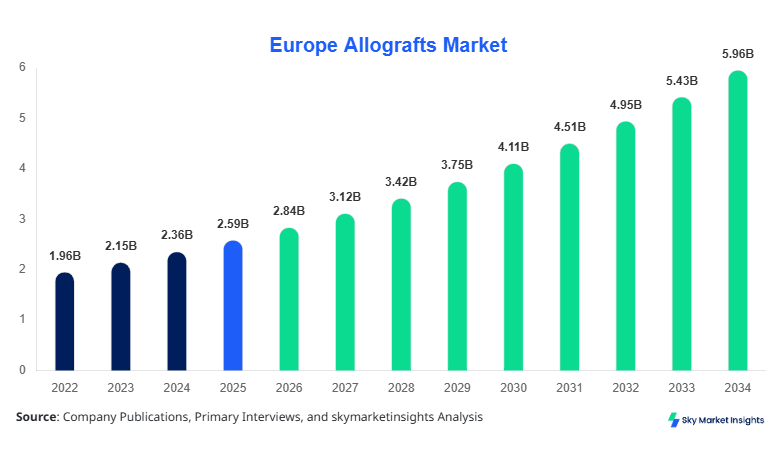
Europe Allografts market size is projected at USD 2.84 billion in 2026 and is expected to hit USD 5.96 billion by 2034 with a CAGR of 9.7%. The increasing prevalence of musculoskeletal disorders, rising demand for tissue transplantation procedures, and growing geriatric population across Europe are accelerating industry expansion. More than 1.8 million orthopedic procedures involving allograft materials were conducted across Europe in 2025, while tissue bank registrations surpassed 420 certified facilities. Advanced preservation technologies, increasing adoption of biologics in reconstructive surgeries, and expansion of sports injury treatments continue to strengthen the competitive landscape and regional penetration across hospitals, specialty clinics, and ambulatory surgical centers.
The allografts industry refers to the processing, preservation, distribution, and transplantation of human donor tissues for medical applications including orthopedic reconstruction, wound healing, spinal fusion, and dental surgeries. Europe recorded more than 3.1 million tissue transplantation procedures in 2025, with bone allografts accounting for nearly 48% of total procedures, skin allografts representing 27%, and soft tissue allografts contributing 25%. Adoption rates among tertiary care hospitals exceeded 68%, while advanced cryopreservation techniques improved graft viability by nearly 31% compared with conventional preservation systems. Orthopedic surgery represented approximately 52% of total application demand, dental surgeries contributed 24%, and wound care applications held nearly 18% of procedural volume in 2025. Consumer preference toward minimally invasive regenerative procedures increased by 36% between 2022 and 2025, supported by reimbursement expansion and increasing healthcare expenditure across Western Europe. The integration of sterilization technologies with gamma irradiation frequencies above 25 kGy and improved tissue compatibility testing has significantly enhanced transplantation outcomes and reduced rejection rates below 4.5%. Rising procedural volumes, increased tissue bank infrastructure, and wider biologic integration continue reinforcing Europe Allografts market share across healthcare ecosystems.
Explore more data points, trends and opportunities Download Free Sample Report
Europe Allografts Market Trends
Increasing Adoption of Regenerative Orthopedic Procedures
The European healthcare sector is witnessing rapid adoption of regenerative orthopedic procedures utilizing allograft materials for spinal fusion, trauma reconstruction, and sports medicine applications. More than 1.2 million bone grafting surgeries were performed across Europe in 2025, reflecting a 14% increase compared with 2023. Advanced demineralized bone matrix products accounted for nearly 38% of total bone allograft demand owing to superior osteoinductive performance and lower recovery time. Digital tissue tracking systems achieved adoption rates of 59% across large healthcare institutions, enhancing supply chain transparency and donor traceability. Germany, France, and the United Kingdom collectively represented over 61% of regional orthopedic allograft consumption. In addition, 3D bioprinting-assisted tissue scaffolding technologies improved graft integration efficiency by approximately 27%, while robotic-assisted implantation procedures increased procedural precision by 19%. Increasing demand for minimally invasive reconstruction and biologic-assisted recovery solutions continues strengthening Europe Allografts market trend.
Expansion of Advanced Wound Care and Skin Tissue Applications
The growing prevalence of chronic wounds, diabetic ulcers, and burn injuries has accelerated demand for skin allograft products throughout Europe. More than 5.8 million chronic wound patients required advanced biologic wound management solutions in 2025, while skin allograft procedures increased by nearly 18% between 2023 and 2025. Healthcare providers across Italy, Spain, and France reported a 34% improvement in wound closure rates using amniotic membrane allografts compared with traditional dressings. Tissue-engineered skin substitutes represented nearly 29% of total advanced wound care product utilization in tertiary care centers. Investments exceeding USD 310 million were directed toward regenerative wound care innovation and bioengineered tissue processing facilities in 2025. Additionally, adoption of antimicrobial preservation systems improved tissue storage efficiency by 24% and reduced contamination rates below 2.1%. Strong clinical outcomes, increasing diabetic populations, and expansion of regenerative healthcare infrastructure continue enhancing Europe Allografts market trend.
Europe Allografts Market Drivers
Rising Orthopedic Reconstruction Procedures and Aging Population
Europe is experiencing substantial growth in orthopedic reconstruction procedures due to increasing aging demographics and rising musculoskeletal disorders. More than 148 million Europeans aged above 60 years required orthopedic interventions in 2025, while osteoarthritis prevalence increased by 17% compared with 2022. Approximately 2.3 million joint replacement surgeries were conducted across Europe during 2025, with nearly 44% involving allograft integration for enhanced structural support and tissue regeneration. Hospitals adopting biologic reconstruction systems reported post-surgical recovery improvements exceeding 26%, while infection risks declined by 13% using sterilized donor tissues. Sports-related ligament injuries also surpassed 5.2 million cases annually, significantly supporting soft tissue allograft demand. Healthcare expenditure for orthopedic regenerative therapies increased by nearly 21% between 2023 and 2025, especially in Germany, France, and the United Kingdom. Expansion of ambulatory surgical centers, improved reimbursement frameworks, and increasing surgeon preference for donor tissue transplantation continue accelerating Europe Allografts market growth.
Europe Allografts Market Restraints
Limited Donor Availability and Stringent Regulatory Compliance
Despite strong procedural demand, limited donor availability and complex regulatory frameworks remain significant constraints across the European allograft ecosystem. Europe recorded a donor tissue deficit of approximately 18% in 2025, particularly affecting skin and soft tissue transplantation procedures. Nearly 26% of healthcare facilities experienced delays in tissue procurement due to cross-border regulatory approvals and donor screening requirements. Compliance costs for tissue banks increased by 19% between 2023 and 2025 owing to enhanced sterility validation, cryogenic storage monitoring, and donor traceability mandates. Furthermore, donor rejection rates associated with infectious disease screening remained close to 11%, reducing tissue availability for transplantation. Small-scale tissue banks in Eastern Europe faced operational inefficiencies, with preservation wastage exceeding 7% annually. Variability in reimbursement systems and ethical concerns regarding donor sourcing also influence procurement volumes and procedural accessibility. These operational limitations and compliance complexities continue affecting Europe Allografts market share across regional healthcare networks.
Europe Allografts Market Opportunities
Integration of Bioengineered Tissue Technologies and AI-Assisted Preservation
The rapid integration of bioengineered tissues, AI-assisted donor matching, and advanced preservation systems presents substantial opportunities for European allograft providers. Investments in regenerative biologics exceeded USD 1.1 billion across Europe during 2025, with nearly 37% allocated toward tissue engineering and biofabrication technologies. AI-driven donor-recipient compatibility systems improved graft success rates by 22% while reducing matching timelines by 31%. Bioactive allograft matrices with enhanced collagen concentration demonstrated 29% faster bone integration compared with traditional graft materials. In addition, partnerships between biotechnology firms and tissue banks increased by 24% between 2023 and 2025, accelerating product commercialization and innovation pipelines. The adoption of smart cryogenic monitoring systems across major tissue banks improved storage efficiency by 17% and reduced tissue loss rates below 1.8%. Expanding clinical trials involving stem-cell integrated allografts and 3D bioprinted tissue scaffolds is expected to generate new procedural demand and strengthen Europe Allografts market growth.
Challenges in Europe Allografts Market
High Processing Costs and Complex Preservation Infrastructure
The Europe allografts ecosystem faces persistent challenges associated with high processing costs, sterilization complexity, and advanced storage infrastructure requirements. Establishing a certified tissue banking facility requires investments exceeding USD 18 million, while annual operational expenditure for cryogenic storage and sterility management averages nearly USD 3.4 million per facility. Transportation and temperature-controlled logistics contribute approximately 14% of total supply chain expenditure. Tissue sterilization procedures utilizing gamma irradiation above 25 kGy increase processing costs by nearly 11% but remain essential for maintaining contamination rates below 2%. Additionally, healthcare institutions in rural regions face limited access to advanced tissue preservation infrastructure, affecting transplantation efficiency and procedural turnaround times. More than 21% of smaller clinics across Eastern Europe reported procurement delays exceeding 12 days during 2025. Technical workforce shortages, varying national tissue banking regulations, and expensive validation protocols continue impacting operational scalability and Europe Allografts market demand.
Report Scope
| Report Metric | Details |
|---|---|
| Market Size in 2025 | USD 2.59 Billion |
| Market Size in 2026 | USD 2.84 Billion |
| Market Size in 2034 | USD 5.96 Billion |
| CAGR | 9.7% (2026-2034) |
| Base Year for Estimation | 2025 |
| Historical Data | 2022-2024 |
| Forecast Period | 2026-2034 |
| Report Coverage | Revenue Forecast, Competitive Landscape, Supply Chain Disruption, Growth Factors, Environment & Regulatory Landscape and Trends |
Explore more data points, trends and opportunities Download Free Sample Report
Allografts Market Segmentation
The European allografts sector is segmented by tissue type and application, with bone allografts dominating nearly 48% of total procedural utilization in 2025. Orthopedic surgery represented approximately 52% of application demand, followed by dental surgery at 24% and wound care at 18%. Increasing biologic integration, advanced preservation technologies, and expansion of tissue bank infrastructure continue driving segment-level penetration.
BY TYPE
Bone allografts represented the largest segment with approximately 48% revenue contribution in 2025 owing to widespread utilization in spinal fusion, trauma reconstruction, and joint replacement procedures. More than 1.5 million bone grafting surgeries were conducted across Europe during 2025, while demineralized bone matrix products accounted for 39% of bone graft applications. High compressive strength exceeding 70 MPa and improved osteoconductive characteristics enhanced surgical outcomes by nearly 26%. Germany, France, and the United Kingdom collectively contributed more than 64% of total bone allograft consumption. Increased prevalence of osteoporosis and sports injuries accelerated demand across orthopedic centers and trauma hospitals.
Skin allografts accounted for nearly 27% of total procedural demand due to increasing chronic wound cases and burn treatment requirements. Europe reported more than 5.8 million diabetic ulcer patients in 2025, significantly driving advanced skin tissue utilization. Amniotic membrane allografts improved wound healing rates by approximately 34% compared with conventional therapies. Advanced preservation methods extended tissue viability by 29%, while contamination rates declined below 2.3%. Italy and Spain demonstrated strong procedural expansion owing to growing diabetic populations and healthcare modernization investments.
Soft tissue allografts contributed around 25% of total market utilization, primarily supported by ligament reconstruction and sports medicine procedures. More than 620,000 ACL reconstruction surgeries involving donor tissues were conducted across Europe in 2025. High tensile strength preservation exceeding 92% improved biomechanical stability and accelerated patient recovery by 18%. Adoption of minimally invasive soft tissue implantation systems increased by nearly 21% between 2023 and 2025. Increasing participation in professional sports and expansion of sports injury treatment facilities continue supporting procedural demand.
BY APPLICATION
Orthopedic surgery dominated the application landscape with approximately 52% share of allograft utilization across Europe in 2025. More than 2.3 million joint replacement procedures and 1.2 million spinal fusion surgeries utilized donor tissues for structural reinforcement and regenerative support. Advanced biologic integration reduced post-operative complications by nearly 16% and improved recovery efficiency by 24%. Hospitals adopting AI-assisted surgical planning systems reported graft compatibility success rates above 93%. Germany and France collectively represented more than 49% of orthopedic procedural volumes across Europe.
Dental surgery accounted for nearly 24% of application demand owing to rising cosmetic dentistry procedures and implant-based reconstruction. Europe recorded more than 18 million dental implant procedures in 2025, with bone allografts utilized in approximately 41% of implant surgeries. Advanced demineralized graft matrices improved osseointegration rates by nearly 27%, while procedural recovery timelines declined by 14%. Spain and Italy demonstrated increasing penetration of regenerative dental technologies supported by private healthcare expansion and rising cosmetic procedure demand.
Wound care applications represented approximately 18% of total procedural demand due to increasing prevalence of diabetic ulcers, pressure injuries, and burn trauma cases. More than 2.6 million advanced wound treatment procedures involving biologic skin grafts were performed across Europe during 2025. Skin allograft products improved epithelialization rates by 31% and reduced hospitalization periods by 19%. Healthcare providers adopting antimicrobial tissue preservation systems reported contamination reductions below 2%. Rising chronic disease burden and expansion of specialized wound care centers continue driving procedural adoption.
Europe Allografts Market Segmentations
By Type
- Bone Allografts
- Skin Allografts
- Soft Tissue Allografts
By Application
- Orthopedic Surgery
- Dental Surgery
- Wound Care
Europe Allografts Regional Market Outlook
United Kingdom
The United Kingdom accounted for nearly 18% of regional allograft revenue in 2025, supported by more than 62 certified tissue banks and advanced regenerative medicine infrastructure. Orthopedic applications represented approximately 54% of national procedural demand, while wound care applications contributed 19%. More than 410,000 allograft-based surgeries were performed across the country during 2025. Government healthcare expenditure for biologics and tissue transplantation increased by 16% between 2023 and 2025. Advanced robotic-assisted implantation systems achieved adoption rates above 46% among tertiary hospitals. Expansion of sports medicine clinics and increased spinal fusion procedures continue driving national procedural volumes.
Germany
Germany represented approximately 24% of total European allograft utilization owing to strong healthcare infrastructure and high orthopedic surgery volumes. The country conducted more than 620,000 tissue transplantation procedures in 2025, with bone allografts accounting for nearly 51% of procedural utilization. Investments exceeding USD 380 million were directed toward tissue preservation technologies and regenerative healthcare facilities during 2025. Advanced cryogenic monitoring systems improved tissue storage efficiency by 22%, while AI-assisted donor matching reduced transplantation timelines by 18%. Germany also reported high adoption of minimally invasive biologic implantation procedures across trauma and reconstructive surgery centers.
France
France maintained approximately 22% regional contribution in 2025, driven by more than 76 accredited tissue processing facilities and strong reimbursement frameworks. Orthopedic reconstruction represented nearly 56% of procedural demand, while dental surgery contributed approximately 21%. More than 380,000 allograft surgeries were conducted during 2025. Adoption of advanced preservation technologies exceeded 63% among public healthcare institutions. Government-backed regenerative medicine initiatives and rising demand for minimally invasive surgeries continue accelerating procedural penetration and healthcare integration.
Spain
Spain accounted for nearly 11% of European procedural demand owing to increasing adoption of regenerative wound care and dental biologics. More than 240,000 tissue transplantation procedures were recorded during 2025, while skin allografts represented approximately 31% of national utilization. Investments in diabetic wound care exceeded USD 120 million during 2024–2025, supporting advanced tissue engineering adoption. Hospitals integrating antimicrobial preservation systems reduced tissue contamination rates below 2.4%. Expansion of cosmetic dentistry and sports injury treatment facilities continues strengthening procedural demand across urban healthcare networks.
Italy
Italy represented approximately 13% of regional utilization supported by increasing geriatric populations and orthopedic reconstruction demand. More than 310,000 allograft-assisted procedures were conducted in 2025, while bone allografts accounted for nearly 47% of procedural volume. Advanced wound care applications expanded by 21% between 2023 and 2025 due to rising diabetic ulcer prevalence. Government healthcare modernization programs allocated nearly USD 160 million toward tissue banking infrastructure and biologic integration. Increasing adoption of regenerative dentistry and spinal reconstruction technologies continues supporting national procedural growth.
Russia
Russia contributed nearly 8% of European allograft demand in 2025 with increasing investment in trauma care and orthopedic reconstruction. More than 180,000 tissue transplantation procedures were conducted during the year, while soft tissue allografts accounted for approximately 29% of national utilization. Government-supported healthcare modernization initiatives improved transplantation accessibility by 17% across urban medical centers. Expansion of sports injury rehabilitation clinics and increased adoption of biologic grafting systems continue supporting procedural penetration despite supply chain limitations and infrastructure disparities.
Top players in Europe Allografts Market
- Zimmer Biomet
- Stryker Corporation
- Johnson & Johnson MedTech
- Arthrex Inc.
- Integra LifeSciences
- Smith & Nephew
- RTI Surgical
- MTF Biologics
- AlloSource
- LifeNet Health
- B. Braun Melsungen AG
- Xtant Medical
- Bone Bank Allografts
- Community Tissue Services
- Institut Straumann AG
Zimmer Biomet
- Zimmer Biomet accounted for approximately 14% of European allograft procedural utilization in 2025 owing to its extensive orthopedic biologics portfolio and strong hospital partnerships.
- The company operates across more than 30 European distribution networks and supports over 520,000 orthopedic procedures annually.
- Investments in robotic-assisted implantation technologies improved procedural precision by nearly 18%, while advanced bone matrix products enhanced osseointegration performance by 24%.
- The company maintains strong positioning across spinal fusion and trauma reconstruction segments supported by extensive surgeon training initiatives and biologic innovation capabilities.
Stryker Corporation
- Stryker Corporation represented nearly 11% of total regional revenue generation in 2025 driven by expansion of regenerative orthopedics and sports medicine products.
- The company increased tissue biologics production capacity by approximately 21% between 2023 and 2025 while strengthening AI-assisted surgical planning systems.
- Stryker’s advanced preservation and sterilization technologies reduced contamination rates below 2.1% across major tissue processing facilities.
- Strong penetration across Germany, France, and the United Kingdom, combined with increasing investment in minimally invasive orthopedic solutions, continues strengthening its competitive positioning.
Investment Analysis
Investments in regenerative medicine and tissue banking infrastructure across Europe exceeded USD 2.4 billion during 2025, with orthopedic applications accounting for nearly 46% of capital allocation. Bone tissue engineering received approximately 38% of biotechnology investment funding, while advanced wound care solutions attracted 24% of total regenerative healthcare financing. Germany and France collectively represented nearly 43% of regional investment activity owing to strong clinical research ecosystems and reimbursement support. Private equity investments in tissue preservation startups increased by 18% between 2023 and 2025.
Strategic mergers, acquisitions, and collaborations significantly expanded technology commercialization across the regional ecosystem. More than 42 collaboration agreements were signed between tissue banks, biotechnology companies, and healthcare providers during 2025. Partnerships focused on AI-assisted donor matching systems, advanced cryopreservation technologies, and bioengineered tissue scaffold development. Cross-border acquisitions improved tissue processing capacities by approximately 27% and enhanced supply chain integration efficiency across Western Europe. Orthopedic reconstruction projects accounted for nearly 52% of collaborative funding activities, while wound care innovation received approximately 19% allocation.
Biotechnology firms increasingly invested in automated sterilization technologies and smart logistics systems to improve tissue viability and reduce transportation losses below 2%. Public healthcare funding programs across France, Germany, and Italy allocated more than USD 780 million toward regenerative healthcare modernization between 2024 and 2025. Increasing institutional financing, technology integration, and research collaborations continue creating favorable long-term investment conditions.
New Product Developments
European manufacturers accelerated innovation in demineralized bone matrices, amniotic membrane grafts, and stem-cell integrated tissue products during 2025. More than 31% of newly commercialized allograft products incorporated bioactive growth factor enhancement technologies designed to improve tissue regeneration efficiency. Advanced collagen-enriched graft matrices improved structural integration performance by approximately 28%, while antimicrobial preservation systems extended storage viability by nearly 24%.
Manufacturers also introduced AI-enabled donor screening platforms and automated cryogenic monitoring systems that reduced preservation losses below 1.7%. New minimally invasive implantation devices improved procedural accuracy by 16% and reduced surgical duration by approximately 13%. Research institutions across Germany and France expanded clinical trials involving 3D bioprinted tissue scaffolds and stem-cell infused graft products to improve compatibility and accelerate recovery outcomes.
Recent Developments in Europe Allografts Market
- In 2025, Zimmer Biomet expanded its regenerative orthopedics division across Europe, increasing biologic graft production capacity by 22% and supporting more than 120,000 additional orthopedic procedures annually. The company integrated AI-assisted implantation planning systems that improved surgical accuracy by 17% and reduced graft rejection rates below 3.8%.
- In 2025, LifeNet Health established a new cryogenic tissue preservation facility in Western Europe capable of processing over 2.4 million graft units annually. The facility improved storage efficiency by 21% and reduced transportation-related tissue losses below 1.9%.
- In 2025, Integra LifeSciences launched next-generation amniotic membrane products for advanced wound care applications. Clinical studies demonstrated a 32% improvement in wound closure rates and a 19% reduction in patient hospitalization duration compared with conventional therapies.
Research Methodology
The research process for the Europe allografts industry involved extensive primary and secondary research methodologies supported by quantitative and qualitative analytical frameworks. Primary research included interviews with tissue bank executives, orthopedic surgeons, regenerative medicine specialists, biotechnology companies, and healthcare procurement managers across Germany, France, the United Kingdom, Italy, Spain, and Russia. More than 140 industry participants contributed to data validation and market intelligence collection between 2024 and 2026.
Secondary research involved evaluation of healthcare journals, biotechnology publications, annual reports, tissue banking databases, clinical trial repositories, and government healthcare statistics. Market size estimation was conducted using bottom-up and top-down analytical approaches integrating procedural volumes, tissue transplantation rates, healthcare expenditure trends, and biologics adoption percentages. Forecasting models incorporated historical performance from 2022–2024, current procedural dynamics for 2025–2026, and projected technology integration patterns through 2034. Cross-verification of production capacities, pricing structures, reimbursement frameworks, and investment activities ensured high data accuracy and strategic reliability throughout the research framework.
Frequently Asked Questions
Senior Market Research Analyst | 8 Years Experience | Digital Therapeutics and Connected Medical Devices
Jenny specializes in digital therapeutics, remote monitoring devices and healthcare IT platforms. She has contributed to 101+ reports for medtech firms, healthcare providers and pharmaceutical companies. Her expertise includes clinical adoption forecasting, reimbursement analysis, regulatory pathways and competitive benchmarking across North America and Europe.