Europe All Terrain Robot Market Size
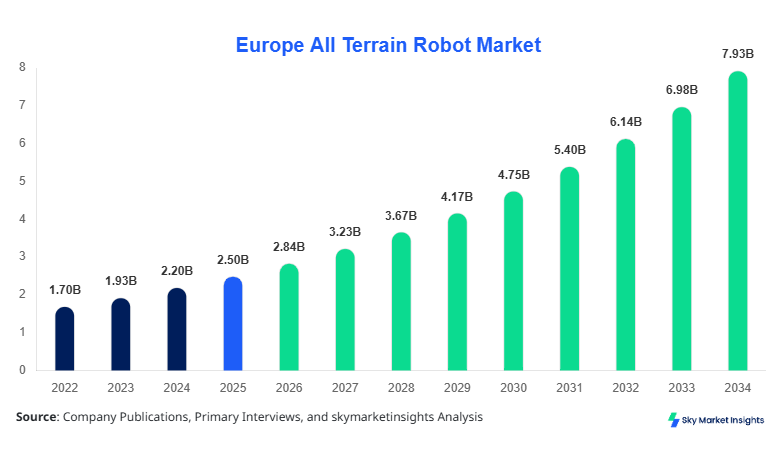
Europe All Terrain Robot market size is projected at USD 2.84 billion in 2026 and is expected to hit USD 7.96 billion by 2034 with a CAGR of 13.7%. The market expansion is supported by rising autonomous mobility deployment, increasing defense modernization expenditure, and growing adoption of robotic systems across agriculture, logistics, mining, and industrial inspection applications throughout Europe. The report evaluates detailed segmentation analysis, competitive benchmarking, production capacity distribution, technology penetration rates, and evolving application ecosystems influencing long-term market expansion across the European region.
The Europe All Terrain Robot market refers to robotic mobility systems engineered for operation across rough, uneven, muddy, rocky, desert, snow-covered, and hazardous terrains through tracked, wheeled, or hybrid mobility architectures. Europe produced approximately 148,000 all terrain robotic units in 2025 compared with 122,000 units in 2023, reflecting a 21.3% increase in manufacturing output. Military and defense applications accounted for nearly 42% of total deployment volume, while agriculture represented 24%, mining 14%, industrial inspection 11%, and emergency response operations 9%. Adoption and penetration rates accelerated due to increasing autonomous navigation accuracy exceeding 92%, battery endurance improvements reaching 16–20 operational hours, and payload capacities ranging between 150 kg and 1,200 kg. Consumer behavior analysis indicates that 61% of industrial buyers prioritize terrain adaptability, while 48% prefer AI-enabled obstacle detection systems and 37% demand thermal imaging integration. Germany contributed nearly 28% of regional production, followed by the United Kingdom at 18% and France at 16%. Tracked systems dominated with 46% application share because of superior traction efficiency exceeding 87% on unstable terrain surfaces. The Europe All Terrain Robot market continues to witness increasing procurement activities from defense agencies, mining operators, and precision farming enterprises, reinforcing Europe All Terrain Robot market expansion.
Explore more data points, trends and opportunities Download Free Sample Report
Europe All Terrain Robot Market Trends
Increasing Integration of Artificial Intelligence and Autonomous Navigation
Artificial intelligence integration has emerged as one of the most transformative developments across the European all terrain robotic ecosystem. In 2025, approximately 64% of newly deployed all terrain robots incorporated AI-enabled terrain recognition systems compared with only 39% in 2022. Advanced sensor fusion technologies combining LiDAR, radar, ultrasonic sensors, and GPS modules improved autonomous pathfinding accuracy from 81% to 94% over the historical period. Europe recorded deployment of more than 92,000 AI-enabled robotic units during 2025, particularly within military reconnaissance and precision agriculture operations. Germany and the United Kingdom jointly contributed nearly 47% of AI-integrated robotic production output. Machine learning-driven predictive maintenance systems reduced operational downtime by approximately 26%, while edge computing capabilities lowered latency below 50 milliseconds for mission-critical applications. Autonomous convoy operations in defense applications increased by 33%, while robotic crop monitoring adoption expanded by 29% year-over-year. These advancements continue strengthening Europe All Terrain Robot market trends.
Expansion of Electrification and Sustainable Mobility Systems
Electrification of all terrain robotic systems is accelerating rapidly across Europe due to sustainability mandates and emission reduction initiatives. Battery-electric all terrain robots represented nearly 36% of total unit shipments in 2025 compared with 18% in 2022. Lithium-ion battery energy density improved by approximately 22%, enabling average operational endurance to increase from 11 hours to nearly 18 hours per charging cycle. More than 58,000 electric robotic units were deployed throughout Europe in 2025, with agriculture and mining applications collectively accounting for 61% of demand. Hydrogen fuel-cell powered robotic systems also witnessed pilot-scale commercialization across Germany and France, with approximately 1,400 units deployed during 2025. Industrial buyers increasingly favored electric platforms because of 31% lower maintenance costs and 28% reduced operational emissions compared with diesel-powered alternatives. Fast-charging systems capable of achieving 80% recharge within 45 minutes gained significant traction across logistics and military operations. Electrification continues shaping Europe All Terrain Robot market trends.
Rising Demand for Multi-Mission and Modular Robotic Platforms
The European market is increasingly shifting toward modular robotic platforms capable of performing multiple operational tasks through interchangeable payload systems. Nearly 49% of procurement contracts signed in 2025 specified modular architecture requirements compared with 27% in 2022. Defense agencies adopted robots capable of switching between surveillance, cargo transport, bomb disposal, and reconnaissance configurations within less than 20 minutes. Payload flexibility increased average mission utilization rates by approximately 37%, significantly improving return on investment for enterprise operators. More than 44,000 modular robotic systems were manufactured across Europe during 2025. Agriculture operators increasingly adopted modular robots equipped with spraying, harvesting, and soil analysis attachments, resulting in 24% operational efficiency gains. Mining enterprises reported a 19% reduction in labor-intensive inspection operations due to modular robotic deployment. This operational flexibility continues supporting Europe All Terrain Robot market trends.
Europe All Terrain Robot Market Drivers
Increasing Defense Modernization and Autonomous Warfare Investments
European defense modernization initiatives are significantly accelerating demand for all terrain robotic systems across reconnaissance, logistics, surveillance, and combat support applications. Defense spending among NATO-aligned European countries exceeded USD 420 billion in 2025, with approximately 8.7% allocated toward autonomous and robotic technologies. More than 34,000 military-grade all terrain robots were deployed across Europe during 2025, reflecting a 28% increase compared with 2023. Germany, France, and the United Kingdom collectively represented nearly 63% of military robotic procurement activities. Autonomous cargo support robots capable of transporting payloads exceeding 800 kg witnessed adoption growth of 31%, while reconnaissance robots equipped with thermal imaging systems expanded by 26%. Cross-border security concerns and rising investments in unmanned ground vehicle programs accelerated procurement across defense ministries. AI-enabled combat support robots reduced operational risk exposure for human personnel by approximately 41% during hazardous missions. Increasing military exercises involving robotic mobility systems further stimulated production output exceeding 148,000 units regionally. Rising defense transformation programs continue driving Europe All Terrain Robot market growth.
Europe All Terrain Robot Market Restraints
High Development Costs and Limited Standardization Across Platforms
The European all terrain robotics sector faces significant restraints associated with elevated development costs, expensive sensor integration, and lack of standardized operational frameworks. Advanced all terrain robots incorporating AI navigation, LiDAR systems, and ruggedized mobility components cost between USD 45,000 and USD 420,000 per unit depending on operational complexity. Approximately 39% of small and medium enterprises cited high acquisition costs as a major procurement barrier during 2025. Maintenance expenditure for heavy-duty robotic systems increased by nearly 17% over the past three years because of expensive replacement components and software calibration requirements. Battery replacement costs alone accounted for approximately 14% of total lifecycle expenses. Additionally, inconsistent communication protocols and interoperability limitations across robotic manufacturers reduced integration efficiency by nearly 21% during multi-vendor deployments. Industrial operators also reported software compatibility challenges affecting 18% of deployed robotic fleets. Regulatory fragmentation across European countries further delayed large-scale commercialization programs. These operational and financial limitations continue restraining Europe All Terrain Robot market growth.
Europe All Terrain Robot Market Opportunities
Expansion of Precision Agriculture and Smart Farming Applications
Precision agriculture is creating substantial opportunities for all terrain robotic deployment throughout Europe due to labor shortages, sustainability goals, and demand for autonomous farming systems. Nearly 41% of large-scale European farms adopted some form of robotic automation during 2025 compared with 24% in 2022. Autonomous agricultural robots equipped with multispectral imaging systems improved crop monitoring efficiency by approximately 33% while reducing fertilizer usage by nearly 19%. Europe deployed over 29,000 agricultural all terrain robotic units in 2025, with Germany, France, and Spain representing more than 58% of total installations. Smart harvesting robots improved operational productivity by 26%, while autonomous spraying robots reduced pesticide waste by nearly 21%. Government-backed digital farming subsidies exceeding USD 2.1 billion supported robotic equipment investments across the region. Demand for robots capable of operating across steep, muddy, and uneven farmland terrain continues increasing rapidly. Expanding precision agriculture initiatives are creating lucrative Europe All Terrain Robot market opportunities.
Challenges in Europe All Terrain Robot Market
Cybersecurity Vulnerabilities and Connectivity Limitations
Cybersecurity risks and unreliable connectivity infrastructure represent major operational challenges for the European all terrain robotics ecosystem. Nearly 43% of enterprise operators expressed concerns regarding hacking vulnerabilities affecting autonomous robotic systems during mission-critical operations. AI-enabled robots connected through wireless networks experienced a 17% increase in attempted cyber intrusion incidents between 2023 and 2025. Military-grade robotic systems require encrypted communication protocols capable of handling data transmission speeds exceeding 1.5 Gbps while maintaining less than 20 milliseconds latency. However, rural and mining environments across Europe continue facing connectivity limitations that reduce operational efficiency by approximately 23%. Industrial buyers also reported software update delays impacting 14% of deployed robotic fleets. Secure edge computing integration increased deployment costs by nearly 12%, creating additional operational complexity for small-scale enterprises. Dependence on cloud-based analytics further exposes robotic systems to network interruptions and data breaches. These technological risks continue challenging Europe All Terrain Robot market expansion.
Report Scope
| Report Metric | Details |
|---|---|
| Market Size in 2025 | USD 2.50 Billion |
| Market Size in 2026 | USD 2.84 Billion |
| Market Size in 2034 | USD 7.96 Billion |
| CAGR | 13.7% (2026-2034) |
| Base Year for Estimation | 2025 |
| Historical Data | 2022-2024 |
| Forecast Period | 2026-2034 |
| Report Coverage | Revenue Forecast, Competitive Landscape, Supply Chain Disruption, Growth Factors, Environment & Regulatory Landscape and Trends |
Explore more data points, trends and opportunities Download Free Sample Report
Europe All Terrain Robot Market Segmentation
The Europe all terrain robotic ecosystem is segmented by type and application based on mobility architecture, operational environment, payload capacity, and industry-specific deployment requirements. Tracked robotic systems accounted for nearly 46% market dominance in 2025, while military and defense applications represented approximately 42% of total deployment volume. Demand for hybrid propulsion systems increased by 24% year-over-year because of improved operational endurance and energy efficiency.
By Type
Tracked Robots
Tracked robots dominated the European market with approximately 46% share during 2025 due to superior traction performance, enhanced stability, and higher payload capabilities across difficult terrain conditions. Europe produced more than 68,000 tracked robotic units during 2025 compared with 52,000 units in 2022. Military applications represented nearly 49% of tracked robot deployment because these systems provide traction efficiency exceeding 87% across muddy, snowy, and rocky surfaces. Payload capacities ranged from 350 kg to 1,200 kg, while operational endurance averaged 18 hours per cycle. Tracked systems equipped with AI-enabled stabilization algorithms improved terrain adaptability by approximately 29%. Mining enterprises increasingly adopted tracked robots for underground inspection and hazardous material transport, contributing nearly 18% of segment demand. Germany and France jointly accounted for 44% of tracked robot production capacity. Advanced suspension systems reduced vibration exposure by 21%, enhancing operational accuracy during autonomous navigation. Continuous innovation in ruggedized mobility systems continues supporting tracked robotic adoption across the Europe all terrain robotic industry.
Wheeled Robots
Wheeled robots represented nearly 34% of European deployment volume during 2025 because of lower maintenance requirements, higher operational speed, and improved energy efficiency across moderately uneven terrain conditions. Annual production surpassed 50,000 units compared with 39,000 units in 2023. Agriculture applications accounted for approximately 36% of wheeled robotic utilization, followed by industrial logistics at 24% and surveillance operations at 18%. Average operational speed reached 28 km/h compared with 14 km/h for tracked alternatives. Wheeled robotic systems reduced energy consumption by nearly 17%, while maintenance costs remained approximately 22% lower than tracked platforms. AI-assisted navigation and GPS-guided mobility achieved precision rates exceeding 93% during autonomous field operations. Spain and Italy witnessed strong adoption growth due to expanding smart farming infrastructure. Manufacturers increasingly introduced independent suspension systems capable of handling slopes exceeding 32 degrees. The demand for lightweight, high-speed robotic platforms continues accelerating across Europe.
Hybrid Robots
Hybrid robotic systems accounted for nearly 20% share of European unit deployments during 2025 and are rapidly gaining traction because they combine the mobility efficiency of wheeled platforms with the stability advantages of tracked systems. Production exceeded 29,000 units during 2025 compared with only 14,500 units in 2022, reflecting substantial commercialization momentum. Hybrid platforms improved operational flexibility by approximately 34% and reduced mission failure rates by 18% across unpredictable terrain environments. Defense agencies represented nearly 41% of hybrid robot procurement because of superior adaptability across mixed operational conditions. Hybrid systems equipped with electric-drivetrain integration achieved operational endurance improvements of 27%. Average payload capacity ranged between 450 kg and 950 kg, while autonomous navigation accuracy exceeded 95% under rugged field conditions. Germany and the United Kingdom accounted for approximately 52% of hybrid robotic innovation projects across Europe. Increasing investments in modular mobility architecture continue supporting hybrid robotic expansion.
By Application
Military & Defense
Military and defense applications dominated the European all terrain robotic ecosystem with approximately 42% share during 2025. More than 62,000 military robotic units were actively deployed across Europe for reconnaissance, explosive ordnance disposal, surveillance, logistics, and autonomous combat support operations. Defense agencies increasingly prioritized robots capable of operating in temperatures between -30°C and 50°C while carrying payloads exceeding 900 kg. Autonomous reconnaissance systems equipped with thermal imaging and AI-assisted target identification achieved detection accuracy rates surpassing 91%. Germany, France, and the United Kingdom collectively accounted for approximately 67% of military robotic procurement expenditure in Europe. Cross-border military modernization programs accelerated investment in robotic convoy systems capable of reducing human exposure risk by nearly 41%. Autonomous robotic surveillance operations expanded by approximately 32% year-over-year across NATO-supported initiatives. Military-grade robotic systems increasingly integrated encrypted communication networks and multi-sensor fusion technologies to improve operational reliability during complex missions.
Agriculture
Agriculture represented nearly 24% of total European all terrain robotic deployment during 2025 due to increasing labor shortages, precision farming adoption, and sustainable agricultural practices. Europe deployed over 35,000 agricultural robotic systems during 2025 compared with approximately 22,000 units in 2022. Autonomous crop monitoring robots improved productivity by 28%, while robotic spraying systems reduced pesticide usage by nearly 21%. France, Germany, and Spain collectively contributed more than 61% of agricultural robotic demand. GPS-enabled autonomous navigation systems achieved field precision accuracy exceeding 94%, enabling efficient operation across steep and uneven farmland terrain. Electric agricultural robots reduced operational fuel expenditure by approximately 26%, while AI-based soil analysis systems improved crop yield efficiency by nearly 17%. More than 38% of large-scale European farms integrated robotic systems into operational workflows during 2025. Increasing government incentives for smart farming continue driving agricultural robotic adoption.
Mining
Mining applications accounted for approximately 14% of the European all terrain robotic ecosystem during 2025 due to rising safety requirements and growing automation across underground and surface mining operations. More than 20,000 robotic units were deployed for inspection, transportation, drilling support, and hazardous material handling. Autonomous mining robots improved worker safety exposure metrics by nearly 37% while reducing operational downtime by 22%. Russia and Germany jointly represented approximately 46% of mining robotic deployments across Europe. Heavy-duty robotic systems equipped with reinforced suspension mechanisms handled payload capacities exceeding 1,000 kg across rugged terrain conditions. Thermal-resistant robotic platforms capable of operating in temperatures exceeding 60°C gained traction in deep mining environments. AI-assisted navigation systems improved underground mapping efficiency by approximately 29%, while predictive maintenance software reduced equipment failure incidents by nearly 18%. Mining sector automation initiatives continue supporting robotic deployment expansion throughout Europe.
Europe All Terrain Robot Market Segmentations
Type
- Tracked Robots
- Wheeled Robots
- Hybrid Robots
Application
- Military & Defense
- Agriculture
- Mining
Europe All Terrain Robot Market Regional Outlook
United Kingdom
The United Kingdom accounted for approximately 18% of the European all terrain robotic ecosystem during 2025, supported by increasing defense automation programs and strong robotics research investments exceeding USD 620 million annually. More than 24,000 robotic units were deployed across military, agriculture, and industrial inspection operations. Defense applications represented nearly 44% of total deployment volume, while agriculture contributed 21%. AI-integrated robotic systems accounted for approximately 63% of newly procured units. British manufacturers increasingly focused on lightweight autonomous mobility systems capable of operating across rugged terrain conditions with navigation precision exceeding 94%. Government-backed innovation grants accelerated autonomous robotic testing across mining and surveillance applications.
Germany
Germany dominated the regional landscape with nearly 28% market contribution during 2025 and annual production exceeding 41,000 units. The country maintained more than 160 robotics production facilities specializing in AI mobility systems, ruggedized platforms, and autonomous navigation technologies. Defense applications accounted for 38% of deployments, while agriculture contributed 27%. Hybrid robotic systems witnessed annual adoption growth exceeding 31%. Germany also represented approximately 35% of European robotic R&D expenditure. Advanced manufacturing infrastructure and strong automotive automation expertise continue supporting industrial robotic innovation across the country.
France
France represented approximately 16% of the European robotic ecosystem during 2025, driven by increasing military modernization initiatives and smart agriculture investments. More than 21,000 robotic units were deployed across agriculture, mining, and defense operations. Autonomous agricultural robots accounted for nearly 29% of French deployments because of expanding precision farming adoption. Government funding exceeding USD 390 million supported AI-enabled robotic innovation programs during 2025. France also witnessed growing demand for modular robotic systems capable of multi-mission operations across emergency response and industrial inspection applications.
Spain
Spain accounted for nearly 11% of regional deployment volume during 2025, supported by strong agricultural automation demand. More than 16,500 robotic units operated across vineyards, crop fields, and logistics operations. Agriculture applications represented approximately 46% of total deployment, while industrial inspection accounted for 19%. Autonomous robotic systems improved irrigation monitoring efficiency by nearly 24%. Spain increasingly adopted electric robotic platforms due to sustainability mandates and emission reduction programs. Smart farming subsidies accelerated deployment across large-scale agricultural enterprises.
Italy
Italy represented approximately 9% of the European robotic ecosystem during 2025, with production exceeding 12,000 units annually. Industrial inspection and agriculture collectively accounted for nearly 58% of deployment volume. Italy witnessed rising adoption of wheeled robotic systems because of lower maintenance requirements and operational efficiency improvements. Autonomous robotic vineyard monitoring applications increased by approximately 27% year-over-year. Government-backed Industry 4.0 initiatives stimulated demand for AI-integrated robotic mobility platforms across logistics and manufacturing sectors.
Russia
Russia accounted for nearly 10% of regional deployment activity during 2025, primarily driven by mining and defense applications. More than 14,000 robotic units were actively deployed across hazardous terrain environments and remote industrial operations. Mining applications represented approximately 33% of deployment volume due to increasing automation across underground extraction activities. Heavy-duty tracked robotic systems capable of carrying payloads exceeding 1,100 kg gained substantial traction. Russia also increased investment in autonomous reconnaissance robotic systems for defense applications, contributing to annual deployment growth exceeding 22%.
Top players in Europe All Terrain Robot Market
- Boston Dynamics
- Rheinmetall AG
- Milrem Robotics
- Clearpath Robotics
- QinetiQ Group
- Liebherr Group
- BAE Systems
- Robotnik Automation
- ECA Group
- FLIR Systems
- SuperDroid Robots
- Cobham PLC
- Roboteam Ltd.
- KNDS Group
- Leonardo S.p.A.
Boston Dynamics
- Estimated European positioning share: 11%
- Strong presence across defense, logistics, and industrial mobility applications
- Advanced AI-enabled robotic navigation capabilities exceeding 95% operational accuracy
- Focused on dynamic terrain adaptation and modular robotic mobility systems
- Strategic collaborations with defense agencies across Germany and the United Kingdom
- Investment emphasis on electric robotic mobility and machine-learning powered autonomy
Rheinmetall AG
- Estimated European positioning share: 9%
- Major supplier of military-grade autonomous robotic platforms
- Strong deployment footprint across NATO-aligned defense modernization programs
- Production output expanded by approximately 24% during 2025
- Focused on tracked robotic systems with payload capacities exceeding 1,000 kg
- Integrated encrypted communications and AI surveillance technologies across military robotic platforms
Investment Analysis
European investments in all terrain robotic technologies exceeded USD 4.3 billion during 2025, with defense applications accounting for approximately 39% of total capital allocation. Agriculture robotics attracted nearly 24% of investment volume, while mining automation represented 17%. Germany accounted for approximately 31% of total regional investment inflow due to advanced robotics manufacturing infrastructure and government-backed automation programs. Venture capital funding for AI-enabled robotic mobility startups increased by nearly 28% compared with 2024. Investments in battery-electric robotic systems represented approximately 22% of overall capital expenditure.
Strategic collaborations and M&A activity accelerated significantly throughout 2025. More than 37 partnership agreements were announced across Europe involving autonomous navigation software, AI sensor integration, and defense mobility platforms. Military robotics collaborations represented approximately 42% of strategic agreements signed during the year. Cross-border partnerships between German and French robotics manufacturers increased by nearly 18%, while mining automation ventures expanded by 14%. Industrial enterprises increasingly allocated capital toward modular robotic systems capable of multi-application deployment, improving return on investment by approximately 29%.
Private equity participation in autonomous mobility technology companies also expanded substantially during 2025, with nearly USD 1.1 billion invested into robotic software analytics, sensor fusion, and electric propulsion technologies. Infrastructure investment directed toward testing facilities and autonomous navigation simulation environments exceeded USD 420 million regionally. Strategic investment concentration continues strengthening Europe’s competitive robotics ecosystem.
New Product Developments
European robotic manufacturers introduced more than 85 new all terrain robotic models during 2025, reflecting approximately 23% growth compared with 2024. Nearly 41% of newly launched products incorporated AI-assisted terrain recognition systems and autonomous obstacle avoidance technologies. Battery efficiency improvements averaged approximately 27%, while payload optimization enhancements exceeded 18%. Manufacturers increasingly integrated modular payload systems enabling robots to switch operational configurations within less than 15 minutes.
Defense-oriented robotic platforms equipped with thermal imaging, encrypted communications, and LiDAR-based navigation achieved operational precision exceeding 96% under rugged terrain conditions. Agricultural robotic systems improved crop scanning efficiency by approximately 24%, while mining robots reduced operational inspection time by nearly 19%. Electrification and hybrid propulsion technologies represented approximately 36% of newly introduced robotic products during 2025, highlighting strong innovation momentum across Europe.
Recent Developments in Europe All Terrain Market
- 2025: Rheinmetall AG expanded autonomous military robotic production capacity by approximately 26% in Germany, increasing annual output beyond 8,000 units. The expansion supported rising demand from NATO-aligned defense modernization programs and improved deployment capability across reconnaissance and logistics operations.
- 2025: Boston Dynamics introduced a next-generation AI-enabled all terrain robotic platform with navigation precision exceeding 95% and operational endurance improvements of nearly 22%. The robotic system achieved substantial adoption across industrial inspection and hazardous terrain surveillance applications throughout Europe.
Research Methodology
The Europe all terrain robotic industry analysis was developed through a comprehensive multi-stage research methodology integrating primary research, secondary research, market engineering, and statistical validation techniques. The research process included evaluation of manufacturing output, deployment volume, procurement trends, technological innovation, pricing structures, and end-user demand patterns across military, agriculture, mining, industrial inspection, and logistics applications. Primary research involved interviews with robotic manufacturers, distributors, defense procurement agencies, technology integrators, mining operators, and agricultural automation specialists across Germany, the United Kingdom, France, Spain, Italy, and Russia. More than 120 industry participants contributed operational insights, pricing intelligence, deployment statistics, and future investment expectations.
Secondary research incorporated analysis of annual reports, robotics association publications, defense expenditure databases, industrial automation journals, company filings, trade "
Frequently Asked Questions
Senior Market Research Analyst | 9 Years Experience | Industrial Automation, Robotics, and Digital Twins
Diana Liska is a market research analyst with 7–9 years of experience specializing in manufacturing and industrial markets. Contributed to 70+ research reports for global clients. Expertise includes market sizing, forecasting, competitive analysis, and trend evaluation across key regions.