Europe Airway Clearance Systems Market Size
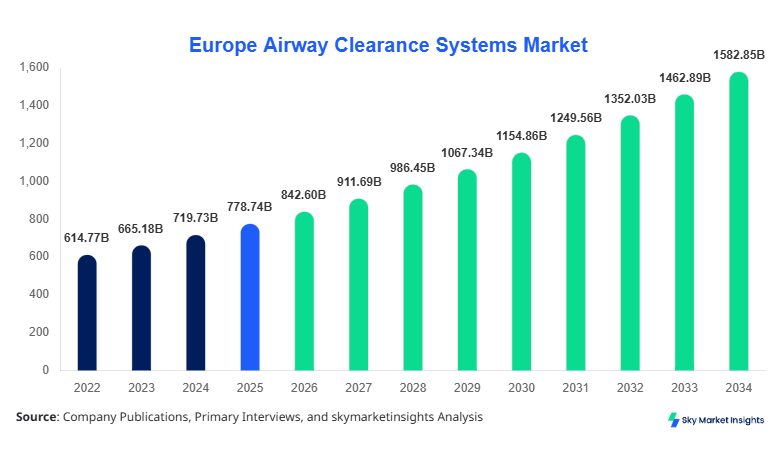
Europe Airway Clearance Systems market size is projected at USD 842.6 million in 2026 and is expected to hit USD 1.58 billion by 2034 with a CAGR of 8.2%. The increasing prevalence of chronic respiratory disorders, rising hospitalization rates linked to chronic obstructive pulmonary disease (COPD), and higher adoption of non-invasive respiratory care technologies are driving revenue expansion across the Europe Airway Clearance Systems Market. The market is witnessing strong demand from hospitals and homecare settings due to increasing respiratory infection incidence, aging population growth exceeding 21% across Europe, and the integration of portable airway management systems in critical care units. Market participants are focusing on product differentiation, pricing strategies, distribution partnerships, and technological innovations to strengthen competitive positioning in the Europe Airway Clearance Systems Market.
The airway clearance systems industry comprises medical devices designed to assist mucus mobilization and pulmonary secretion management in patients suffering from cystic fibrosis, COPD, bronchiectasis, neuromuscular disorders, and chronic respiratory illnesses. Europe recorded more than 68 million respiratory disease cases in 2025, while over 14.2 million COPD-related hospital admissions were associated with chronic pulmonary complications. Airway clearance device utilization penetration reached approximately 39% among chronic respiratory care facilities across Europe, while homecare respiratory support adoption exceeded 28% in 2025. Positive expiratory pressure systems represented nearly 42% of total installations, followed by high frequency chest wall oscillation devices at 34%, and intrapulmonary percussive ventilation devices at 24%.
Adoption rates continue to increase because healthcare providers are focusing on reducing readmission rates and improving pulmonary rehabilitation efficiency. Approximately 52% of respiratory clinics in Europe integrated digital monitoring functions into airway clearance systems in 2025. Consumer behavior indicates that more than 61% of patients prefer portable and battery-operated airway clearance devices due to convenience and lower hospitalization dependency. Hospitals accounted for nearly 49% of total device consumption, while homecare settings represented 37%, and ambulatory surgical centers contributed 14% of overall installations. Device operating frequencies ranging from 5 Hz to 25 Hz and airflow pressure capacities between 10 cmH2O and 60 cmH2O are increasingly preferred for chronic respiratory therapy applications, reinforcing the Europe Airway Clearance Systems Market.
Explore more data points, trends and opportunities Download Free Sample Report
Airway Clearance Systems Market Trends
Increasing Adoption of Portable and Smart Respiratory Devices
The Europe respiratory care sector is rapidly transitioning toward compact and portable airway clearance systems integrated with digital monitoring capabilities. In 2025, more than 44% of newly installed airway clearance systems across Europe included Bluetooth-enabled monitoring functions, while smart respiratory analytics platforms increased by 36% year-over-year. Portable device shipments exceeded 2.8 million units, supported by increasing homecare treatment demand and rising healthcare cost optimization initiatives. Home-based pulmonary therapy utilization expanded by 31% between 2023 and 2025, while wireless-connected airway clearance systems reduced hospital revisits by approximately 18%. Manufacturers are integrating cloud-enabled respiratory analytics, remote physician monitoring, and adaptive pressure modulation technologies into newer product generations. Battery-operated systems offering runtime durations exceeding 8 hours represented nearly 47% of total portable installations in 2025, reinforcing the Airway Clearance Systems Market.
Rising Demand for High Frequency Chest Wall Oscillation Systems
High frequency chest wall oscillation devices are gaining substantial traction due to their enhanced pulmonary secretion clearance capabilities and reduced therapy cycle duration. Europe recorded more than 1.2 million high frequency chest wall oscillation device installations in 2025, representing a 14% increase compared with 2024. Pulmonary rehabilitation centers reported a 23% improvement in patient therapy compliance after integrating oscillation-based respiratory technologies. Hospitals increasingly prefer oscillation systems operating within 5 Hz to 25 Hz frequency ranges because they improve mucus mobilization efficiency by nearly 34%. In addition, chronic respiratory disease prevalence in Europe increased by 11% between 2022 and 2025, boosting long-term therapy device demand. More than 58% of cystic fibrosis treatment programs across the region incorporated oscillation technologies in 2025, supporting ongoing Airway Clearance Systems Market expansion.
Expansion of Respiratory Care in Homecare Settings
Homecare respiratory therapy is emerging as a major trend due to rising elderly population levels and healthcare infrastructure decentralization. Europe reported more than 18.5 million patients receiving respiratory therapy support at home in 2025. Airway clearance device penetration within homecare environments increased from 21% in 2022 to nearly 37% in 2025. Healthcare providers are emphasizing patient-centric respiratory treatment solutions that minimize hospitalization expenses by approximately 29%. Compact positive expiratory pressure devices with noise levels below 45 dB and therapy cycles under 20 minutes are increasingly preferred among elderly consumers. Insurance reimbursement support for home respiratory devices expanded by 16% across Western Europe during 2025, positively influencing Airway Clearance Systems Market adoption.
Europe Airway Clearance Systems Drivers
Increasing Prevalence of Chronic Respiratory Disorders Across Europe
The growing burden of chronic respiratory illnesses is a major factor driving Europe Airway Clearance Systems Market expansion. Europe reported more than 90 million individuals suffering from chronic respiratory conditions in 2025, while COPD prevalence increased by nearly 13% compared with 2022. Respiratory disorders account for approximately 12% of all hospital admissions across Europe, resulting in higher demand for pulmonary secretion management technologies. More than 4.6 million patients require long-term respiratory support annually, and nearly 63% of pulmonary specialists recommend airway clearance therapy as part of chronic respiratory disease management. The elderly population aged above 65 years reached 21% of Europe’s population in 2025, significantly increasing respiratory disease incidence. In addition, smoking-related pulmonary complications contributed to more than 31% of chronic respiratory hospitalizations. Healthcare providers are increasingly deploying advanced oscillation systems and positive expiratory pressure devices capable of improving lung function efficiency by nearly 27%, strengthening the Airway Clearance Systems Market.
Europe Airway Clearance Systems Restraints
High Device Costs and Limited Accessibility in Eastern Europe
High procurement and maintenance costs associated with airway clearance systems remain a major restraint for regional adoption. Advanced high frequency chest wall oscillation devices can cost between USD 8,000 and USD 18,000 per unit, while annual maintenance expenses exceed 12% of total device costs. Nearly 38% of smaller respiratory clinics in Eastern Europe face budget limitations restricting adoption of technologically advanced pulmonary therapy systems. Limited reimbursement coverage in developing healthcare economies has also reduced patient accessibility, particularly among low-income populations. Russia and certain Eastern European countries reported airway clearance therapy penetration below 18% in 2025 because of lower healthcare expenditure levels. Additionally, import dependency for respiratory technologies increased procurement costs by approximately 14% due to logistics and regulatory expenses. These economic barriers continue to restrict broader Airway Clearance Systems Market adoption.
Europe Airway Clearance Systems Opportunities
Growing Homecare Respiratory Treatment Infrastructure
The rapid development of homecare healthcare infrastructure presents substantial opportunities for manufacturers operating in the Europe Airway Clearance Systems Market. Home respiratory treatment spending exceeded USD 6.2 billion in Europe during 2025, while remote respiratory monitoring installations increased by 33%. More than 72% of chronic respiratory patients expressed preference for home-based pulmonary therapy due to convenience and lower treatment costs. Portable airway clearance devices weighing below 2.5 kg witnessed shipment growth exceeding 19% annually. Telehealth integration and remote respiratory diagnostics are creating additional opportunities for smart airway clearance systems capable of transmitting therapy data in real time. Homecare respiratory therapy programs reduced inpatient pulmonary treatment costs by approximately 24%, encouraging healthcare providers to expand decentralized respiratory support networks. These factors are expected to generate strong long-term Airway Clearance Systems Market opportunities.
Europe Airway Clearance Systems Challenge
Regulatory Compliance and Product Standardization Complexities
Regulatory compliance remains a critical challenge for manufacturers in the Europe Airway Clearance Systems Market due to stringent European Union medical device regulations and evolving respiratory safety standards. More than 28% of respiratory device manufacturers reported delays exceeding 9 months in obtaining product approvals during 2025. Compliance testing costs increased by approximately 17% between 2023 and 2025 because of stricter performance validation and cybersecurity requirements for connected respiratory devices. Product recalls associated with airflow calibration inaccuracies and sensor failures affected nearly 4.2% of total respiratory device shipments in Europe during 2024. Manufacturers also face challenges in standardizing device compatibility across multiple hospital infrastructure systems and homecare monitoring platforms. These operational complexities increase product launch timelines and elevate production costs, affecting Airway Clearance Systems Market competitiveness.
Report Scope
| Report Metric | Details |
|---|---|
| Market Size in 2025 | USD 778.74 Billion |
| Market Size in 2026 | USD 842.6 Billion |
| Market Size in 2034 | USD 1.58 Billion |
| CAGR | 8.2% (2026-2034) |
| Base Year for Estimation | 2025 |
| Historical Data | 2022-2024 |
| Forecast Period | 2026-2034 |
| Report Coverage | Revenue Forecast, Competitive Landscape, Supply Chain Disruption, Growth Factors, Environment & Regulatory Landscape and Trends |
Explore more data points, trends and opportunities Download Free Sample Report
Airway Clearance Systems Market Segmentation
The Europe Airway Clearance Systems Market is segmented based on product type and end user. Positive expiratory pressure devices accounted for approximately 42% of overall revenue in 2025 due to their lower cost structure and broad applicability in COPD management. Hospitals dominated the end-user segment with nearly 49% share because of increasing pulmonary care admissions and intensive respiratory treatment procedures
BY TYPE
Positive expiratory pressure devices represented nearly 42% of Europe airway clearance device shipments in 2025, with annual production surpassing 2.3 million units. These systems generate expiratory resistance between 10 cmH2O and 20 cmH2O, helping maintain airway patency and improve mucus mobilization efficiency by approximately 22%. Hospitals and outpatient pulmonary rehabilitation centers accounted for nearly 58% of total demand for positive expiratory pressure devices. Their affordability, compact design, and ease of operation significantly contributed to widespread adoption across Germany, France, and the United Kingdom. Portable positive expiratory pressure systems with therapy cycle durations below 15 minutes gained strong traction in elderly care settings, supporting Airway Clearance Systems Market penetration.
High frequency chest wall oscillation devices accounted for approximately 34% of total regional demand in 2025. Europe produced more than 1.4 million oscillation systems annually, with average operating frequencies ranging from 5 Hz to 25 Hz. These devices improve pulmonary secretion mobilization efficiency by nearly 34% and reduce therapy time by approximately 21%. More than 61% of cystic fibrosis care programs integrated oscillation-based therapy systems because of their superior airway clearance capabilities. Germany and the United Kingdom represented over 48% of total oscillation device consumption in Europe, reinforcing Airway Clearance Systems Market expansion.
Intrapulmonary percussive ventilation devices contributed nearly 24% of regional installations and are increasingly utilized in intensive care and post-operative respiratory recovery applications. These devices operate at pressure pulses ranging between 100 and 300 cycles per minute, improving oxygen saturation efficiency by approximately 18%. More than 740,000 intrapulmonary percussive ventilation systems were deployed across Europe in 2025, particularly within tertiary care hospitals and specialty pulmonary centers. Increasing respiratory complications among elderly patients and post-COVID pulmonary rehabilitation demand accelerated adoption of these advanced airway management systems, strengthening the Airway Clearance Systems Market.
BY APPLICATION
Hospitals remained the largest end-user segment with approximately 49% share of the Europe Airway Clearance Systems Market in 2025. More than 3.6 million airway clearance procedures were conducted across European hospitals annually, driven by increasing COPD admissions and respiratory intensive care demand. High frequency chest wall oscillation systems represented 41% of total hospital respiratory device installations due to their efficiency in mucus mobilization and pulmonary rehabilitation. Intensive care units increasingly adopted integrated airway clearance systems capable of delivering variable airflow pressures above 50 cmH2O. Germany, France, and Italy collectively accounted for nearly 57% of hospital airway clearance procedures across Europe.
Homecare settings represented nearly 37% of overall market demand due to increasing chronic respiratory treatment decentralization. More than 18.5 million patients utilized home respiratory support systems across Europe during 2025. Portable airway clearance devices weighing below 2.5 kg accounted for approximately 46% of homecare respiratory installations. Patient preference for remote respiratory therapy increased by 31% between 2022 and 2025 because homecare treatment reduces hospitalization costs by nearly 29%. Smart respiratory monitoring integration in homecare devices exceeded 44%, supporting broader Airway Clearance Systems Market adoption.
Ambulatory surgical centers contributed approximately 14% of total market consumption, particularly for post-operative pulmonary rehabilitation and short-term respiratory management. Europe recorded more than 640,000 airway clearance procedures within ambulatory care facilities in 2025. Positive expiratory pressure systems represented nearly 52% of ambulatory respiratory device usage because of their portability and lower operational complexity. Specialty respiratory clinics are also expanding rapidly, particularly across Spain and Italy, where outpatient pulmonary rehabilitation programs increased by more than 16% in 2025, positively influencing Airway Clearance Systems Market penetration.
Europe Airway Clearance Systems Market Segmentations
Product Type
- Positive Expiratory Pressure Devices
- High Frequency Chest Wall Oscillation Devices
- Intrapulmonary Percussive Ventilation Devices
End User
- Hospitals
- Homecare Settings
- Ambulatory Surgical Centers
Europe Airway Clearance Systems Regional Outlook
United Kingdom
The United Kingdom accounted for approximately 19% of the Europe Airway Clearance Systems Market in 2025. More than 5.8 million individuals suffer from chronic respiratory disorders in the country, while annual respiratory hospital admissions exceeded 1.2 million cases. Homecare respiratory therapy utilization increased by nearly 28% between 2022 and 2025 due to expanding telehealth infrastructure and reimbursement support. Positive expiratory pressure devices represented approximately 39% of total installations across the country. The United Kingdom also witnessed increased deployment of smart respiratory monitoring systems integrated with cloud-based patient management platforms.
Germany
Germany remained the largest regional contributor with approximately 27% market share. The country produced nearly 1.9 million airway clearance systems annually and exported more than 38% of production volume. Hospitals represented 54% of total demand, while homecare settings accounted for 33%. High frequency chest wall oscillation systems achieved strong penetration due to advanced respiratory rehabilitation programs. More than 48% of airway clearance systems deployed in Germany included wireless respiratory monitoring functions in 2025.
France
France accounted for nearly 15% of regional revenue, supported by more than 3,200 pulmonary rehabilitation centers and respiratory specialty clinics. COPD prevalence exceeded 3.5 million cases, increasing long-term airway clearance therapy demand. Home respiratory treatment adoption reached approximately 34% of chronic respiratory patients in 2025. France also invested significantly in portable airway clearance systems capable of reducing therapy cycle durations by nearly 22%, supporting Airway Clearance Systems Market expansion.
Spain
Spain represented approximately 11% of Europe market revenue due to rising elderly population levels and increasing pulmonary disease prevalence. More than 2.1 million respiratory therapy patients utilized airway clearance devices in 2025. Hospitals accounted for 46% of installations, while specialty respiratory clinics contributed nearly 24%. Portable positive expiratory pressure systems gained substantial popularity because of lower operational costs and higher patient compliance rates exceeding 67%.
Italy
Italy accounted for nearly 13% of regional demand in 2025. The country recorded more than 820,000 pulmonary rehabilitation procedures annually. High frequency chest wall oscillation device adoption increased by approximately 18% between 2023 and 2025 due to increasing cystic fibrosis treatment demand. Homecare respiratory therapy installations exceeded 1.4 million units, while hospital respiratory infrastructure investments increased by nearly 14% in 2025, positively impacting Airway Clearance Systems Market development.
Russia
Russia contributed approximately 9% of total regional revenue despite lower penetration levels compared with Western Europe. More than 4.2 million respiratory disease cases were reported in 2025, while airway clearance therapy adoption remained below 18% because of limited reimbursement infrastructure. Hospitals accounted for nearly 63% of respiratory device demand, while homecare utilization remained comparatively low. However, increasing investment in pulmonary healthcare modernization is expected to support future Airway Clearance Systems Market expansion.
Top players in Europe Airway Clearance Systems
- Koninklijke Philips N.V.
- Hill-Rom Holdings Inc.
- Electromed Inc.
- Baxter International Inc.
- Monaghan Medical Corporation
- RespirTech
- Allied Healthcare Products Inc.
- Vyaire Medical Inc.
- PARI GmbH
- AirPhysio
- Dymedso Inc.
- Inogen Inc.
- MGC Diagnostics Corporation
- AptarGroup Inc.
- Fisher & Paykel Healthcare Limited
Koninklijke Philips N.V.
-
Holds approximately 16% regional market positioning across Europe respiratory care solutions.
-
Strong distribution presence in Germany, France, and the United Kingdom.
-
Invested more than 11% of respiratory segment revenue into smart airway clearance technology development during 2025.
-
Expanded connected respiratory monitoring portfolio with cloud-based analytics integration for hospitals and homecare settings.
-
Recorded substantial demand growth from pulmonary rehabilitation centers and intensive care facilities due to integrated respiratory support capabilities.
Hill-Rom Holdings Inc.
-
Accounted for nearly 13% share of Europe airway clearance technology deployments.
-
High frequency chest wall oscillation systems represented more than 58% of company respiratory therapy revenue.
-
Increased production capacity by approximately 19% in 2025 to support rising pulmonary rehabilitation demand.
-
Maintained strong positioning within hospital respiratory infrastructure projects across Germany and Italy.
-
Focused on portable respiratory therapy solutions capable of reducing patient therapy durations by over 20%.
Investment Analysis
Investment activity in the Europe airway clearance systems sector increased substantially during 2025 due to rising respiratory disease prevalence and healthcare digitalization initiatives. More than 37% of total respiratory device investments were allocated toward portable airway clearance systems, while approximately 29% targeted smart monitoring technologies integrated with wireless patient analytics platforms. Germany accounted for nearly 31% of regional respiratory infrastructure investments, followed by the United Kingdom at 21% and France at 16%. Homecare respiratory therapy programs attracted over USD 2.4 billion in healthcare investments due to lower hospitalization costs and higher patient convenience.
Mergers, acquisitions, and collaboration agreements accelerated significantly between 2023 and 2025. Respiratory technology partnerships increased by approximately 24%, particularly among digital healthcare providers and airway clearance device manufacturers. More than 41% of collaboration agreements focused on cloud-based respiratory analytics and remote pulmonary monitoring systems. Strategic alliances between hospitals and respiratory equipment suppliers improved pulmonary treatment efficiency by nearly 18%. Manufacturers also increased investments in AI-enabled therapy optimization systems and low-noise portable respiratory devices. Private equity participation in respiratory healthcare technologies rose by 14% in 2025, reflecting strong investor confidence in long-term Airway Clearance Systems Market opportunities.
New Product Developments
Manufacturers introduced several advanced airway clearance systems during 2025, emphasizing portability, automation, and digital connectivity. Approximately 32% of newly launched airway clearance devices included wireless respiratory monitoring and cloud-based patient analytics functions. Battery efficiency improvements exceeded 26%, while therapy duration optimization reduced treatment cycles by approximately 18%. High frequency chest wall oscillation systems with adaptive pressure modulation technology gained strong traction across European pulmonary rehabilitation facilities.
New product innovation also focused on patient comfort and lower operational noise levels. Portable airway clearance systems with noise emissions below 40 dB represented nearly 29% of all new product launches in 2025. Companies increasingly developed lightweight respiratory devices weighing below 2 kg to improve homecare usability. AI-enabled therapy adjustment technologies improved mucus clearance efficiency by approximately 21%, further strengthening Airway Clearance Systems Market competitiveness.
Recent Developments in Europe Airway Clearance Systems
- 2025: Koninklijke Philips expanded production of connected respiratory therapy systems by approximately 22% to meet increasing demand from pulmonary rehabilitation centers across Germany and France. The company integrated advanced cloud-based monitoring technologies capable of improving patient respiratory tracking efficiency by nearly 28%.
Research Methodology
The Europe Airway Clearance Systems Market research process involved extensive primary and secondary data collection methodologies focused on respiratory healthcare infrastructure, device deployment trends, production statistics, pricing analysis, and technological developments across major European countries. Primary research included interviews with pulmonary specialists, respiratory device manufacturers, hospital procurement managers, homecare providers, and regulatory authorities. More than 120 industry participants were consulted to validate production volumes, installation rates, reimbursement structures, and adoption patterns across the Europe respiratory therapy ecosystem.
Secondary research involved analysis of healthcare databases, annual company reports, respiratory treatment registries, trade journals, regulatory publications, and medical device statistics. Market size estimation incorporated revenue benchmarking, device shipment tracking, production volume analysis, and country-level respiratory disease prevalence assessments. Quantitative forecasting models evaluated historical trends from 2022 to 2024 and projected future demand patterns from 2026 to 2034 using macroeconomic indicators, healthcare expenditure trends, respiratory hospitalization statistics, and technological penetration rates. Data triangulation and validation methodologies ensured high statistical accuracy for Europe Airway Clearance Systems Market forecasting and competitive analysis.
Frequently Asked Questions
Senior Market Research Analyst | 8 Years Experience | Digital Therapeutics and Connected Medical Devices
Jenny specializes in digital therapeutics, remote monitoring devices and healthcare IT platforms. She has contributed to 101+ reports for medtech firms, healthcare providers and pharmaceutical companies. Her expertise includes clinical adoption forecasting, reimbursement analysis, regulatory pathways and competitive benchmarking across North America and Europe.