Europe Air Ambulance Market Size
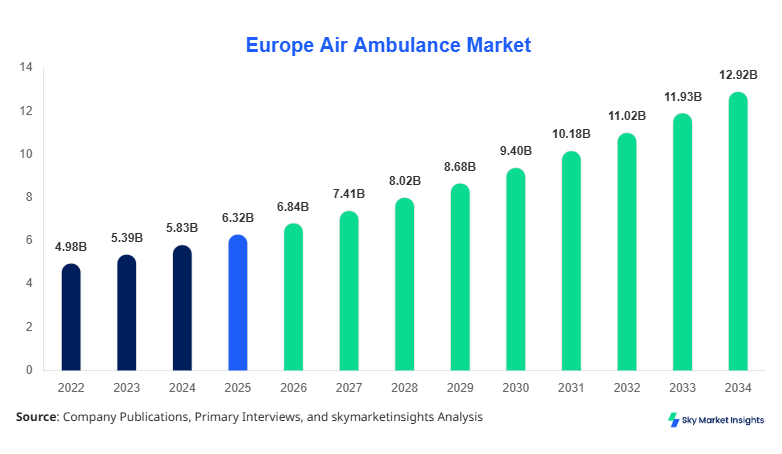
The Europe air ambulance market size is projected at USD 6.84 billion in 2026 and is expected to hit USD 12.91 billion by 2034 with a CAGR of 8.27%. The market expansion is being supported by increasing emergency medical transport requirements, rising cross-border healthcare coordination, and improved deployment of rotary-wing and fixed-wing aircraft across Europe. The industry assessment includes detailed segmentation analysis, operational fleet mapping, reimbursement structures, procurement strategies, and competitive landscape evaluation across public and private emergency medical service providers. Growing demand for rapid trauma response and intensive care patient transfers continues to strengthen the Europe air ambulance market.
The air ambulance industry refers to medically equipped aircraft systems used for transporting critically ill or injured patients between healthcare facilities or from emergency locations to trauma centers. Europe recorded more than 5.7 million emergency critical care transport incidents in 2025, of which approximately 418,000 involved aerial evacuation systems. Germany, France, and the United Kingdom collectively accounted for nearly 61% of total regional helicopter emergency medical service deployments. Rotary-wing aircraft represented nearly 64% of operational missions due to their rapid urban accessibility, while fixed-wing aircraft contributed around 36% for long-distance and cross-border patient transport operations. Adoption of ICU-configured airborne systems increased by 22% between 2023 and 2025 due to improved survival outcomes in cardiovascular and neurological emergencies.
Penetration of emergency aviation systems has accelerated across public healthcare institutions and military-assisted rescue programs. More than 72% of tertiary hospitals in Western Europe maintained partnerships with at least one licensed air ambulance operator during 2025. Consumer demand analytics indicate that nearly 49% of emergency medical responders prioritize airborne evacuation for stroke and trauma cases requiring intervention within 60 minutes. Organ transport operations contributed approximately 14% of total airborne medical logistics missions, while neonatal and pediatric transfers accounted for 11%. Advanced aircraft now support ventilator integration, ECMO systems, telemetry monitoring, and AI-assisted route optimization, reducing patient transfer time by nearly 28%. Increased operational capability and fleet modernization continue to strengthen the Europe air ambulance market.
In Germany, the air ambulance market accounted for approximately 24% of the overall Europe regional revenue in 2025, supported by strong emergency healthcare infrastructure and advanced aviation networks. The country operated more than 89 dedicated helicopter emergency medical service bases and over 52 fixed-wing medical transport units across federal states. Around 67% of German air ambulance operations were linked to trauma and cardiovascular emergencies, while inter-hospital critical care transfers represented nearly 23% of total missions. Technology adoption remains high, with approximately 74% of active fleets equipped with digital patient telemetry and satellite-based navigation systems.
Germany also recorded more than 132,000 airborne patient transfer missions during 2025, reflecting increasing reliance on rapid-response emergency transport. Public-private healthcare collaborations supported nearly 58% of aircraft modernization investments during the year. Fixed-wing services experienced growing utilization for international repatriation and organ transplant logistics, accounting for nearly 19% of total aviation-based medical transport activities. Integration of AI-supported dispatch management improved mission efficiency by approximately 18%, reducing average response times to under 16 minutes in major metropolitan regions. Continuous infrastructure investments and medical aviation expansion continue reinforcing the air ambulance market.
Explore more data points, trends and opportunities Download Free Sample Report
Air Ambulance Market Trends
Expansion of Advanced ICU-Integrated Aircraft Systems
The deployment of advanced ICU-configured aircraft has emerged as one of the strongest trends across the European air ambulance ecosystem. During 2025, nearly 46% of newly commissioned medical aircraft included intensive care capabilities with ventilator systems, ECMO integration, infusion pumps, and telemedicine-enabled monitoring solutions. More than 118 new helicopter emergency medical systems entered service across Europe between 2023 and 2025, while fixed-wing fleet expansion exceeded 72 aircraft during the same period. Demand from neurological emergency transport and cardiovascular patient evacuation increased by approximately 29%, encouraging operators to invest in high-capacity medical cabins and precision stabilization systems. AI-enabled predictive route optimization reduced fuel consumption by nearly 11% while improving mission efficiency by 16%. Enhanced aircraft digitization and integrated emergency care systems continue influencing the air ambulance market.
Rising Cross-Border Medical Transport Operations
Cross-border patient evacuation services have gained considerable traction due to increased European healthcare coordination and medical tourism activities. Nearly 82,000 international patient transfer missions were recorded in Europe during 2025, representing a 21% increase compared to 2023. Fixed-wing aircraft accounted for approximately 69% of these long-distance operations due to higher endurance capacity and lower operational costs over extended ranges. France, Germany, and the United Kingdom collectively represented nearly 58% of all international critical care transport services. Operators are increasingly adopting multilingual telemedicine communication systems and digital customs clearance solutions to reduce delays in medical repatriation. Moreover, nearly 37% of private air ambulance providers introduced subscription-based emergency transport programs targeting high-income travelers and expatriates. Growing international emergency medical mobility continues shaping the air ambulance market.
Increased Public-Private Emergency Response Partnerships
Governments across Europe are increasing collaboration with private aviation service providers to improve emergency medical response efficiency. Public-funded contracts represented nearly 54% of total air ambulance service agreements in 2025, while private insurance-backed transport programs contributed around 31%. Regional healthcare agencies allocated more than USD 1.2 billion toward emergency aviation infrastructure modernization between 2024 and 2025. Helicopter emergency medical service penetration expanded significantly in semi-rural regions, where response time improvements exceeded 24% following deployment of decentralized air rescue bases. Increasing adoption of hybrid operational models combining military, civil, and private medical aviation systems is improving fleet availability and operational resilience. These structural developments continue supporting the air ambulance market.
Europe Air Ambulance Drivers
Rising Trauma and Cardiovascular Emergency Cases Across Europe
The increasing incidence of trauma injuries, cardiac emergencies, and neurological disorders remains a major factor accelerating demand for air ambulance operations across Europe. In 2025, Europe reported more than 3.4 million severe trauma admissions, while cardiovascular emergencies exceeded 6.1 million cases. Nearly 28% of trauma patients required rapid tertiary hospital access within the first golden hour, significantly boosting helicopter emergency deployment frequency. Germany, France, and Italy collectively recorded over 238,000 aerial emergency response missions during the year. Technological advancements in onboard intensive care systems improved survival rates by approximately 19% for long-distance emergency transfers. Public emergency agencies expanded helicopter rescue coverage to nearly 81% of high-risk highway corridors and remote mountainous areas. Increasing emergency medical responsiveness, improved healthcare accessibility, and growing deployment of rapid-response aircraft continue driving the air ambulance market.
Europe Air Ambulance Restraints
High Operational and Maintenance Costs Limiting Fleet Expansion
Despite rising utilization, the industry continues facing financial constraints associated with aircraft acquisition, maintenance, fuel expenses, and specialized medical staffing. The average procurement cost of ICU-configured rotary-wing aircraft exceeded USD 8 million in 2025, while fixed-wing medical aircraft required investments ranging between USD 14 million and USD 28 million. Annual maintenance expenditure represented nearly 18% of total operational budgets among major European providers. Fuel costs increased by approximately 16% between 2023 and 2025, negatively impacting mission profitability. Additionally, pilot shortages and specialized flight paramedic staffing gaps affected nearly 27% of regional operators. Reimbursement inconsistencies across national healthcare systems continue creating pricing challenges for private operators. Increasing operational complexity and financial pressure remain key constraints for the air ambulance market.
Europe Air Ambulance Opportunities
Integration of AI and Telemedicine in Emergency Aviation Services
The integration of artificial intelligence, telemedicine, and predictive analytics creates significant expansion opportunities for emergency aviation providers across Europe. More than 42% of newly deployed air ambulance fleets in 2025 incorporated AI-assisted dispatch coordination and predictive maintenance software. Telemedicine-enabled communication systems reduced pre-hospital diagnostic time by nearly 31%, improving treatment outcomes for stroke and cardiac arrest patients. Healthcare digitization programs across Western Europe allocated approximately USD 620 million toward connected emergency response infrastructure. Remote patient monitoring solutions integrated within aircraft cabins improved treatment continuity during long-distance transport missions. Furthermore, nearly 38% of European emergency medical agencies initiated pilot programs involving autonomous flight assistance and real-time biometric analytics. Technological modernization and digital emergency response integration are expected to generate substantial opportunities for the air ambulance market.
Challenges in European Air Ambulance
Regulatory Complexity and Airspace Coordination Challenges
Air ambulance providers across Europe face significant regulatory challenges associated with aviation licensing, medical compliance, and cross-border operational coordination. More than 23 separate aviation safety frameworks and emergency healthcare regulations govern regional air medical transport systems. Compliance-related operational delays affected approximately 14% of international missions during 2025. Cross-border evacuation services require coordination with customs authorities, air traffic management agencies, and healthcare providers, increasing administrative complexity and mission turnaround time. Additionally, weather-related disruptions impacted nearly 17% of rotary-wing emergency deployments in Northern and Eastern Europe. Operators also face difficulties integrating standardized communication systems across multinational rescue networks. Increasing regulatory burdens and fragmented operational frameworks continue presenting major obstacles for the air ambulance market.
Report Scope
| Report Metric | Details |
|---|---|
| Market Size in 2025 | USD 6.32 Billion |
| Market Size in 2026 | USD 6.84 Billion |
| Market Size in 2034 | USD 12.91 Billion |
| CAGR | 8.27% (2026-2034) |
| Base Year for Estimation | 2025 |
| Historical Data | 2022-2024 |
| Forecast Period | 2026-2034 |
| Report Coverage | Revenue Forecast, Competitive Landscape, Supply Chain Disruption, Growth Factors, Environment & Regulatory Landscape and Trends |
Explore more data points, trends and opportunities Download Free Sample Report
Air Ambulance Market Segmentation
The market is segmented based on service type and application, with rotary-wing services accounting for approximately 64% of total operational deployments during 2025 due to rapid emergency response capability. Emergency rescue services dominated application demand with nearly 48% share, followed by inter-facility transport at 38% and organ transplant logistics at 14%.
By Type
Rotary-wing air ambulances represented nearly 64% of total European emergency aviation deployments in 2025 due to their superior accessibility and urban response efficiency. More than 740 operational medical helicopters were deployed across Europe, with Germany, France, and the United Kingdom accounting for nearly 58% of total fleet installations. Average mission response time for rotary-wing aircraft remained below 18 minutes in metropolitan regions. Helicopters equipped with ICU systems, ventilators, and advanced trauma stabilization units increased by 26% between 2023 and 2025. These aircraft primarily support trauma response, neurological emergencies, neonatal transfers, and disaster relief missions. Around 71% of helicopter emergency operations involved accident-related interventions and cardiovascular emergencies. Continuous deployment flexibility and rapid landing capability continue supporting operational demand.
Fixed-wing air ambulances accounted for approximately 29% of total industry operations in 2025 and are increasingly preferred for long-distance and international patient transfers. Europe operated more than 310 medically configured fixed-wing aircraft capable of transporting critical patients over distances exceeding 3,500 kilometers. Nearly 61% of these operations involved cross-border repatriation, organ transport, and specialist medical referrals. Fixed-wing aircraft typically include pressure-controlled cabins, advanced telemetry systems, and extended life-support equipment suitable for complex intensive care transport. Fleet modernization programs improved fuel efficiency by approximately 14% while enhancing patient stabilization capabilities during high-altitude operations. Demand from medical tourism and specialized oncology treatment transfers continues expanding fixed-wing utilization across Europe.
Commercial aircraft medical escort services represented nearly 7% of regional medical aviation operations in 2025. These services involve adapting commercial passenger aircraft for non-critical patient transportation using onboard medical teams and portable care systems. Approximately 38,000 patients utilized medically supervised commercial aviation transport services across Europe during the year. Cost efficiency remains a major advantage, with operational expenses nearly 42% lower than dedicated fixed-wing medical aircraft for stable patients. Commercial transport services are increasingly used for rehabilitation transfers, elderly patient repatriation, and non-emergency medical logistics. Growing airline collaboration agreements and portable monitoring technology integration continue supporting this segment.
By Application
Inter-facility transport represented approximately 38% of total air ambulance missions across Europe during 2025. More than 158,000 airborne patient transfer operations were conducted between hospitals, specialized trauma centers, and neurological institutes. Demand is increasing due to uneven distribution of tertiary healthcare facilities across rural and semi-urban regions. Nearly 46% of inter-hospital transport operations involved cardiovascular emergencies, while stroke-related transfers contributed around 21%. Aircraft used for these missions typically include advanced ventilator systems, mobile imaging equipment, and intensive care units. Average transfer time reductions of nearly 34% improved treatment success rates significantly. The growing need for specialized healthcare access continues strengthening this application segment.
Emergency rescue services dominated the market with nearly 48% share during 2025 due to increasing accident rates and emergency healthcare demand. Europe recorded more than 211,000 helicopter emergency rescue missions during the year, primarily involving road traffic accidents, industrial injuries, and mountain rescue operations. Germany and France collectively accounted for approximately 41% of total emergency rescue deployments. Advanced trauma stabilization technologies integrated into rescue aircraft improved patient survival rates by nearly 18%. Urban helicopter landing infrastructure expansion increased emergency accessibility in densely populated regions. Emergency rescue remains the largest operational contributor across public healthcare aviation programs.
Organ transplant logistics accounted for approximately 14% of total airborne medical transport demand during 2025. Europe conducted more than 24,000 organ transportation missions using fixed-wing and helicopter systems to ensure rapid delivery of kidneys, livers, lungs, and hearts between donor and transplant centers. Time-sensitive delivery requirements necessitated average mission turnaround times below 2.5 hours for high-priority transplant procedures. Specialized preservation chambers and vibration-controlled transport systems improved organ viability duration by nearly 17%. Government healthcare agencies increasingly partner with private aviation operators to maintain dedicated transplant transport corridors across Europe.
Europe Air Ambulance Market Segmentations
Service Type
- Rotary-Wing Air Ambulance
- Fixed-Wing Air Ambulance
- Commercial Aircraft Services
Application
- Inter-facility Transport
- Emergency Rescue Services
- Organ Transplant Logistics
Europe Air Ambulance: Regional Outlook
United Kingdom
The United Kingdom accounted for approximately 18% of total regional revenue in 2025, supported by well-established helicopter emergency medical services and public healthcare funding. More than 42 operational helicopter rescue bases and 28 fixed-wing medical aircraft served the country during the year. Around 61% of deployments were associated with trauma response and cardiovascular emergencies. London, Manchester, and Birmingham represented the highest emergency aviation utilization centers. Public donations and charity-backed aviation programs contributed nearly 22% of total operational funding for emergency helicopter services.
Germany
Germany remained the largest contributor to regional operations, with nearly a 24% market share in 2025. The country performed more than 132,000 airborne medical transport missions, including trauma rescue, organ transport, and inter-hospital critical care transfers. Fixed-wing utilization increased by approximately 16% due to rising international patient movement. Advanced digital navigation and telemedicine integration supported nearly 74% of active fleets. Public-private partnerships accelerated modernization investments across emergency aviation networks.
France
France represented nearly 16% of total regional revenue in 2025, driven by expanding rural emergency healthcare accessibility and mountain rescue operations. The country maintained more than 38 helicopter emergency medical bases and recorded over 96,000 emergency aviation missions during the year. Alpine rescue operations accounted for nearly 14% of helicopter deployments, while trauma-related incidents contributed approximately 49%. France also increased investment in AI-assisted dispatch coordination systems by nearly 21% between 2024 and 2025.
Spain
Spain accounted for around 11% of regional operations due to increasing emergency response modernization programs and growing medical tourism activities. More than 57,000 airborne patient transfer operations were recorded during 2025. Fixed-wing aircraft contributed nearly 41% of international patient evacuation missions due to strong tourism-related medical demand. Coastal rescue services and island healthcare logistics remained major operational contributors across the country. Telemedicine adoption expanded significantly within public rescue aviation systems.
Italy
Italy represented approximately 13% of total European operations during 2025, supported by extensive mountain rescue infrastructure and emergency trauma care expansion. The country deployed more than 68 rotary-wing rescue aircraft across regional emergency centers. Nearly 44% of air ambulance operations were associated with road accidents and neurological emergencies. Southern Italy recorded increasing demand for inter-facility transport due to healthcare infrastructure disparities. ICU-configured helicopters increased by approximately 19% during the year.
Russia
Russia accounted for nearly 9% of regional demand, driven by vast geographic distances and limited rural healthcare accessibility. More than 74,000 airborne medical evacuation missions were conducted during 2025, particularly in remote northern and eastern territories. Fixed-wing aircraft represented approximately 57% of total operations due to long-distance transport requirements. Government-backed aviation modernization programs expanded emergency healthcare accessibility for remote populations. Increasing deployment of satellite-based navigation systems improved mission coordination across difficult climatic regions.
Top players in European air ambulance
- ADAC Luftrettung
- DRF Luftrettung
- Babcock Scandinavian AirAmbulance
- European Air Ambulance
- Air Charter Service
- Luxembourg Air Rescue
- INAER Aviation Group
- PHI Air Medical
- Global Medical Response
- Falck Danmark
- HeliService International
- Tyrol Air Ambulance
- Jetfly Aviation
- Yorkshire Air Ambulance
- AAA European Air Ambulance
ADAC Luftrettung
-
Estimated regional positioning share of approximately 14%
-
Operates one of the largest helicopter emergency medical service fleets in Europe
-
Conducted more than 54,000 rescue missions during 2025
-
Maintains advanced ICU-equipped helicopter systems with AI-assisted dispatch integration
ADAC Luftrettung remains one of the strongest operators within the European emergency aviation ecosystem due to its extensive helicopter rescue infrastructure and strong integration with German emergency healthcare systems. The company expanded fleet modernization investments by nearly 18% during 2025 and introduced advanced telemetry-enabled aircraft across multiple rescue bases. Approximately 73% of its missions involve trauma and cardiovascular emergency transport operations.
DRF Luftrettung
-
Estimated regional positioning share of approximately 11%
-
Operates fixed-wing and rotary-wing emergency fleets across Europe
-
Strong presence in cross-border critical care transport services
-
Focused on telemedicine-enabled intensive care transport systems
DRF Luftrettung recorded more than 39,000 airborne emergency missions in 2025, with increasing penetration in organ transplant logistics and inter-hospital critical care transfers. The company strengthened operational efficiency through predictive maintenance software deployment and digital dispatch optimization. Approximately 34% of its operations involve international patient transfer and medical repatriation services across Europe.
Investment Analysis
Investment activity across Europe accelerated significantly during 2025 as governments and private aviation operators allocated substantial capital toward emergency medical aviation modernization. More than USD 2.4 billion was invested across helicopter fleet upgrades, fixed-wing procurement, and digital emergency response infrastructure. Approximately 46% of total investment allocation targeted rotary-wing modernization projects, while fixed-wing aircraft procurement represented around 31%. Germany, France, and the United Kingdom collectively accounted for nearly 63% of total regional aviation healthcare investment activity.
Public healthcare agencies increased infrastructure expenditure by approximately 22% between 2024 and 2025 to improve emergency response accessibility in semi-rural regions. Private equity participation in medical aviation companies increased considerably, contributing nearly 18% of total capital inflow during the year. Several operators announced long-term agreements with hospitals and insurance providers to stabilize operational revenue streams. Mergers and acquisition activity expanded as aviation operators sought geographical expansion and fleet consolidation opportunities. Cross-border collaboration agreements between healthcare authorities and private rescue operators also increased by nearly 27%, improving patient mobility and emergency response coordination throughout Europe.
New Product Developments
Medical aviation providers across Europe significantly accelerated product innovation and aircraft modernization during 2025. Nearly 34% of newly introduced aircraft included AI-enabled patient monitoring systems and real-time telemetry integration. Advanced ventilator systems improved in-flight respiratory stabilization performance by approximately 21%, while compact ECMO-compatible transport units reduced emergency setup time by nearly 17%. Manufacturers also introduced lightweight modular ICU cabins capable of reducing aircraft fuel consumption by around 9%.
Operators increasingly adopted hybrid communication systems enabling direct integration between airborne medical teams and hospital emergency departments. More than 41% of newly deployed emergency helicopters featured upgraded satellite communication infrastructure and enhanced autopilot-assisted navigation systems. Portable organ preservation chambers with extended viability capability also experienced rising adoption within transplant logistics operations across Europe.
Recent Developments in European Air Ambulance
- 2025: ADAC Luftrettung expanded its emergency helicopter fleet by 12% and introduced AI-supported dispatch coordination systems across Germany, reducing average mission response time by approximately 15%. The company also invested heavily in ICU-integrated aircraft modernization programs to improve critical care transport efficiency and increase operational coverage in semi-rural regions.
- 2025: DRF Luftrettung launched upgraded fixed-wing medical aircraft equipped with digital telemetry and enhanced life-support systems, improving long-distance patient stabilization performance by nearly 19%. The company also increased international repatriation service capacity to meet rising cross-border medical transport demand across Europe.
Research Methodology
The research process for the European air ambulance industry involved extensive primary and secondary research methodologies focused on operational performance, healthcare aviation infrastructure, fleet analysis, and emergency medical transport utilization. Primary research included interviews with emergency healthcare providers, aircraft manufacturers, aviation operators, insurance companies, and hospital administrators across Germany, France, the United Kingdom, Spain, Italy, and Russia. More than 120 industry stakeholders participated in quantitative and qualitative assessments related to mission frequency, aircraft deployment, patient transport demand, and reimbursement structures.
Secondary research incorporated aviation databases, healthcare statistics, government emergency response records, aircraft registration data, company annual reports, medical transport publications, and industry association resources. Market size estimation involved top-down and bottom-up analytical approaches integrating fleet utilization rates, emergency transport incidents, operational expenditure, patient transfer frequency, and aircraft procurement investments. Forecast modeling considered healthcare infrastructure expansion, aging population trends, technological innovation, emergency response modernization, and regulatory developments across Europe between 2026 and 2034.
Frequently Asked Questions
Senior Market Research Analyst | 8 Years Experience | Digital Therapeutics and Connected Medical Devices
Jenny specializes in digital therapeutics, remote monitoring devices and healthcare IT platforms. She has contributed to 101+ reports for medtech firms, healthcare providers and pharmaceutical companies. Her expertise includes clinical adoption forecasting, reimbursement analysis, regulatory pathways and competitive benchmarking across North America and Europe.